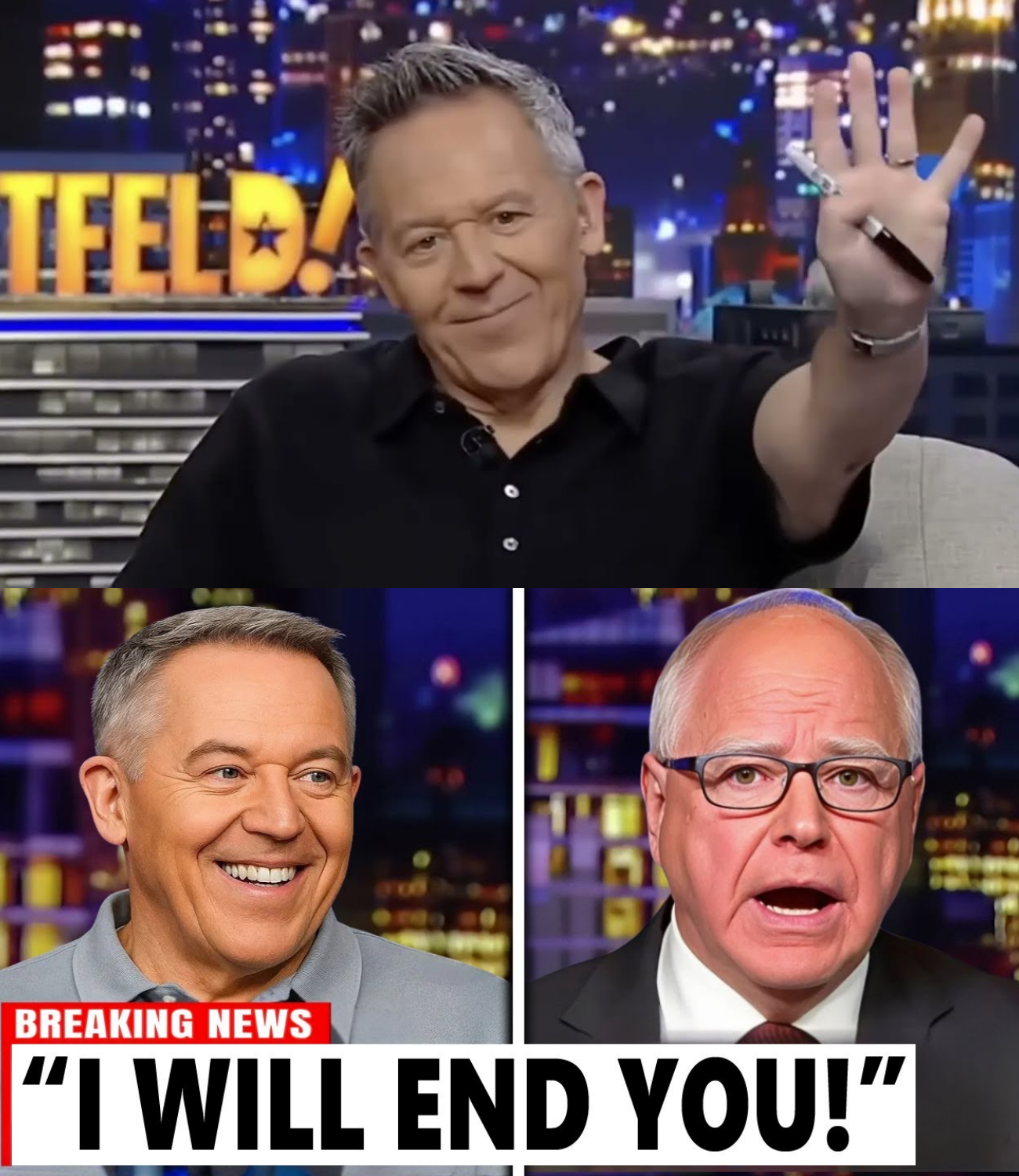
In the high-stakes arena of modern political discourse, few moments capture the public’s attention quite like a direct, no-holds-barred confrontation between a media firebrand and a sitting politician. Recently, that collision occurred when Greg Gutfeld, known for his acerbic wit and sharp delivery, turned his sights on Minnesota Governor Tim Walz. The result was a segment that felt less like a standard political interview and more like a demolition derby, leaving observers to parse through the wreckage of policy, persona, and public perception.
For those who tuned in, the display was visceral. Gutfeld wasted little time, dissecting Walz’s tenure in Minnesota with a surgical, if sarcastic, precision. The commentary targeted everything from the governor’s economic strategy to his handling of state-wide crime, painting a picture of a leader fundamentally at odds with the realities of his own jurisdiction. Throughout the segment, Gutfeld framed Walz’s governance not as a series of calculated political moves, but as a disjointed performance that left taxpayers footing the bill for what he characterized as unnecessary bureaucracy and social engineering.
One of the central themes of Gutfeld’s critique involved the portrayal of Walz’s “folksy” persona. While Walz has often leaned into an image of a relatable, down-to-earth Midwesterner, Gutfeld argued that this exterior masks a disconnect from the people he governs. By contrasting this image with specific policy decisions—such as the allocation of budget surpluses and the implementation of various diversity and equity initiatives—Gutfeld crafted a narrative of a leader who is more concerned with “lifestyle branding” than with the tangible needs of the middle class. He famously dubbed Walz the “IKEA governor,” suggesting that the administration arrives in a box with missing screws and instructions that no one can seem to decipher.
The criticism did not stop at economics. The segment delved into the explosive issue of public safety, with Gutfeld asserting that the administration’s approach to crime has been dangerously optimistic. He compared Walz’s strategy to that of a mall cop attempting to manage a crisis with a clipboard and a kazoo, highlighting a growing frustration among critics who feel that the state has become increasingly chaotic under his watch. The critique was bolstered by a series of jabs at the governor’s communication style, with Gutfeld suggesting that Walz’s public statements often devolve into “word salad”—an endless loop of jargon that fails to provide clear, actionable insights for the public.
Perhaps the most stinging portion of the broadcast involved the questioning of Walz’s past, specifically regarding his military record. Gutfeld leaned into the controversies surrounding the governor’s service, using the platform to amplify criticisms regarding his rank and his departure from the National Guard ahead of a deployment to Iraq. By framing these allegations as a breach of trust, Gutfeld successfully tapped into a deep vein of frustration felt by many veterans and observers who demand transparency and integrity from their elected officials.
The segment also took aim at what Gutfeld described as an infatuation with California-style progressivism. By drawing parallels between Walz’s policies and those of California Governor Gavin Newsom, Gutfeld argued that Minnesota is being steered toward a “West Coast disaster script,” complete with higher taxes, crumbling infrastructure, and a focus on social justice mandates that many voters find alienating. The argument was clear: the policies that have caused economic and social strain in California are being imported to the Midwest, to the detriment of the local economy.
However, the discussion was not merely about policy; it was about the nature of modern political performance. Gutfeld’s critique highlighted a growing sentiment that politics has become increasingly performative, where the goal is often to signal virtue or appeal to a specific base rather than to govern effectively. The mention of “interpretive policy theater” struck a chord, suggesting that the electorate is growing weary of leaders who prioritize optics over outcomes. When Walz speaks, Gutfeld posits, it is rarely to engage in a substantive debate but rather to present a carefully curated image—an image that Gutfeld believes is crumbling under the weight of actual results.
The reaction to the segment was immediate and expectedly polarized. Supporters of the Governor might see the critique as a partisan hit job, a predictable assault from a media personality known for his combative style. Conversely, those frustrated with the current state of governance in Minnesota found in Gutfeld’s words a voice for their own concerns. The intensity of the debate underscores a fundamental truth about our current era: the divide between political ideologies is not just about policy preferences, but about the very way we view leadership and responsibility.
Ultimately, the broadcast serves as a case study in how political narratives are constructed and dismantled in the 24-hour news cycle. Whether one views Gutfeld as a truth-teller holding power to account or as a provocateur seeking ratings, the impact of such segments cannot be ignored. They shape public opinion, they define the political discourse, and they force voters to confront the gap between campaign rhetoric and governing reality.
As the political landscape continues to evolve, the demand for accountability remains constant. The roast of Tim Walz was, in essence, a demand for that accountability. It was a call to look past the fleece vests and the carefully crafted slogans to see the mechanisms of power at work. Regardless of where one stands on the political spectrum, the exchange provides a stark reminder that in an age of constant connectivity, no policy, no decision, and no personal history is safe from the bright, unforgiving lights of public scrutiny. The questions raised during this segment will undoubtedly persist, serving as a backdrop for the political battles that lie ahead in the coming months. For the viewers, the takeaway was clear: in the arena of public life, if you cannot stand the heat of the scrutiny, perhaps you should never have entered the ring in the first place.
Full video: