
For decades, the name Robert De Niro was synonymous with the absolute pinnacle of cinematic achievement. From the gritty, controlled intensity of Taxi Driver to the raw, visceral power of Raging Bull, De Niro was the ultimate method actor—a man who could communicate volumes with a single, squinting gaze or a subtle shift in posture. He was a titan, a performer whose presence commanded respect and whose work defined the landscape of modern film. Yet, in recent years, the public has witnessed a transformation that feels less like a natural evolution and more like a slow-motion unraveling. Today, the man who once whispered menace in the ears of mob bosses is better known for shouting at political opponents on television, his legacy seemingly overshadowed by a series of unprompted, rage-fueled outbursts.
This shift has not gone unnoticed, and few have been as effective in deconstructing this new, volatile version of De Niro as political commentator Greg Gutfeld. While many might view De Niro’s recent television appearances as typical celebrity activism, Gutfeld sees something far more clinical: the frantic, desperate behavior of an icon struggling to find relevance in a world that has moved beyond the reach of his golden years.
The tension reached a boiling point during a recent appearance on The View. Surrounded by a sympathetic panel, including Joy Behar, De Niro struggled to maintain the composure that once defined his craft. Instead of the nuanced dialogue fans might expect from an Oscar-winning legend, the audience was met with a display of emotional volatility. When pressed on his intense disdain for Donald Trump, De Niro’s response was not one of measured political critique but of deep, personal, and almost incoherent anger. He painted a picture of a world on the brink of catastrophe, delivered with the urgency of a man convinced that his voice is the only thing standing between civilization and total collapse.
Greg Gutfeld, known for his acerbic wit and ability to cut through the noise of cable news, dissected this performance with devastating precision. He did not simply mock De Niro’s political views; he mocked the delivery. Gutfeld pointed out that the man who once breathed life into some of cinema’s most complex characters now seems to struggle with basic analytical thinking when removed from a prepared script. Watching the clips of De Niro’s interview, Gutfeld suggested that the actor has become a “living caricature”—a man who has turned his legendary glare and gruff demeanor into a personal brand of performative fury.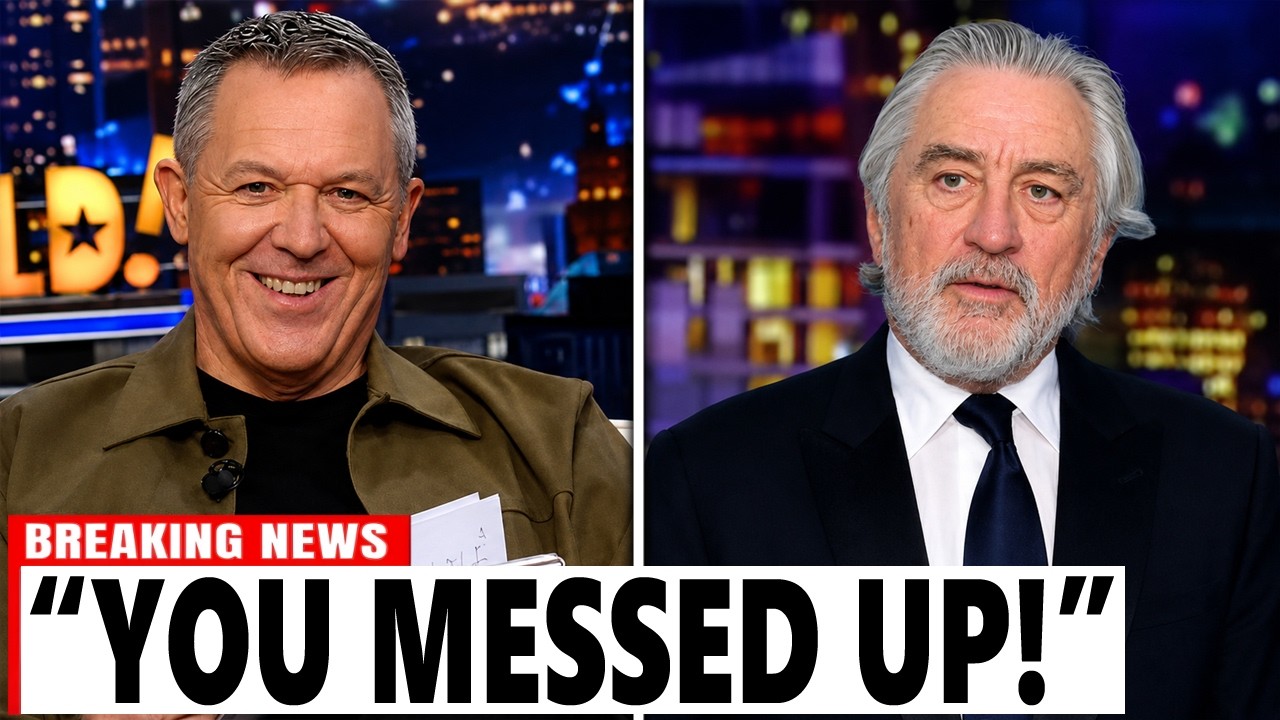
The irony is palpable. De Niro, the king of the gritty, blue-collar, street-smart tough guy, now lives in a world of profound disconnection from the very audience that once idolized him. His recent film choices—often leaning into self-parody and slapstick roles—have only served to amplify the sense that the prestige that once surrounded him has dissipated. Gutfeld’s commentary serves as a stark reminder that celebrity does not equate to wisdom, and that volume is not a substitute for substance. By constantly choosing to engage in the chaotic, often toxic, arena of cable news debate, De Niro has effectively traded his mysterious, quiet gravitas for the loud, directionless finger-wagging of a man who refuses to yield the spotlight.
The most tragic element of this descent is that it appears entirely voluntary. De Niro could have easily retreated into the status of an untouchable elder statesman of Hollywood, honored for his contributions to the arts and largely shielded from the front lines of political warfare. Instead, he has seemingly chosen the path of the crusader, inserting himself into every controversy with the desperate energy of a man who believes his celebrity status grants him special authority. Gutfeld argues that this behavior is not merely annoying; it is a symptom of a deeper crisis within the Hollywood elite—a realization that their influence over the public is waning, and a subsequent, frantic attempt to reclaim it through emotional, rather than rational, means.
This is not a story about political affiliation; it is a story about the fragility of a legacy. De Niro’s outbursts—his clenching fists, his bulging neck veins, and his tendency to treat every interview as a confessional for his own frustration—have alienated a large portion of his fanbase. People who once flocked to theaters to see what he would do next now find themselves wincing at his latest soundbite, wondering why he cannot simply step back and enjoy the respect he rightfully earned throughout his long and storied career.
In the end, Greg Gutfeld’s takedown is a reflection of a wider cultural fatigue. The audience is tired of the shouting. They are tired of the constant, unearned moralizing from those who inhabit the bubbles of wealth and fame. When Gutfeld holds up the mirror to De Niro, he is showing the public a man who has lost his way—not because of the times, but because of his own refusal to accept that the world has changed. The legend of Robert De Niro is cemented in history, but his present, unfortunately, is being written as a series of angry, forgettable scenes that threaten to overwrite the brilliance of his past. Whether De Niro realizes this, or whether he is destined to continue his role as the loudest man in the room, remains to be seen. But one thing is clear: the curtain has been pulled back, and the image behind it is far more complex, and far sadder, than we ever dared to imagine.
Full video: