The sound came first. Before the woman, before the cabin, before the story that would outlive them all, there was the sound, metal striking clay, a shovel blade biting into earth that did not want to be moved, steady, slow, heavy. One strike every 4 seconds, the rhythm of someone who had been digging for a long time and intended to dig for a long time more.
Martha Thornton was 28 years old and she was building a grave for food instead of people. September 1886. The cabin sat on 160 acres in the Gallatin Valley, Montana Territory. One room, pine logs chinked with mud and horsehair. A door that faced east to catch the morning sun. A window that faced west to watch the weather come in over the mountains.
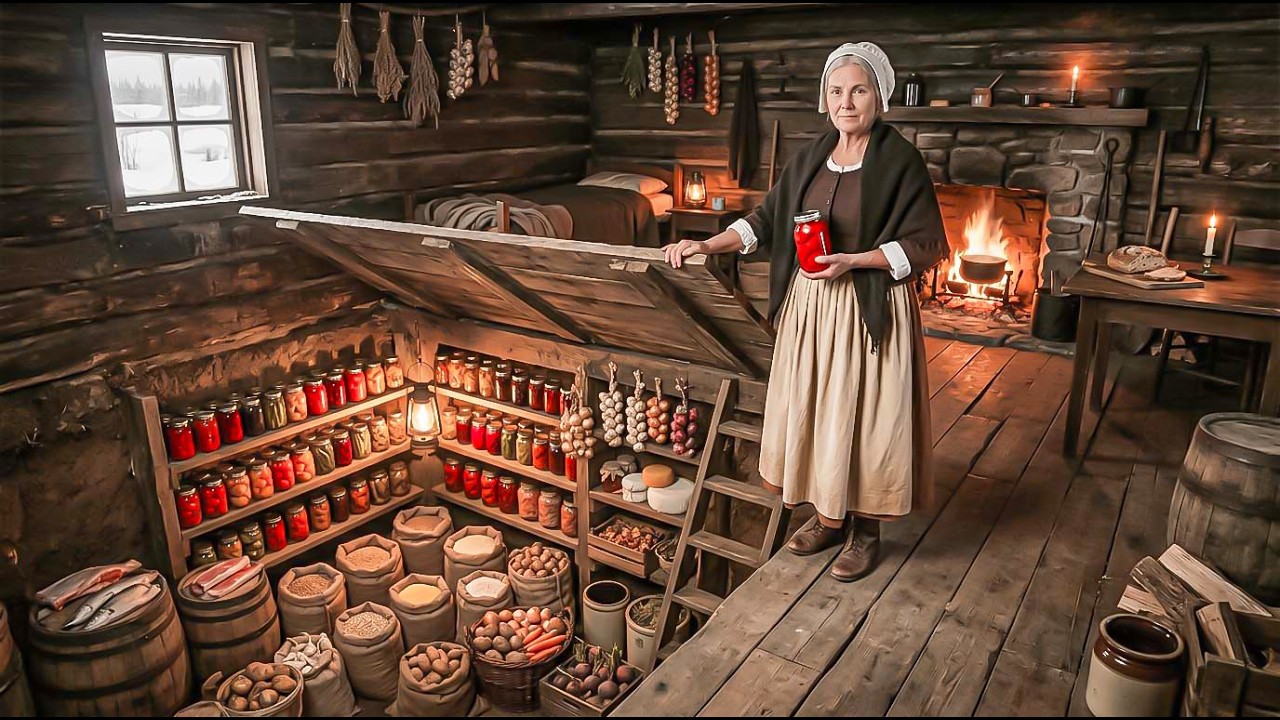
And now in the center of the floor, a hole. 8 ft deep, 4 ft wide, 6 ft long. Martha had been digging for 3 days. She knew exactly what she was doing cuz her grandmother had taught her before she could read. Elsa Bergren, 83 years old and nearly blind hands twisted into claws from six decades of Scandinavian farm work, had drawn diagrams in the dirt floor of a cabin in Minnesota when Martha was seven.
“8 ft down,” she had said, “that is where the earth stops caring about the weather.” Below 8 ft, the temperature holds steady. 40° in winter, 55 in summer, cool enough to keep potatoes firm through March, warm enough that nothing freezes solid. You line the walls with straw and sawdust.
You lay planks across the bottom. You build shelves from scrap lumber. And then you fill it. You fill it until there is no more room and then you find more room and you fill that, too. Martha remembered every word. She remembered because her grandmother spoke them only once and expected them to be remembered the way people who survived famines expected things.
The shovel struck clay and the clay surrendered another inch. Montana clay was not like the black soil of Minnesota or the sandy loam of Ohio. It was dense calcium-rich hardpan that had never been broken by plow or pick. The root systems of prairie grass ran through it like wire, and Martha had to chop through those roots with the edge of her shovel before she could scoop the loosened dirt into the bucket she hauled up by rope.
Three days of this. Her palms had blistered on the first day, the blisters had torn on the second, and by the third day, the raw skin underneath had begun to harden into calluses that formed in exactly the same places where her husband Henrick’s calluses had been. She knew this because she remembered every callus on his hands.
She remembered the specific roughness of his palm against her cheek the last time he touched her face the morning he walked out the door with his Winchester on his shoulder and did not come back. She did not think about that. She dug. The walls of the pit were straight and clean. She had squared them with a plumb line made from a rock and a piece of string the way Henrick had squared the cabin walls two years ago using the same method.
The floor of the pit was level. She had checked it with a bowl of water watching for the water to settle evenly the way her grandmother had taught her to check the floor of a root cellar in the old country. Every detail mattered because every detail was the difference between food that lasted 7 months and food that rotted in 6 weeks.
A root cellar with uneven walls allowed warm air pockets. Warm air pockets grew mold. Mold spread. And by February, when you open the trap door expecting potatoes, you found black slime and the smell of failure. Martha did not intend to smell failure. Not this year. Not ever again. She was lining the pit with planks of pine spacing them 4 inches from the clay walls and packing the gap with alternating layers of straw and sawdust when she heard the horses.
Not one horse. Four. And the particular sound of iron-rimmed wheels and hard-packed dirt that meant a carriage. There was only one person in the Gallatin Valley who traveled by four-horse carriage with a driver in a button coat, and that person was now pulling up to Martha’s cabin as if arriving at a Boston tea parlor instead of a dirt yard where a woman knelt in a hole.
Eleanor Prescott stepped down from the carriage without waiting for the driver’s hand. 34 years old, black hair curled tight and pinned high, a cameo brooch carved from ivory at her throat, silk dress dove gray with 16 buttons up the front, each one covered in matching fabric, shoes with heeled soles designed for cobblestone sidewalks, not for Montana mud.
She was beautiful in the way that expensive things are beautiful with a perfection that suggested money had been spent to achieve it and would need to be spent continuously to maintain it. She looked through the cabin door at the hole in the floor and the woman in the hole and her nose drew tight the way a person’s nose draws tight when confronted with something they find distasteful but must acknowledge exists.
“Storing food,” Martha said without looking up. She lowered another crate of potatoes into the darkness where the cool air rose like breath from the earth. “For winter.” Eleanor’s voice carried the bright clarity of someone who had grown up in parlors where projection was considered a social grace. “Winter is 5 months away and you already have a root cellar.
” “Yes, my husband says you have been buying every potato and turnip and cabbage in the valley.” “He says you have been drying meat since June.” “He says you have enough food buried under this cabin and defeat an army.” Martha placed another crate on the shelf she had built inside the pit. Potatoes 40 lb.
She noted the number in her memory the way she noted every number relating to food automatically and without effort because her grandmother had taught her that the woman who did not count her provisions was the woman who starved in March. “People are starting to talk, Mrs. Thornton.” Eleanor stepped closer to the doorway but did not step inside.
The threshold of a dirt floor cabin was apparently a border she preferred not to cross. “They are saying the Swedish widow has gone mad with grief. They are saying you are hoarding food like a squirrel because you are afraid of your own shadow.” Martha stopped. She set the shovel against the pit wall. She placed both hands on the edge of the floor and lifted herself up and out of the hole with the kind of quiet strength that comes from months of physical labor performed alone.
She stood and looked at Eleanor Prescott and Eleanor Prescott looked at her and for a moment the two women simply took the measure of one another. Martha saw a woman who had never been hungry. She saw it in the way Eleanor held herself, in the unconscious assumption that her body would always be fed and warm and clothed in silk, in the absolute absence of the particular tension that lived in the shoulders of people who had known want.
Eleanor Prescott did not know what it felt like to count potatoes. She did not know the specific mathematics of survival, how many calories a person needed to stay alive through a Montana winter, how many pounds of dried meat equaled how many days of continued breathing. She did not know these things because she had never needed to know them and she assumed she never would.
Eleanor saw a woman on her hands and knees in the dirt. She saw cracked skin and a plain dress in a cabin that could have fit inside the parlor of the Prescott ranch house. She saw someone to pity and perhaps to advise the way one might advise a child who was going about something the wrong way. “My husband died last winter,” Martha said.
Her voice was level, not angry, not pleading, just the sound of someone stating a fact that had rearranged the entire architecture of her life. “He went out hunting in a storm because we were running low on food and he froze to death two miles from home. I found his body three days later when the snow melted enough for me to see where he had fallen.
” Three seconds of silence. Long enough for Martha to know that Eleanor heard, short enough for Martha to know that Eleanor did not understand. Because Eleanor Prescott had never found a frozen body in the snow. She had never opened a door and looked out at white emptiness and wondered if the person she loved was somewhere under it already dead, already gone, already turning into something that was not a person anymore, but just a shape in the drifts. That is terrible, of course.
Eleanor’s voice adjusted itself the way voices do when they encounter grief they cannot comprehend, softening around the edges and while remaining structurally unchanged. But surely the answer is not to become a hermit surrounded by vegetables. The answer is to be part of a community, to rely on your neighbors, to trust that civilization will provide.
Civilization does not provide when the snow is 6 ft deep and the temperature is 40 below. Neighbors cannot help you when they are trapped in their their own houses starving just as fast as you are. Martha climbed back into the pit, picked up the shovel, resumed digging with the same steady rhythm, one strike every 4 seconds.
I am storing 600 lb of food under this floor. Potatoes, turnips, carrots, cabbage, dried beans, dried meat, preserved fruit. Enough to last 7 months without leaving this cabin, and when winter comes I will be ready. Eleanor laughed. It was a short sound, bright and sharp, the kind of laugh that was not really about amusement, but about the need to establish that what one was witnessing was absurd.
7 months. Winter in Montana is 4 months at most, five in a bad year. You are preparing for something that will never happen. My grandmother survived a famine in Sweden. She told me about winters that lasted until June, about people eating bark and leather and things I will not describe to you.
She taught me that you never know how long winter will last until it is over, and by then it is too late to prepare. This is not Sweden, Mrs. Thornton. This is America. This is Montana. We have trains, we have telegraphs, we have ranchers with 100,000 head of cattle grazing in the valleys.
Eleanor gathered her skirts and turned toward the carriage. She paused at the step, one hand on the lacquered door, and looked back. When spring comes and you are sitting on a mountain of rotting vegetables, I hope you will remember this conversation. I hope you will realize how foolish you have been. The carriage rolled away. Dust rose behind the wheels and settled slowly in the September sun.
Martha watched it go, then looked down at the shovel in her hands, at the pit beneath her feet, at the crates of potatoes waiting to be lowered into the dark. She dug. What Eleanor Prescott did not know, what no one in the Gallatin Valley knew except Martha herself, was that the hole under the cabin floor was not the first hole Martha had dug that year.
In March, when the ground finally thawed enough to accept a blade, Martha had dug another hole behind the cabin, 6 ft deep, 3 ft wide, long enough for a man who stood 5 ft 11 in tall and had died with his arms at his sides and his rifle still on his shoulder. She had buried Henrik Thornton in that hole on the first day the earth would take him, 6 weeks after she had found his body 2 miles from home, frozen upright in the snow.
His face turned toward the cabin he could see but could not reach. And 3 weeks after burying Henrik, Martha had lost her child. She did not speak of this to anyone. There was no one to speak to. The nearest neighbor was 2 miles away and the snow had only just begun to melt and Martha was alone in the cabin when it happened, alone on the floor, alone with the blood and the pain and the absolute certainty that her body had finally surrendered the last thing it had been holding.
She lay on the floor for 3 days. On the fourth day, she stood up. She boiled water. She made broth from the last handful of flour in the cabin. She drank it. She cleaned the floor. She opened the door and looked at the world outside, still white, still cold, still utterly indifferent to what had happened inside these walls.
And she understood something that would govern every decision she made for the rest of her life. She understood the price of not enough. Not enough food, not enough preparation, not enough respect for what winter could do when it decided to keep going. Henrik had been a good man, a kind man, the kind of man who stopped to help strangers with broken wagon wheels and gave away his last dollar to someone who looked like they needed it more.
A man who laughed easily, who sang Swedish folk songs while he worked, who believed with his whole heart that things would work out because things had always worked out for him. He had grown up comfortable in Gothenburg, the son of a merchant who sold woolen goods and never missed a meal. Never truly hungry, never truly afraid, never forced to reckon with the reality that the world contained forces that did not respond to good intentions or hard work, or the simple belief that tomorrow would be better than today. He met
Martha at a Lutheran church gathering in Minneapolis in 1881. He was 26, she was 23. He noticed her because she was the only woman in the room who was not talking. She sat in a corner with a cup of coffee that she held with both hands, watching the room the way a person watches a river, alert to the current, reading the flow.
He walked over and introduced himself, and she looked at him with those ice blue eyes and said nothing for so long that he almost walked away. Then she said, “You have never been hungry.” Not as an insult, not as an observation, as a fact stated plainly the way one might note that the sky was blue or the coffee was hot.
He laughed because he did not know what else to do with a sentence like that, and then he sat down beside her, and they talked for 3 hours. And by the end of those 3 hours, he knew two things. First, that this woman frightened him in a way that he found completely compelling. Second, that she knew things about the world that he did not know and might never learn and that marrying her would be like marrying a book he could not finish reading.
They married in the spring of 1882 and came to Montana that summer. Henrik saw paradise, long summers, rich soil, endless grass stretching from the mountains to the horizon. He saw opportunity in abundance and the promise of a life built on good land under a big sky. Martha saw all of that, too, but she also saw the other thing, the thing that Henrik could not see because he had never needed to see it.
She saw the distance between the cabin and the nearest neighbor. She saw the width of the sky and understood that a sky that big could hold weather that a Swedish merchant’s son had never imagined. She saw the mountains and knew that wind coming over those peaks in January would carry cold that could kill a man standing up, freeze him in mid-stride, stop his heart between one step and the next.
She told Henrik they should store more food. He smiled and kissed her forehead and said the sentence that she would hear in her memory for the rest of her life, the sentence that would echo in the empty cabin after he was gone. We have enough. Do not worry. He said it was such warmth, such absolute confidence, that for a while she almost believed him.
He built a cabin, broke ground for a farm, bought 30 head of cattle on credit, and stored just enough food to survive what he thought would be a normal winter. 200 lb of potatoes and flour and dried goods, enough for 4 months, maybe 5. He calculated based on his experience in Sweden, where winters were long but temperate compared to what waited for them in Montana, and based on what the established ranchers told him, men who had been in the territory for 5 or 10 years and who said winter was cold but manageable.
Nothing a well-built cabin and a decent supply of firewood could not handle. The winter of 1885 to 1886 was not normal. Snow in November that did not stop until April. Temperatures that dropped to 30 below and stayed there for weeks. Henrik’s cattle froze where they stood in the fields, ice forming on their hides.
Their legs locked, their eyes open and unseeing, slowly disappearing under drifts that grew higher each day. By February, the food was running low, and Martha was 4 months pregnant, and Henrik made the decision that killed him. He went hunting on February 23rd. He took the Winchester Model 1873 in .44 .
440 caliber that he had carried from Minnesota. He wore his heaviest coat. He told Martha he would be back before dark. She asked him not to go, not with tear, not with pleading. Martha did not plead. She said it flat and plain. I would rather eat less than lose you. Henrik kissed her forehead and said the words that kind men who have never been truly afraid always say, “You and the baby need food.
I will be back before dark.” A Montana blizzard is not like a storm in the east. It does not build slowly with darkening skies and dropping pressure. It drops out of nowhere. The Chinook winds reverse, the temperature falls 30° in an hour, and the world turns white so fast that a man standing in an open field cannot see his own hand in front of his face.
Henrik was 3 miles north of the cabin when the sky erased itself. He turned back. The tracks they found later proved he turned in the right direction. He was walking home. He was 2 miles from the door when his body stopped. Martha waited at the window through the night. She put another log on the fire. She boiled water for tea that she did not drink.
She stood at the window and pressed her hand against the glass, and the glass was so cold it burned her palm, and she kept her hand there anyway because the pain was something real, something that was not the white void outside where her husband was, somewhere alive or not alive, walking or not walking, and she could not go to him because the wind would kill her, too, and then there would be two bodies in the snow and a baby inside one of them that would never be born.
Through the next day she waited. She ate a handful of flour mixed with water because the baby needed something even if Martha could not taste it. Even if her throat had closed around the fear so tight that swallowing felt like pushing food through a fist. She talked to the baby. She put her hands on her belly and talked in Swedish, the language she used when she was most afraid, the language of her childhood, of her grandmother’s kitchen, of the stories about the famine that she had heard so many times.
They were part of her the way bones were part of her. She told the baby that its father would come home. She said it in Swedish because lies sounded more like prayers in Swedish. Through the day after that on the third morning the snow thinned enough to walk not much. Still knee-deep, but the wind had stopped and the sun was a pale disc behind clouds that had finally exhausted themselves.
Martha put on Henrik’s second coat, the one he had not taken because he only had two and he had worn the heavier one. She walked out the door and began to search. She found him two miles north standing upright in a drift, frozen in mid-stride, his rifle on his shoulder, his face turned toward the cabin. He had died walking home.
His eyes were open. They were covered with a thin film of ice that made them look like they had been glazed like the eyes of a porcelain doll and in the morning light they reflected the sky above him blue and cold and empty. His lips were slightly parted as if he had been about to speak about to call out to her, about to say her name or say I am coming or say I can see the cabin.
I am almost there, but the cold had stopped him between the thought and the word, between the breath and the voice and what remained was silence shaped like a man. She wrapped him in a blanket and dragged him back. Two miles through knee-deep snow. It took three hours. She could not bury him because the ground was frozen solid to a depth that no shovel could reach.
So she laid him on the porch and covered him and went inside and ate the last of their flour and waited for spring. Spring came. She buried him. She lost the baby. She lay on the floor. She stood up. And then she began to prepare. The summer of 1886 was the summer Martha Thornton declared war on winter. She planted a garden three times the size of what one person needed, breaking new ground from dawn to dark, chopping through prairie root systems with a grub hoe, turning soil that had never been turned, planting potatoes in rows 12 in
apart and 4 in deep the way Grandmother Elsa had taught her. Turnips, carrots, cabbage, more than she could possibly eat alone. She bought additional potatoes and turnips from every farm in the valley, paying cash she earned by taking in laundry, mending clothes, mucking stalls, doing any work that anyone would pay her for.
The meat took longest. She shot a white-tailed deer in June with Henrik’s Winchester, dropping it clean at 80 yd with a single round behind the shoulder. She had been shooting since she was 12 because Grandmother Elsa believed that a woman who could not feed herself was a woman who depended on the kindness of weather and men, and neither could be trusted.
Martha skinned the deer, stripped the meat into slices as thin as her finger, rubbed each piece with coarse salt and black pepper, and hung them in the smokehouse she had built from scrap lumber. The structure was simple. Four posts sunk 2 ft into the ground. Walls of canvas stretched tight.
A small fire pit burning alder wood which gave sweet smoke that would not bitter the meat. She tended the fire for 3 days straight, turning the strips every 8 hours until the venison was hard as boot leather and would keep until spring without spoiling. She shot a second deer in July, a third in August, and in September she killed a bull elk that dressed out at over 400 lb on the hoof and yielded nearly 200 lb of meat, which became roughly 60 lb of jerky after smoking.
More meat than the three deer combined. She picked wild huckleberries and chokecherries from the hillsides above the valley. Cooked them down with sugar into preserves, sealed the jars with beeswax. She made sauerkraut in oak barrels layering shredded cabbage with salt at a ratio of 3 and 1/2% brine by weight pressing it down with river stones fermenting it for 4 weeks in the cool shade behind the cabin.
She sliced apples and pears from a neighbor’s orchard paper thin and dried them in the afternoon sun until they were crisp enough to snap between her fingers. And she dug the pit 8 ft into Montana clay lined with straw and sawdust and pine planks shelved with scrap lumber designed to hold 800 lb of provisions.
She filled 600 of those pounds and kept going. 600 lb for one person was too much. She knew it. Even for 7 months it was more than she needed. But she could not stop. Part of it was fear, the kind that does not have a bottom, the kind that wakes you at 3:00 in the morning and sends you to the garden to check the potatoes in the dark.
Part of it was something else, something her grandmother had planted in her along with the knowledge of root cellars and smoking meat. A sentence spoken once in Swedish in a cabin in Minnesota by a woman who had watched 100,000 people die of hunger. Always store enough for the people you have not met yet.
Martha did not fully understand what that meant, not yet. She would understand it in February when the first knock came at her door. One afternoon in early September Martha was hauling a sack of potatoes from a wagon to the cabin when a man on horseback stopped on the road. He was about 32 lean clean-shaven wearing clothes that were old but mended carefully the way a man mends who lives alone and has no one to do it for him.
He looked at her, looked at the sack and without a word dismounted, walked over, lifted the sack onto his shoulder and carried it to her door. He set it down. He nodded once. He mounted his horse and rode on without having spoken a single syllable. Martha watched him go. She did not know his name. She did not know where he lived.
She knew only that he had helped without being asked and left without expecting thanks. She picked up the sack and carried it inside and lowered it into the pit. Grandmother Elsa came in late September making the long journey from her son’s farm near Helena. 83 years old, nearly blind, her hands curled into shapes that no longer straightened.
But when Martha helped her down the ladder into the pit, the old woman’s remaining senses sharpened like a blade drawn across a stone. She felt the cool air rising from the packed earth. She ran her twisted fingers along the pine planks testing the gaps between boards, checking the insulation layers. She pressed her palm against the sack of potatoes and held it there for a long time feeling the temperature of the skin through the burlap gauging whether the storage conditions were correct.
“You are doing it right,” she said. “This is how we survived in the old country, not by trusting weather, not by trusting governments, not by trusting neighbors who smile in summer and lock their doors in winter. By trusting your own hands and the food they put away. People think I am crazy. Mrs.
Prescott told everyone in town that I have lost my mind. Mrs. Prescott has never been hungry. She does not know what it looks like when children grow thin, when their eyes get large in their faces while their bodies shrink around them. She does not know what it means to dig through snow searching for anything, anything at all that might keep you alive one more day.
” The old woman’s clouded eyes seemed to fix on something far away, something that had happened 50 years ago in a country across an ocean. The famine of 1867 killed 100,000 people in Sweden. I was 30 years old. I watched my mother and two of my sisters starve to death in front of me. I watched their faces change. I watched their hands stop moving.
I watched the light go out of their eyes like a candle flame pinched between two fingers. The winter lasted 7 months. Snow in October, no thaw until May. People ate grass, they boiled leather. They did things I will not speak of even now, not in any language, not to anyone. She paused.
Her blind eyes stared at nothing and everything. When it ended, I swore I would never be caught without food again. Never. How much should I store? Enough for 7 months. Do not let anyone tell you that is too much. It is not nearly enough, but it is a start. Before she left, Grandmother Elsa took something from the deep pocket of her coat and placed it in Martha’s hands.
A small hand trowel with a birch wood handle worn smooth by 60 years of use. The blade was iron thinned by decades of sharpening until it was almost translucent at the edge, but still true, still capable of biting into earth. This was my mother’s. She used it to dig the last turnip from the ground before she died.
I have carried it for 60 years across an ocean and half a continent. Now you carry it, not to display, not to remember, to use. Every time you dig, remember why you dig. Martha held the trowel. It was light. It fit her palm the way a thing fits when it has been shaped by hands that work the same way hers did, the same grip, the same calluses, the same knowledge passed from mother to daughter to granddaughter through the medium of blistered skin and aching backs.
She put it in her coat pocket where it would stay for the rest of her life. One more thing about the community that Martha lived in because the people who would come knocking on her door in the months ahead were not strangers. They were the Gallatin Valley. They were Montana Territory. And they deserved to be known before the snow buried them.
Tom Whitmore and his wife Sarah had six children between the ages of two and 14. They had come from Ohio two years before drawn by the promise of cheap land and long summers in the advertisements that the railroad companies had plastered across every post office and train station east of the Mississippi. Advertisements that showed green valleys and fat cattle and happy families standing in front of whitewash farmhouses with mountains in the background and not a snowflake in sight.
Tom was a decent farmer who worked hard and treated his family well and measured Montana winters by Ohio standards, which was like measuring an ocean by the depth of a bathtub. In Ohio, winter meant four months of cold and occasional snow and roads that might be difficult for a week or two. In Montana, winter meant something else entirely, something that Ohio had no vocabulary for, but Tom did not know that yet because he had only been through one Montana winter and it had been a mild one, the kind that old-timers called a shirtsleeve winter,
barely below zero snow that came and went, nothing that challenged the assumption that this was a livable place. Sarah worried more than Tom. She had a mother’s instinct for danger. The particular radar that comes from being responsible for small lives that cannot protect themselves. She watched the sky the way Martha watched the sky with the constant low-grade alertness of a woman who has looked at her pantry and counted the jars and the sacks and the tins and done the math and come up short.
She told Tom they should store more food. He said the same thing Henrik had said to Martha. It will be fine. Do not worry. There will be supply wagons. There are neighbors. This is not the wilderness. This is civilization. He said it with the certainty of a man who has never been wrong about anything important and does not expect to start being wrong now.
One afternoon at the general store in town while Martha was buying another 50 pounds of potatoes from the bin by the door, three women standing by the fabric counter stopped their conversation and watched her with the kind of attention that people reserve for spectacles and embarrassments. One of them said loud enough for Martha to hear, “That is the Swedish widow, the one who has been buying up everything.
Prescott’s wife says she has gone completely mad.” Another laughed. The third shook her head with the particular satisfaction of a person who enjoys the misfortunes and eccentricities of others. Martha loaded the potatoes onto her handcart without acknowledging them. She had learned a long time ago that people who talked about you in your presence were not worth the energy of a response.
But as she pushed the cart toward the door, Sarah Whitmore stepped away from the counter where she had been pricing flowers she could not afford and walked over to Martha. Sarah was thin already thin in the way farm wives get thin when they feed their children first and eat whatever is left, which some nights is nothing.
She leaned close and said quietly so only Martha could hear, “I do not think you are crazy, Mrs. Thornton. I just hope you are wrong.” Martha looked into Sarah’s eyes and saw the flicker of fear that Sarah was trying to keep hidden behind a smile that did not quite reach her cheekbones. The fear of a mother with six children and a pantry that was not full enough and a husband who kept saying it would be fine.
Martha wanted to say something. She wanted to say store more food. She wanted to say your husband is wrong. She wanted to say winter is coming and it will be worse than anything you have imagined. But she did not say any of those things because she knew that people who are not ready to hear the truth experience it as cruelty.
And she did not want to be cruel to a woman who was already afraid. So she nodded, just once, a small movement of her head that could have meant anything or nothing. And Sarah nodded back and they parted and 3 months later Sarah would stand in Martha’s cabin with six silent children and tears she could not afford to cry, and the nod would mean everything.
James Prescott, Eleanor’s husband, 40 years old, big man, broad shoulders, voice that carried across a room without effort, because he was accustomed to being heard. He had built the ranch from Eleanor’s family money, though he never acknowledged this, presenting it instead as the product of his own vision and labor.
50,000 head of cattle on 100,000 acres. He looked at winter the way he looked at everything, as a problem to be managed, an inconvenience to be endured, a temporary condition that would yield to sufficient confidence and capital. When someone mentioned Martha’s preparations, he said, “Let the woman bury her potatoes. At least she is not bothering anyone.
” He did not mean it unkindly. He simply could not imagine that potatoes buried under a cabin floor could matter more than 50,000 head of cattle on open range. And there was the man who had carried Martha’s potato sack. She did not know his name yet. She would learn it later. Samuel Caldwell, 32 years old, a small farmer on a quarter section a few miles from Martha’s place. He lived alone.
He stored food the way Martha did, though less of it, because he had less money and less fear, and less of the specific knowledge that Grandmother Elsa had planted in Martha’s bones. But he understood something about preparation that most people in the valley did not. He understood that the sky was not to be trusted.
He had lost a brother to a Kansas blizzard in 1878, and the lesson had stayed with him the way such lessons do not, as a thought, but as a reflex, a tightening in the chest when the clouds moved wrong. The first snow fell on November 9th, 1 foot of white that covered the valley from the mountains to the river, and did not melt. Martha stood at her west-facing window and watched it come, watched the flakes falling thick and steady, watched the fence posts disappear inch by inch.
More snow the following week. More the week after that. By the end of November, the drifts were 2 ft deep and the roads were becoming difficult. By December, 3 ft. The temperature dropped with the snow, 20 below in early December, 25 by mid-month, 30 below by Christmas. Martha stood at the window and felt something she had not felt in months. Not peace, exactly.
Not happiness. Something quieter. The particular calm of a person who has done everything they can do and knows it. The pit was full. 600 lb of potatoes, turnips, carrots, cabbage, dried beans, smoked venison, and elk, preserved berries, sauerkraut, dried apple and pear slices. The firewood was stacked 8 ft high along the north wall of the cabin.
The door was sealed with rags stuffed into every crack. The water barrel was full. The fire was lit. She had done the work. Now there was only the waiting. But standing at that window, watching the snow erase the valley 1 in at a time, she thought of Grandmother Elsa in Helena, of Sarah Whitmore and her six children 2 mi down the road, of all the families in the Gallatin who did not have 600 lb of food beneath their floors, who had stored enough for a normal winter, because they believed in normal winters, who had trusted trains and telegraphs
and 100,000 head of cattle to stand between them and starvation. She reached into her coat pocket and closed her fingers around the worn birch handle of the trowel, and she understood that this winter would test more than her preparation. It would test something deeper, something that her grandmother had tried to teach her with seven words in a cold cabin in Minnesota.
Always store enough for the people you have not met yet. Outside the temperature dropped another 10° as the sun went down. In the forest above the valley, trees began to explode in the darkness. The sap inside them froze and expanded and split the trunks apart with sounds like rifle shots that echoed across the snow and rolled down into the valley where Martha stood at her window and listened.
And on the Prescott ranch, spread across a hundred thousand acres of what had seemed like endless paradise just two months before, 50,000 head of cattle stood in the open with snow on their backs and ice on their hides and nothing to eat beneath 6 ft of white and they began to die. December came down on the Gallatin Valley like a hand pressing a pillow over a sleeping face.
Slow, steady, suffocating. The snow did not fall so much as accumulate each storm, adding another layer to what was already there, compressing the world beneath it until the fences disappeared and the roads became suggestions and the only thing visible from Martha Thornton’s west-facing window was white.
White from the cabin to the mountains. White from the ground to the sky. White in every direction broken only by the dark spears of pine trees on the ridgelines and the occasional dark shape of something that had once been alive and was now becoming part of the landscape. The cattle died first, not all at once, not dramatically.
They died the way large animals die when the world turns against them slowly and with a terrible patience that made it worse than any sudden catastrophe could have been. The snow covered the grass and the grass was the only thing keeping 50,000 head of cattle alive on the Prescott ranch and 10,000 head alive across the smaller operations in the valley.
And when the grass disappeared beneath 6 ft of frozen white, the cattle had nothing left to eat. They stood in the fields and waited. That was the thing that stayed with people long after the winter ended, long after the bodies had been cleared and the bones had been collected and sold to fertilizer companies in Chicago for $6 a ton.
The cattle did not run, did not panic, did not try to escape. They stood where the last grass had been and they waited for it to come back and it did not come back and they died standing up. Their bodies froze in place, legs locked, heads bowed, ice forming on their hides in layers that thickened each night until the animals looked less like cattle and more like sculptures carved from something that was not quite stone and not quite flesh.
The snow drifted around them and over them, and by January, you could walk across a field that held 200 dead animals and see nothing but white mounds with the occasional horn or ear tip breaking the surface like a dark accusation pointed at the sky. James Prescott rode out every morning with his men.
12 cowboys who had worked the range in summer, slept under stars, sung songs around campfires, and lived the life that eastern newspapers wrote about with breathless admiration. Now, they fought a war they could not win against weather that did not care about their effort or their courage or the number of hours they spent in the saddle. They dug through drifts looking for living cattle.
They found them sometimes standing in draws or pressed against the south sides of barns, thin and trembling, their ribs showing through hides that had lost all the fat beneath them. They pulled these animals into the barns when they could, but the barns held maybe 300 head, and there were 50,000 on the range, and the mathematics of that gap was the mathematics of ruin.
Every evening, James came home with a number. How many lost today? 200 on the good days when the temperature stayed above 20 below and the wind was not too bad. 300 on the average days. 500 on the bad days when a new storm came through and the temperature dropped below 40 below, and the cattle that had survived the starvation could not survive the cold on top of it.
He sat in his study with the leather-bound ledger open on the mahogany desk and the whiskey bottle within reach. And he wrote the numbers down in a column that grew longer each week. 50,000 in October. 42,000 in November. 31,000 in December. 20,000 in January. The numbers fell like the temperature steadily, mercilessly, and James Prescott fell with them.
Not in his body, which remained large and upright and capable of riding 12 hours in brutal cold without complaint. He fell in something behind his eyes. Something that Eleanor noticed first as absence. A place where her husband used to be that was now empty when she looked at him and later recognized as collapse.
He stopped talking at dinner. He stopped asking the children about their lessons. He stopped looking at Eleanor when she spoke to him. His gaze fixed instead on some middle distance that contained only numbers and snow and the slow erasure of everything he had built and everything he had believed about himself.
Eleanor watched her husband disappear into himself the way a man disappears into deep water. Gradually. Silently. Still visible for a long time after he has stopped being reachable. She did not know what to do about it because she had never seen a man break before. In Boston, men did not break. They adjusted.
They restructured their portfolios and spoke to their bankers and their lawyers and they solved problems with telephone calls and handshakes and the quiet application of capital to difficulty. But there was no capital that could melt 6 ft of snow. There was no telephone call that could bring grass back from under the frozen earth. There was no handshake that could make a dead cow stand up and breathe again.
And James Prescott, who had built his empire on the assumption that ambition and hard work could overcome any obstacle, was discovering that winter was not an obstacle. Winter was a fact and facts did not negotiate. The house began to ration. The cook, a German woman named Mrs. Hartley, who had been with the Prescotts since Helena started measuring flour by the cup instead of the scoop.
Sugar went from the bowl on the table to the locked cabinet in the pantry. Butter disappeared entirely. then eggs, then fresh bread replaced by flat cakes made from flour and water that grew thinner and less frequent as the weeks passed. The children, two girls and a boy between the ages of five and 10, asked why there was porridge for breakfast instead of eggs and toast.
Eleanor told them it was temporary. She said the supply wagons would come soon. She said everything was fine. She said these things with the bright, firm voice she had learned in Boston drawing rooms, the voice of a woman who believed that if you stated something with enough confidence, it became true.
But the supply wagons did not come. The roads were buried under drifts that rose higher than a man on horseback. The railroad tracks were blocked by snow that the plows could not clear because the drifts reformed overnight faster than the plows could work, as if the land itself was rejecting the idea that anyone should be allowed to come or go.
The hunting parties that James sent out returned with nothing because the deer were dead and the elk had moved to lower elevations far from the valley, and there was nothing left on the ridgelines except snow and silence and the frozen carcasses of animals that had made the same mistake the cattle had made, which was believing that Montana would behave the way it had always behaved before.
They called it the great die-up, though that name would not come until later when people could bear to count what they had lost and give the counting a title. In some parts of Montana territory, 90% of the cattle died that winter. Not gradually, not manageably, not in a way that allowed ranchers to adjust and adapt and salvage what they could. 90%.
Think about what that number means. A man who owned 10,000 cattle in October owned 1,000 in March, and most of those thousand were too weak to stand and would be dead by April. A man who had borrowed $50,000 against the value of his herd now owed $50,000 on an asset worth nothing less than nothing because dead cattle are not just worthless, they are expensive.
Someone has to deal with the bodies. Someone has to pay for the cleanup. Someone has to face the banker and explain that the collateral is scattered across a hundred thousand acres of rangeland frozen solid being eaten by wolves. Ranchers who had been millionaires in October were bankrupt by February. Men who had shaken hands with governors and senators, who had entertained visiting dignitaries in ranch houses with crystal chandeliers and mahogany furniture shipped from Chicago, who had believed with absolute certainty that
the grass would last forever and the cattle would multiply forever and the money would flow forever. These men discovered in the space of four months that forever was a word and winter was a fact and the difference between a word and a fact was the difference between a chandelier and a candle, between mahogany and pine, between a million dollars and nothing at all.
The entire economy of the territory built on grass and cattle and the assumption that both were infinite collapsed under six feet of snow and temperatures that would not rise above zero for weeks at a time. The railroads that were supposed to connect Montana to the civilized world were paralyzed. Their tracks buried, their engines useless against drifts that reformed as fast as they could be cleared.
The telegraphs that were supposed to summon help transmitted messages into a void because there was no help to send. The system that Eleanor Prescott had believed in the system of trains and telegraphs and civilization had not failed exactly. It had simply proven to be irrelevant. You cannot eat a telegraph. You cannot heat a house with a railroad schedule.
And when the temperature is 40 below and the snow is six feet deep, civilization is just another word for a set of assumptions that the weather does not share. And the winter kept going. February came and the snow kept falling. March arrived on the calendar, but winter paid no attention to calendars. The blizzards continued.
The drifts grew higher. April appeared as a date and nothing more, a word on a page that meant nothing to the sky or the snow or the cold that held the valley in its grip like a hand that did not intend to let go. The people who had thought they were prepared discovered they had prepared for a normal winter and this was not a normal winter and the difference between those two things was the difference between survival and catastrophe.
In her cabin Martha Thornton lived inside a rhythm. She woke before dawn when the darkness outside the window was absolute and the only light came from the coals in the hearth glowing orange beneath a layer of white ash. She added wood to the fire, pine which caught fast but burned quick for the initial heat, then a piece of the dense Douglas fir she had split and stacked in October which burned slow and hot and would hold the cabin at a livable temperature for hours.
She waited for the flames to catch and the warmth to spread. She filled the kettle from the water barrel she kept inside the cabin near the stove. The barrel she refilled every afternoon by packing a pot with snow and melting it over the fire, a process that took two hours to produce three gallons of water because snow is mostly air and must be compressed before it surrenders its moisture.
She made porridge from dried oats mixed with a small amount of dried apple for sweetness. One bowl she ate slowly not because she savored it but because eating slowly made the food feel like more than it was and she had learned from grandmother Elsa that the psychology of hunger was as important as the biology of it.
A person who ate fast felt hungry again in an hour. A person who ate the same amount slowly felt satisfied for three. After eating she opened the trapdoor and descended the ladder into the pit. The cool air rose around her like water, 43° steady unchanged since November, unchanging because that was the entire point of an 8-ft pit lined with straw and sawdust and pine planks.
The earth at that depth did not care about the blizzard above or the 40 below on the surface. It held its temperature the way a promise holds its shape firm and reliable and worth trusting your life to. She counted. Every morning she counted. The potatoes in their burlap sacks sorted by size because small potatoes spoiled faster and needed to be eaten first.
The turnips in their straw-lined crates hard and dense and capable of lasting until May if the temperature stayed below 50. The carrots packed in sawdust which wicked moisture away from the skin and prevented the soft rot that could destroy a carrot in 2 weeks of stored wrong. The cabbage heads wrapped individually in newspaper because cabbage released moisture as it aged and the paper absorbed it keeping the heads dry and firm.
The jars of preserved food on the upper shelves where the air was slightly warmer. Their wax seals intact. Their contents glowing amber and dark red like small windows into the summer that had produced them. The dried meat hanging from hooks driven into the pine plank walls. Dark strips of venison and elk that were hard as wood and would stay that way until water and heat softened them back into something a human body could digest. She had a notebook.
She recorded the numbers. She calculated how many days each category of food would last at her current rate of consumption. She did this every morning without fail. And she did it not because the numbers changed overnight but because the act of counting was the only thing that stood between her and the particular madness that comes from being alone in a small room for months while the world outside tries to erase everything in it.
Some mornings she counted twice. Some mornings three times. She would close the trapdoor, climb up, sit at the table, and then open it again and go back down and count again. The numbers had not changed in the 15 minutes since she last counted them. She knew they had not changed. But the act of not counting felt like the act of not breathing, a voluntary cessation of something that her body demanded she do.
And so she counted, and the counting held her together the way the straw and sawdust held the temperature in the pit through insulation and persistence and the stubborn refusal to let the cold get in. The nights were the hardest, not because of the cold, which the cabin handled well enough with a good fire and the quilt she had sewn from scraps during the summer months.
Not because of the wind, which howled and rattled the door, but could not enter through the sealed walls and the rags stuffed into every crack. The nights were hard because they were long, and they were silent, and in the silence Martha’s mind did things she could not control. She heard Henrik’s footsteps on the porch.
She heard him stamping snow from his boots the way he always did, two hard stamps of each foot, left, right, left, right, a pattern so specific and so familiar that her body responded to it before her mind could intervene. Her heart lifting, her eyes going to the door, her lips beginning to form the beginning of a word that would be his name.
The door did not open. The footsteps were ice cracking on the roof or a branch falling against the wall or nothing at all, just the sound of a cabin settling in extreme cold, the logs contracting as the temperature dropped, the joints between them shifting by fractions of an inch that sounded like boot heels on wood.
One night in January, 40 below, outside the trees in the forest above the valley exploding with sounds like gunshots as their frozen sap split the trunks apart. Martha got out of bed. She lit the oil lamp. She sat at the table. She poured a cup of water from the barrel. She set a second cup across from her in front of the empty chair where Henrik used to sit, and she talked to him.
She told him about the pit beneath the floor. She told him how many pounds of potatoes she had stored and how she had arranged them by size and how the temperature held steady at 43° exactly as grandmother Elsa had predicted. She told him about Eleanor Prescott and the black carriage and the cameo brooch and the silk dress and the laugh that was bright and sharp and dismissive.
She told him about the sauerkraut in the oak barrels and the venison jerky that was hard as boot leather and the preserved pears that glowed like amber in the dim light of the pit. She told him she was ready. She told him she had done the work. She told him he would have been proud. Then she stopped. She looked at the empty chair and the full cup of water that no one would drink and the silence that filled the space between the two cups like something solid like snow like the 6 ft of white between the ground and the sky
outside. She sat there for a longer time than as she poured the water back into the barrel. She blew out the lamp. She went to bed. She did not do it again. But she opened and closed the trapdoor three times the next morning instead of once. And that was how the damage showed. On February 19th, someone knocked on the cabin door.
Martha had not had a visitor since November. Three months of silence. Three months of the fire in the pit and the notebook and the counting. She crossed the room 12 steps from bed to door and lifted the latch and the cold air hit her face and in the cold air stood Eleanor Prescott. Not the Eleanor Prescott of September. Not the woman with the silk dress and the cameo brooch and the four-horse carriage and the bright sharp laugh.
This Eleanor had come on horseback because the carriage could not move through 5-ft drifts. Her black curls were hidden under a wool scarf. The brooch was gone, sold or traded or simply abandoned as irrelevant to a world that had stopped caring about adornment. And her face. Martha looked at Eleanor’s face and recognized it immediately, recognized it the way you recognize a word in your own language even when someone else is speaking it for the first time.
The cheekbones pushing forward, the eye sockets deepening, the skin going gray, the first signs of hunger when the body begins to consume itself because there is nothing else left to consume. Martha had seen that face before. Grandmother Elsa had described it in detail that was clinical and precise and terrible.
Martha had seen it in her own mirror 14 months ago in the cabin with Henrik dead on the porch. And the flour almost gone and the baby still inside her, still alive, still needing calories that Martha did not have to give. “Mrs. Thornton.” Eleanor’s voice was hoarse, stripped of its Boston projection, reduced to the bare minimum of sound required to form words, as if even the energy needed to speak was being rationed now along with the flour and the sugar and the hope.
“I have come to ask for your help.” Martha opened the door wider. The warmth of the cabin struck Eleanor like a physical blow. She swayed in the doorway, one hand on the frame, her body registering the change from 40 below to 60 above in a single step and not quite knowing what to do with it. Her eyes moved across the room, taking in everything she had mocked six months before.
The fire burning in the hearth with a steady orange glow that spoke of adequate fuel and careful management. The dried meat hanging from the rafters in dark strips enough to last weeks. The jars of preserved fruit lined up on the shelves, their contents glowing amber and deep red in the firelight. Like small promises kept.
The smell of warmth and smoke and food and survival. The smell of a place where someone had prepared and the preparation had held. Eleanor stepped inside. She stood in the middle of the cabin and she was shaking, not from the cold that she had just left, but from the warmth that she had just entered, her body trembling with the effort of adjusting to a temperature it had not felt in months.
And the tears came before the words did. Not dramatic tears. Not the kind that announce themselves with sound and gesture. The quiet kind that simply appear on a person’s face like condensation on cold glass. The body’s acknowledgement of something the mind has not yet agreed to say out loud. We are running out of food. Each word cost her something.
Each word was a coin spent from a purse that was almost empty. The supply wagons cannot get through. The hunting parties cannot find anything. The deer are dead. The elk have moved to lower ground. Everything that could be eaten has already been eaten. She paused. She swallowed. The swallowing was visible.
A physical act of forcing pride down a throat that did not want to accept it. I know I said things. I know I laughed at you. But my children are hungry, Mrs. Thornton. They are getting that look in their eyes, that hollow look, and I do not know what to do. Martha walked to the center of the cabin. She bent down and lifted the trapdoor.
Cool air rose from the darkness carrying the smell of earth and root vegetables and the particular mineral scent of Montana clay that had been holding steady at 43° for 4 months while the world above it froze and starved and died. She descended the ladder. In the dim light of the pit, she reached into her coat pocket for the hand trowel, the one with the birch handle worn smooth by her grandmother’s grip, and her grandmother’s mother’s grip before that, and she used it to work a sack of potatoes free from the shelf where it
sat wedged between a crate of turnips and a row of glass jars. She brought up the potatoes. She went back down for a jar of preserved pears, back down again for a package of smoked venison wrapped in cheesecloth and tied with string. She set them on the table. “This is enough for a week.
Come back next week and I will give you more.” Eleanor stared at the food, then at Martha, then at the open trapdoor, and the pit that still held hundreds of pounds of provisions visible in the lamplight as a dark orderly space filled with sacks and crates and jars, an underground treasury of calories that represented the difference between living and dying for everyone who came through that door.
I do not understand. I mocked you. I told everyone you were crazy. I laughed at you for preparing for something that would never happen. It happened. You were wrong, and now you are hungry. Martha pushed the food across the table toward Eleanor. Her hands were steady. Her voice was steady. Her ice-blue eyes were steady.
Everything about Martha Thornton was steady because steadiness was the only thing she had left, and she held on to it the way a drowning person holds on to wood. But your children did not mock me, and I will not let them starve because their mother had too much pride to admit when she was wrong. She held Eleanor’s gaze.
Take it. Feed your family. And when spring comes, whenever spring comes, remember that you survived because a Swedish peasant knew something you did not. Eleanor took the food. She held it against her chest with both arms the way a person holds something precious, something that means the difference between today and tomorrow, between a mother who feeds her children dinner tonight and a mother who cannot.
She walked to the door. She stopped. She did not say thank you. What she said was smaller and harder and more honest than thank you. She said you were right about all of it. Then she stepped into the cold and mounted her horse and rode into the white. Martha watched her go. Then she closed the door against the cold, descended into the pit, and counted what remained.
The Whitmores came the following week. Tom and Sarah and their six children, the oldest 14, the youngest two, carried in his mother’s arms because he was too weak to walk. The children were silent in the way that only hungry children are silent. Not the silence of obedience, not the silence of shyness, the silence of conservation. bodies that had learned to spend nothing that did not absolutely need to be spent.
No unnecessary movement, no unnecessary speech, no unnecessary anything because everything cost calories, and calories were the currency that kept you alive, and they had almost none left. Sarah looked at Martha. Her eyes were wet, but she did not cry because crying burned energy, and she could not afford to burn energy on anything that did not directly result in food entering her children’s mouths.
Tom removed his hat and held it in both hands and turned it around and around in his fingers the way men do when they are about to say something that shames them. I should have listened to my wife. She worried since September, and I kept saying it would be fine. I kept saying it would be a normal winter. He looked at the floor.
It is not a normal winter. Martha gave them food. She told Sarah to make thin broth from the potatoes. First feed the children the broth before the solids. Let their stomachs adjust to food after days of little or nothing. She told her to give the youngest child just a few spoonfuls at first because a stomach that had been empty too long could reject a full meal, and vomiting wasted calories that the child could not afford to lose.
She knew these things because Grandmother Elsa had taught her because these were the lessons of the Swedish famine of 1867 passed down through decades and across an ocean, still accurate, still relevant, still saving lives in a Montana cabin in 1887. The Dawsons came after the Whitmores, then the Hargroves, then families whose names Martha had never learned.
People who had walked through blizzards, people who had crawled through drifts on hands and knees, people who had heard from someone who heard from someone else that the Swedish widow on the quarter section at the edge of the valley had food when no one else did who had made the journey because they had nowhere else to go and nothing left to lose and children whose eyes were getting hollow and whose bodies were getting small.
They came and Martha opened the door. Every time. Every knock. She opened the door and she went down into the pit and she brought up what she could spare and she set it on the table and she said, “Come back next week.” And the numbers in her notebook fell. 600 lb in November. 500 in January. 400 by early February. 300 by the end of February.
200 in March. The column of numbers became a countdown. Martha watched it the way a person watches a candle burning in a room with no other light knowing that when the flame reaches the bottom, the darkness will be complete. She began cutting her own rations. One bowl of porridge became half a bowl.
Half a bowl became a few spoonfuls. The spoonfuls became smaller. She ate less so others could eat and her body responded the way bodies respond to deprivation. Surrendering fat first, then muscle, then the particular energy that allows a person to stand without gripping something for support. She grew thin. The dress that had been snug in September hung loose by February and shapeless by March.
She braced herself against the wall when she rose from her chair. Her hands shook when she lifted the trapdoor, but every time someone knocked, she opened it. Sometime during those weeks, Eleanor Prescott began to change. It was not sudden. It was not dramatic. It happened the way a rust happens one molecule at a time, invisible until you look at the whole and realize the entire surface is different from what it was.
She came every week for food. Every week Martha gave her what she could spare from the diminishing stores in the pit. And every week Eleanor stayed a little longer at the table, asked a question or two, watched Martha’s hands as they worked and learned something she had never known before.
How to make potato broth that could stretch to feed five people for a day from potatoes that would have been one person’s meal. You boiled the potatoes whole first, then mashed them in the cooking water, then added more water and a pinch of salt, and simmered it until the starch dissolved and the liquid became thick enough to feel like sustenance even when it was mostly water.
How to cut dried meat into shavings so thin they were nearly transparent, thin enough to dissolve in hot water, creating a protein-rich broth from an ounce of jerky that would have been a single unsatisfying bite if eaten solid. How to keep children warm at night without burning more wood than necessary by heating a stone in the fire, wrapping it in cloth, and placing it at the foot of the bed where it would radiate warmth for hours.
Small lessons, practical lessons. The accumulated wisdom of generations of women who had survived in cold climates with limited resources. Knowledge that had been refined by necessity over centuries and passed from mother to daughter in kitchens and cellars and beside fires and cabins not much different from this one. The kind of knowledge that Boston finishing schools did not teach because Boston finishing schools assumed there would always be servants and money and supply wagons and the entire apparatus of civilization standing between a woman
and the need to know how to keep herself alive with her own hands. Eleanor absorbed these lessons with an intensity that surprised Martha. She asked questions the way a good student asked questions, not to make conversation, but to understand. She repeated instructions back to make sure she had them right.
She practiced cutting dried meat with the knife Martha lent her, trying to get the slices thin enough, failing, trying again. She was, Martha realized, a capable woman who had simply never been asked to be capable of anything beyond social performance and household management conducted through servants. Under the silk and the cameo and the bright Boston voice, there was someone who could learn, someone who could survive.
Someone who just needed the crisis to be large enough to burn away everything that was not essential and reveal the structure underneath. One afternoon in March, sitting at Martha’s table while a blizzard screamed outside and the cabin shuddered in the wind, Eleanor asked the question that had been building in her for weeks.
“Are you not afraid of running out?” “Every day.” Martha said. Eleanor was quiet for a long time. The fire cracked in the hearth sending up a shower of sparks that glowed briefly in the dark. The wind threw handfuls of ice crystals against the window with a sound like sand being poured on glass. “I was never afraid of anything before this winter.
” Eleanor said finally. Her voice was different now. Not the bright projecting Boston voice. Something quieter. Something that had been stripped of performance the way her wardrobe had been stripped of silk. “I thought that was because I was brave. I thought the absence of fear meant the presence of courage. Now I understand it was because I was ignorant.
I was not brave. I was just comfortable and comfort looks like courage when you have never been tested.” Martha did not respond to that. There was nothing to add. Eleanor had arrived at a truth that most people never reach because most people are never cold enough or hungry enough or frightened enough to see past the assumptions they were raised with.
She had earned that truth with five months of winter and the slow erosion of everything she had believed and it was hers now and it did not need Martha’s commentary or approval. One night in March with the pit down to 150 lb, Martha sat on the floor beside the open trapdoor. The cool air rose from the darkness and her legs hung over the edge and in her hand she held the trowel the birch handle warm from her grip.
She looked down at what remained. Potatoes, some beans, a few jars. The dried meat nearly gone. The shelves that had been full in November were mostly empty. Now bare pine planks that had once held the weight of 600 lbs of survival and now held dust and the faint smell of vegetables that were no longer there.
She calculated if she stopped giving food away today right now, if she sealed the trapdoor and told the next person who knocked that she had nothing left she could survive until May. Maybe June if she stretched it. She would be alive when the snow melted. She would walk out of this cabin on her own two feet into a spring that would come eventually because spring always came eventually.
But the Whitmore children would not walk out. And the Dawson family would not walk out. And the Hargrove baby 3 months old born in November into a world that was trying to kill it would not survive another week without the milk that its mother could only produce if its mother had enough to eat.
Martha opened the trapdoor closed it opened it closed it stood up walked to the window walked back opened the trapdoor again. The argument was not with anyone outside the cabin. It was with the part of herself that wanted to live the animal part, the part that counted potatoes and measured survival in pounds and knew exactly how many days of breathing each sack represented.
That part said close of the door. Keep it closed. You have lost enough. You have given enough. No one would blame you. She looked at the trowel the birch handle the iron blade 60 years of use by women who had dug food out of the earth and given it to people who needed it. Not a decoration, not a symbol a tool. A tool for digging things up and giving them away. She closed the trapdoor.
She went to bed. And in the morning when the next family knocked, she opened the door and went down into the pit and brought up food and gave it away. In the middle of March a man walked through the snow to Martha’s cabin. She opened the door and saw Samuel Caldwell the man who had carried her potato sack in September without speaking.
He was thinner than she remembered, much thinner. But he was standing and on his shoulder was a burlap sack that was not small. He did not speak. He set the sack on the porch. Inside it Martha could see potatoes, dried beans, a wrapped portion of smoked meat. Not a great deal, but enough. Enough to keep one person alive for 2 weeks if that person was careful and Martha was always careful. She looked at the sack.
She looked at him. She understood what it meant. He had given away his own reserves or close to it. He was doing for her what she had been doing for everyone else. You have been feeding 11 families. His voice was low and quiet, the voice of a man who measured his words the way Martha measured her potatoes carefully and without waste.
Who has been feeding you? Martha did not answer. She pulled the sack inside. She opened it. She examined the potatoes. Firm, no sprouts, good. She put a pot of water on the stove. Samuel stood at the door not entering, not leaving, occupying the threshold with the patience of a man who was accustomed to waiting for things to happen in their own time.
Martha looked at him over her shoulder. Come in, it is cold. He came in. He sat in the chair. Henrik’s chair, Martha noticed. She felt something shift, not in the chair but in the air around it, the faint disturbance of a space that had been empty for a long time suddenly having someone in it again.
Not painful, not comfortable. Just different, just new. She cooked porridge. Two bowls. The first time in months she had cooked for two. They ate in silence. The silence was not awkward. It was not heavy. It was the kind of silence that exists between people who understand the same things and do not need to explain them to each other the way two people who speak the same language do not need to translate.
Near the end of the meal Samuel looked at the cabin door. That hinge is loose. Cold warps the pins. Yes, Martha said. He took tools from his saddlebag and fixed it. 20 minutes of work, quiet and precise, removing the iron pin, straightening it against the porch rail with a small hammer, reseating it in the barrel, testing the swing of the door until it moved smooth and silent.
He put his tools away. He stood at the door. “I will come back next week,” he said. “All right,” Martha said. He left. After that, every week food appeared on Martha’s porch before dawn. A small bundle wrapped in cloth. No knock. No note. Just sustenance left by a man who said very little but did a great deal.
And Martha ate it and it kept her alive. Meanwhile, the news from the Prescott ranch grew worse with each of Eleanor’s visits. James had stopped riding out. He sat in his study all day. He had stopped talking to the children entirely. The whiskey bottle emptied and was replaced and emptied again. Eleanor described this in fragments, not as a story, but as a series of observations that she had not yet assembled into their obvious conclusion.
Martha listened and heard what Eleanor was not saying, heard the fear beneath the facts, the growing certainty that something was happening in that study that Eleanor could not stop and did not know how to name. One evening in late April, the snow still falling, the pit down to 30 lb, Martha opened the door expecting another hungry family.
It was Eleanor, but not the Eleanor who came for food. This Eleanor was shaking. Her face was wet. Her breathing came in short gasps. She stood in the doorway and tried to speak and the words would not come and all that emerged was a single syllable. “James.” She did not finish. She did not need to. Martha looked at Eleanor’s eyes and saw in them something that went beyond hunger and exhaustion and the slow erosion of pride.
She saw the specific devastation of a woman who had just witnessed something that could not be undone, something that ended not with a period but with a permanent silence. And Martha reached out and took Eleanor’s arm and pulled her inside and closed the door against the cold. Eleanor sat at the table and told it in pieces, not in order, not coherently, the way a person tells something that has just happened and has not yet become a story when it is still raw and jagged and the mind has not yet figured out how to arrange the fragments into a sequence that makes
sense. James had been in his study. The door was locked. He had locked it from the inside which he had never done before in all the years Eleanor had known him. Because James Prescott was a man who kept doors open, who wanted to be available, who ran his ranch and his household with the expansive confidence of someone who believed that access to him was a privilege people should enjoy.
But that afternoon the door was locked and when Eleanor turned the handle and found it would not move, she had felt something cold settle in her stomach. That was not hunger, though she was hungry, and was not fear exactly, though she was afraid. It was recognition. The recognition of a pattern completing itself, of something that had been building for weeks, finally arriving at the place it had always been heading.
The children were napping upstairs, two girls in one bed, the boy in the other. Eleanor had arranged them that way every afternoon since December because napping conserved calories and sleeping children did not ask questions about why there was no bread and no butter and no meat and no anything except thin potato broth made from the provisions that Martha Thornton had given them each week.
The provisions that were keeping them alive while their father sat in his study and watched the numbers destroy him. Eleanor was in the kitchen trying to make soup from potato peels and the last tablespoon of salt in the house when she heard the sound. She knew what it was immediately. She said this to Martha without inflection, without drama, as a simple statement of fact. She knew.
There was no moment of confusion, no wondering if a door had slammed or a shelf had fallen or a window had broken in the wind. The sound of a rifle fired inside a closed room is not like any other sound on earth. And Eleanor had lived on a cattle ranch for two years, and she knew exactly what a gunshot sounded like.
And this was a gunshot, and it came from the study where her husband was locked inside with his ledger and his whiskey and the column of numbers that had erased his fortune and his pride. And finally on this afternoon in April with the snow still falling outside his will to continue. She walked to the study door.
She stood outside it for 10 minutes. She told Martha this with the specificity of someone who had counted each of those minutes. 10. She counted them because counting gave her something to do other than open the door, and she needed those 10 minutes. She needed them to assemble herself. To check the parts of Eleanor Prescott that still function, to test the structural integrity of the woman who would walk through that door and see what was on the other side and then walk back out and climb the stairs and wake the children and be their mother, their
only remaining parent, the only adult left in their lives who had not been destroyed by 7 months of snow. She needed those 10 minutes to become the person her children would need when they woke up. Then she opened the door. She did not describe what she saw. She did not need to. Martha had found Henrik frozen in the snow with his rifle on his shoulder and his face turned toward home.
She understood that the specifics of a man’s death mattered less than the fact of his absence. The sudden void in the architecture of a life where a person had been standing, the silence that fills a room when the last echo of a gunshot fades and what is left is not quiet but emptiness, a different thing entirely.
James had used the Winchester he kept mounted above the fireplace, the one he was prouder of than anything else in the house. He had the ledger open on the desk. He had been looking at the numbers. The column that began with 50,000 in October and ended with something close to nothing in April. The arithmetic of ruin written in his own hand, each entry a step down a staircase that led to the locked door and the rifle on the wall and the decision that men like James Prescott make when they discover that the world does not bend to ambition and that
cattle and money and confidence are not enough. And that winter does not care who you are or what you built or how hard you work to build it. Martha listened to all of this. She did not say I am sorry because Martha did not say things she could not make true and no words she possessed could travel back in time and unlock that study door and take the rifle from the wall and hide it and sit James Prescott down and tell him that bankruptcy was not the end of a life, only the end of a fortune.
And that the difference between those two things was the difference between something that could be rebuilt and something that could not. She did not say it will be all right because it would not be all right. Not for a long time, perhaps not ever. A woman with three children and no husband and no money and no cattle and a house full of Boston furniture that was worth nothing in a territory where everyone was ruined was not going to be all right.
She was going to survive or she was not. And the margin between those two outcomes was measured in pounds of food and the willingness to keep going when every reason to keep going had been taken away. Martha did what she knew how to do. She went to the trapdoor. She opened it. She descended the ladder into the pit where the air was 43° and the light was dim and the food was almost gone.
She used the trowel, Grandmother Elsa’s trowel, the birch handle fitting her palm the way it had always fit her palm and she worked free nearly everything that remained. A small sack of potatoes, maybe 15 lb, a double handful of dried beans that rattled like pebbles in the cloth she gathered them in. The last jar of preserved pears, the glass cold against her fingers, the fruit inside floating in syrup that caught the lamplight and glowed amber, the last gold in the mine.
She brought them up. She set them on the table in front of Eleanor. “This is almost everything I have left.” Eleanor looked at the food on the table. She looked at Martha standing beside it. She saw what the winter had done to Martha’s body, what months of giving had cost. The dress hanging loose on a frame that had given away its own substance.
The hands trembling slightly when they set the jar down, trembling not from cold, but from the kind of weakness that comes when a body has been running on almost nothing for weeks. The face that carried its own hollowness, now its own version of the hunger that Eleanor had brought to this cabin in February, because Martha had been feeding 11 families with food meant for one, and she had cut her own meals to almost nothing so that children she had never met before this winter could eat. “You will die,” Eleanor said.
“Maybe, but your children will not.” The words sat on the table between them with the potatoes and the beans and the single jar of pears. Martha did not explain them. She did not elaborate or justify or deliver a speech. She stated the arithmetic. She might die. The children would not. The math was clear, and Martha had always trusted mathematics more than words because mathematics did not lie and did not change its mind and did not promise things it could not deliver.
Eleanor picked up the food. She held it against her body. She stood at the door and looked at Martha for a long time, and in that look something passed between the two women that neither would ever fully describe. It was not friendship, though it was closer to friendship than anything either had felt for the other before.
It was not forgiveness, though forgiveness was part of it. It was recognition. The recognition of two women who had both lost husbands to the same winter, one to a blizzard and one to a ledger, who had both been broken by it in different ways, who stood on opposite sides of a divide that had once seemed permanent and immovable and now seemed like nothing like a line drawn in snow already melting already disappearing.
Eleanor left, Martha closed the door. She went to the pit. She looked down into it. The shelves that had held 600 lb of survival were bare. A few potatoes the size of her fist, a scattering of beans, enough for 3 days maybe four if she stretched it and she would stretch it because stretching was what she did.
It was what her grandmother had done. It was what her grandmother’s mother had done with the last turnip before she died. She sat on the edge of the pit with her legs hanging into the cold darkness. She held the trowel in both hands, the birch handle warm from her grip, the iron blade catching the firelight.
And for the first time since this story began, for the first time since she had dragged Henrik’s frozen body across 2 mi of snow, for the first time since she had lain on the cabin floor and lost the child that had been growing inside her, Martha Thornton cried. Not for long, not with sound. She cried the way a person cries when they have been holding something so tightly and for so long that their hands have cramped around it and they cannot uncurl their fingers anymore.
She cried because she was tired. Tired of being strong. Tired of being prepared. Tired of being the one who opened the door and went down into the pit and brought up food and gave it away while her own body consumed itself. Tired of being right. Being right about winter, being right about preparation, being right about the fragility of civilization and the reliability of snow had not kept her warm and had not filled the empty chair at her table and had not brought back the husband or the child she had lost.
Being right was just another word for being alone with accurate information. She wanted someone to be strong for her. Just for one night, just for one hour. She wanted to sit in a chair and have someone bring her food and tell her she did not have to count it. She wiped her eyes with the heel of her hand.
She closed the trapdoor. She boiled the few remaining potatoes and ate half and saved half for tomorrow. She went to bed and she told herself what she had told herself every night since she stood up from the floor where she lost her baby. Tomorrow, if someone knocks, you will open the door because that is what you do. That is what Grandmother Elsa did.
That is what Grandmother Elsa’s mother did and the chain does not break because you are tired. The next morning someone knocked. Martha braced herself against the wall and crossed the cabin. She lifted the latch expecting another family. Hollow eyes, silent children, the arithmetic of desperation. Samuel Caldwell stood on the porch, thin, thinner than she had ever seen him.
His cheekbones sharp under skin that had gone tight from weeks of eating less than a body needs. His coat hung loose on shoulders that had narrowed over the winter. But he was standing straight. And on his shoulder was a burlap sack and the sack was heavy. He set it down on the porch without a word. Martha looked inside.
Potatoes, dried beans, smoked meat, not a little, enough, enough for 2 weeks, maybe 3. She understood what this sack was. It was his last reserve or close to it. He was giving her what she had been giving everyone else. He was closing the circle. She looked at the sack. She looked at him. And then something happened that had not happened before in any of Samuel’s Oz visits.
Martha’s legs gave out, not dramatically, not with a cry or a collapse. She simply sat down on the porch step because her body had decided without consulting her mind that it was done standing. She sat with the sack of food beside her and her hands in her lap and she looked at the ground between her boots and she did not get up.
Samuel did not move for a long time. He stood on the porch and looked at the woman sitting on the step, and he understood what he was seeing. He was seeing the caught. He was seeing what it looked like when a person had given everything away and had nothing left to stand on. Not food, not strength, not the particular stubborn energy that had kept Martha Thornton upright and functioning and opening her door for 5 months while her body consumed itself to feed strangers.
He sat down beside her down the step. Not close. Not touching. Just beside her the way two people sit on a bench when they both need to rest. He did not speak. He did not offer comfort. He did not say any of the things that well-meaning people say to exhausted people. Things like you need to rest and you have done enough and let someone else carry this because he understood that Martha did not want words.
She wanted silence that was not lonely. She wanted to sit beside another person and not have to explain anything or justify anything or be strong about anything. They sat on the porch step for a long time. The April air was still cold, but the worst of the cold had broken and somewhere in the distance beneath the snow that still covered the valley, water was beginning to move.
The faintest sound of dripping. The first whisper of a thaw that was still weeks away, but already announcing itself in small ways that only people who listen to the earth could hear. Martha spoke first. “I fed 11 families.” “I know.” Samuel said. “The pit is empty.” “I know. James Prescott shot himself this afternoon.
” Samuel was quiet for a moment. Then he said, “I heard a shot. I was not sure where it came from.” They sat in silence again. Martha reached into her coat pocket and closed her hand around the trowel. The birch handle warm against her palm. The tool that had dug food out of the earth and given it away over and over until there was nothing left to dig.
“I do not know how to stop.” she said. It was the most honest thing she had said to anyone since Henrik died. Not I am tired. Not I am afraid, not I need help, but I do not know how to stop. The confession of a woman who had turned preparation into a religion and giving into a compulsion and did not know who she was if she was not the person digging and counting and opening the door. Samuel looked at her.
You do not have to stop. You just have to let someone dig beside you. He picked up the sack of food, carried it inside and began to unpack it. Martha heard him moving in the cabin, heard him opening the trap door, heard his boots on the ladder as he descended into the pit, heard the sound of potatoes being placed on shelves.
He was filling her root cellar. He was putting food back into the space she had emptied feeding other people. The sound of it, the quiet thud of sacks being set on wooden planks, was the most beautiful sound Martha had heard in months, more beautiful than birdsong or running water or any of the sounds of spring that were still weeks away.
She stood up from the porch step. She went inside. She put water on the stove. She cooked porridge. Two bowls. “I will come back next week,” Samuel said when they had finished eating. “All right,” Martha said, but this time the words meant something different than they had meant in March.
In March they had meant I accept your help. Now they meant I accept you. He came back every week. Sometimes with food, sometimes with just himself and his tools, fixing what needed fixing, replacing what had worn out, doing the quiet necessary work of maintaining a place where one had been living alone for too long. He did not court Martha.
He did not bring gifts or speak of feelings or do any of the things that men in stories do when they are falling in love. He brought potatoes and fixed hinges and sat in a chair and ate porridge and left. And Martha let him. And that was the beginning. May came. The winter did not end on a particular day. There was no morning when Martha woke and the snow was gone and the sun was warm and the birds were singing.
It retreated the way it had advanced gradually, stubbornly, fighting for every inch, giving up ground with the reluctance of an army that knows it will return. The temperature climbed above zero, then above 20, then one afternoon in the second week of May above 32° and the sound of water began dripping from the eaves, running in rivulets down the sides of snow banks, pooling in low spots in the yard.
The sound of a world thawing, waking up, remembering that it had another season besides winter. And as the snow pulled back, it revealed everything it had been hiding for 7 months. Cattle carcasses everywhere. On every field and hillside and draw and flat and ridge and valley floor in the Gallatin and beyond.
Thousands of them, tens of thousands. The bodies had been preserved by the cold through the winter, frozen solid, stacked in drifts, buried under snow. Now, as the temperature climbed above freezing, they began to thaw and the smell rose over the valley like a tide sweet and rotten and so thick that you could taste it on your tongue a mile from the nearest carcass.
Buzzards came from everywhere, from distances that seemed impossible, drawn by the scent of decomposition that carried for miles on the spring winds. They circled in columns so dense they cast moving shadows on the ground like dark clouds drifting across a landscape that had no real clouds left, just blue sky and sunshine and the smell of death and the sight of bones.
The Gallatin Valley, which had looked like paradise in the summer of 1886 with its long grass and its fat cattle and its confident ranchers and its trains and its telegraphs and its absolute faith in civilization was a graveyard by the spring of 1887. The ranches that had employed hundreds of men stood empty, their owners fled to cities where failure could be absorbed into anonymity or gone bankrupt in proceedings that took everything, including the Boston furniture and the Chinese porcelain, or dead by their own
hands. James Prescott was not the only one. Martha heard of three others that spring who had made the same choice in the same way, alone in their studies or their barns or their fields. Men who had measured their worth in cattle and found themselves worthless when the cattle died.
The banks that had lent money against livestock that no longer existed began to fail. The merchants who had extended credit to ranchers who could never repay went under. The entire economic structure of Montana territory, which had been built on the assumption that grass grew forever and cattle lived forever and winter was a temporary inconvenience that ended in March crumbled like a wall built on sand when the water rises.
But the small farm survived. The homesteaders who had root cellars and stored food and prepared for the worst and listened to old wisdom passed down from people who had lived through worse. They came through the winter thin and scarred and changed in ways that would take years to fully understand, but they came through it alive.
And they learned what the cattle barons had never understood. That preparation was worth more than ambition. That 600 pounds of vegetables buried under a cabin floor was worth more than 50,000 head of cattle standing on 100,000 acres of open range. That the woman who digs a hole and fills it with potatoes knows something that the man who buys 50,000 cattle on credit does not.
And the something she knows is this, you cannot eat confidence. Eleanor Prescott came to Martha’s cabin one last time after the snow melted. She walked the 2 miles from what remained of the Prescott ranch, no carriage, no horse. On foot in a plain wool dress, the silk and the cameo and the 16 covered buttons long gone sold or traded or abandoned during the desperate weeks of April when the last of the food ran out, and Elanor discovered capabilities she never knew she possessed.
She discovered she could barter her piano for a sack of flour and not feel diminished by the exchange. She discovered she could chop firewood and haul water, and build a fire from kindling, and cook a meal from almost nothing, and do every single thing that servants and money had done for her for 34 years.
Her children walked behind her, thin but upright, but walking, but alive. Alive because a woman who owed them nothing had fed them for 5 months out of a pit beneath a cabin floor, while their father’s empire dissolved around them like sugar in hot water. “I do not know how to thank you,” Elanor said. She stood in Martha’s yard with the May sun on her face, and she looked older than 34.
Older by a decade age, not by time, but by the specific education that comes from discovering that everything you believed was wrong, and that the things you mocked were the only things that mattered. “You saved my children’s lives. You saved mine, and I repaid you with contempt.” “You repaid me by keeping your children alive,” Martha said.
“That is enough.” She was in the garden, kneeling in the dirt, the same posture Elanor had found her in 7 months ago, but this time the dirt was wet and dark and full of the promise that only spring dirt has, the promise that something planted now will grow and feed someone later. She was using the trowel, Grandmother Elsa’s trowel, the birch handle warm in her grip, pressing open furrows for the first potato seed of the new season.
“Next year you will store your own food. Next year you will be ready. Next year I will not be here,” Elanor said. “I am taking my children to Boston. I cannot face another winter in this place. I do not have the strength.” She looked around at the valley, at the cattle bones whitening in the spring sun, at the empty ranch houses and the collapsed barns and the abandoned corrals, at the wreckage of an economy and a way of life in a hundred thousand dreams that had all frozen to death along with the cattle.
I thought civilization had come to Montana. I thought trains and telegraphs and money meant that we did not have to be afraid anymore. I thought we were beyond all that, beyond hunger, beyond cold, beyond the kind of fear that makes a person bury potatoes under a floor. She paused. She looked at Martha kneeling in the dirt with the trowel in her hand and the sun on her back planting food that would grow through the summer and be stored in the fall and eaten through the winter by someone who needed it. The endless cycle
of preparation and provision that had kept Martha alive and kept 11 families alive and kept the memory of Grandmother Elsa alive and kept alive the lessons of a Swedish famine that happened 50 years ago and 8,000 miles away. “I was wrong,” Elanor said. “Civilization is a word. Winter is real.
” Martha set another potato seed in the furrow, covered it with dark wet earth, pressed it down with the flat of the trowel. The people who understand that are the ones who survive. Elenor extended her hand. Martha took it. The hand she held was not the hand she remembered from September, the soft manicured Boston hand that had never gripped anything rougher than a silver fork.
This hand was cracked and calloused. The nails were broken. The skin was rough from months of work that no amount of cream or care would ever fully reverse the permanent record of a winter that had rewritten everything Elenor Prescott believed about who she was and what she was capable of.
Martha squeezed the hand once, then let it go. Elenor turned and walked away down the road with her three children behind her single file, the oldest carrying the youngest, walking south toward the railroad that would take them east to Boston and away from Montana forever. Martha watched them go until they were small on the road and then gone.
Then she turned back to garden and opened another furrow. Grandmother Elsa Bergren died that summer, peacefully in the cabin of her son near Helena. She was 84 years old. She had crossed an ocean and half a continent carrying nothing but knowledge and a hand trowel and the memory of a hundred thousand dead. She had lived long enough to see another famine find her in a new country, another winter that lasted seven months, another proof that the lessons she had learned in Sweden in 1867 were true everywhere and always in every language
on every continent in every century, regardless of what people told themselves about trains and telegraphs and the triumph of civilization over nature. Martha traveled to Helena for the burial. She stood beside the grave on a hillside overlooking the valley where her grandmother’s son had farmed for 20 years.
The minister read from the Bible. The son and his wife wept. Martha did not weep. She held the trowel in her coat pocket, the birch handle against her palm, and she listened to the words and she thought about the women who had held this tool before her. The mother who had dug the last turnip and died, the daughter who had carried the trowel across an ocean and taught a granddaughter how to build a root cellar in Montana clay.
And now the granddaughter standing at a grave holding the tool carrying the knowledge forward. She thought about placing the trowel in the grave, giving it back, returning it to the woman who had given it to her. Her hand moved toward her pocket then stopped. Grandmother Elsa would not want it in a grave. Grandmother Elsa would want it in a garden.
She would want it in the hands of someone who was still digging, still planting, still storing food for the people she had not met yet. Tools were not for the dead. Tools were for the living and the living had a great deal of work left to do. Martha Thornton married Samuel Caldwell in the autumn of 1889 in a small ceremony at the Lutheran church in town.
The minister was the same one who had read the service for Grandmother Elsa two summers before. The congregation was small. Farmers and their wives, homesteaders, who had survived the winter people who understood what it meant to be alive in Montana in 1889 and did not take the fact of their survival lightly.
Martha wore a new dress, the first new dress she had owned since coming to Montana 7 years before. It was simple, cotton not silk, blue not gray, no cameo brooch, no 16 covered buttons, just a dress that fit a woman who had spent the summer eating well and working hard and slowly rebuilding the reserves that the winter had taken from her body.
In her coat pocket, the trowel. She had considered leaving it at home, but that felt wrong, like leaving part of herself behind, like walking into a new life without the tool that had dug her out of the old one. When the minister asked the question and Martha said yes, she thought about Henrik. Not with grief, though grief was there, permanent and quieted a room in the house of her heart that would never be empty and never be fully lit.
She thought about him with gratitude. He had taught her how to love another person. He had shown her what kindness looked like in a man who gave it freely and without calculation. And his death had taught her the other lesson, the harder one, the lesson about preparation and survival and the price of not enough.
Both lessons were part of her. Both had brought her to this church, to this man, to this moment of beginning again. Samuel understood. He understood because he was the same kind of person, made from the same material, shaped by the same knowledge. He stored food. He read the sky. He planned for the worst and worked for the best and did not confuse optimism with preparation.
He had survived the great die-up not through luck or wealth or the size of his herd, but through the simple persistent practice of putting things away before they were needed. He had watched Martha through her cabin window on a February night giving food to the Whitmore family’s six children, the youngest barely able to stand, and he had seen something he had never seen before.
Not charity, which implies a giver and a receiver and a distance between them. Something else. Something more like water finding its level. Food moving from where it was to where it was needed naturally without ceremony, without expectation of return. He had fallen in love with the act before he fell in love with the woman, and when spring came and he helped her plant her garden, he was not courting her.
He was joining her. There is a difference and both of them knew what it was. Together they built a larger farm. Together they dug a new root cellar wider and deeper than the one Martha had dug alone in 1886 capable of holding 2,000 lb of provisions. Enough for a year if it came to that. Enough to share with every family in the valley if winter decided to test them again.
Samuel dug and Martha lined the walls and together they filled the shelves and every autumn for the rest of their lives they descended into the cool darkness with a lantern and a notebook and counted what they had the way Martha had counted every morning in the cabin during the long winter. Except now there were two sets of hands holding the lantern and two voices counting and the numbers were large enough to hold not just their own survival but the survival of anyone who might come knocking when the snow began
to fall. They raised four children, two boys and two girls born between 1890 and 1897. Each one entering the world in the farmhouse that Samuel and Martha had built together on the land where Martha’s original cabin still stood. Each one taught from the day they could hold a spoon that food was not a thing to be taken for granted.
That a full plate was not a right but a result, the result of work done months before the plate was set on the table. That winter was not a season to be underestimated or romanticized or spoken of casually by people who had never watched a kill. That the difference between the families who survived and the families who did not was not wealth or luck or the number of cattle on the range or the size of the house or the quality of the furniture inside it.
It was preparation. It was the work done in summer that kept you alive in February. It was the hours spent digging and planting and harvesting and smoking and salting and preserving and counting and calculating. It was 600 lb of potatoes buried in a hole under a cabin floor by a woman who had lost everything she loved and decided that losing everything was not the same as being defeated.
That standing up after the worst day of your life was not courage but necessity and that necessity properly understood was the only kind of courage that mattered. Every autumn the children helped fill the root cellar. Every autumn they carried sacks of potatoes down the ladder and stacked them on the shelves and packed carrots in sawdust and wrapped cabbage in newspaper and hung strips of dried meat on hooks driven into the pine plank walls.
They did this the way other children did chores with varying degrees of enthusiasm and complaint but they did it and Martha and Samuel stood at the top of the ladder and watched their children work and said nothing because the lesson was in the doing not in the telling. And children who carried food into a root cellar with their own hands understood something about survival that no amount of sermons or lectures or cautionary tales could teach.
You had to feel the weight of a sack of potatoes on your shoulder. You had to smell the cool earth at the bottom of the pit. You had to see the shelves fill up and know that each jar and each sack and each wrapped head of cabbage was a day of life, a day that you had earned with your hands, a day that no blizzard and no banker and no amount of bad luck could take away from you.
The cabin where Martha had buried 600 lb of food under her floor stood until 1923. 37 years of Montana winters and summers of snow and sun and rain and wind. The logs darkened with age. The roof was repaired, and re-repaired, and repaired again. The door with the hinge that Samuel had fixed twice was replaced by a new door that opened on new hinges, but still faced east to catch the morning sun.
Workers tearing down the cabin to build a new farmhouse found the old storage pit still intact beneath the floor. 8 ft deep, 4 ft wide, 6 ft long. The pine plank walls were dark with age, but solid. The straw insulation had compressed over the decades into a thin, hard layer that still held a faint smell of the earth it had been packed against.
The shelves were empty, but the marks where the sacks and crates had rested were still visible in the wood, faint rectangular ghosts of the provisions that had kept 11 families alive through the worst winter in Montana history. They filled the pit with dirt. They poured a concrete foundation over it. They built a new farmhouse where the cabin had been.
The physical evidence of what had happened there disappeared under concrete and progress, and the particular American belief that what comes next is always more important than what came before. But the story did not disappear. Stories have a different kind of architecture than buildings. They do not need foundations or walls or roofs.
They live in the air between people, passed from one mouth to another, carried in the memory the way the trowel was carried in a coat pocket, always there, always ready, waiting for the moment when someone needs to hear what it has to say. The story of Martha Thornton in the root cellar passed through the Thornton and Caldwell families like a river passes through a valley, shaping everything it touched.
It was told at family gatherings around Thanksgiving, tables loaded with food, told as a reminder of what it meant to have a table and food to put on it. It was told at community suppers in the Lutheran church, told to people who had never known real hunger, so they would understand that hunger was not an abstraction, but a physical force that could empty a child’s eyes and stop a man’s heart.
It was told to children and grandchildren and great-grandchildren, each telling slightly different in detail, but identical in its central truth. Which was this, you prepare not because you are afraid, but because you are wise and you share not because you are generous, but because survival that excludes your neighbor is not survival at all, but only a slower way of dying.
Years later on a September afternoon, not unlike the one where this story began, Martha Thornton Caldwell sat on the porch of the new farmhouse and watched her four children dig. Four shovels striking Montana clay in the yard behind the house steady and rhythmic. The same sound that had opened this story metal on earth, the oldest human percussion, the sound of people preparing for what is coming.
They were digging a new storage pit for the winter provisions, and they were doing it the way their mother had taught them, which was the way Grandmother Elsa had taught their mother, which was the way Grandmother Elsa’s mother had done it in Sweden before the famine came. Martha could not help them anymore.
Her back would not allow the bending, and her hands had grown stiff in the way that hands grow stiff after decades of gripping shovels and trowels and rifle stocks and the handles of pots filled with potato broth. But she watched and she counted. She counted the depth of the pit and the number of sacks waiting to be lowered in and the bushels of potatoes and turnips and carrots that her children had grown and harvested and prepared with their own hands in the same soil that she had broken with a grub hoe 30 years ago when
she was 28 years old and alone and had nothing left in the world except a cabin and a piece of land and the knowledge of what happens when you do not have enough. On the kitchen shelf inside the house visible through the open door, the trowel rested in its place. Birch handle worn smooth as river stone by the grip of four women across three generations.
Iron blade thin by decades of sharpening, but still true, still capable of biting into earth, still ready to dig something up and give it to someone who needed it. Ready as it had always been ready. Martha’s youngest child, a girl of 16 with her mother’s ice blue eyes and her father’s quiet hands, stopped digging and leaned on the shovel handle and wiped her forehead with her sleeve and looked up at Martha on the porch.
Mama, how much is enough? Martha looked at the sky, looked at the mountains to the west where the weather came from, where the clouds were building the way they always built in September, white and tall and innocent-looking, giving no sign of what they would become in November when the temperature dropped and the wind changed and the snow began to fall.
She looked at the valley spread out below the farmhouse, green and gold in the autumn sun, dotted with cattle and farmhouses and the straight lines of fences and roads, the orderly geometry of a civilization that believed in its own permanence. She looked at the bones of the old cabin visible at the edge of the yard, the last few logs not yet cleared away, dark with age, the remains of the place where she had dug a hole in the floor and filled it with 600 lb of food and opened her door to everyone who knocked. She reached into her coat
pocket and touched the trowel. The birch handle was warm from resting against her body. The iron blade was cool against her fingertips. 60 years of use, three countries, four women, one lesson. She answered in the voice that grandmother Elsa had used, flat, calm, not afraid, just the truth delivered the way truth should be delivered without decoration, without apology, without any doubt at all.
Always store enough for the people you have not met yet. Her daughter looked at her for a moment, then she nodded the way Martha had nodded when grandmother Elsa said the same words to her 40 years ago in a cabin in Minnesota. The nod of someone who does not yet fully understand what they have been told, but who recognizes its weight and files it away in the place where important things are kept, the place that does not forget.
The girl picked up her shovel and went back to digging. And the sound of metal striking earth filled the September air, steady and slow and heavy, the rhythm of preparation, the rhythm of people who knew what winter meant and intended to be ready when it came. The sound came first. And the sound came last.
And in between there was a woman in a hole in the floor and 600 lb of food in a winter that lasted 7 months and a door that opened every time someone knocked. That is the story. That is all of it. And it is enough.