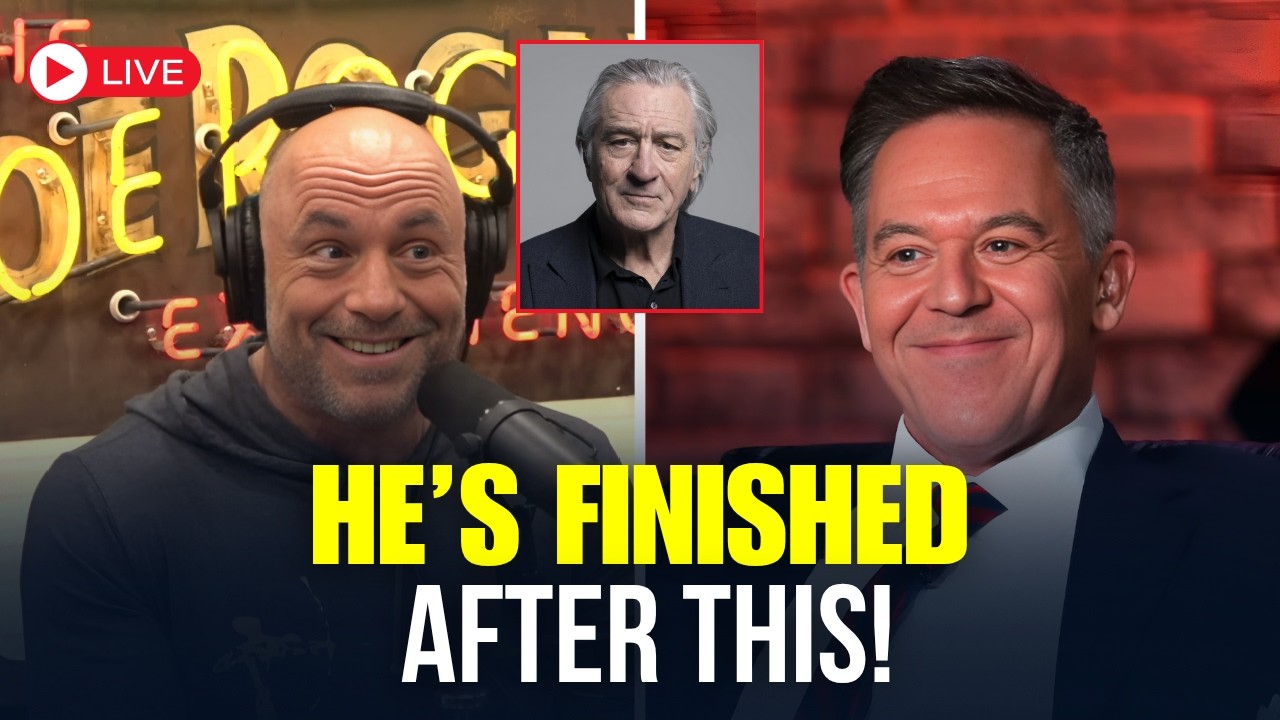
The modern political landscape has become a strange theater where the line between serious statesmanship and low-budget performance art is increasingly difficult to distinguish. Recently, this bizarre stage saw one of its most peculiar acts yet: a verbal demolition of Hollywood legend Robert De Niro by media powerhouses Joe Rogan and Greg Gutfeld. What started as a commentary on a celebrity’s political outbursts quickly descended into a no-holds-barred roasting session that left the “Taxi Driver” star looking less like a cinematic heavyweight and more like a caricature of his own making.
For decades, Robert De Niro was the embodiment of grit and gravitas. With a mere squint or a cold, silent stare, he could command the attention of an entire audience. He was the quintessential New York tough guy—the man who didn’t need a thousand words to tell you exactly how he felt. Yet, in recent years, that brooding silence has been replaced by a deafening, espresso-fueled roar of political grievance. It is a transition that has baffled fans and provided an endless supply of material for critics like Rogan and Gutfeld, who view his recent behavior as a sad decline into performative absurdity.
The takedown initiated by Rogan and Gutfeld was not rooted in complex political theory, but in the sheer, unvarnished observation of a legend who seems to have lost his way. Rogan, a man known for his skepticism toward the “Hollywood bubble,” expressed a sentiment shared by many: a heartbreak for the actor’s fall from grace. He noted that while he loves De Niro’s classic mob movies, the current version of the actor—a man who stands on street corners shouting at political opponents—is a jarring departure from the artist who once held the world in his palm. The consensus from the duo was simple and brutally direct: it is time for the microphone to be taken away.
Gutfeld, with his trademark sardonic wit, took the critique a step further, positioning De Niro as the “honorary president of Hollywood’s Midlife Meltdown Society.” He argued that the actor has become trapped in a feedback loop of performative outrage, where he believes every opinion he holds is more important than anyone else’s. Gutfeld’s analysis suggested that De Niro is now “auditioning for the title of the most self-important man in America,” yet the theater is empty, and the audience has grown tired of the act. The irony, they pointed out, is that in his desperate attempt to be a moral compass, De Niro has instead become a walking, talking meme.
The discussion also touched upon the growing disconnect between Hollywood’s elite and the reality of the average person. Rogan pointed out that the public is increasingly gravitating toward “real” people—even those they may disagree with—because they can feel the authenticity. In contrast, De Niro’s political performances feel manufactured and scripted, even when they aren’t. They are the rants of a man who has lived so long in an echo chamber of industry sycophants that he has lost his grip on how he is perceived by the rest of the world. It is the classic “Hollywood bubble” scenario, where one’s own echo is mistaken for a roar of approval.
What makes this roast particularly biting is the contrast between who De Niro once was and who he appears to be now. In his prime, he disappeared into characters with a terrifying, calculated intensity. Now, that same intensity is directed at political opponents with a confusing, half-coherent frustration that often leaves onlookers wondering if he remembers his own talking points. The duo highlighted the surreal nature of watching a man who built a fortune portraying dangerous, morally ambiguous characters suddenly scolding the nation about ethics and integrity. It is an irony that borders on performance art, the kind that might be profound if it weren’t so unintentionally hilarious.
The duo didn’t need to dig deep to find the flaws in De Niro’s political crusade. The footage of the actor shouting at bystanders or delivering erratic speeches at trials provides all the fuel they needed. Rogan’s reaction—often just a raised eyebrow of disbelief or a deadpan question about what, exactly, the actor is angry about—was far more devastating than any scripted monologue. It underscored the point that De Niro is no longer debating ideas; he is merely yelling at the wind.
Furthermore, they analyzed the “lifestyle” of the modern political resistor, noting that for some, opposing a political figure has become a personality trait rather than a measured ideological stance. De Niro, they argued, has fully committed to this lifestyle. He is a man who seems to believe that he is a revolutionary hero in his own personal movie, while the rest of the world sees him as a cranky retiree who has taken his method acting into the wrong arena.
The tragedy in all of this is the loss of the artist. As Rogan lamented, every time De Niro opens his mouth to spout political vitriol, it becomes harder to go back and enjoy the cinematic masterpieces that defined his career. The actor has become a cautionary tale of what happens when fame ages like milk and wisdom is swapped for sheer volume. He has allowed himself to become a pawn in a game of cultural relevancy, chasing likes and media attention at the expense of his dignity.
As the dust settles on this verbal thrashing, the overarching message from Rogan and Gutfeld is a call for a return to normalcy. They are essentially telling a legend to “shut up and act,” a sentiment that resonates with a public tired of being lectured by the ultra-wealthy. Whether De Niro will heed this advice is doubtful. He seems far too invested in his current role—the lead in his own real-life tragedy, playing to an audience that is increasingly checking their watches.
Ultimately, the clash serves as a grim reminder that fame does not confer intelligence, and an Oscar does not make one a political strategist. Robert De Niro’s descent into the world of performative outrage is not just a personal embarrassment; it is a symptom of a larger issue in our culture, where even the most talented individuals can lose themselves to the allure of their own self-importance. In the end, Rogan and Gutfeld did more than just roast an actor; they held up a mirror to a phenomenon that has become all too common in our media-saturated age. And what they revealed is not a hero fighting for justice, but a man who has lost his way, desperately grasping for a relevance that he left behind years ago.