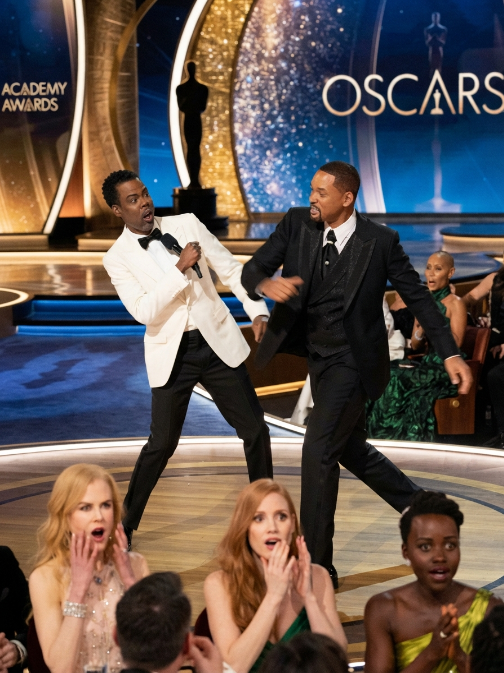
Will Smith’s Oscars Slap: The Shocking Moment That Sparked One of Hollywood’s Biggest Debates
The room did not gasp at first.
That was the strange part.
A thousand people sat inside the Dolby Theatre under chandeliers and spotlights, wrapped in silk, diamonds, tuxedos, borrowed confidence, and decades of ambition. Outside, Los Angeles glittered like it always did on Oscar night, pretending there was no traffic, no insecurity, no unpaid rent, no lonely people watching from studio apartments with microwaved dinners on their laps. Inside, Hollywood was doing what Hollywood does best: selling a dream so polished you could see your own reflection in it.
Then one man walked onto the stage.
At first, some people laughed because they thought it was a bit. In Hollywood, everything could be a bit. Anger could be a bit. Tears could be a bit. Even pain, if timed right, could get applause.
But this was not a bit.
The slap cracked across the room like someone had split the night open with a hammer.
For one second, Chris Rock’s face held a look that nobody watching at home would forget. Not because it was dramatic. Not because it was exaggerated. Because it was real. His mouth parted. His body stayed upright. His eyes blinked once, twice, as if his brain had to ask his skin what had just happened.
Will Smith turned around and walked back to his seat.
And the world changed seats with him.
Nobody knew what to do. That was what scared me most. Not the slap itself, though that was shocking enough. Not the silence that followed, thick and hot and impossible to breathe through. It was the hesitation. The frozen hands. The half-smiles dying on famous faces. The producers whispering into headsets. The audience looking around to see what reaction had been approved.
Because in that room, people knew how to handle tragedy when it came with a script. They knew how to handle scandal when it came through a publicist. They knew how to handle tears when a camera was already waiting.
But a man losing control in the middle of Hollywood’s holiest ceremony?
No one had a line for that.
I was standing near the back of the theater, close enough to hear the audience breathing, far enough to feel invisible. My job that night was small. I was an assistant floor coordinator, one of the people who ran messages between people more important than me. I carried a clipboard, a headset, extra envelopes, and the quiet desperation of a twenty-seven-year-old who still believed one perfect night could open a door.
I had spent three years in Los Angeles learning that dreams come with badges around their necks. Mine said STAFF.
I remember my fingers tightening around the clipboard after the slap. The paper bent. My headset crackled.
“Is this real?” someone said.
No one answered.
Onstage, Chris tried to keep the show alive. He made a small joke, the kind a man makes when he is standing in front of millions and cannot afford to fall apart. It was professional. It was painful. It was almost heroic in that uncomfortable way nobody wants to be heroic.
Then Will shouted from his seat.
The words hit harder than the slap because they killed the last bit of doubt. This was not planned. This was not comedy. This was not some edgy award-show stunt cooked up by producers desperate for ratings.
This was rage.
Raw, public, shaking rage.
And sitting beside him was Jada Pinkett Smith, silent beneath the lights, her expression impossible to read from where I stood. People would spend months reading it anyway. They would zoom in, pause frames, argue over her face like it was evidence in a trial none of them had been asked to join.
That is what fame does. It turns human reactions into property.
I looked down at my shoes because looking at the stage suddenly felt rude. That sounds ridiculous, I know. Millions of people were watching from home. The cameras were still rolling. But inside that theater, for a few seconds, it felt like we had walked into someone’s private living room during the worst argument of their marriage.
Except the living room had a global broadcast deal.
The rest of the ceremony moved forward because the Oscars always move forward. Awards shows are built on the belief that nothing—not death, not scandal, not war, not humiliation—should stop the next category. Cue the music. Bring out the presenters. Smile. Cut to camera two.
But the mood never recovered.
It shifted into something cold and electric. Every laugh after that sounded nervous. Every speech floated over a floor that had cracked beneath us. People clapped, but you could hear the question behind the applause.
What just happened?
By the time Will Smith won Best Actor later that night, the whole room had become two rooms. One room saw a man who had carried a lifetime of pressure, pain, love, pride, and public expectation until something inside him snapped. The other room saw a man who had assaulted another man on live television and was still being allowed to receive the highest honor in the business.
Both rooms existed at once.
That was the beginning of the debate.
Not the slap. The split.
Hollywood loves a simple story. Hero. Villain. Redemption. Fall from grace. Comeback. Betrayal. Forgiveness. But that night refused to stay simple. It became about masculinity, marriage, comedy, race, respect, trauma, ego, power, and the strange American habit of turning every public mistake into a national morality exam.
And I was there, holding a bent clipboard, watching the most glamorous room in the world become just another room full of people who did not know what to say.
A year earlier, I would have thought being inside the Oscars meant I had finally made it close to the magic.
That night, I learned magic has a backstage.
And backstage, everyone panics.
By the time the show ended, nobody rushed to leave the way they normally did.
Usually, after the final award, the theater breaks into organized chaos. Winners clutch statues. Publicists appear out of nowhere like emergency surgeons. Assistants gather trains of dresses. Security moves bodies toward exits. Journalists prepare questions that sound spontaneous but have been sharpened for hours.
That night, people lingered.
They hugged a little too tightly. They spoke in low voices. Some stared at their phones, watching the moment replayed from angles they had just seen in person. It is a strange feeling to witness something real and then immediately watch it become content. Reality, once uploaded, stops belonging to the people in the room.
My supervisor, Denise, found me near the aisle.
“You okay?” she asked.
Denise was fifty-two, from Chicago, and had the kind of calm that comes only from having survived worse rooms than Hollywood. She had worked live events for twenty-five years. Presidential fundraisers. Sports ceremonies. Charity galas where billionaires cried on cue. Nothing impressed her. Almost nothing startled her.
But that night, her jaw was tight.
“I don’t know,” I said.
“That’s honest.”
“Were we supposed to do something?”
She looked toward the stage, where crews were already moving with forced efficiency. “Everybody’s going to ask that.”
“Do you know the answer?”
“No,” she said. “And anybody who says they do tonight is lying.”
That was Denise. She believed truth should be served black, no sugar.
We walked toward the side corridor, where the air smelled like perfume, sweat, and expensive flowers. People were talking everywhere. Not loudly. That was another thing I noticed. The shock had made everyone quieter. Even the powerful people looked smaller with phones in their hands.
A young actor I recognized from a streaming drama stood by the wall saying, “He was defending his wife.” A few feet away, an older producer snapped back, “You don’t defend anyone by hitting a comedian onstage.”
Both sounded certain. Both sounded afraid of being wrong.
Near the lobby, I saw a woman in a gold dress crying while her date whispered, “Don’t say anything online tonight. Nothing.” That was good advice. Nobody took it.
Outside, the internet had already become a wildfire.
Clips spread before the ceremony was over. People who had missed the live broadcast saw the slap before they saw the winners. By midnight, everyone had an opinion. By morning, everyone had a theory. By the end of the week, people who had never watched an Oscar ceremony in their lives were speaking about “the sanctity of the Academy” like they had personally built the Dolby Theatre brick by brick.
My phone buzzed until it felt alive.
Friends from high school texted me.
Were you there???
Did it sound real???
Was Will crying???
Was Chris mad backstage???
People wanted the inside story. That is what people always want when something public becomes shocking. They want a hidden version that explains everything. They want a secret hallway, a whispered confession, a villain caught without makeup.
But the truth was uglier and less satisfying.
There was no neat answer.
There was just a moment. A very human, very public, very damaging moment. And then the machinery of fame trying to grind it into meaning.
I went home at 3:17 in the morning.
My apartment in Koreatown was small enough that my refrigerator hummed like a roommate. I kicked off my heels by the door, peeled off the black blazer I wore to disappear into professional backgrounds, and sat on the floor because the couch had laundry on it. My television was still on from earlier, muted, showing replay after replay.
The slap looked different on television.
Cleaner. Smaller. Almost unreal.
In the theater, the sound had lived in my chest. On TV, it became a clip. A meme. A loop. Something people could caption.
That bothered me more than I expected.
I opened social media and immediately regretted it.
One person wrote: “That’s what love looks like.”
Another wrote: “That’s what abuse of power looks like.”
A comedian said every comic should be scared now.
A relationship blogger said men had forgotten how to protect women.
A retired athlete said if someone insulted his wife, he would do the same.
A schoolteacher replied that if one of her students did it in class, he would be suspended before lunch.
Under every post, strangers fought like the slap had landed on them personally.
Maybe it had, in some way.
That is the thing about moments like that. People do not react only to what happened. They react to every memory the moment wakes up.
People who had been mocked saw themselves in Jada.
People who had been hit saw themselves in Chris.
People who had swallowed humiliation to protect a family saw themselves in Will.
People who had watched powerful men escape consequences saw something else entirely.
The debate was never just about one hand crossing one face. It was about what people believed respect should cost.
I did not sleep that night.
At sunrise, my mother called from Arizona.
My mother never watched the Oscars unless someone from her church group told her a dress was inappropriate. She did not care about Hollywood. She thought most actors needed “a regular job and a casserole.” But she had seen the clip on the morning news.
“Were you there?” she asked.
“Yes.”
“My God.”
“I know.”
There was a pause.
Then she said, “I don’t like what he did.”
I rubbed my eyes. “Most people don’t.”
“But I understand the feeling.”
That surprised me.
My mother had raised two daughters after my father left when I was twelve. She had worked double shifts at a hospital cafeteria and still made it to parent-teacher conferences smelling like fryer oil and lemon soap. She was not dramatic. She did not excuse foolishness. If anything, she believed too much emotion was like too much salt. It ruined the dish.
“What do you mean?” I asked.
“You ever been so tired of watching someone you love get hurt that you act before your brain catches up?”
I did not answer.
She continued, softer now. “That doesn’t make it right. But I know that kind of tired.”
That sentence stayed with me.
That kind of tired.
It became the quiet center of how I thought about the slap. Not an excuse. Never an excuse. But a window.
I had seen men lose control before. Not famous men. Regular men. An uncle at Thanksgiving who punched a wall because nobody respected him. A neighbor who screamed at his son for crying. A boyfriend in college who once threw my phone onto a bed, then looked shocked that his own hand had done it.
In America, we teach boys two conflicting lessons. We tell them to control themselves, then we tell them a real man does not let disrespect slide. We tell them violence is wrong, then sell them a thousand movies where the hero proves love by breaking someone’s jaw. We tell them to talk about their feelings, then laugh when they do.
So when Will Smith walked onstage, part of the country saw failure. Part of the country saw training.
That is not comfortable to admit.
But it felt true.
The next morning, Denise called an emergency staff meeting over video. Everyone looked exhausted. One intern joined from bed and forgot to turn off her camera until Denise gently said, “Baby, your pillow is famous now.”
Nobody laughed much.
The official instruction was simple: do not speak publicly. Do not post. Do not confirm details. Do not speculate. Refer all questions to communications.
That is what organizations say when they are terrified and hoping language can build a fence around chaos.
After the meeting, I had fourteen unread messages from friends in the industry.
One was from my friend Caleb, a comedy writer who had spent years performing in clubs where the ceiling leaked and the audience sometimes included three drunk nurses and a man asleep in the front row.
His text said: “Call me. I’m furious.”
So I did.
He answered on the first ring. “You saw it?”
“Yes.”
“Tell me it looked fake in the room.”
“It didn’t.”
He cursed.
Caleb was usually funny even when he was angry. That morning, he was not funny.
“People don’t understand,” he said. “A stage is supposed to be sacred.”
“The Oscars stage?”
“Any stage. A club stage. A church stage. A middle school cafeteria with a broken mic. You don’t walk up and hit the performer because you don’t like a joke.”
“I get that.”
“No, people say they get it, but they don’t. Every comic has bombed. Every comic has crossed a line or stepped near one. You deal with it after. You don’t make the stage unsafe.”
His voice cracked on the last word.
That told me this was not just about Chris Rock.
Caleb had been heckled, threatened, once followed to his car after a set in Long Beach because a man thought a joke about divorce was aimed at him. Caleb never talked about it unless he was drunk.
“You okay?” I asked.
“I’m tired of people calling it protection.”
There it was again. Tired.
“What would you call it?”
“A rich man losing control and everyone being too stunned to stop him.”
I did not argue.
A few hours later, my sister Bri called during her lunch break. She worked as a domestic violence advocate in Phoenix and had the kind of job that changed how she heard every argument.
“I’m not saying this is the same as what my clients go through,” she said before I could even say hello. “But I hate how fast people romanticized it.”
“I know.”
“No, Maya, I really hate it. The ‘that’s love’ stuff. The ‘stand up for your woman’ stuff. It scares me.”
“Because of the violence?”
“Because of the applause around the violence.”
I went quiet.
Bri sighed. “A man can defend a woman without making her the reason he hit somebody.”
That sentence hit me harder than half the think pieces I read later.
A man can defend a woman without making her the reason he hit somebody.
By noon, my brain felt like a crowded courtroom.
Caleb was right. Bri was right. My mother was right, too, in a different way. The internet was mostly wrong because it insisted on choosing only one truth.
But real life rarely offers one.
That was the problem with the slap. It was too easy to simplify and too complicated to ignore.
For the next week, Los Angeles talked about nothing else.
At coffee shops, people whispered as if Will Smith might be hiding behind the oat milk. At gyms, men on treadmills debated whether Chris should have swung back. On podcasts, hosts discovered the phrase “toxic masculinity” like it had been buried in their backyard. Comedians announced they would never perform award shows again, then booked panels to talk about why.
Everywhere, the slap became a mirror.
The Academy released statements. Representatives released statements. People apologized. People criticized the apologies. People apologized for criticizing the apologies. Someone always had one more angle, one more hot take, one more brave truth that sounded suspiciously like a brand strategy.
I was assigned to help organize internal notes for a post-event review. That meant sitting in a conference room with people who used phrases like “security posture” and “crisis optics” while avoiding the simplest words.
Hit.
Shock.
Fear.
Failure.
There were timelines. Who knew what and when. Who made which call. Why no one removed him immediately. Whether removing him would have caused more chaos. Whether the live broadcast delay was enough. Whether future ceremonies needed new protocols for “unexpected stage contact,” which was the most bloodless phrase I had ever heard for a slap.
Denise sat beside me through those meetings with a legal pad and the face of a woman losing patience professionally.
During one break, she leaned over and whispered, “You notice nobody wants to say everybody froze?”
I nodded.
“That’s the truth. Everybody froze.”
“Can they say that?”
“They should. They won’t.”
She was right.
Institutions hate admitting they are made of humans. Humans freeze. Institutions prefer to “evaluate response procedures.”
Meanwhile, the public debate grew sharper.
Some people insisted the joke about Jada’s shaved head crossed a line because her hair loss had been discussed publicly before. Others argued comedians cannot be expected to know every personal sensitivity, especially in a room full of celebrities whose lives are treated as open material. Some pointed out that Black women’s hair carries cultural weight that outsiders often underestimate. Others responded that none of that justified violence.
The argument kept turning because every side had something real inside it.
I thought about hair more than I expected.
That may sound strange, but I did. I thought about how often women’s bodies become public conversation, especially women in famous marriages. I thought about the time a producer told a Black actress I worked with that her natural hair made her look “less universal.” He said it like he was discussing lighting, not identity. She smiled through it, then cried in the bathroom.
I had stood outside that bathroom door, holding tissues and feeling useless.
That was one of those real-life situations that changes your opinion before you even know it has changed. Until you see someone trying to stay professional while being quietly humiliated, you do not understand how many small cuts people are expected to absorb with grace.
So yes, I understood why a joke about a woman’s appearance could hurt.
I also understood that hurt is not a permission slip.
That tension made people angry because Americans love certainty. Certainty is easier to sell. Certainty gets cleaner headlines.
But human beings are messy. Fame makes them messier. Marriage makes them exposed. Comedy makes pain public. And live television gives nobody time to become their best self.
One afternoon, about ten days after the Oscars, I met Caleb at a taco truck in Silver Lake. He was wearing sunglasses even though the sky was gray.
“You look like a divorced detective,” I said.
“I feel like one.”
We ordered carne asada tacos and stood by a metal table sticky with salsa.
“Have you changed your mind?” he asked.
“About what?”
“About the slap.”
“I didn’t have one clean mind to change.”
He snorted. “That sounds like something a person says before disappointing everyone.”
“Probably.”
He took a bite, chewed angrily, then said, “I know people are bringing in race, marriage, hair, all of it. I’m not saying those things don’t matter.”
“They do.”
“I know. But the stage thing matters, too. That’s my home. A stage is where someone who usually has no power gets a microphone. If powerful people can walk up and hit you because they don’t like what you said, that changes the deal.”
That was Caleb’s center. Safety. Not celebrity safety. Performer safety.
“I hear you,” I said.
“But?”
“But I also think some people are pretending the joke happened in a vacuum.”
He looked at me. “It was a joke.”
“I know.”
“Bad joke, maybe. Lazy joke, sure. But a joke.”
“Yes.”
“So?”
“So people hear jokes through history. Through personal pain. Through whatever they dragged into the room that night.”
Caleb looked away.
The truck generator hummed behind us.
Finally he said, “You sound like your sister.”
“My sister is usually right.”
“I hate that for me.”
We smiled a little. It was the first time the conversation felt breathable.
Then Caleb said, “Can two things be true?”
“That’s what I keep thinking.”
“That the joke hurt, and the slap was wrong?”
“Yes.”
“That Will might have been in pain, and still caused harm?”
“Yes.”
“That people can love him and still think he deserved consequences?”
“Yes.”
Caleb leaned against the table. “Then why is everybody acting like picking one side is a citizenship test?”
Because outrage gives people belonging, I thought.
Because nuance does not trend.
Because saying “this is complicated” makes people think you are weak, when sometimes it is the only honest thing left.
Instead, I said, “Because the internet is a terrible place to have a human moment.”
Caleb raised his taco. “Amen.”
About a month later, I visited my mother in Arizona.
She lived in a beige house with a lemon tree in the yard and a porch swing that creaked like it was keeping secrets. I had gone home partly because I needed sleep and partly because Los Angeles had started to feel like one long group chat I could not leave.
On my second night there, my mother invited her friend Diane over for dinner. Diane was a retired school principal with silver hair, bright lipstick, and the energy of a woman who had broken up hundreds of cafeteria fights without once raising her voice.
We ate baked chicken, rice, and collard greens because my mother believed vegetables did not count unless they had suffered.
Of course, the slap came up.
Diane set down her fork. “I spent thirty-one years telling boys to use their words. Thirty-one. You know how many of them had fathers who told them the opposite at home?”
My mother nodded.
Diane continued, “A boy would get suspended for hitting someone, and then his daddy would come in mad because his son didn’t hit hard enough. Said we were making boys soft.”
I thought about that.
Diane looked at me. “Hollywood didn’t invent that slap, baby. It just put it in better lighting.”
That was the most accurate thing anyone had said.
She told us about a seventh-grade boy named Marcus who punched another student for making fun of his mother’s weight. Marcus was not a bad kid, Diane said. He was funny, smart, protective of his little sister. But when Diane asked why he hit the boy, Marcus said, “Because if I don’t, people think I’m weak.”
Diane had asked, “And what do they think now?”
Marcus had cried.
“That,” Diane said, pointing her fork at me, “is what people don’t understand. Shame is gasoline.”
Shame is gasoline.
Will Smith was not a seventh-grade boy, of course. He was a grown man, a global star, wealthy, powerful, beloved by millions. Consequences are different when you have choices other people can only dream of. But Diane’s point was not about excusing him. It was about recognizing the fire.
Men are often taught to treat embarrassment like a threat. For some, public humiliation feels like death. Add love, pride, history, cameras, jokes, unresolved pain, and a room full of people laughing, and suddenly the body reacts before wisdom can get its coat on.
Still, the aftermath matters.
That was another thing Diane said.
“What you do after you hurt someone tells me more than what you say when everyone is watching.”
I carried that back to Los Angeles.
By then, the official consequences were unfolding. Membership decisions. Bans. Statements. Apologies. The machine had found its language. The public had found new things to fight about, though the slap still surfaced daily like a bruise someone could not stop pressing.
I kept thinking about consequences.
In ordinary life, consequences are usually immediate and practical. You hit someone at work, you may lose your job. You hit someone at a bar, you may face police. You hit someone in school, you may be suspended. But fame bends consequence. It delays it, negotiates it, packages it, sometimes monetizes it.
That is why people were so angry when Will Smith gave his acceptance speech later that night. It was not just that he won. It was that the ceremony continued around him, as if the room was still deciding whether the laws of normal human behavior applied.
I understood that anger.
I also remember the room during his speech. It was not simple applause. It was confusion. Compassion. Shock. Loyalty. Discomfort. Some people stood because others stood. Some stayed seated because they could not stand. Some cried. Some looked trapped inside the moment, unsure whether they were witnessing accountability, denial, collapse, or history.
At home, viewers saw hypocrisy.
Inside, it felt more like a car accident where everybody stepped out dazed and started directing traffic.
This is not a defense. It is a description.
And sometimes description is necessary because judgment without description turns people into cartoons.
Will Smith had built a career on charm. That mattered. America had known his smile for decades. People watched him grow from a rapper with playful swagger to a sitcom prince to a movie star who could carry summer blockbusters on his back. He had been funny, accessible, polished. He had made people feel like they knew him.
That is why the slap felt personal to so many viewers. It broke a contract they did not realize they had signed.
The contract said: You are the good guy.
But no human being can be the good guy all the time. Fame just makes the fall more public when the mask cracks.
I thought about Chris Rock, too.
It bothered me that so much conversation turned him into a symbol instead of a person. He became “the comedian,” “the victim,” “the professional,” “the man who took it.” But what does it mean to be hit in front of millions and then have the world debate whether you deserved it? How do you process embarrassment when everyone has replayed your face? How do you make sense of pain when strangers keep assigning it a political meaning?
I did not know him. I do not pretend to know what he felt. But I know what humiliation does. It echoes. It shows up later, when the room is quiet.
There is a cruelty in public analysis. Even sympathetic people dissect you.
That realization made me delete three drafts of a personal essay I had been writing about the night. Every version felt too confident. Too clean. Too eager to make meaning out of other people’s wounds.
Then Denise called.
“You still thinking about quitting?” she asked.
I had not told her that directly, which meant she had seen it on my face.
“Maybe.”
“Don’t quit because Hollywood is ugly.”
“Isn’t that a decent reason?”
“No. Quit if you don’t love the work. Quit if you find better work. Don’t quit because you discovered famous people are people.”
I laughed. “That sounds like a fortune cookie written by a bitter stage manager.”
“I contain multitudes.”
Denise invited me to coffee the next morning.
We met at a place near Studio City where every table had at least one person pretending not to read a screenplay. Denise ordered black coffee. I ordered something with cinnamon and shame.
She looked at me over her cup. “Tell me what’s really bothering you.”
I shrugged. “I think I wanted Hollywood to be better than regular life.”
“Ah.”
“That sounds stupid.”
“It sounds young.”
“Thanks.”
“I don’t mean it as an insult. Everybody comes here thinking the lights mean something. Then they find out people under lights are still people. Sometimes worse.”
I stirred my coffee. “Do you think the industry learned anything?”
Denise smiled without humor. “Industries don’t learn. People learn. Then systems decide whether to punish them for it.”
That was Denise’s worldview in one sentence.
She told me about a singer in the nineties who threw a microphone backstage and nearly hit a wardrobe assistant. The official story called it “technical frustration.” She told me about a director who screamed at a teenage actor until the boy threw up. People called him a genius. She told me about a producer who once told her not to report a drunk star’s behavior because “the show needs him charming.”
“Hollywood has always forgiven temper when temper made money,” she said. “The slap was different because the audience saw it before anyone could rename it.”
That, too, felt true.
The slap had escaped the machine.
Before publicists could soften it, before lawyers could frame it, before friends could explain it, before think pieces could categorize it, millions of people saw the raw thing. A man walked up. A hand moved. Another man absorbed it. Then came the shout.
No edit.
No filter.
No tasteful statement.
That is why it haunted people. It was not supposed to happen in a room built for illusion.
Months passed.
The debate faded, then returned whenever an award show aired, whenever a comedian made a joke about boundaries, whenever Will Smith released a statement, whenever Chris Rock spoke publicly, whenever someone online needed a familiar battlefield.
By fall, I was working on another live event, smaller than the Oscars but still fancy enough to make everyone anxious. Before the show, security briefed us on stage access. New rules. Clearer procedures. Faster intervention. Everyone pretended this was normal, but the reason sat in the room like an uninvited guest.
After the briefing, a young intern named Leo asked me, “Were you really there?”
I said yes.
“What was it like?”
I almost gave him the easy answer. Surreal. Shocking. Crazy.
Instead, I said, “It felt like watching adults realize there was no adult in charge.”
Leo frowned.
“That’s terrifying.”
“It was.”
“Do you think it could happen again?”
I looked toward the empty stage, where tape marks waited for people who would soon smile under lights.
“Something always happens again,” I said. “Maybe not the same way. But live events are live because nobody fully controls them.”
That is the truth people forget.
We worship control. Especially in entertainment. Every camera angle planned. Every presenter rehearsed. Every joke loaded onto a teleprompter. Every dress fitted. Every reaction shot anticipated. But human emotion is the one guest who never follows seating instructions.
The question is not whether people will break script.
They will.
The question is what we build around that knowledge.
Later that night, during the event, a presenter stumbled over a nominee’s name. The audience laughed gently. The presenter blushed, recovered, and moved on. Nothing dramatic happened. No one slapped anyone. No headlines followed.
But I watched the room differently.
I noticed the tiny humiliations people swallow to keep a night smooth. The actress whose joke fell flat and who smiled anyway. The producer who lost an award and clapped while his jaw tightened. The singer who received mild applause and bowed like it was thunder. The host who read the room every three seconds, adjusting tone like a pilot correcting altitude.
Professionalism is not the absence of feeling. It is the decision not to make every feeling everyone else’s emergency.
That may be the lesson I kept returning to.
Not the only lesson. Maybe not even the biggest. But one that felt practical.
We are all humiliated sometimes. We are misunderstood. Mocked. Dismissed. Put on the spot. Made smaller in rooms where we wanted to feel respected. And in those moments, the body offers old tools. Strike back. Shout. Walk out. Burn it down. Prove they cannot do that to you.
Sometimes walking away feels like losing.
But maybe walking away is not weakness. Maybe it is one of the hardest forms of power because nobody applauds it in the moment. There is no dramatic soundtrack for self-control. No slow-motion hero shot for the man who takes a breath. No viral clip for the woman who says, “We’ll discuss this later,” and keeps her dignity intact.
Violence is cinematic. Restraint is usually quiet.
That is why we undervalue it.
I started thinking about my father around then.
I had not seen him in years. He left when I was twelve, came back twice with apologies that sounded borrowed, then disappeared into a new family in Nevada. When I was little, I thought he was the loudest person in the world. He never hit my mother, not that I saw, but he hit walls, slammed cabinets, broke plates, cursed at bills like they had insulted his bloodline. When he was ashamed, the whole house had to know.
For years, I thought anger meant strength because it took up space.
My mother taught me otherwise.
Her strength looked like staying calm at the bank when the account was wrong. It looked like telling my father, “Lower your voice,” even when her hands trembled. It looked like working until her feet swelled, then asking if we had homework. It looked boring from the outside. It saved us anyway.
After the Oscars, I realized how much American culture still mistakes volume for courage.
The loudest man in the room is not always the bravest. Sometimes he is just the man most afraid of silence.
That opinion is personal. I know it is. It comes from my house, my memories, my mother’s porch, Diane’s stories about seventh-grade boys, Caleb’s fear for the stage, Bri’s warning about romanticized violence. I do not pretend to be neutral. Nobody truly is.
But I believe this: dignity cannot depend on somebody else’s humiliation.
The slap humiliated everyone involved in different ways. It humiliated Chris Rock because he was struck while working. It humiliated Will Smith because a lifetime of achievement became attached to one uncontrolled moment. It humiliated the Academy because its grand ceremony looked suddenly fragile. It humiliated viewers who had celebrated Hollywood glamour and then found themselves watching a family wound explode in public.
And it humiliated the culture because we did not know how to talk about it without becoming cruel.
We made jokes. Of course we did. Humor is how people digest shock. Some jokes were sharp. Some were lazy. Some were mean in the way online humor often is when people forget there are human beings underneath the trending topic.
We debated punishment like we were judges. We debated marriage like we were invited into theirs. We debated Black masculinity, Black womanhood, respectability, comedy, violence, trauma, celebrity privilege, and whether anyone was allowed to be complicated after causing harm.
In all that noise, one thing became clear to me.
America does not know what it wants from fallen heroes.
We say we want accountability, but we often confuse it with permanent exile. We say we believe in redemption, but only if the apology sounds exactly right and arrives before our patience runs out. We say everyone makes mistakes, then act shocked when someone we admire makes one in public.
The slap forced people to ask whether one terrible moment should define a person.
That question made everyone uncomfortable because the honest answer is: sometimes it does, but maybe it should not be the only thing.
Accountability matters. Without it, power becomes dangerous. But accountability that leaves no path forward is not justice. It is just punishment with better vocabulary.
I thought Will Smith needed consequences. I still do. I also thought he deserved the possibility of growth. Those are not opposites.
Chris Rock deserved safety, respect, and the space to respond in his own time. Jada deserved not to be reduced to a reaction shot or a motive. The audience deserved clarity. The industry deserved scrutiny.
And the rest of us deserved a better conversation than “Was he right or wrong?”
He was wrong.
That should have been the beginning of the conversation, not the end.
One year after the slap, I found myself back near the Dolby Theatre.
Not inside this time. I was meeting a friend for dinner a few blocks away, and the sidewalks were already showing signs of another award season. Barricades. Lighting rigs. Tourists taking pictures of places they recognized from television. Hollywood Boulevard smelled like hot dogs, car exhaust, and ambition.
I stopped across the street and looked at the theater.
From outside, it seemed harmless. Just a building with columns and stairs and tourists posing badly. You would never know how much pressure that place could hold. You would never know how many people had walked in hoping to be immortal and walked out as punchlines, winners, legends, ghosts.
My friend was late, so I stood there longer than I meant to.
A street performer dressed as Spider-Man argued with a man dressed as Batman over twenty dollars. A family from Ohio asked someone where the stars on the sidewalk started. A woman in platform heels took selfies under a giant billboard. Life moved on with no respect for symbolism.
I appreciated that.
Life should move on.
But moving on is not the same as forgetting.
A young couple beside me was talking about the slap. The man said, “I still can’t believe that happened.” The woman said, “I can. People snap every day. He just did it on TV.”
I almost turned to look at her.
She was right.
People snap every day. In kitchens. Offices. Parking lots. Classrooms. Group chats. Marriages. Boardrooms. Churches. Family reunions. Most of them do not become global debates because no camera catches the exact second pride defeats judgment.
That is why the slap mattered beyond celebrity gossip.
It showed a private human failure in a public sacred space. It made people ask what they would do. It made people lie about what they would do. It made people remember what had been done to them. It made people defend things they had not fully examined.
It made people talk.
Not always well. But talk.
My friend arrived, breathless and apologetic. Her name was Nora, and she worked in documentary production, which meant she could turn any dinner into a moral investigation.
We ate at a crowded restaurant with small tables and loud music. Halfway through the meal, she asked, “Do you think people are bored with the slap now?”
“People are bored with everything until it becomes useful again.”
“That’s bleak.”
“That’s Hollywood.”
She laughed. “Fair.”
Then she said, “I’m producing a series about public apologies.”
“Of course you are.”
“We’re talking about the slap in one episode.”
I groaned.
“I know, I know. But not in the cheap way. We’re asking what an apology is supposed to do when harm is public.”
That interested me despite myself.
“What do you think?” she asked.
I dipped a fry into ketchup and thought about it.
“I think public apologies are usually written for three audiences at once,” I said. “The person harmed, the institution affected, and the crowd demanding a performance of remorse.”
Nora pointed at me. “That’s good.”
“Don’t steal it.”
“I’m absolutely stealing it.”
I smiled.
Then I added, “The problem is those audiences don’t need the same thing.”
Chris Rock might have needed something private, something honest, something not shaped by public pressure. The Academy needed policy and reassurance. The public wanted clarity, emotion, maybe a little shame. Fans wanted their affection repaired. Critics wanted proof that power had limits.
No apology can satisfy all of that.
Especially when the internet treats remorse like a video audition.
Nora asked, “So what makes an apology real?”
I thought of my father again. The apologies that came too late. The ones that explained more than they repaired. The ones that wanted forgiveness without change.
“Change,” I said. “Not poetry. Not tears. Change.”
That is not a glamorous answer. It does not fit well on a Notes app screenshot. But it is the only one I trust.
An apology is a door. Change is walking through it.
The night after dinner, I went home and watched Will Smith’s acceptance speech again. I had avoided it for months. It was harder to watch than the slap in some ways. The slap was sudden. The speech was aftermath happening before anyone had processed the event.
I watched his face. The tears. The references to protecting people. The attempt to connect the role he had played with the man he wanted to be. The room applauding, uneasy and moved and confused.
I did not feel the same anger some people felt.
I felt sadness.
Not pity. Sadness.
There is a difference.
Pity looks down. Sadness sits beside.
I felt sad that a man reached what should have been one of the greatest moments of his life and carried into it the shadow of something he had just done. I felt sad for Chris Rock having to stand there and absorb shock like part of the job. I felt sad for Jada, whose name became a battlefield. I felt sad for everyone who saw their own pain in it and then had to watch strangers mock the wound.
And I felt sad for us, the audience, because we are so hungry for heroes and so ruthless when they remind us they are human.
But sadness does not erase responsibility.
That is another lesson adulthood keeps teaching whether we ask for it or not. You can feel compassion for someone and still believe they must answer for what they did. You can understand the roots of a mistake and still name it a mistake. You can love someone and refuse to excuse them.
In fact, maybe that is the only love worth trusting.
Two years after that night, I left live events.
Not because of the slap. Not exactly. Denise was right; you should not quit just because famous people are people. I left because I had finally admitted I wanted to tell stories, not manage the rooms where stories were sold.
I started working with a small production company that made documentary shorts. The pay was worse. The hours were somehow also worse. But I felt closer to something honest.
One of our first projects was about comedy clubs after the pandemic. We followed comics across the country as they rebuilt audiences, dealt with new sensitivities, and argued about what could still be said onstage.
Caleb appeared in one episode.
He hated the camera until he loved it.
During his interview, the director asked him about the slap. I sat behind the monitor, headphones on, pretending to check audio levels while actually holding my breath.
Caleb took a long pause.
“I was angry when it happened,” he said. “I’m still angry, honestly. But anger changes shape if you let it sit long enough.”
The director asked, “What shape did it become?”
Caleb looked toward the empty club stage.
“Fear first. Then grief. Then a question.”
“What question?”
“What kind of culture do comics owe the room, and what kind of culture does the room owe comics?”
That answer stayed in the final cut.
It was one of the best things he had ever said.
Because yes, comedy needs freedom. It needs risk. It needs room to offend sometimes, to stumble, to challenge, to be imperfect. But comedy is also not magic armor. A joke can wound. A stage can be sacred without being above criticism.
Again, two things true.
Our documentary did not solve anything. Documentaries rarely do. But after screenings, people talked in ways that felt better than online fighting. Comics spoke about fear. Audience members spoke about cruelty disguised as humor. One woman said she loved comedy but hated being reduced to a punchline. One older comic admitted he had used “it’s just a joke” as a shield when he did not want to think harder.
That, to me, felt like progress.
Not agreement. Progress.
A good conversation does not always end with everyone on the same side. Sometimes it ends with people understanding the cost of their side more clearly.
Around that time, I visited my mother again. Diane came for dinner, as usual, and we ended up on the porch after sunset. The Arizona sky turned purple, then black. The lemon tree moved softly in the warm wind.
My mother asked if people still talked about the Oscars in Los Angeles.
“Sometimes,” I said.
Diane laughed. “People will be talking about that slap when we’re all dust.”
“She’s probably right,” my mother said.
I leaned back against the porch swing. “Why do you think it lasted so long?”
Diane did not hesitate. “Because everybody thinks respect is important, but nobody agrees what it means.”
That was another fork-point sentence from Diane.
Respect.
That word had been everywhere after the slap. Respect my wife. Respect comedians. Respect the stage. Respect Black women. Respect boundaries. Respect the Academy. Respect the law. Respect pain. Respect free speech. Respect yourself.
But respect means different things depending on who taught it to you.
For some people, respect means never letting an insult pass unanswered. For others, respect means controlling yourself when insulted. For some, respect is public loyalty. For others, it is private honesty. For some, respect means silence in the face of a joke. For others, it means refusing to be the joke.
No wonder we fought.
We were using the same word for different wounds.
My mother sipped iced tea. “I keep thinking about his mama.”
“Will’s?”
“Mmm-hmm. I wonder what it’s like to watch the whole world talk about your child’s worst moment.”
I had never thought of that.
That is what my mother does. She finds the person standing just outside the frame.
“Hard,” I said.
“Very hard.”
She looked at me. “You know, people love to say, ‘I would never.’ But you live long enough, you stop saying that so much.”
“I hope I would never slap someone on television.”
My mother smiled. “Me too. But that’s not the point.”
“What is?”
“The point is humility. You can condemn a thing without pretending you’re made of better clay.”
I looked at the lemon tree.
Better clay.
That was the missing ingredient in so much public judgment. Humility. The knowledge that human beings are capable of ugliness under the right pressure. Not equally. Not excusably. But truly.
Humility does not weaken accountability. It deepens it.
Because if you believe only monsters do harmful things, you will never recognize the harmful thing growing inside yourself until it has already found your hand, your mouth, your silence, your excuse.
The slap became a Hollywood scandal because famous people were involved. But it became a cultural debate because the ingredients were ordinary.
A bad joke.
A wounded spouse.
A protective impulse.
A public room.
A lifetime of image.
A second of rage.
A consequence that could not be edited out.
Most of us will never sit in the front row at the Oscars. But we know those ingredients. Maybe not all at once. Maybe not with cameras rolling. But we know them.
That is why the moment traveled so far.
Years later, when people ask me what I remember most about that night, they expect me to mention the sound.
And yes, I remember the sound.
I remember it too clearly.
But what I remember most is the silence after.
The silence was not empty. It was crowded. It held confusion, fear, calculation, sympathy, disbelief. It held every person in that room suddenly realizing that the script had failed and no one knew what story we were in anymore.
That silence told the truth about Hollywood.
The industry is powerful, but not all-powerful. It can create worlds, but it cannot fully control a human heart. It can light a face perfectly and still not know what is happening behind the eyes. It can reward performances, but it cannot always distinguish performance from pain until pain has already crossed the stage.
I used to think the Oscars were about winning.
Now I think they are about exposure.
Winning exposes desire. Losing exposes character. Live television exposes everything else by accident.
Will Smith’s slap exposed more than anger. It exposed how fragile reputation is, how quickly admiration can turn into interrogation, how hungry the public is for moral clarity, and how poorly we handle complexity when it comes dressed as scandal.
It exposed the limits of charm.
It exposed the danger of making masculinity a performance of force.
It exposed the vulnerability of comedians and the wounds jokes can touch.
It exposed the way institutions freeze, then rewrite freezing as procedure.
It exposed us.
Maybe that is why, even now, people still bring it up. Not because they are obsessed with celebrity gossip, though some are. Not because they care deeply about award-show etiquette, though a few do. But because the slap sits at the intersection of questions America has never answered cleanly.
When does defense become aggression?
When does a joke become cruelty?
When does pain deserve patience, and when does harm demand consequence?
Can a person be more than their worst public moment?
Can accountability leave room for redemption?
Can we discuss wrongdoing without turning into a mob?
Can we love flawed people without making their flaws invisible?
I do not have perfect answers.
I distrust people who do.
But I know what I saw.
I saw a man walk onto a stage and make a choice he could not take back. I saw another man absorb that choice in front of the world. I saw a room full of powerful people become powerless for a few seconds. I saw the internet turn shock into sport. I saw friends, family, comedians, advocates, teachers, and strangers bring their own histories to the same clip and walk away with different truths.
And I saw, beneath all the noise, a simple warning.
The worst moment of your life may last only seconds.
But what you do next can last for years.
That is the part people forget when anger feels righteous. Anger is fast. Consequence is patient. It waits outside the door while you are still breathing hard, still convinced you had no choice, still telling yourself anyone would have done the same.
Then consequence walks in and sits down.
It sat with Will Smith. It sat with the Academy. It sat with Chris Rock. It sat with viewers. It sat with conversations about comedy, marriage, race, and masculinity. It sat with all of us who had to ask why the moment felt so personal.
For me, it changed the way I understood storytelling.
Before that night, I thought stories needed clean arcs. Beginning. Middle. End. Mistake. Lesson. Redemption. But real stories are not always clean. Sometimes the lesson arrives before the person is ready. Sometimes redemption is not a grand comeback but a long private discipline. Sometimes the ending is not applause, but a quieter life lived with more care.
Hollywood will always chase the big ending.
The standing ovation. The tearful apology. The comeback role. The headline that says forgiven or finished.
But I have learned to trust smaller endings.
A man choosing not to strike back.
A comedian returning to the stage.
A woman refusing to be reduced to someone else’s narrative.
An institution changing rules because it failed in real time.
A viewer admitting two things can be true.
A mother saying, “You can condemn a thing without pretending you’re made of better clay.”
Those are endings, too.
Not perfect. Not final. But real.
On the last night I worked near the Oscars, long after the slap and long before the world stopped mentioning it, I walked through the empty theater after rehearsal. The seats were covered in shadows. The stage was bare except for a podium and strips of tape. Without celebrities, without music, without cameras, the room looked almost ordinary.
I stood near the place where it happened.
No thunder came. No memory played itself aloud. It was just a stage.
That surprised me.
I had expected to feel something dramatic, maybe because Hollywood teaches even its workers to expect symbolism on demand. Instead, I felt calm. The kind of calm that comes when a place gives back the meaning you loaded onto it and says, gently, that meaning was yours all along.
The stage had not caused the slap.
The stage had revealed it.
That is what stages do.
They reveal what people bring to them.
Some bring talent. Some bring hunger. Some bring beauty. Some bring jokes. Some bring grief. Some bring a version of themselves they hope the world will accept. And sometimes, someone brings a wound they have not learned how to carry.
Under enough light, even hidden wounds cast shadows.
I left through a side door into the cool Los Angeles night. Traffic moved along Hollywood Boulevard. A siren wailed somewhere far off. Tourists laughed near the corner. Someone sold bottled water from a cooler. Life, loud and ordinary, continued.
I thought about the slap one last time, not as a scandal, but as a warning folded inside a story.
A moment can shock the world.
A debate can divide it.
But the harder work happens after the noise fades, when nobody is clapping, nobody is filming, nobody is asking for a statement, and a person has to sit alone with the truth of what they did.
That is where accountability begins.
Not onstage.
Not online.
Not in the headlines.
In the quiet after.
And if there is any hope in the whole ugly, unforgettable thing, maybe it is this: the quiet after still gives people a chance to become better than the moment that broke them open.