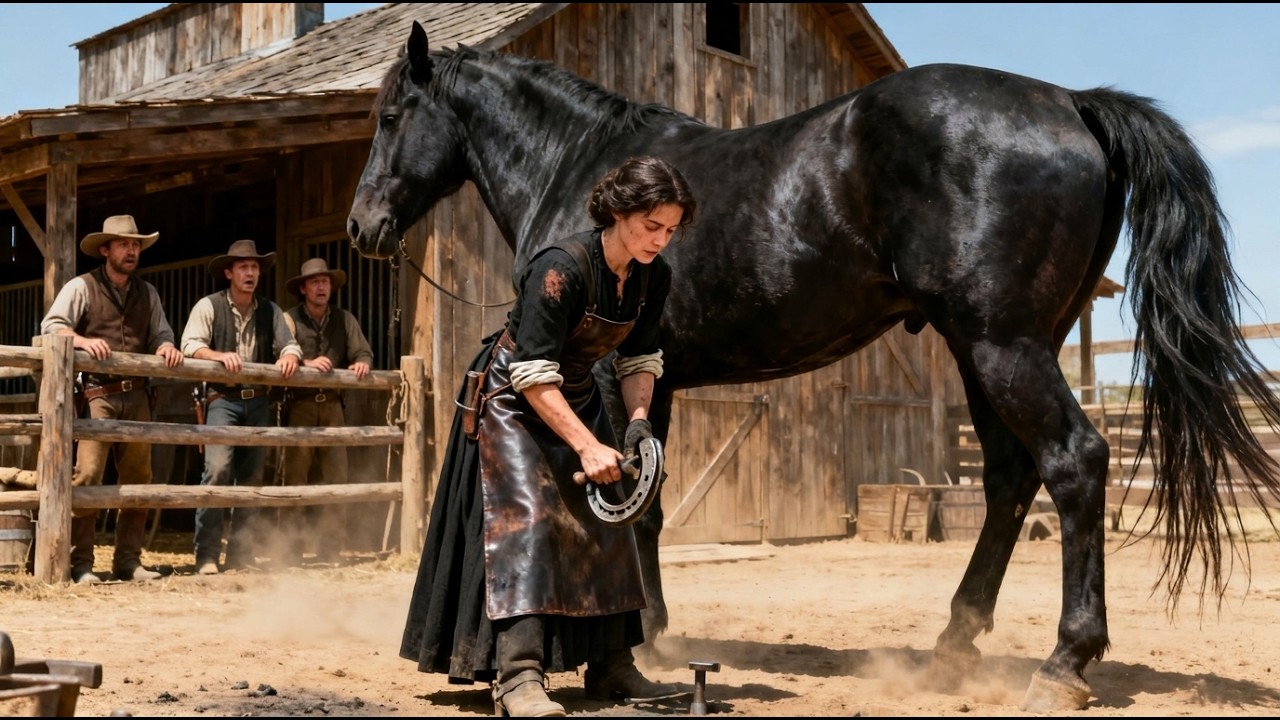
She rode into the ranch with nothing but dust on her skirt and a mule that looked ready to die. They laughed at her, called her weak, told her she didn’t belong. But when fire tore through the valley and the wild black mare screamed in the flames, it wasn’t the men who ran toward the inferno.
It was the widow they’d thrown away. This is a story about a woman who had to burn through doubt, betrayal, and fear just to prove she was worth the ground she stood on. Stay with me until the end. Hit that like button and drop a comment with the city you’re watching from. I want to see how far this story travels.
The wagon wheel hit another rut and Maris Holloway felt the jolt all the way up her spine. She didn’t flinch. Couldn’t afford to. The mule pulling her forward looked worse than she felt. Ribs showing head low, each step slower than the last. If the animal gave out now, she’d be walking the rest of the way to wherever the hell this road led.
She squinted through the late afternoon glare. Ahead, the land opened up into something that didn’t look like hope, but might have been close. A sprawling ranch tucked against the feet of the Tetons, the mountains rising behind it like broken teeth. Fences stretched in every direction. Cattle dotted the fields. Smoke curled from a stone chimney.
It looked solid, permanent, the kind of place that didn’t move, didn’t run, didn’t collapse under bad luck. Maris pulled the mule to a stop near the main barn and climbed down. Her legs were stiff. Her dress was filthy. She’d washed it in a creek 2 days ago, but the dust had claimed it again. She straightened her back anyway, brushed her hands down her sides, and walked toward the barn like she had a right to be there.
A man stood near the open doors, coiling a length of rope with the kind of precision that came from doing it 10,000 times. He was broad shouldered, sunburned, and looked her over the way someone might size up a stray dog. “Help you?” he said, didn’t stop coiling. I’m looking for work, Maris said. He glanced past her at the mule in the wagon, then back at her face. His expression didn’t change.
You got experience? I can cook, clean, handle animals, whatever needs doing. Can you lift a hay bale? If I have to. He smiled, but it wasn’t friendly. Ranch works not for women. Especially not. He paused, eyes flicking down her frame again. Women built like you. Maris held his gaze. I didn’t ask if it was for women. I asked if you had work.
The man let the rope drop and stepped closer. He smelled like sweat and tobacco. Name’s Lyall. I’m the foreman here. And what I’m telling you is we don’t need help from someone who will fold after 2 days and cost us more trouble than she’s worth. I won’t fold. Everyone says that. He turned his back on her and started walking toward the barn. Move along.
Mara stood there, hands clenched at her sides. She wanted to scream, wanted to grab him by the collar and make him listen. But she didn’t. She just watched him disappear into the shadows of the barn. And then she turned toward the main house. It was a two-story structure, timber and stone, with a porch that wrapped around the front.
A man sat on the steps, hat pulled low, one leg stretched out in front of him. He didn’t look up when she approached, but she knew he’d seen her. “Excuse me,” she said. He tilted his head just enough for her to see his face. Sharp features, dark eyes, a jawline that looked like it had been carved out of something harder than wood.
He was younger than she’d expected. Maybe mid30s, but there was something old in the way he looked at her, like he’d already decided she wasn’t worth his time. Foreman said no, didn’t he? The man said, not a question. He did. Then why are you still here? because I need work and I’ll do it better than half the men you’ve got. The corner of his mouth twitched.
Might have been a smile. Might have been irritation. That so. Yes. He stood and she realized he was tall. Taller than Lyall. Taller than most men she’d known. He studied her the way someone might study a fence post, checking for rot. What’s your name? Maris Holloway. You got family? Maris Holloway? No. husband dead recently? Two months? He nodded slowly like that explained something.
And you think a ranch in the middle of nowhere is where you’re supposed to land? I think it’s where I am, she said. And I’m not leaving until I’ve tried. He was quiet for a long moment. Then he turned and walked back up the steps. There’s a cot in the cook house. You can stay there. Mrs. Reese will tell you what needs doing. Don’t cause trouble.
Don’t slow anyone down. And don’t expect anyone to carry you. I won’t. He stopped at the door. My name’s Jonas Caldwell. I own this place. You work hard, you stay. You don’t, you’re gone. Understood. He disappeared inside, and Maris stood there, staring at the empty doorway. Her chest felt tight.
Not from gratitude, from something closer to relief, but sharper. She’d been given a chance, barely. But it was enough. She walked back to the wagon, unhitched the mule, and led it toward the barn. “Ly was inside, talking to another hand. A wiry man with a crooked nose and a mouth that looked like it was used to sneering.” “She’s staying,” the wiry man said loud enough for her to hear.
“Boss must be getting soft.” Lyall snorted. “Give her 3 days, she’ll be crying herself back to town.” Maris didn’t look at them. She tied the mule to a post, found a bucket, and filled it with water. The animal drank like it hadn’t seen water in a week. Maybe it hadn’t. “Need help?” a voice said behind her. She turned.
A young man stood there, maybe 19, with sandy hair and a sunburn across his nose. He wasn’t smiling, but he didn’t look hostile either. “I’m fine,” Mara said. “Name’s Tom. I work the stables mostly. If you need anything, feed, tools, whatever, just ask. Thank you. He nodded and walked off. Maris watched him go, then turned back to the mule.
It had finished drinking and was nosing at the empty bucket. She scratched its neck, and the animal leaned into her hand. “You and me both,” she muttered. The cookhouse was a low building attached to the main house by a covered walkway. Inside, it smelled like bacon grease and wood smoke.
A large woman with gray hair and flower dusted hands stood at the stove stirring something in a cast iron pot. “You the new one?” the woman said without turning around. “Yes, ma’am. Maris Holloway.” “I’m Mrs. Ree. You’ll be helping me with meals, cleaning, washing, and whatever else I tell you to do. You get up at 4:00. You don’t stop until the work’s done.
You sleep over there.” She pointed to a narrow cot in the corner, half hidden behind a stack of crates. Don’t complain. Don’t slack. and don’t get in my way. Yes, ma’am. Mrs. Ree finally turned and looked at her. Her eyes were sharp, but not unkind. You look like you’ve been dragged behind a horse. Something like that.
Well, get yourself cleaned up and come back here in 20 minutes. Supper won’t cook itself. Mis nodded and made her way to the pump outside. She stripped off her shawl, rolled up her sleeves, and scrubbed her face and arms with cold water. It stung. She didn’t care. When she was done, she dried off with the hem of her skirt and went back inside. Mrs.
Ree handed her a knife and a pile of potatoes. Peel. Maris sat at the long wooden table and started peeling. Her hands moved automatically. Muscle memory from years of doing the same thing in different kitchens, different towns, different lives. Mrs. Ree worked at the stove, humming under her breath. “You ever work a ranch before?” Mrs. Ree asked. “No.
” then you’re going to have a rough time. These men don’t go easy on anyone, and they sure as hell won’t go easy on you. I don’t need easy. Good, because you won’t get it. Supper was served at 6. The men came in loud and hungry, boots scraping, voices overlapping. Maris stayed in the kitchen, filling bowls and passing them through the window to Mrs.
Ree, who carried them out to the long table in the dining hall. She didn’t see Jonas. Didn’t see Lyall either, though she heard his voice once, barking orders at someone. When the men were done, Mrs. Ree brought the empty bowls back and Maris washed them in a basin of hot water. Her hands achd. Her feet achd. She ignored both. “You’ll do,” Mrs.
Ree said, wiping down the counter. “Get some sleep. Tomorrow’s worse.” Maris collapsed onto the cot without bothering to pull off her boots. The blanket smelled like smoke and someone else’s sweat, but she didn’t care. She was asleep in seconds. She woke to the sound of a bell clanging somewhere outside. The sky was still dark.
She sat up, disoriented, then remembered where she was. Mrs. Ree was already at the stove moving pots and pans with the efficiency of someone who’d done this for decades. “Get moving,” Mrs. Ree said. “Coffee first, then biscuits, then bacon.” Maris stumbled to her feet and got to work. The days blurred together. She cooked.
She cleaned. She scrubbed floors until her knees were bruised and her hands were raw. The men barely looked at her. When they did, it was with the kind of indifference reserved for furniture. She didn’t exist to them. Not really, but she noticed things. She noticed the way Tom lingered near the stables, always the first one there and the last to leave.
She noticed the way Lyall barked orders but never did the heavy lifting himself. She noticed the way Jonas moved, silent, watchful, like a man who’d stopped expecting anything good to happen. And she noticed the horses. There were a dozen of them in the main corral, and most were calm, well-trained. But there was one that wasn’t, a black mare, wildeyed and skittish, pacing the fence line like she was looking for a way out.
The men called her midnight, and they treated her like a problem. She’s got the devil in her, Lyall said one morning, standing near the fence with his arms crossed. Ought to sell her off before she kills someone. She’s not mean, Tom said quietly. She’s scared. Same difference. Maris watched from the cook house door, a basket of laundry in her arms.
The mayor circled the corral, head high, muscles tense. When one of the hands tried to approach her with a rope, she bolted to the far corner and kicked at the fence. Leave her,” Jonas said, appearing from the barn. His voice was flat. “Final. We’ll deal with her later.” Lyall shrugged and walked off. The mayor stood alone, trembling.
Mar set the laundry down and walked to the fence. She didn’t get close, just stood there, arms resting on the top rail. The mayor watched her, nostrils flaring. “You’re all right,” Maris said softly. “No one’s coming after you.” The mayor didn’t move. Maris stayed there for a long moment, then turned and went back to her work.
That night, after supper, she slipped out to the corral again. The ranch was quiet, the men either asleep or playing cards in the bunk house. The mayor was standing in the center of the corral, head low. Maris climbed onto the fence and sat on the top rail. She didn’t say anything, just sat there, letting the horse get used to her presence.
After a while, the mayor took a step closer, then another. She stopped a few feet away, ears flicking forward. “Yeah,” Maris said quietly. “I know how you feel.” The mayor snorted and walked off, but Maris didn’t move. She stayed there until the cold drove her back inside. The next day, Tom found her near the pump, washing out a pot.
“You good with horses?” he asked. “I used to be.” “Used to be?” “My father trained them, taught me some before he died.” Tom nodded slowly. You ought to talk to Mr. Caldwell. We could use someone who knows what they’re doing. Lyall already told me I don’t belong here. Lyall’s an ass. Mr.
Caldwell listens to results, not noise. Maris didn’t answer, but later that afternoon when Jonas walked past the cook house, she stepped outside. Mr. Caldwell. He stopped and turned. Something wrong? No. I wanted to ask if you need help with the horses, I can do that. He studied her for a moment. You know horses? Some? My father trained them. I watched, learned.
You ever break one? No, but I’ve calmed a few. He glanced toward the corral where Midnight was pacing again. That one’s been nothing but trouble. You think you can calm her? I don’t know, but I’d like to try. Jonas was quiet. Then he nodded. Fine. You’ve got a week. If she’s still wild, we’re selling her. Understood. He walked off and Maris let out a slow breath.
She didn’t know if she could do it, but she was damn sure going to try. Over the next few days, she spent every spare moment near the mayor. She didn’t rush, didn’t push, just sat on the fence, sometimes talking, sometimes silent. The mayor began to approach her more often, curiosity outweighing fear. On the fourth day, Maris brought an apple. She held it out, palm flat.
The mayor hesitated, then stepped forward and took it, teeth scraping against her hand. “Good girl,” Maris murmured. By the end of the week, the mayor let Maris touch her neck. “It wasn’t much, but it was something.” Jonas came to the corral one evening and watched from a distance. “Mary didn’t acknowledge him.
She stayed focused on the mayor, running her hand along the animals shoulder. “She’s calmer,” Jonas said. “She’s learning she doesn’t have to be afraid.” He nodded slowly. keep working with her. Maris looked over at him. Does that mean I can stay? It means you’re useful. Don’t make me regret it.
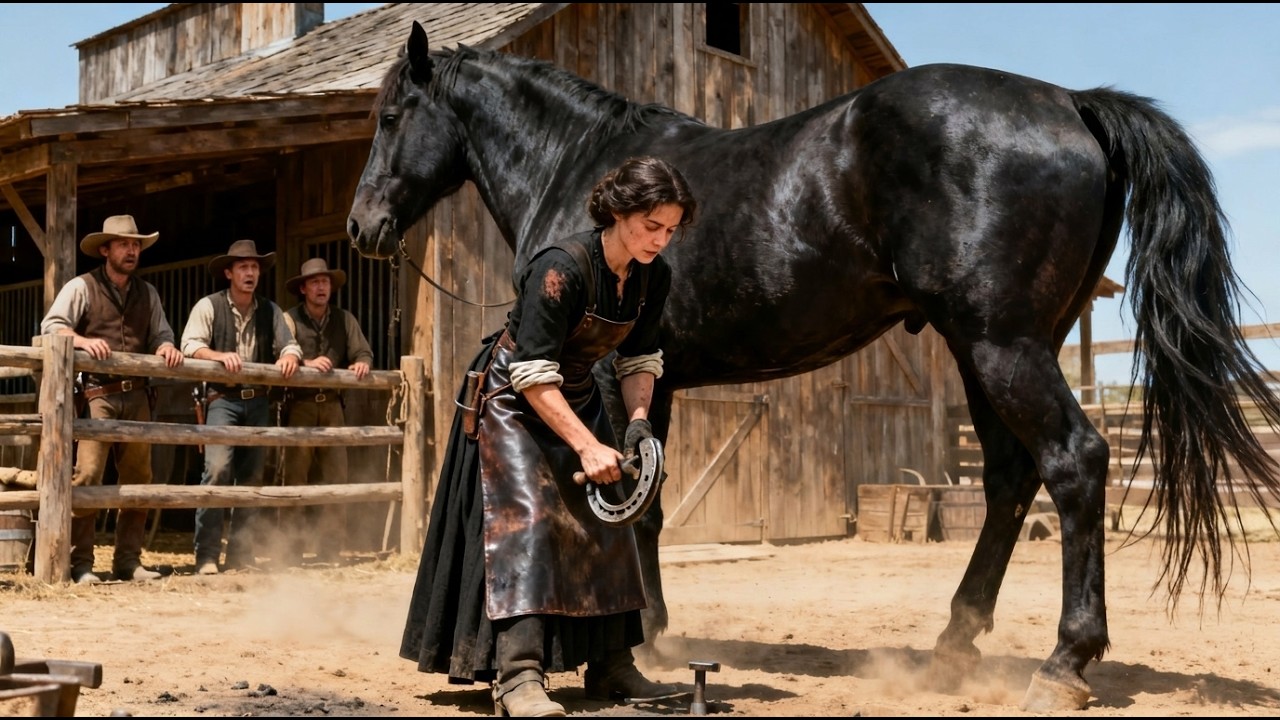
He walked off and Maris turned back to the mayor, a small smile tugging at her mouth. It wasn’t trust. Not yet, but it was close. The work didn’t get easier. Mrs. Ree still ran her ragged. Lyall still looked at her like she was something he’d scraped off his boot, but Maris kept her head down and her hands moving. And every night she went back to the corral.
Midnight started meeting her at the fence, started following her around the corral, started leaning into her touch. Tom noticed. “You’ve got a gift,” he said one afternoon. “I’ve got patience, that’s all.” “It’s more than that,” Maris didn’t argue. But deep down, she wondered if he was right. Because when she was with the mayor, she felt something she hadn’t felt in months.
Something like purpose. Jonas noticed, too. He didn’t say anything, but she caught him watching her more often. Not with suspicion, with something quieter, something that looked almost like respect. One night after supper, she found him sitting alone on the porch. She hesitated, then climbed the steps and leaned against the railing.
“Thank you,” she said. He glanced up at her. “For what?” “For letting me stay.” He looked away toward the mountains. “You’ve earned it. They were quiet for a long moment. Then Maris said, “Why’d you take me on? Most men wouldn’t have.” Jonas was silent. Then he said, “I know what it’s like to have nowhere to go.” She didn’t ask him to explain, didn’t push, just nodded and went back inside.
But something had shifted. Not much, but enough. The ranch didn’t feel quite as hostile anymore. The work was still brutal. The men were still indifferent. But Maris had found her place, small as it was, and she wasn’t letting go. Midnight ran to her now when she approached. Nuzzled her hand. Let her slip a halter over her head without flinching. Lyall hated it.
“You’re spoiling that horse,” he said one morning. “I’m training her. You’re making her soft. She was never hard. She was scared.” He scoffed and walked off. But Maris didn’t care. She knew what she was doing, and so did Jonas. Late one afternoon, he came to the corral while Maris was leading midnight in slow circles.
The mayor’s stride was smooth now, her head level, calm. Jonas leaned against the fence and watched. When Maris brought the mayor to a stop, he said, “You’ve done good work. She’s a good horse. She is now.” He paused. “You ever think about doing this full-time training? I mean, Maris looked at him surprised. You serious? We’ve got more horses than we know what to do with.
Most of them need work. If you can do with them what you did with her, you’d be worth keeping around. I’d like that. He nodded. Then it settled. Maris felt something warm settle in her chest. Not happiness exactly, but something close. Something that felt like she’d finally stopped falling.
That night, she slept better than she had in months. The first real test came 3 weeks later on a Tuesday morning that started like any other and ended with Maris wondering if she’d made a terrible mistake. She was in the corral with a young geline working him through basic commands when Lyall appeared at the fence with two ranch hands she didn’t know well.
One was tall and lanky with a scar above his left eyebrow. The other was shorter, stockier, with a perpetual scowl that seemed carved into his face. That’s the widow Jonas has doing horse work now, Lyall said loud enough for her to hear. Pretty soon she’ll be running the whole damn place. The scarred man snorted.
She don’t look like much. She ain’t, Lyall said, but the boss seems to think she’s got something special. Maris didn’t look at them. She kept her focus on the geling, murmuring instructions, guiding him with gentle pressure on the lead rope. The horse responded smoothly, turning when she asked, stopping when she signaled. It wasn’t magic.
It was patience and repetition. The same lessons her father had drilled into her when she was 10 years old and barely tall enough to reach a saddle. “Let’s see how special she really is,” the stocky man said. He climbed over the fence and stroed into the corral. “Here, let me show you how it’s done.” Maris stepped back as he grabbed the lead rope from her hand.
The Gelin’s ears flicked back and his body went tense. “Easy,” Maris said. He doesn’t like. I don’t need advice from a woman, the man said. He yanked the rope hard, trying to force the horse into a turn. The geling resisted, planting his hooves. The man yanked again harder this time, and the horse reared back, jerking the rope free and bolting to the far side of the corral.
“Look what you did,” the man said, turning to Maris. “You got him all worked up. You yanked him like he was a sack of grain,” Maris said. Her voice was steady, but her hands were trembling. He doesn’t respond to force. Horses respond to whoever’s in charge, and that ain’t you. Lyall laughed from the fence. Come on, Garrett. Leave her alone.
She’s just doing what the boss told her to do. Garrett spat into the dirt and walked back to the fence, muttering something under his breath. The scarred man clapped him on the shoulder, and the three of them left, still laughing. Meis stood there, breathing hard, her fists clenched at her sides. The geling was still at the far end of the corral, head high, eyes wide.
She wanted to scream, wanted to chase after Garrett and tell him exactly what she thought of him, but she didn’t. She turned back to the horse and walked slowly toward him, hands open, voice soft. “It’s all right,” she said. “He’s gone.” The geling watched her, nostrils flaring. She stopped a few feet away and waited.
After a long moment, the horse took a step toward her, then another. She reached out and touched his neck and he leaned into her hand. “That’s it,” she murmured. “You’re all right.” She spent the rest of the morning working with him, undoing the damage Garrett had caused. By the time she led him back to the stable, her shirt was soaked with sweat and her shoulders achd.
“Tom was inside mucking out stalls.” “Heard Garrett gave you trouble,” he said. “He’s an idiot.” “Yeah, but he’s Lyall’s idiot, and Lyall’s been with Mr. Caldwell since the beginning. So he’s got pull. Does it make him right? No, but it makes him dangerous. Tom leaned on his shovel and looked at her. Watch your back, Maris.
Some of these men don’t like seeing a woman do what they can’t. She nodded and walked out into the sunlight. The ranch stretched out around her. Fields, fences, mountains in the distance. It was beautiful in a harsh, unforgiving sort of way. But it didn’t feel like home. Not yet. Maybe not ever. That night, she was washing dishes in the cook house when Jonas came in.
He poured himself a cup of coffee and leaned against the counter watching her work. “Ly said, “You had some trouble with Garrett today,” he said. “Nothing I couldn’t handle. That’s not what I asked.” Maris set down the plate she was scrubbing and turned to face him. He grabbed the lead rope from me and spooked the horse, then blamed me for it. Jonas took a sip of coffee.
You want me to talk to him? No, I just want to do my job. He does it again. You tell me. I will. He nodded and left. Maris watched him go, then turned back to the dishes. She didn’t know what to make of Jonas. He wasn’t warm, wasn’t particularly kind, but he was fair, and that was more than most men bothered to be.
Over the next few weeks, she settled into a rhythm. Mornings were spent in the cook house, helping Mrs. Ree prepare breakfast. Afternoons were for the horses. Evenings were for cleaning up, washing, mending, whatever Mrs. Ree told her to do. The work was relentless, but Maris didn’t mind. It kept her hands busy and her mind quiet.
Midnight had become her shadow. The mayor followed her everywhere, knickering when Maris approached, pressing her head against Maris’s shoulder. The other horses were coming along, too. The geling she’d worked with on the day Garrett interfered was calm now, responsive. A chestnut mare with a nervous disposition had started trusting her.
Even the older stallion, who’d been labeled too stubborn to train, was beginning to soften. Jonas noticed. He didn’t say much, but Maris caught him watching her more often. Sometimes he’d stand at the fence while she worked, arms crossed, expression unreadable. Other times he’d come into the corral and ask her questions, how she got a horse to trust her, what she did when they resisted, why her methods worked when others didn’t.
My father used to say, “Horses aren’t stupid,” Maris told him one afternoon. “They just don’t understand what you want unless you show them, and you can’t show them if you’re yelling or hitting. Most men don’t have the patience for that.” “Most men don’t care about the horse. They just care about getting the job done.” Jonas looked at her for a long moment.
“You care?” “I do.” He nodded and walked off, and Maris wondered if that was approval or just acknowledgement. With Jonas, it was hard to tell. She started noticing other things about him, too. The way he carried himself, straight back, shoulders tight, like he was holding something heavy that he couldn’t put down.
The way he barely spoke at meals, just listened to the men talk and nodded when necessary. The way he’d stand on the porch at night, staring out at the mountains alone. One evening, she brought him a cup of coffee while he was standing there. He glanced at her, surprised. “Thought you might want this,” she said. He took it. “Thanks.” She leaned against the railing, looking out at the same view he’d been watching.
The sky was turning purple and the mountains looked like shadows against the fading light. “You ever think about leaving?” she asked. “No.” “Why not?” “Because there’s nothing out there I want.” She didn’t ask what he meant. Didn’t push. They stood there in silence. And after a while, Jonas said, “What about you? You planning to stay?” “If you’ll let me, I will.
” It wasn’t much, but coming from Jonas, it felt like a promise. The trouble started again a few days later. Maris was leading Midnight out to the pasture when she heard raised voices near the barn. She tied the mayor to the fence and walked over. Lyall was standing outside the barn with Garrett and the scarred man, whose name she’d learned was Coleman.
They were looking at a young colt that had been brought in the day before. A beautiful animal, white with gray dappling, but skittish as hell. I’m telling you, he’s not ready,” Tom was saying. He stood between Lyall and the Colt, arms crossed. “You push him too hard, you’ll ruin him. We don’t have time to baby every damn horse on this ranch,” Lyall said. “Mr.
Caldwell wants him broke by the end of the week.” “Then let Maris work with him.” Lyle’s expression darkened. “I’m not letting some widow play nursemaid to a horse that needs real training. She’s gotten more done with the others than any of you have. That’s because those horses were already half-trained. This one’s wild. He needs a firm hand.
He needs someone who won’t scare the hell out of him. Tom shot back. Garrett stepped forward, grinning. You got a problem with how we do things, boy? Tom didn’t back down. Yeah, I do. Garrett shoved him. Tom stumbled back, but kept his footing. Before he could respond, Maris stepped between them. That’s enough, she said.
Lyall looked at her like she’d just crawled out from under a rock. This doesn’t concern you. It does. If you’re about to ruin a good horse, you don’t know what you’re talking about. I know you’re about to break his spirit because you’re too impatient to do it right. Ly’s jaw tightened. You’ve got a lot of nerve. I’ve got experience. And if Mr.
Caldwell wants that colt trained properly, I can do it. Like hell you can. Then let me try. If I can’t do it, you can step in. Lyall stared at her, and for a moment she thought he was going to shove her the way Garrett had shoved Tom. But then Jonas’s voice cut through the tension. What’s going on? Everyone turned.
Jonas was standing a few feet away, hands on his hips, eyes moving from Lyall to Maris to the colt. Nothing, boss, Lyall said quickly. Just discussing how to handle the new horse. Jonas looked at Maris. You got something to say? I think I can work with him, but Lyall wants to rush it. Jonas walked over to the colt and studied him.
The animal was trembling, ears pinned back, eyes rolling. Jonas reached out slowly and the colt shied away. He’s scared, Jonas said. He’s wild, Lyall countered. Jonas turned to Maris. You think you can calm him down? I can try. How long? A week, maybe two, Lyall scoffed. We don’t have two weeks.
Then we’ll ruin him, Maris said. And Mr. Caldwell, we’ll lose a valuable horse. Jonas looked at the cult again, then back at Maris. You’ve got 10 days. If he’s not making progress by then, Lyall takes over. Understood. Lyall looked furious, but he didn’t argue. Jonas walked off, and the tension broke.
Garrett and Coleman drifted away, muttering to each other. Tom caught Maris’s eye and nodded. She nodded back. Lyall stayed where he was, glaring at her. You just made this harder on yourself. I’ll take my chances. He walked off and Maris turned to the colt. The animal was still trembling, still watching her with wide, frightened eyes. She approached slowly, hands open, voice soft. “All right,” she said.
“Let’s see what we can do.” The first three days were brutal. The cult wanted nothing to do with her. Every time she got close, he bolted to the far corner of the corral, kicking at the fence, snorting. She didn’t force it, just sat on the fence rail and waited, letting him get used to her presence.
On the fourth day, he stopped running. He still kept his distance, but he watched her. On the fifth day, he took a few steps closer. By the sixth day, he was eating hay while she sat nearby. Jonas came by every evening to check on her progress. He didn’t say much, just stood at the fence and watched. On the seventh day, he said, “You’re halfway there.
He’s learning to trust me. What happens when he trusts you but won’t let anyone else near him? Then I’ll work with him until he does. Jonas nodded. Lyall’s watching this like a hawk. Don’t give him a reason to say you failed. I won’t. On the eighth day, the colt let Maris touch his neck.
On the ninth day, he followed her around the corral. On the 10th day, she slipped a halter over his head, and he didn’t fight her. When Jonas came by that evening, Maris was leading the colt in slow, careful circles. The animals stride was smooth, his head low, calm. Jonas climbed over the fence and walked toward them.
The colt’s ears flicked back, but he didn’t bolt. Jonas stopped a few feet away and studied the horse. “Well done,” he said quietly. “He’s not finished yet, but he’s getting there.” Jonas looked at her. “You’ve got a gift, Maris. Don’t let anyone tell you otherwise.” She felt something warm settle in her chest. Not pride exactly, but something close. “Thank you.
” He nodded and walked off. Mara stayed in the corral with the colt until the sun set, running her hand along his neck, murmuring to him. When she finally led him back to the stable, Tom was waiting. “You did it,” he said, grinning. “We’ll see. Lyall’s not going to let this go.” “No, but Mr. Caldwell saw what you did.
That’s what matters.” Maris wasn’t so sure. But she didn’t say that. She just took care of the colt and went back to the cook house exhausted. That night she dreamed of her father. He was standing in a corral working with a young horse, his hands steady, his voice calm. She was 10 years old again, watching him, trying to memorize every movement.
He glanced over at her and smiled. “You’re doing fine, Maris,” he said. “Just keep going.” She woke with tears on her face. The cook house was dark and quiet. Mrs. Reese was snoring softly in her cot on the other side of the room. Maris wiped her eyes and stared at the ceiling until sleep came again.
The next few weeks were easier. The cult continued to improve and Maris moved on to other horses. Jonas started consulting her more often, asking her opinion on which animals were ready for sale, which ones needed more work, which ones weren’t worth the effort. Lyall didn’t like it, but he kept his mouth shut. At least when Jonas was around.
When Jonas wasn’t around, Lyall made sure Maris knew exactly where she stood. Don’t get comfortable, he said one afternoon, cornering her near the pump. You’re still just hired help, and the second you slip up, you’re gone. I’m not planning to slip up. Everyone slips up eventually. He walked off, and Maris stood there, water dripping from her hands, jaw tight.
She wanted to hate him, and maybe she did, but mostly she just wanted him to leave her alone. Tom told her to ignore Lyall. Mrs. Ree told her to keep her head down and her mouth shut. Jonas didn’t say anything, but Maris got the sense he knew what was going on. He just didn’t see it as his problem to solve. One evening after supper, she was sitting on the porch steps when Jonas came out and sat down beside her.
They didn’t speak for a long time, just sat there watching the sky turn dark. “You miss him?” Jonas asked finally. Maris knew he meant her husband. “Sometimes.” What was he like? She thought about how to answer. Reckless, charming, bad with money. He loved cards more than he loved me. Why’d you marry him? Because I was young and stupid and because I thought he’d change. Jonas nodded.
People don’t change. No, they don’t. They were quiet again. Then Jonas said, “I was married once.” Maris looked at him surprised. “What happened?” She died. Fever 3 years ago. Sorry. So am I. He stood and went back inside, leaving Maris alone on the porch. She sat there for a long time thinking about what he’d said. People don’t change.
Maybe that was true. But maybe it didn’t matter. Maybe you just had to find someone whose flaws you could live with. The ranch felt different after that. Not warmer, exactly, but less hostile. The men still ignored her, but she didn’t care. She had her work. She had the horses and she had a place to sleep that didn’t involve a wagon and a dying mule.
It was enough for now. It was enough. But then Eleanor Graves came to town and everything changed. Maris first heard the name Eleanor Graves on a Thursday afternoon while she was brushing down the chestnut mare in the stable. Tom was mcking out the stall next to her and he mentioned it casually like it was nothing. Mrs.
Graves is coming to town this weekend. heard she’s staying at the hotel for a few days. Maris didn’t look up. Who’s that widow from back east? Her husband owned half the mining operations in Colorado before he died. She’s been traveling around looking at property investments or something. Mr. Caldwell knows her from before.
Before what? Tom shrugged. Before he came out here, I guess I don’t know the details, but Lyall was talking about it this morning. said she’s real refined, educated, the kind of woman who belongs in a place like this. Maris felt something twist in her chest, but she ignored it. Good for her. Tom glanced over at her.
I didn’t mean anything by it. I know, but the comment stuck with her, the kind of woman who belongs in a place like this. She thought about it while she finished with the mayor, while she washed her hands at the pump, while she helped Mrs. Ree prepare supper. What kind of woman did belong here? Not the kind who showed up half starved with a mule that could barely walk.
Not the kind who scrubbed floors and mucked stalls and worked herself raw just to earn a cot in the corner of a cook house. That evening, Jonas was quieter than usual. He ate quickly, barely looking at anyone, and left before the men had finished their coffee. “Mary watched him go, then cleared the dishes and took them back to the kitchen.
“Something’s bothering him,” Mrs. Ree said, scraping leftover beans into a jar. He gets like this sometimes, goes all tight and silent. Means he’s thinking about something he doesn’t want to think about. You think it’s about this Mrs. Graves? Mrs. Ree gave her a sharp look. You heard about that, did you? Tom mentioned it.
Well, don’t go reading too much into it. Jonas knew her a long time ago back when he was still in Denver, but that was years ago. People change, do they? Mrs. Ree didn’t answer. She just handed Maris a stack of plates and told her to get washing. Eleanor Graves arrived on Saturday. Maris didn’t see her come in, but she heard about it from every man on the ranch within an hour.
She was beautiful, they said, elegant. She wore a dark blue dress with lace at the collar and a hat with a feather that looked like it cost more than Maris made in a year. She’d arrived in a private coach with a driver and a trunk full of luggage, and she’d gone straight to the hotel without stopping to look at anything else.
By Sunday morning, the whole town was talking about her. Maris went into town with Mrs. Ree to pick up supplies, and everywhere they went, people were whispering. Eleanor Graves had taken the finest room at the hotel. Eleanor Graves had ordered a bottle of French wine with her dinner. Eleanor Graves had asked the shopkeeper about local properties and left him stammering like a school boy.
Maris kept her head down and helped Mrs. Ree load sacks of flour and sugar into the wagon. She didn’t care about Ellaner Graves, didn’t care about her fancy clothes or her money or her refined manners. She had work to do, and that was all that mattered. But then she saw Jonas. He was standing outside the general store talking to a woman Maris didn’t recognize at first.
She was tall with dark hair pinned up in an elaborate style, and she stood with the kind of posture that came from years of being told she was better than everyone else. She was smiling at Jonas, and he was smiling back. a real smile, the kind Maris had never seen on his face before. “That’s her,” Mrs. Ree said quietly, coming up beside Maris.
“That’s Eleanor Graves.” Maris watched them for a moment longer, then turned away and climbed onto the wagon. Mrs. Ree followed, and they drove back to the ranch in silence. That night, Jonas didn’t come to supper. Lyall said he’d gone into town to have dinner with Mrs. Graves, and the men spent the entire meal speculating about what that meant.
Maris ate quickly and excused herself, retreating to the cook house. She tried to sleep, but her mind wouldn’t stop turning. She kept seeing Jonas’s smile, the way he’d looked at Eleanor Graves like she was someone who mattered. The next morning, Eleanor Graves came to the ranch. Maris was in the corral with Midnight when the coach pulled up to the main house.
She watched from a distance as Jonas came out to greet Eleanor, offering his arm as she stepped down from the coach. Eleanor said something that made him laugh. And Maris felt that twist in her chest again, sharper this time. “Don’t let it get to you,” Tom said, appearing beside her. “She’s just visiting.” “I’m not letting it get to me.
” “Sure you’re not.” Maris turned back to midnight and focused on brushing her coat, but she couldn’t stop glancing toward the house. Jonas and Eleanor had gone inside, and Lyall was standing on the porch looking smug. “She’s going to ruin everything,” Tom muttered. What do you mean, Mrs. Graves? She’s the kind of woman who gets what she wants, and if she wants Mr.
Caldwell, she’s not going to let anything stand in her way. That’s not my problem. Tom gave her a long look. Isn’t it? Maris didn’t answer. She finished with midnight and led her back to the stable, trying to ignore the knot in her stomach. Eleanor stayed for lunch. Maris helped Mrs.
Reese prepare the meal, roasted chicken, fresh bread, vegetables from the garden, and carried the dishes to the dining room. Jonas and Eleanor were sitting at the table, deep in conversation. Eleanor glanced up when Maris entered, and her expression shifted just slightly. Not hostile, just curious, in the way someone might look at a piece of furniture they were considering buying.
“Who’s this?” Eleanor asked. “Mis Holloway,” Jonas said. She works here. Helps with the horses. How interesting. Eleanor’s smile didn’t reach her eyes. You must be very capable. I do what’s needed, Maris said. I’m sure you do. Maris set the plates down and left. She could feel Eleanor’s gaze on her back the entire way out of the room.
Over the next few days, Eleanor became a fixture at the ranch. She came by every afternoon, always dressed impeccably, always smiling, always finding reasons to linger. She walked the grounds with Jonas, admired the horses, asked questions about the ranch’s operations. The men loved her. Even Lyall, who didn’t have a kind word for anyone, treated her like royalty.
Maris tried to stay out of her way. She focused on her work, kept her head down, avoided the main house as much as possible. But it was hard to ignore the way Jonas changed when Eleanor was around. He laughed more, talked more, looked almost happy. One afternoon, Maris was working with the cult when Eleanor appeared at the fence. She was alone, which was unusual.
She stood there for a moment watching, then said, “You’re quite good with them.” Maris didn’t stop what she was doing. Thank you. Jonas speaks highly of you. That’s kind of him. Eleanor was quiet for a moment, then she said, “You must have an interesting story. A woman like you working on a ranch like this.
” Not really. Come now. Everyone has a story. Maris finally looked at her. What do you want, Mrs. Graves? Eleanor smiled, but it was cold. I’m just curious. Jonas told me you’re a widow. That you came here with nothing. It’s quite remarkable, really, that you’ve managed to stay as long as you have. I work hard. I’m sure you do.
But hard work only gets you so far, doesn’t it? Especially for someone in your position. Maris’s jaw tightened. What’s that supposed to mean? It means that this ranch, this town, this life, it’s not built for people like you. It’s built for people who have resources, education, standing. You’re surviving, Maris, but you’re not thriving, and you never will be.
I’m doing fine for now, but what happens when Jonas doesn’t need you anymore? What happens when someone better comes along? Maris turned away from her and focused on the cult. I think you should leave. Eleanor’s smile widened. Of course, I didn’t mean to upset you. I was just being honest. She walked off and Maris stood there, hands shaking.
She wanted to scream, wanted to throw something, but she didn’t. She just took a breath and went back to work. That night, she barely slept. Eleanor’s words kept replaying in her head. What happens when someone better comes along? She knew what Eleanor was really saying. She was the someone better, and Maris was just an obstacle. The next day, Jonas asked Maris to come to his office.
She knocked on the door and he called for her to enter. He was sitting at his desk, paper spread out in front of him, looking tired. “Sit down,” he said. She sat. Eleanor told me you two talked yesterday. Maris’s stomach dropped. “We did. She said you were rude to her.” “I wasn’t rude. I just didn’t want to talk.” Jonas rubbed his face.
Look, Maris, I know Eleanor can be it direct, but she’s a guest here, and I need you to be respectful. I was respectful. She didn’t feel that way. Maris stared at him. So, you’re taking her side. I’m not taking anyone’s side. I’m just asking you to be polite. I’m always polite, Jonah sighed. Just try. All right. For me, Mayor stood.
Is that all? Yeah, that’s all. She left the office and went straight to the corral. She stayed there until dark, working with the horses, trying to calm the anger churning inside her. She thought Jonas trusted her, thought he respected her. But the moment Elanor Graves said something, he’d believed her without question.
Over the next week, things got worse. Eleanor started dropping hints to the other ranch hands. Little comments about Maris’s past, her husband, the way she’d shown up with nothing. She never said anything outright, but the implications were clear. Maris was an outsider, a drifter, someone who couldn’t be trusted. Lyall picked up on it immediately.
Heard your husband was a gambler, he said one afternoon loud enough for the other men to hear. That true? Maris didn’t answer. Heard he got himself killed over a card game. Left you with nothing but debts. That’s none of your business. It is if you’re working here. We don’t need trouble following you. I’m not bringing any trouble. That’s what they all say.
The men laughed and Maris walked away, her face burning. Tom found her later sitting on the fence near the stable. Don’t listen to them, he said. They’re just repeating what Mrs. Graves has been saying. Why is she doing this? Because she wants Jonas and you’re in her way. I’m not in anyone’s way.
I’m just trying to work. Doesn’t matter. She sees you as competition. That’s ridiculous. Jonas doesn’t think of me that way. Tom didn’t say anything. He just looked at her and Maris felt her stomach sink. “Does he?” she asked quietly. “I don’t know, but Mrs. Graves thinks he does.” “And that’s enough.” Mars didn’t know what to say.
She just sat there staring at the ground, feeling like everything she’d built was crumbling beneath her. The breaking point came the following Sunday. Eleanor had invited Jonas to a social gathering in town, and he’d accepted. Maris heard about it from Mrs. Ree, who’d heard it from one of the shopkeepers.
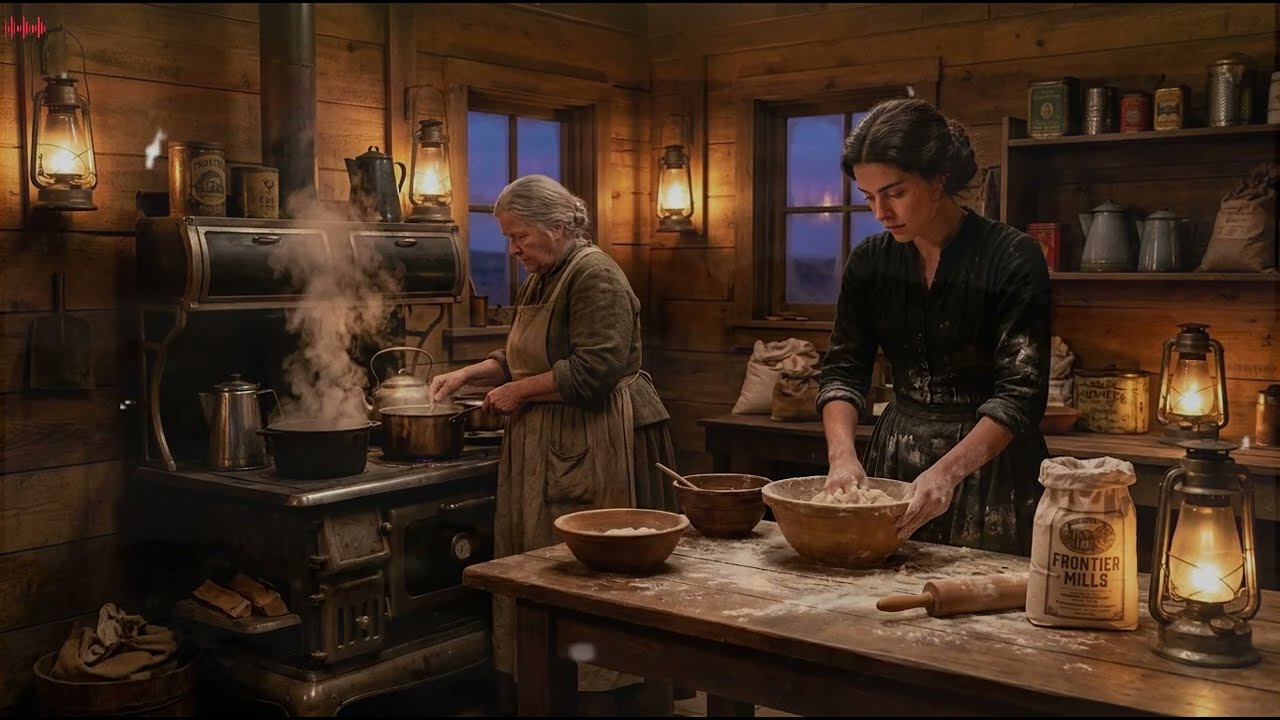
Apparently, Eleanor had been telling everyone in town about her plans to invest in property near the ranch. “She was talking about building a house, settling down, becoming part of the community.” “She’s making her move,” Mrs. Ree said, shaking her head. “And Jonas is too blind to see it. Maybe he’s not blind,” Maris said.
“Maybe he wants this. You don’t believe that.” “I don’t know what I believe anymore.” That evening, Maris was in the cook house when Eleanor arrived at the ranch. She heard the coach pull up, heard Eleanor’s voice calling for Jonas, heard him come out to meet her. They talked for a few minutes, their voices low, and then they left together.
Maris stood at the window, watching them go. Eleanor was laughing, her hand resting lightly on Jonas’s arm. He looked down at her, smiling, and Maris felt something crack inside her chest. She turned away from the window and went to her cot. She lay there in the dark staring at the ceiling and tried not to think about what was happening.
Tried not to imagine Jonas with Eleanor. Tried not to picture them together. Tried not to feel the jealousy and hurt and anger that was threatening to consume her. But it was no use. She felt all of it, and she didn’t know what to do. The next morning, Eleanor came to the ranch earlier than usual. Maris was in the stable when she arrived, but she could hear her voice carrying across the yard.
She was talking to Jonas loud enough for everyone to hear. I’ve been thinking,” Elellaner said, about what you told me the other night, about your concerns regarding certain people on the ranch. Maris’s blood went cold. She set down the brush she’d been using and moved closer to the stable door. “I know you’ve been generous,” Eleanor continued, giving people second chances, letting them prove themselves.
“But Jonas, darling, you have to be careful. Not everyone deserves your trust.” “What are you getting at?” Jonas’s voice was cautious. I’m talking about Maris Holloway. Maris’s breath caught. What about her? I did some asking around back in the town she came from. And Jonas, the things I heard, they’re not good.
What things? Her husband wasn’t just a gambler. He was a con man. He cheated people out of their money, made promises he never kept. And Maris was right there with him. She helped him, lured people in, made them trust her, and then took them for everything they had. That’s not true, Maris whispered.
But no one could hear her. Are you sure about this? Jonas asked. I have sources. People who knew them. People who lost money because of them. And when her husband got himself killed, she ran. Didn’t pay back a single debt. Just took what little money they had left and disappeared. Eleanor, I know you want to believe the best in people, but Jonas, you have to face facts. She’s using you.
She saw an opportunity here and she took it. and the moment she gets what she wants, she’ll be gone.” There was a long silence. Then Jonas said, “I need to think about this.” Of course, but don’t wait too long. People like her, they’re dangerous. Maris heard footsteps and she ducked back into the shadows of the stable.
Her heart was pounding, her hands shaking. She wanted to run out there to scream the truth, to tell Jonas that Eleanor was lying, but she couldn’t move, couldn’t breathe. Eleanor’s voice faded as she and Jonas walked toward the house. Maris stood there frozen, feeling like the world had just collapsed around her.
Tom found her an hour later, still standing in the stable, staring at nothing. Maris, he said, “You all right?” She shook her head. She told him I’m a criminal. What? Eleanor, she told Jonas I was part of my husband’s schemes, that I helped him cheat people. It’s not true, Tom. None of it’s true. Then tell him that. He won’t believe me.
He’ll believe her. You don’t know that. But Maris did know. She’d seen the way Jonas looked at Eleanor. She’d heard the doubt in his voice when he asked if Eleanor was sure. He wanted to believe Eleanor because Eleanor was everything Maris wasn’t. Refined, educated, wealthy, the kind of woman who belonged. That afternoon, Jonas came to find her.
She was in the corral with Midnight, and she saw him approaching from a distance. Her stomach twisted into knots and knots. Maris, he said, “We need to talk.” She turned to face him. About what? Eleanor told me some things about your past. About your husband. And you believe her? I don’t know what to believe. That’s why I’m asking you.
What did she say? Jonas hesitated. She said you were involved in your husband’s cons. That you helped him cheat people. That’s a lie. Is it? Maris felt like she’d been slapped. You really think I’d do that? I don’t know, Maris. I don’t know anything about you. You showed up here with nothing, no references, no past.
How am I supposed to know what’s true and what’s not? Because you know me. You’ve worked with me. You’ve seen what I can do. I’ve seen that you’re good with horses. That doesn’t tell me who you are. I’m someone who’s trying to survive. That’s all. That’s not enough. The words hit her like a punch to the gut. She stared at him, unable to speak.
“I’m sorry,” Jonas said. “But I can’t have someone on this ranch I don’t trust. I need you to leave.” “Jonas, I’ll pay you for your time. Give you enough to get wherever you’re going, but I want you gone by tomorrow.” He turned and walked away, leaving Maris standing there alone. Midnight nickered softly and pressed her head against Maris’s shoulder, but Maris barely felt it.
She just stood there numb, feeling like everything she’d fought for had been ripped away in an instant. That night, she packed her things. It didn’t take long. She didn’t have much. A few changes of clothes, a worn blanket, a pair of boots that were falling apart. She sat on the edge of her cot and stared at the small pile and wondered where the hell she was supposed to go. Mrs.
Ree came in and sat down beside her. “This isn’t right,” she said. “Jonas is making a mistake.” “Doesn’t matter. He’s made up his mind. Then change it. How? Tell him the truth. All of it. Make him listen. Marisa shook her head. He doesn’t want to listen. He wants to believe her. Because he’s scared of what? Of being wrong again.
Of trusting someone and getting hurt. He’s been burned before, Maris. And Eleanor knows that. She’s using it against him. Then there’s nothing I can do. Mrs. Ree put a hand on her shoulder. Don’t give up yet. You fought too hard to let her win. But Maris didn’t feel like fighting. She just felt tired.
Tired of trying to prove herself. Tired of being doubted. Tired of never being enough. She lay down on the cot and closed her eyes and tried not to think about what tomorrow would bring. Maris woke before dawn the way she always did. But this time there was no rhythm to follow. No breakfast to prepare. No horses waiting.
just her bundle of belongings sitting by the cot and the sick feeling in her stomach that hadn’t left since Jonas had told her to go. She sat up slowly, her body heavy with exhaustion and something worse, resignation. Mrs. Ree was already at the stove, moving quietly, pretending not to notice that Maris was awake.
But when Maris stood and started folding her blanket, Mrs. Ree turned around. “You’re really leaving?” she said. It wasn’t a question. Jonas made that clear. You could fight this. You could go to town, find someone who knew your husband, get proof that Eleanor’s lying. And who’s going to believe me? A widow with no money and no standing against a woman like Eleanor Graves? Mara shook her head.
It doesn’t matter what the truth is. It matters what people believe. Mrs. Reese’s face hardened. That’s a coward’s way of thinking. Maybe, but I’m tired of fighting for a place that doesn’t want me. The ranch wants you. Jonas is just too stubborn to see it. Maris didn’t answer. She tied her bundle with a piece of twine and slung it over her shoulder.
It weighed almost nothing. Everything she owned in the world, and it felt like air. “Where will you go?” Mrs. Ree asked. “I don’t know. Somewhere.” “That’s not a plan.” “It’s all I’ve got.” Mrs. Ree crossed the room and gripped Maris by the shoulders. “Listen to me. You are not nothing. You are not what that woman says you are.
And if you walk away now, you’re letting her win. She’s already won. Not yet, she hasn’t. Maris pulled free gently. Thank you for everything, but I can’t stay where I’m not wanted. She walked out of this cook house before Mrs. Ree could say anything else. The air outside was cold and sharp, and the sky was just beginning to lighten at the edges.
The ranch was quiet. Most of the men were still asleep. She was grateful for that. She didn’t want to see their faces. didn’t want to hear their whispers or their satisfaction that the widow was finally leaving. She headed toward the barn to get the mule. He was old and slow, but he was hers and he’d gotten her this far.
Maybe he’d get her a little farther. Tom was in the barn mcking out a stall. He looked up when she came in and his face fell. You’re leaving? Yeah. This is wrong, Maris. Mr. Caldwell’s making a mistake. Doesn’t matter. It’s done. Tom set down his shovel. At least let me saddle the mule for you. I can do it.
I know you can, but let me help anyway. She nodded and Tom went to work. She stood there watching him and [clears throat] felt a lump form in her throat. Tom had been kind to her from the beginning. He’d never looked at her like she was less than. Never treated her like she didn’t belong. “You’re a good man, Tom,” she said quietly. He glanced at her.
“Don’t say that like it’s goodbye forever. You could always come back.” “No, I don’t think I could.” He finished saddling the mule and handed her the res. For what it’s worth, I think you belong here more than Mrs. Graves ever will. Thank you. She led the mule out of the barn and started toward the gate.
The sun was rising now, painting the mountains in shades of gold and pink. It was beautiful. She’d always thought so, but it didn’t feel like hers. It never had. She was halfway across the yard when she heard footsteps behind her. She turned and saw Jonas walking toward her, his face unreadable. “You’re leaving early,” he said.
Figured it was better that way. He nodded. He had an envelope in his hand and he held it out to her. “Your pay and a little extra.” She took it without looking at it. “Thanks.” They stood there for a moment, neither of them speaking. Then Jonas said, “I didn’t want it to end like this.
” “Then why did it?” because I can’t take the risk. I’ve been burned before, Maris. I’ve trusted the wrong people and it cost me everything. I can’t do that again. So, you’d rather believe a woman you haven’t seen in years than someone who’s been working beside you for months. Eleanor has no reason to lie. She has every reason. She wants you, Jonas. And I was in her way.
His jaw tightened. That’s not Yes, it is. You know it is. You just don’t want to see it. He looked away toward the mountains and for a moment she thought he might say something else. Might admit that he’d been wrong, but he didn’t. He just stood there silent and Maris realized that was his answer.
“Goodbye, Jonas,” she said. She turned and walked toward the gate, leading the mule behind her. She didn’t look back, didn’t let herself. “If she did, she might break, and she couldn’t afford that. Not now.” The road stretched out in front of her, dusty and empty. She had no idea where she was going.
No plan, no destination, just the vague hope that she’d find something somewhere that didn’t feel like this. She walked for an hour before she heard the sound of hoof beatats behind her. She turned half expecting to see Jonas, but it was Tom. He was riding one of the ranch horses, and he pulled up beside her, slightly out of breath.
“What are you doing?” she asked. “Coming after you.” “Why?” because something’s wrong. I went back to the barn after you left and I saw smoke out past the grazing fields. It’s small now, but if the wind picks up, it’s going to spread. Maris’s stomach dropped. Did you tell Jonas? I tried. He’s not at the house.
Ly said he rode out early this morning to check the fences, but Maris, midnight’s out there. Her heart stopped. What? We moved some of those horses to the far pasture yesterday because the near one was getting overg grazed. Midnight’s out there, and if the fire spreads, he didn’t finish. He didn’t have to.
Maris handed him the mule’s reigns and swung up onto the horse behind him. “Go,” she said. Tom didn’t argue. He kicked the horse into a gallop, and they raced back toward the ranch. By the time they got there, the smoke was visible, a dark plume rising from the direction of the grazing fields. Men were running toward it, shouting, grabbing buckets and shovels.
Lyall was yelling orders, his face red. Where the hell is Caldwell? He shouted. Out checking fences, someone yelled back. Will someone ride out and find him? We need every man we’ve got. Maris slid off the horse and ran toward the fields. Tom was right behind her. You can’t go out there, he said.
Midnight’s out there, Maris. It’s too dangerous. I I don’t care. She kept running. The smoke was thicker now, and she could see the flames in the distance, small but growing. The wind was picking up, pushing the fire toward the fence line where the horses were. She could hear them screaming. Her lungs burned as she ran, and her legs felt like they might give out, but she didn’t stop.
When she reached the fence, she saw them. A dozen horses panicking, running in circles, trapped by the flames on one side and the fence on the other. And there, in the middle of the chaos, was midnight. The mayor was rearing, eyes wild, her black coat slick with sweat. She was terrified. Maris didn’t think.
She just climbed over the fence and ran into the field. “Maris, no!” Tom shouted from behind her, but she was already moving. The smoke was choking and the heat was unbearable, but she kept going. She reached midnight and grabbed the mayor’s halter, but the horse pulled away, too frightened to recognize her.
It’s me, Maris said, her voice. It’s me, girl. I’ve got you. Midnight reared again, and Maris barely dodged her hooves. The flames were closer now, crackling and roaring, and the other horses were bolting, crashing into each other in their panic. Maris held on to Midnight’s halter, and forced herself to stay calm. “Listen to me,” she said, her voice low and steady despite the chaos.
“You know me. You trust me. We’re getting out of here, but you have to trust me. The mayor’s ears flicked forward just slightly. Maris took a step back and Midnight followed. Then another step and another. The mayor was still trembling, still scared, but she was following. Maris led her toward the gate, moving slowly, talking the entire time.
The smoke was so thick now she could barely see, and her eyes were streaming. Behind her, she could hear the other horses stampeding, could hear men shouting, but she didn’t look back. She just kept moving. They were almost at the gate when a burning branch fell from a nearby tree and landed right in front of them.
Midnight reared and this time Maris lost her grip. The mayor bolted, running back toward the flames. “No!” Maris screamed. She ran after her, but the smoke was too thick. She couldn’t see, couldn’t breathe. She stumbled and fell, hitting the ground hard. Her hand scraped against the dirt and she coughed, gasping for air.
Then she heard it, a winnie, loud and clear. She looked up and saw Midnight standing a few feet away, silhouetted against the flames. The mayor was watching her. Maris pushed herself to her feet and walked toward her slow and steady. Come on, girl. Let’s go home. This time, Midnight didn’t run. She stood still, and when Maris reached her, she pressed her head against Maris’s chest.
Maris wrapped her arms around the mayor’s neck and held on. “That’s it,” she whispered. “That’s it.” She led Midnight out of the field, through the gate, and into the open air beyond. The moment they were clear, Maris collapsed to her knees, coughing so hard she thought her lungs might tear apart.
Tom was there, pulling her to her feet, shouting something she couldn’t hear. The fire was spreading faster now, and more men had arrived. They were forming a line, passing buckets of water, trying to contain it. Lyall was still shouting orders, and someone said Jonas had finally arrived. Maris didn’t care. She sat on the ground, Midnight standing beside her and just tried to breathe. Her hands were shaking.
Her chest hurt, but she was alive. And so was Midnight. Tom brought her water and she drank it, then coughed again. “The other horses?” she managed to ask. “Most of them got out. A few are still trapped, but the men are working on it.” She nodded and closed her eyes. She was so tired. So damn tired.
When she opened her eyes again, Jonas was standing in front of her. His face was stre with soot and his eyes were wide. “What the hell were you doing?” he said. “Saving your horse.” “You could have died. She would have died if I didn’t.” He stared at her, and for a moment, she thought he was going to yell at her, but then he dropped to his knees beside her and pulled her into his arms.
She was too surprised to move, too exhausted to push him away. You’re an idiot, he said, his voice rough. Yeah, she said. I know. He pulled back and looked at her, and she saw something in his eyes she hadn’t seen before. Something that looked like fear. I thought I’d lost you. You told me to leave. I was wrong.
She stared at him. What? I was wrong about everything. Eleanor lied to me, Maris. I didn’t want to believe it, but she did. And I He stopped, his jaw tightening. I’m sorry. I should have trusted you. Maris didn’t know what to say. She just sat there looking at him, her chest tight. How do you know she lied? She asked finally.
Because after you left, I couldn’t stop thinking about what you said. That she wanted me and you were in her way. So, I went into town and asked around, talked to the shopkeeper, the hotel clerk, anyone who might have heard her talking, and they all said the same thing. She’s been telling people she’s going to marry me, that she’s going to take over the ranch, that I just need to get rid of the dead weight first. He looked away.
She was talking about you. Maris felt something crack inside her, but it wasn’t anger. It was relief. Painful, overwhelming relief. She played me, Jonas continued. And I let her because I was scared. Scared of trusting someone and being wrong again. But I was wrong about the wrong person. Jonas, I don’t expect you to forgive me.
I don’t even expect you to stay, but I need you to know that I see you now. I see what you are, and I’m sorry I didn’t see it before. Maris looked at him, this man who’d given her a chance when no one else would, who doubted her and hurt her and broken something inside her. And she realized she didn’t know what she felt.
Anger, relief, exhaustion, all of it tangled together. I don’t know if I can stay, she said quietly. I understand, but I need time to think. He nodded. Take all the time you need. He stood and walked away, leaving her sitting there with midnight beside her. The mayor nuzzled her shoulder, and Maris reached up and stroked her neck.
“What do you think, girl?” she murmured. “Should we stay?” Midnight snorted, and Maris almost smiled. The fire was contained by late afternoon. The men were exhausted, covered in soot and ash, but they’d managed to save most of the grazing land. A few horses had been injured, but none had died. It could have been so much worse.
Eleanor Graves showed it up just as the sun was setting. She arrived in her coach, dressed in yet another expensive gown, and stepped out like she was arriving at a party. When she saw the smoke and the charred fields, her face pald. “What happened?” she asked, looking around. “Fire,” Lyall said. started this morning. We just got it under control.
Is Jonas all right? He’s fine. He’s over by the barn. Eleanor hurried toward the barn and Maris watched her go. She was still sitting by the corral, midnight grazing nearby. She was too tired to move. A few minutes later, she heard raised voices. She looked up and saw Jonas and Eleanor standing near the barn. Eleanor was gesturing wildly, and Jonas was shaking his head.
You told me she was dangerous, Jonas said loud enough for Maris to hear. You told me she was using me. She is. No, you were using me. You’ve been using me this whole time. That’s not true. I talk to people, Eleanor. I know what you’ve been saying about marrying me, about taking over the ranch.
You didn’t come here because you cared about me. You came here because you saw an opportunity. Eleanor’s face twisted. And what’s wrong with that? You have land, Jonas. Resources, a future. I could help you build something here, something real. I don’t need your help, and I don’t need you. So, you’re choosing her?” Eleanor’s voice was sharp now, bitter.
That pathetic widow who showed up with nothing. Her name is Maris, and she’s worth 10 of you.” Eleanor stared at him, her face white with fury. Then she turned and stormed back to her coach. The driver helped her in and a moment later the coach rolled away kicking up dust. Jonas stood there for a long time watching it go. Then he turned and walked toward Maris.
He stopped a few feet away, his hands shoved in his pockets. She’s gone, he said. I heard. I meant what I said about you. Maris looked up at him. I know. So, will you stay? She was quiet for a long moment. Then she said, I don’t know yet. Fair enough. He turned to leave, but Maris called after him. Jonas.
He stopped and looked back. Thank you, she said, for believing me. He nodded. I should have believed you from the start. That night, Maris stayed in the cook house. Mrs. Ree didn’t say anything, but she made Maris a plate of food and sat with her while she ate. When Maris was finished, Mrs. Ree said, “You did a brave thing today.
” “I did a stupid thing. Sometimes they’re the same.” Maris smiled faintly. Maybe you’re staying, aren’t you? It wasn’t a question, but Maris answered anyway. I think so, but not because Jonas asked me to. Because I want to. Good. That’s the only reason that matters. Over the next few days, the ranch slowly returned to normal.
The burned fields were cleared, the injured horses were tended to, and life went on. Jonas kept his distance, giving Maris the space she’d asked for, but she saw him watching her sometimes from across the yard or through the window of his office, and she realized that maybe, just maybe, things between them had shifted.
One evening, a week after the fire, she was sitting on the porch steps when Jonas came out and sat down beside her. They didn’t speak for a long time, just sat there watching the sky turn dark. “I’ve been thinking,” Jonas said finally. About what? About what comes next? For the ranch? For me? He paused. For us. Maris looked at him.
What do you mean? I mean, I don’t want you to just work here anymore. I want you to stay for real as my partner. Your partner? In every sense of the word? Maris’s heart was pounding. Jonas, I you don’t have to answer now. Just think about it. She nodded slowly. I will. He stood and went back inside.
And Marisa sat there staring at the mountains. She thought about everything that had happened. The way she’d arrived with nothing. The way she’d fought to stay. The way she’d almost lost it all. And the way she’d walked into fire to save what mattered. She didn’t know what the future held. Didn’t know if she and Jonas could build something real together.
But for the first time in a long time, she wanted to try. She stood and walked to the corral where Midnight was waiting. The mayor knickered softly and pressed her head against Maris’s chest. Maris wrapped her arms around her and closed her eyes. “We’re staying, girl,” she whispered. “We’re staying.” The answer didn’t come to Maris right away.
Not that night, not the next day, not even the day after that. Jonas had asked her to be his partner, and the weight of that question sat on her chest like a stone. She went through the motions, fed the horses, worked with the colt, helped Mrs. Reese in the cook house, but her mind was somewhere else, turning over the same thoughts again and again.
What did it mean to be someone’s partner? To trust them completely after they doubted you? To build something together when the foundation had already cracked once? She thought about her husband, about the way he’d made promises he never kept, the way he’d dragged her from town to town, chasing schemes that always fell apart. She’d been his partner, too, in a way, but it had been the kind of partnership where she gave everything and he took it all.
Where she believed in him long after she should have known better. Jonas wasn’t like that. She knew that. But knowing it and feeling it were two different things. 3 days after Jonas had made his offer, she was in the stable brushing down midnight when Tom came in. He leaned against the stall door and watched her work.
“You’re thinking too hard,” he said. “Maybe. You know what you want to do. You’re just scared to do it. Maris glanced at him. And what do I want to do? Stay. Say yes. Stop running. She turned back to the mayor. It’s not that simple. Sure it is. You’re just making it complicated. He doubted me, Tom. He believed Elanor over me.
How am I supposed to forget that? You’re not, but you can decide if it’s worth forgiving. Maris didn’t answer. She finished brushing midnight and led her out to the corral. Tom followed, hands in his pockets. “Can I tell you something?” he said. “Go ahead.” “When I first came here, I was 16. I’d run away from home because my old man used to beat the hell out of me.
I had nothing. No skills, no references, nothing. Mr. Caldwell took me on anyway. Taught me how to work, how to take care of the horses, gave me a place to sleep and food to eat. And then one day, I stole from him.” Maris stopped and looked at him. “What? I took $20 from his desk. I was going to run.
Thought I’d get farther with some money in my pocket, but he caught me before I made it off the property. Tom’s face was tight with the memory. He had every right to turn me into the sheriff. Hell, he could have shot me, but he didn’t. He just asked me why I did it. And when I told him I was scared, scared that he’d kick me out.
Scared that I’d end up back with my old man, he said something I’ll never forget. He said, “Fear makes people do stupid things, but it doesn’t make them bad people.” What happened? He made me work off what I stole, and he never mentioned it again. Never treated me different. Just let me prove I was better than that one mistake.
Tom looked at her. Jonas isn’t perfect, Maris. He’s made mistakes. But so have you. So have I. The question is whether you’re willing to let him prove he’s better than his worst moment. Maris felt something loosen in her chest. Not forgiveness, not yet, but something close. Thanks, Tom. He nodded and walked off, leaving her alone with her thoughts.
That evening, Jonas was sitting on the porch again, same spot as always. Maris climbed the steps and sat down beside him. They didn’t speak for a long time, just watched the light fade from the sky, and the mountains turned to shadows. “I’ve been thinking about what you said,” Maris said finally. Jonas looked at her.
And I don’t know if I can trust you completely. Not yet. You hurt me, Jonas. And that’s not something I can just forget. I know. But I want to try. I want to see if we can build something real. Something that doesn’t fall apart the first time things get hard. Jonas’s face softened. That’s all I’m asking for. A chance. Then you’ve got it.
But I need you to understand something. If you doubt me again, if you choose someone else’s word over mine, I’m gone and I won’t come back. I won’t. I promise you that. She nodded slowly. Okay. They sat there in silence for a while longer. And then Jonas said, “I was married before. You know that.
But what you don’t know is that she left me before she died.” Maris turned to look at him surprised. “We were living in Denver,” Jonas continued. I was working for a cattle company trying to save up enough to buy my own land. She was restless, bored. She wanted more than I could give her. So, she left. Ran off with a man who had money and prospects.
I didn’t hear from her for 6 months. And then I got a letter saying she’d died. Fever. The man she’d left me for didn’t even bother to write. Just had some clerk send the notice. Jonas, I I’m not telling you this for sympathy. I’m telling you because I need you to understand why I reacted the way I did with Eleanor. When she told me you’d been part of your husband’s schemes, it felt like it was happening all over again, like I’d been fooled again, and I couldn’t.
He stopped, his jaw tight. I couldn’t handle the idea that I’d been that stupid twice. Maris reached out and took his hand. You weren’t stupid. You were just scared. So were you when you almost left? Yeah, I was. They sat there, hands clasped, and Maris felt something shift between them.
Not trust, not yet, but the beginning of it. The fragile, tentative beginning. Over the next few weeks, things slowly changed. Jonas started including Maris in decisions about the ranch, which horses to sell, which ones to keep, how to manage the grazing rotation. He asked her opinion and listened when she gave it.
And when Lyall pushed back, Jonas shut him down. She knows what she’s doing,” Jonah said one afternoon when Lyall questioned Maris’s recommendation to hold off on selling a young mayor. And if you’ve got a problem with that, you can take it up with me. Lyall didn’t say anything after that, but Maris could see the resentment in his eyes. He didn’t like the way things were changing.
Didn’t like that a woman was making decisions that used to be his domain. But Jonas had made his position clear, and Lyall wasn’t stupid enough to challenge him outright. The other men noticed, too. They started treating Maris differently, not warmly, but with a grudging respect. They asked her questions about the horses, followed her advice, stopped making snide comments under their breath.
It wasn’t perfect, but it was progress. Tom was thrilled. “You’re running this place now,” he said one afternoon, grinning. “I’m helping run it. There’s a difference.” “Not much of one.” Mrs. Ree was less affusive, but no less pleased. About time Jonas woke up and saw what he had right in front of him.
She muttered one evening while they were cleaning up after supper. We’re taking it slow, Maris said. Nothing wrong with slow. As long as you’re moving forward, Maris was slowly, carefully, but forward nonetheless. She and Jonas started spending more time together. Not just working, but talking about the ranch, about their pasts, about what they wanted for the future.
They didn’t agree on everything. Jonas was cautious, methodical, always thinking three steps ahead. Maris was more impulsive, more willing to take risks. But they balanced each other, and slowly the partnership Jonas had proposed started to feel real. One evening, about a month after the fire, Jonas asked Maris to go riding with him.
She agreed, and they saddled up two horses and rode out toward the mountains. The air was cool, and the sky was stre with orange and pink. They didn’t talk much, just rode side by side, taking in the landscape. When they reached a ridge overlooking the valley, Jonas dismounted and walked to the edge. Maris followed.
The view was breathtaking. The ranch sprawled out below them, the fields stretching toward the horizon, the mountains rising in the distance. “This is what I see when I think about the future,” Jonas said. “Not just the land, but what it could become. a place that’s sustainable, profitable, a place people want to work. It’s already that for now, but I want more.
I want to expand, buy more land, bring in more cattle, maybe start breeding horses seriously instead of just training them. He looked at her. And I want to do it with you. Maris felt her chest tighten. As your partner, as my wife. She stared at him. Jonas, I’m not asking you to answer now. I know we’re still figuring this out, but I need you to know that’s where I’m headed.
And if you’re not, if that’s not what you want, I need to know that, too. Maris looked out of the valley, her mind racing. Marriage. The word felt heavy, loaded with everything that had gone wrong the first time. But this wasn’t the first time. This was different. Jonas was different. I don’t know if I’m ready for that, she said quietly.
Okay. But I’m not saying no. I’m just saying not yet. Jonas nodded. That’s fair. They stood there for a while longer, then mounted up and rode back to the ranch. Maris’s mind was spinning, but she felt something else, too. Hope. Fragile and uncertain, but there. The next few months passed in a blur of work and routine. The ranch thrived.
The horses Maris trained sold for good prices, and Jonas used the money to buy more land. They hired two more hands, both young men who were willing to learn, and didn’t bring the kind of bitterness Lyall carried. Lyall himself had grown quieter, more withdrawn. He still did his job, but he no longer tried to undermine Maris.
He just kept his head down and his mouth shut. Maris and Jonas fell into a rhythm. They worked together during the day, ate together in the evenings, sometimes sat on the porch, and talked until the stars came out. It wasn’t perfect. They argued sometimes about money, about strategy, about whether to take risks or play it safe.
But they always talked it through, always found a way forward. And slowly, Maris started to feel something she hadn’t felt in years. Not happiness exactly, but contentment, a sense that she was where she was supposed to be. One afternoon in late autumn, Maris was working with a new horse, a skittish geling that had been abused by his previous owner when a rider came up the road.
She didn’t recognize him at first, but as he got closer, she realized it was the shopkeeper from town, a thin man named Arthur, who always looked like he was in a hurry. “Mrs. Holloway,” he called, dismounting. “I’ve got a message for you.” Maris walked over, wiping her hands on her skirt. “A message from who? A woman.
She came into the shop yesterday asking about you. Said she had information about your husband. Maris’s stomach dropped. What kind of information? She didn’t say, just said she’d be at the hotel if you wanted to talk. She’s leaving tomorrow morning. Maris took the note Arthur handed her and unfolded it. The handwriting was neat, precise. Mrs.
Holloway, my name is Clara Finch. I knew your late husband, Daniel Holloway, and I have information I believe you deserve to know. If you’re willing to hear it, I’ll be at the hotel until tomorrow morning. CF Maris read it twice, then folded it and tucked it into her pocket. Thank you, Arthur. He nodded and wrote off. Maris stood there for a moment, her mind racing.
She didn’t know anyone named Clara Finch. Didn’t know what information the woman could possibly have, but she knew she had to find out. That evening, she told Jonas about the note. He frowned. “You think it’s legitimate?” “I don’t know, but I have to go. I’ll come with you.” “No, I need to do this alone.” Jonas didn’t argue. He just nodded. “Be careful.
” The next morning, Maris wrote into town and went to the hotel. The clerk directed her to a room on the second floor, and she knocked. A woman answered, middle-aged, with graying hair and kind eyes. “Mrs. Holloway,” the woman said. Yes, I’m Clara Finch. Thank you for coming. Please sit down. Maris sat, her hands folded in her lap.
Clara sat across from her and studied her for a moment. I’ll get right to the point, Clara said. I was a friend of your husbands. We grew up in the same town back in Missouri. I hadn’t seen him in years, but I heard about what happened to him, and I heard the rumors people were spreading about you. Maris’s chest tightened. What rumors? That you were part of his schemes? that you helped him cheat people. Clara shook her head.
I wanted you to know that’s not true. I knew Daniel. I knew what kind of man he was. And I know he didn’t involve you in his cons. He kept you in the dark on purpose. He told me once that you were the only good thing in his life, and he didn’t want to ruin you the way he’d ruined everything else. Maris felt tears prick her eyes. He said that. He did.
He wasn’t a good man, Mrs. Holloway, but he did love you in his own broken way. and he didn’t want you dragged down with him. Maris looked down at her hands. Then why did people say I was involved? Because they didn’t know the truth. And because it’s easier to blame a widow than to admit they were fooled by a charming man.
Clara reached out and touched Maris’s hand. I’m sorry I didn’t come forward sooner. I didn’t know people were saying those things until recently, but I wanted you to know the truth. You deserve that much. Maris wiped her eyes. Thank you. Clara smiled. You’re stronger than he ever was, you know. He told me that, too. Said you were the strong one and he was the coward. Maris let out a shaky laugh.
He wasn’t wrong. They talked for a while longer and then Maris left. She rode back to the ranch in a days. Clara’s words echoing in her head. Daniel had loved her in his broken, selfish way. He’d loved her, and he’d tried in some small way to protect her. It didn’t change what he’d done. didn’t erase the pain or the chaos he’d left behind.
But it gave her something she hadn’t had before. Closure. A sense that maybe, just maybe, she hadn’t been a fool for believing in him. She’d just been someone who’d loved a man who didn’t know how to love her back. When she got back to the ranch, Jonas was waiting on the porch. He stood when he saw her, his face tight with concern.
“You all right?” he asked. She nodded. “Yeah, I’m all right.” She told him everything Clara had said, and when she was finished, Jonas pulled her into his arms. She let herself lean into him, let herself feel the weight of everything she’d been carrying finally start to lift. “You’re not what they said you were,” Jonas murmured. “You never were.
” “I know,” she said. “I know. Winter came and with it the first real snow.” The ranch slowed down the way it always did in the cold months. There was still work to be done. Animals to feed, fences to repair, firewood to chop, but the pace was easier. Maris spent more time in the cook house helping Mrs.
Ree prepare meals and men clothes. She spent evenings by the fire, sometimes with Jonas, sometimes alone, reading or just staring at the flames. One night, Jonas came to her with a small box. He didn’t say anything, just handed it to her. She opened it and found a ring inside, simple, silver, with a small stone that caught the fire light.
It was my mother’s, Jonas said. I want you to have it. Maris looked up at him. Jonas, I’m not asking you to marry me. Not yet. But I want you to have it. So, you know I’m serious about us, about the future. Maris took the ring out of the box and held it up to the light. It was beautiful, simple, and unpretentious, just like Jonas.
Thank you, she said. She didn’t put it on, not yet. But she kept it close, tucked in her pocket, a reminder of the promise they were building together. Spring came, and with it new life. The fields turned green, the horses fold, and the ranch felt alive again. Maris threw herself into the work, training the new FO, working with the older horses, planning out the season with Jonas.
They were a team now in every sense of the word, and it felt right. One evening in late April, Jonas came to her and said, “I think it’s time.” Time for what? Time for you to decide about us. Maris looked at him, her heart pounding. She thought about everything they’d been through, the doubt, the betrayal, the fire, the slow rebuilding of trust.
She thought about the ring in her pocket, the one she’d been carrying for months. And she realized she’d already made her decision. She’d made it weeks ago, maybe even months ago. She just hadn’t said it out loud. “Yes,” she said. Jonas blinked. “Yes, yes, I’ll marry you.” A smile broke across his face, the kind of smile she’d only seen a handful of times, and he pulled her into his arms.
She laughed and he laughed, and for the first time in a long time, Maris felt light. They were married a month later in a small ceremony in town. Tom stood as a witness and Mrs. Ree wept openly. Lyall didn’t come, but Maris didn’t care. She had the people who mattered. After the ceremony, they rode back to the ranch together, side by side.
When they reached the house, Jonas helped her down from her horse and kissed her. And Maris felt a warmth spread through her chest that had nothing to do with the sun. This was home. Not just the ranch, not just the land, but this. This partnership, this trust, this life they were building together. The years that followed weren’t easy.
There were droughts and hard winters, sick cattle and broken fences. There were arguments and frustrations and moments when Maris wondered if they’d made a mistake. But they always found their way through. Always talked it out, always worked together, always chose each other. Maris became more than Jonas’s wife. She became his true partner, his equal in every way.
She managed the horses, trained new hands, made decisions that shaped the ranch’s future. And Jonas never doubted her, never questioned her. He trusted her completely, the way she’d needed him to from the beginning. Midnight grew old, her black coat turning gray at the muzzle. But she still followed Maris everywhere, still pressed her head against Maris’s chest when she was near.
And when the mayor finally passed on a quiet morning in early fall, Maris buried her on the ridge overlooking the valley. Jonas stood beside her, his hand on her shoulder, and they watched the sun set over the mountains. “She was a good horse,” Jonas said. “She was the best.” They stood there until the stars came out, and then they walked back to the ranch together.
Tom eventually bought a small piece of land nearby and started his own operation. He married a girl from town, a quiet woman with a sharp mind and a kind heart. They had children, and Maris and Jonas became like family to them. Lyall left one winter, just packed up and rode off without a word. Jonas didn’t try to stop him. Mrs.
Ree retired, and Maris took over running the cookhouse. She hired a young woman to help. Someone who reminded her of herself all those years ago, lost, desperate, willing to work herself to the bone for a chance. Give her a chance, Maris told Jonas. She’ll prove herself. And she did. The ranch grew, not just in size, but in reputation.
People came from all over to buy horses trained by Maris Caldwell, the woman who had a gift for understanding animals. She never called it a gift, just patience and time, the lessons her father had taught her. So many years ago, Jonas grew older, his hair turning gray, his movement slower. But he was still the man Maris had fallen in love with, steady, thoughtful, strong in the ways that mattered.
They sat on the porch together in the evenings, the way they always had, and watched the mountains turned to shadows. “Do you ever regret it?” Jonas asked one night. “Staying?” Maris thought about the question, about the woman she’d been when she first arrived, half- starved, and desperate.
About the woman she was now, strong, respected, loved. “No,” she said. “Not for a second.” He smiled and took her hand. “Good.” They sat there in silence, and Maris thought about everything they’d built. Not just the ranch, but the life, the partnership, the trust. It hadn’t been easy. It hadn’t been smooth, but it had been real, and that was all that mattered.
Because here’s the thing, people don’t tell you about second chances. They don’t erase the past. They don’t fix what’s broken or undo the mistakes you’ve made. What they do is give you the opportunity to choose differently, to be better, to build something new on top of the rubble of what came before. Maris had been given a second chance when Jonas let her stay, and she’d almost lost it when he doubted her.
But they’d both chosen to try again, to trust again, to believe that people could be more than their worst moments. That’s what love is, Maris had learned. Not the fairy tale kind where everything is perfect and nothing ever goes wrong. But the messy, complicated kind where two imperfect people choose each other every single day.
Where trust is built slowly, painfully through actions and time. Where forgiveness isn’t about forgetting, but about deciding that the future matters more than the past. Jonas had chosen her and she had chosen him. And together they’d built something that lasted. The ranch still stands today, though Maris and Jonas are long gone.
Their names are carved on a stone near the ridge where midnight is buried, overlooking the valley they loved. The horses still run in the fields. The mountains still rise in the distance. And if you listen closely, on quiet evenings when the wind is just right, you can almost hear the sound of hoof beatats and the low murmur of voices on the porch.
Some stories end in fire and destruction. Some end in bitterness and regret. But this one, this one ended the way the best stories do with two people who refused to give up on each other, who fought for what they believed in, and who built [clears throat] a life worth living. Not because it was easy, but because it was worth it.
And that’s the only lesson that matters. that the things worth having, trust, partnership, love, are never handed to you. You have to fight for them. You have to choose them every single day. Even when it’s hard, especially when it’s hard. Maris Caldwell understood that. She lived it. And in the end, she proved that a woman with nothing but a dying mule and a stubborn heart could build an empire.
Not because she was perfect, but because she refused to quit. And maybe that’s all any of us can do. Keep going. Keep choosing. keep building even when the ground beneath us shakes. Because the alternative, giving up, walking away, letting fear and doubt win, that’s not really living at all. Maris knew that.
Jonas knew that. And together, they built something that outlasted them both. A ranch, a partnership, a life. And in the end that was