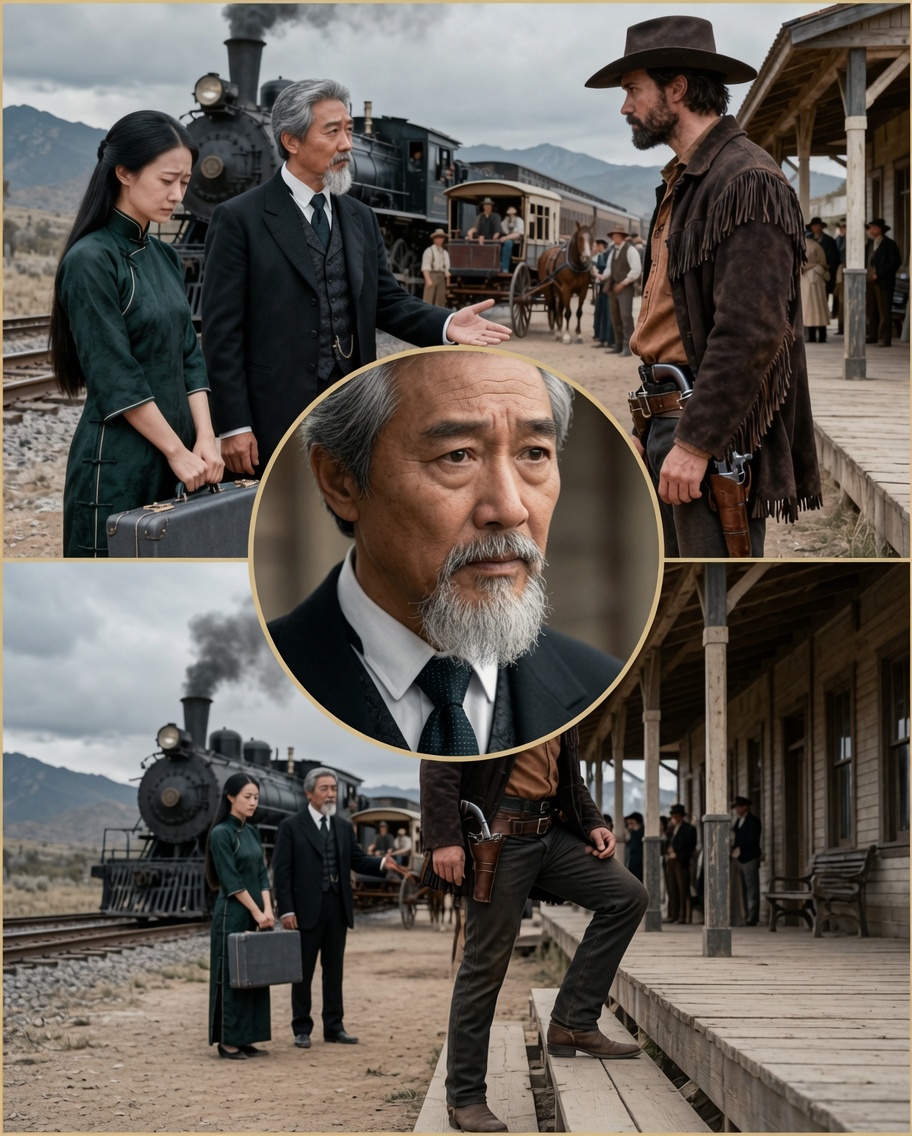
The dark green silk of the dress was the color of moss in a shaded forest, a world away from the baked red dust of the Nevada territory that now clung to its hem. Linmai stood motionless on the warped porch of the Agenta General Store. The fabric a cruel reminder of the life that had been snatched from her.
The dress had cost her father a small fortune in San Francisco, an indulgence he had called it, a disgrace. Now it was the only thing of value she possessed, and it felt like a burial shroud. Her father Bao stood beside her, his face a mask of cold fury. In his hand, he held a document freshly signed by the territorial cler. It was not a deed for a new mine or a contract for timber.
It was a marriage certificate bearing her name and the name of the American who stood before them, his hat held respectfully in his hands. The man’s name was Owen Beck. He was tall and weathered, with eyes the color of a faded blue sky and hands that looked as hard as sunbaked earth. He had not spoken a single word to her. The transaction was complete.
Owen Beck had owed her father a significant sum, a debt that had hung over his small ranch like a storm cloud for 2 years. Now that debt was erased. My was the final payment. She was no longer the daughter of a mining tycoon. She was the property of a stranger, a punishment for her extravagance, a lesson in humility to be served in this desolate corner of the world.
Owen Beck’s gaze was not unkind, but it was steady and unreadable. He looked at her father, then his eyes flickered to her, taking in the fine silk, the intricate embroidery, the pale, defiant set of her face. He gave a short, formal nod as if acknowledging receipt of a piece of freight. Ba turned to her, his voice low and sharp, speaking in their shared tongue, so the American could not understand.
You have shamed our name with your foolish spending. You chased the fashions of Western women and forgot your place. Here you will learn its meaning again,” he gestured with a flick of his wrist at the dusty street, the clapboard buildings, the vast indifferent expanse of sage and rock beyond. You will learn the value of a dollar, the weight of a day’s work.
You will learn humility here. or you will perish. It is no longer my concern. He did not say goodbye. He simply turned his expensive leather boots, making a sharp sound on the wooden planks, and walked to the waiting carriage. He climbed inside without a backward glance. The driver cracked the whip and the carriage lurched forward, kicking up a cloud of red dust that settled over Mai, coating the fine silk of her dress.
She was alone, utterly, terrifyingly alone, on a porch in a town she did not know, beside a man she did not know, with a future that was a blank, terrifying void. The silence stretched, broken only by the buzz of flies and the distant clang of a blacksmith’s hammer. Finally, Owen Beck spoke. His voice was deeper than she expected, a low rumble like stones moving at the bottom of a river.
he said, and that was all. He gestured toward a simple wagon hitched to a sturdyler looking mule. A few sacks of flour and beans were already loaded in the back. It was clear this was their transport. This was her new life. She did not move. Her feet felt rooted to the spot. To step off this porch was to accept the unacceptable, to surrender the last remnant of her identity.
But where could she go? She had no money, no allies, no knowledge of this harsh land. Her father had been methodical in his cruelty. He had not just exiled her, he had erased her. Owen waited, his patience a tangible thing. He did not rush her or command her. He simply stood, his hat in his hands, waiting for her to make the only choice she had left.
After a long moment that felt like an hour, she gathered the dusty hem of her green dress, took a breath that felt like swallowing sand, and stepped down from the porch. The journey to his homestead was made in near total silence. The wagon creaked and jostled over the ruted track, and the sun beat down with a relentless, oppressive heat.
My sat ramrod straight on the hard wooden bench, her hands clenched in her lap, focusing on a distant messa to keep from looking at the man beside her. He handled the mule with an easy, competent hand, his movements economical and sure. He seemed as much a part of the landscape as the sage brush and the rocks, his skin tan to the color of worn leather.
She had been raised in a world of whispers and silk screens, of calculated words and intricate courtesies. This man’s silence was different. It wasn’t empty. It felt solid, rooted in the earth itself. It was unnerving. She was an object, a piece of property traded for a debt. What would he expect of her? The thought sent a cold dread through her, a fear more potent than the blistering heat.
After an hour, he finally spoke again, his voice startling in the quiet. “My place is just over this rise,” he said, pointing with his chin. “It’s not much, but it’s mine.” The words hung in the air. “It’s not much.” That was an understatement. As they crested the rise, she saw it. A small unpainted clapboard house stood starkly against the vast landscape.
Beside it was a corral holding a few horses, a well with a simple wooden bucket, and a barn that looked to be in better repair than the house. The land rolled away in every direction, a sea of brown and pale green under a painfully blue sky. There were no other signs of life. This was not a home. It was a wound on the face of the earth.
As they drew closer, a new problem became apparent. A long section of the fence that enclosed his modest pasture was down. The posts kicked over and the wire lying slack in the dust. A halfozen cattle were missing from the small herd that remained. Owen pulled the wagon to a halt and swore a single sharp word under his breath.
He was out of the wagon in an instant, his body moving with a sudden coiled tension. He walked the broken fence line, his boots kicking up dust, his jaw tight. “Stling,” he muttered, more to himself than to her. He ran a hand through his hair, a gesture of pure frustration. He looked from the broken fence to the vast empty land where his cattle had likely wandered.
Then he looked at her, truly looked at her for the first time since the porch. His expression was not angry, but something closer to weary resignation. I need to track them, he said. They’ll have strayed toward the north spring onto his land. He gestured for her to get down from the wagon. The house is open. There’s water in the bucket.
He didn’t wait for a reply. He stroed to the corral, saddled one of the horses with practiced efficiency, and rode out, leaving her standing alone in the yard of her new prison. The dust from his horse’s hooves settled around her, a fine red powder on the green silk. He did not yet know that the fence was not the only thing his neighbor was trying to break.
The next day, Owen announced they had to go back into town for supplies he had been unable to carry on the first trip. The ride to Argenta was as silent as the first, but the tension had changed. It was no longer just the awkwardness of strangers. It was the shared unspoken knowledge of a threat. Owen had managed to haze his cattle back onto his property, but the message from his neighbor had been delivered.
Argenta was a small dusty collection of buildings that baked under the Nevada sun. As they walked toward the general store, Mai felt the eyes of the town upon her. Men on the saloon porch stopped talking. Women sweeping their stoops paused to stare. They saw her fine silk dress so out of place it might as well have been a royal gown.
They saw her face, her features so different from their own. and they saw her walking beside Owen Beck, a man they all knew to be a quiet homesteader struggling to make ends meet. The whispers followed them like flies. Inside the store, the air was thick with the smell of coffee beans, leather, and dust.
The storekeeper, a stout man with a suspicious squint, nodded curtly at Owen, but let his gaze linger on my with undisguised curiosity. As Owen gave his list, salt, kerosene, a new length of wire, the door swung open, and a man stepped inside, bringing a wave of heat and the scent of whiskey with him. He was large and well-dressed for Argenta, with a silver watch chain gleaming against his waist coat.
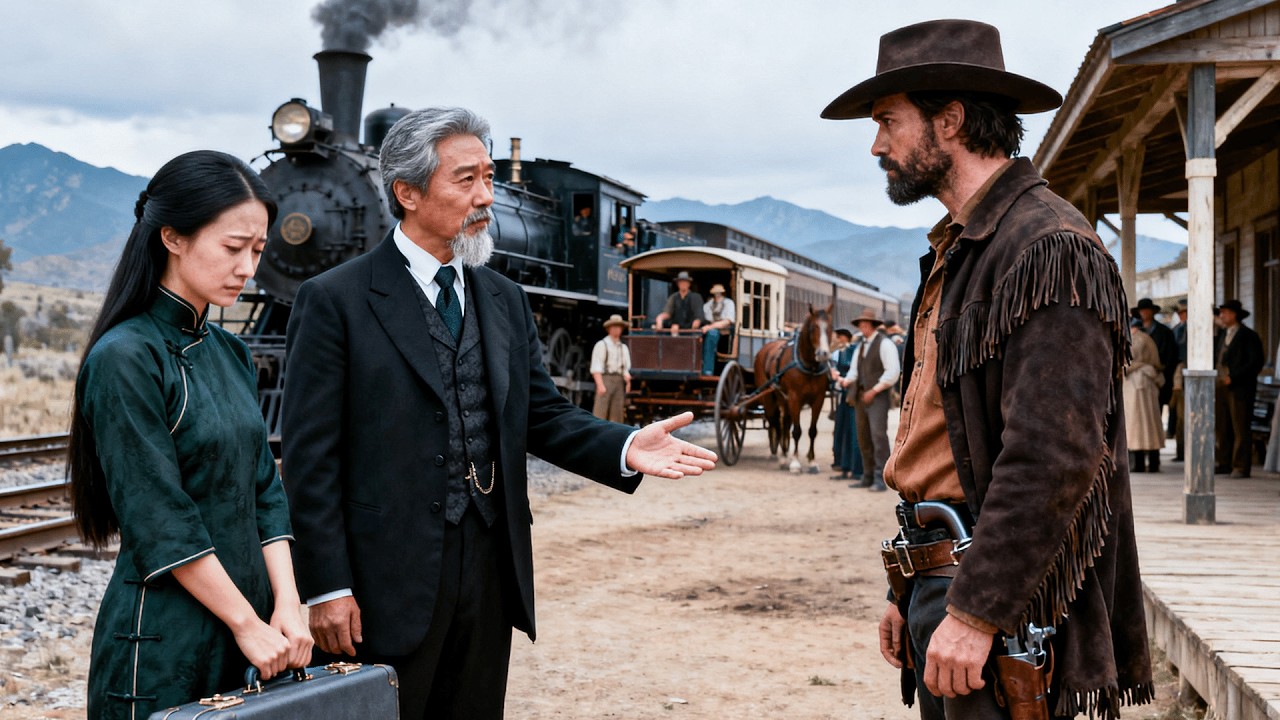
His face was fleshy and smug. He tipped his hat, a gesture that was more mockery than respect. “Beck,” he said, his voice smooth and oily. I see Bao’s final payment arrived safely, his eyes swept over my a slow, insulting appraisal. A bit more delicate than the usual livestock you deal in. My felt a hot flush of shame creep up her neck.
She stood taller, lifting her chin, refusing to let him see her fear. Owen finished his business with the storekeeper, his movements calm and deliberate. He didn’t look at the other man. Sterling, Owen said, his voice flat. He counted out the coins onto the counter. Marcus Sterling chuckled. A low, unpleasant sound.
Heard you had some trouble with your fence. Wind can be a powerful thing out here. Can knock a man right off his feet if he’s not careful. It was a blatant threat delivered with a smile. The storekeeper suddenly found something very interesting to count on a high shelf. Owen picked up his sack of supplies.
He turned and for the first time he met Sterling’s gaze. His faded blue eyes were as hard as granite. I found my fences are stronger than they look. Sterling, and I’m steady on my feet. He turned and walked out, leaving Sterling with his smug smile frozen in place. My followed him, her heart pounding. She had expected shouting, perhaps violence.
Instead, Owen had met the threat with a quiet dignity that was more powerful than any fist. He hadn’t defended her honor with grand words, but he had stood his ground, and in doing so, had drawn a line in the sand. The conflict was no longer just about land and water. Sterling had made it about her.
Back at the homestead, the work of repairing the fence began. Owen worked with a tireless rhythm, digging new post holes and stretching the wire tort. my watched from the porch of the small house, feeling useless. This was a world of physical labor, of sweat and muscle, and she knew nothing of it.
She had been trained in calligraphy, in the art of the tea ceremony, in managing a household of servants. None of that had any value here. After an hour, she could bear the idleness no longer. She carried a dipper of cool water from the well out to him. He stopped, surprised, and took it from her, his callous fingers brushing against hers.
He drank deeply, the water tracing a line down his dusty throat. “Thank you,” he said, his voice rough. He handed the dipper back. He looked at the blisters already forming on his hands from the hard work. “This land, it asks for everything you have.” He wasn’t complaining. It was a simple statement of fact.
He looked out at the valley, his valley, and a flicker of something she couldn’t name crossed his face. “It wasn’t pride exactly. It was something deeper, a connection to the soil itself. It is a harsh place,” she said, her own voice sounding foreign and formal. He nodded. “It is, but the light in the morning,” he said, gesturing to the east.
“And the quiet at night, there’s a peace to it if you can find it.” He was showing her something. She realized not just his land, but a piece of himself. He was not the unfeilling brute she had feared. He was a man of quiet substance, of deeprooted strength. The next afternoon, the danger escalated from veiled threats to immediate physical peril.
A large, mean-tempered bull from Sterling’s herd had somehow found its way through the newly mended fence. It had cornered one of Owen’s two milking cows against the side of the barn, its head low, snorting and pouring at the dry earth. Mai had been trying to coax a few stubborn vegetables to grow in a small patch of earth near the house when she heard the cow’s distressed bellow.
She saw the scene and froze, a cold knot of fear tightening in her stomach. The bull was a mountain of muscle and fury, its horns long and sharp. Owen came running from the corral, holding only a length of thick rope. He didn’t hesitate. “Get in the house, my”,” he yelled, his voice sharp with command. “Now!” She backed away, her feet clumsy, but she couldn’t take her eyes off the scene.
Owen didn’t approach the bull head-on. He moved in a wide circle, his steps light and deliberate, like a dancer. He talked to the animal in a low, steady voice, a stream of calming nonsense. The bull’s attention shifted from the terrified cow to the man. It lowered its head and charged. My stifled a scream. Owen didn’t run. At the last possible second, he sidestepped and as the bull thundered past, he slapped its flank hard with the coiled rope.
The bull bellowed in frustration, skidding to a halt and turning. It charged again. Again. Owen dodged, his movements fluid and precise. It was a terrifying ballet, a contest of nerve and agility against brute force. He was luring the animal away from the barn toward the open gate of the corral. On the third charge, he wasn’t quite fast enough.
The tip of a horn caught his arm, tearing through his sleeve and gouging a long bloody gash from elbow to wrist. He grunted in pain, but didn’t falter. He used the bull’s momentum to guide it through the corral gate and slammed it shut, trapping the beast inside. He stood for a moment, breathing heavily, his hand pressed against his bleeding arm.
The immediate danger was over. That night, the small house felt even smaller, the silence between them thick with the day’s events. Owen sat at the simple wooden table, while my tended to his arm. The gash was deep and angry-look. She had washed it as best she could with water from the well, but she knew from stories she’d heard how easily such wounds could fester in this land without proper medicine.
She tore a long strip from the silk of her own petticote, the fine fabric, a stark contrast to his blooded, sunbrown skin. As she carefully wrapped the bandage, her fingers were steady. In this small act, she felt a flicker of purpose for the first time since her arrival. She was not helpless. He watched her, his expression unreadable in the dim lamplight.
He had barely spoken since the incident, his pain a quiet, stoic thing. When she was finished, she tied the knot gently. He flexed his fingers, testing the bandage. “It will have to do,” she said softly. He finally met her eyes. The faded blue was dark with a weariness that went deeper than the physical wound.
“Thank you,” he said. The words were quiet, but they held a weight that filled the small room. He looked down at his bandaged arm, then back at her. Sterling didn’t cut that fence by accident. And that bull didn’t just wander over. He paused, and the gravity in his voice made her go still.
He’s not just after the land anymore. Weeks turned into a month. A fragile routine settled over the homestead. Mai surprisingly found a rhythm in the work. She took over the small vegetable garden with a fierce determination, coaxing life from the stubborn soil. She learned the quirks of the wood burning stove, the way to mend a shirt, the hundred small tasks that made up a life on the frontier.
She and Owen still spoke little, but their silence had changed. It was no longer the silence of strangers, but the comfortable quiet of two people working toward a common goal, survival. One evening, a summer storm rolled in, the sky turning a bruised purple and the wind howling around the small house, rattling the window panes.
The dust storm forced them inside early, trapping them together in the flickering lamplight. The air grew thick with unspoken things. Owen rose from the table and went to a small shelf above the hearth. He took down a worn leather pouch and brought it back to the table. He untied the drawstring and carefully tipped the contents into his palm.
It wasn’t money or a weapon. It was a single small degara in a tarnished brass frame. He slid it across the table toward her. The image showed a woman with a kind open face and eyes that crinkled at the corners as if she smiled often. She was not a great beauty, but there was a warmth to her that seemed to radiate from the silvered plate.
My wife, Owen said, his voice quiet. Her name was Sarah. She died two years ago. A fever the doctor couldn’t name. He looked at the picture, not at my He was speaking to the memory, to the ghost in the room. The loan from your father. It wasn’t for the land. The land was already mine. It was for the doctor. I brought him all the way from Carson City. paid a fortune for him to come.
It didn’t do any good. He finally lifted his gaze to meet hers, and in his eyes, she saw a grief so profound it was like looking into a deep, dark well. When your father made his offer with a debt for you, I saw the look on his face, and I saw the look on yours. He would have left you in the street in Argenta with nothing.
He took a slow, deep breath. I didn’t take you as payment, Miss Lynn. I took you because I owed Sarah a debt of kindness. She wouldn’t have stood by and watched someone be thrown away. I’m just trying to pay it. The word struck my with the force of a physical blow. All her assumptions, all her fears about this man crumbled into dust.
He had not seen her as a transaction, a punishment, a piece of property. He had seen her as a person in peril, and had offered the only sanctuary he could, however humble. His silence had not been indifference. It had been the quiet language of his own unresolved sorrow. A week later, the weekly freight wagon brought a letter.
It was from her father. The envelope was crisp, the handwriting precise. It was written in English, a clear sign. It was a business document, not a personal correspondence. Inside the letter was cold and brutally to the point. He was formally notifying Owen that the dowy he had promised, the final settlement of their arrangement, would be the deed to a 100 acre parcel of land bordering Owen’s property.
Mine knew the parcel. It was a worthless stretch of alkali flat without water or grass, land that even the coyotes avoided. It was a final calculated insult, a way for her father to claim he had met the terms of their agreement while providing nothing of value. It was a piece of paper designed to humiliate them both.
But the true danger arrived 2 days later. Marcus Sterling rode into the yard, and he was not alone. Beside him was a man with a silver star pinned to his vest, a territorial marshall. Sterling dismounted, a triumphant smirk on his face. Beck, he called out. I have some business with you. Owen came out onto the porch, my right behind him.
The marshall stepped forward holding a sheath of papers. Owen Beck, I have here a legal claim filed by Mr. Bao of San Francisco. He has sold his interest in your outstanding debt to Mr. Sterling. Sterling held up his own document. The agreement was that the debt would be cleared upon receipt of a suitable dowy. A judge in Carson City agreed that a deed to useless land does not qualify.
Therefore, the original debt is still valid, and I own it. The full amount is due in 30 days. It was a trap, perfectly sprung. Her father’s spiteful letter had been the bait. Sterling had used his money and influence to turn it into a legal weapon. There was no way Owen could produce that much cash in a month.
The ranch, the well, the land he had poured his life into. It would all belong to Sterling. Despair, cold and sharp. Pierce my. She had just begun to feel the fragile shoots of a new life, and now it was all to be torn away. But as she looked at Sterling’s gloating face, the despair hardened into a cold, clear anger.
Her father had underestimated her. They all had. She still had one weapon left. Tucked away in her trunk was a small jade pendant, a gift from her grandmother. It was her last link to her old life, a piece of her history. That night, she made a choice. The next morning, she rode into Argenta with Owen.
While he met with the cler to review the legal papers, a futile gesture, she went to the town’s Asai. She sold the pendant for a fraction of its worth. the cash feeling heavy and strange in her hand. She took the money not to the general store but to the telegraph office. She knew her father’s business dealings intimately. His greatest fear was not losing money but losing face especially among his American investors in San Francisco.
His reputation for being a man of his word was the bedrock of his empire. She wrote out the message her hand steady. It was addressed to her father’s primary partner, a cautious man named Thompson. The words were carefully chosen, a mix of Chinese subtlety and American directness. Father’s arrangement in Agenta questioned.
Local dispute threatened stability. Honorable solution required to protect shared interests. She handed the message and the money to the operator. As the clatter of the telegraph key began, she knew there was no turning back. She had not merely asked for help. She had declared war on her own father using his own code of honor against him.
She had burned her last bridge, all for a quiet man and a small piece of land under a vast Nevada sky. Three months passed. The blistering heat of summer softened into the golden hazy light of early autumn. The change in the season was mirrored by the change at the homestead. Two weeks after my sent the telegraph, a packet had arrived from a law office in San Francisco.
It contained a bank draft for the full amount of Owen’s original debt and a new ironclad deed to his property, free and clear, already filed with the territorial land office. There was no letter from her father, no message at all. Bao had chosen to protect his reputation. In silencing the problem, he had unwittingly set her free.
With the threat from Sterling gone and the land secured, a new life took root. Mai’s garden thrived, producing a surprising bounty of squash and beans. She had traded the last of her fine silk garments, save for the dark green dress, to a frighter’s wife, for a halfozen laying hens. She now wore practical denim and cotton clothes made for work, not for show.
The green dress lay carefully folded in her trunk, a relic of a person she no longer was. Owen had used the security of the deed to purchase a dozen more head of cattle. The ranch was still small, but it was no longer struggling. It was solvent. It was growing. The work was still hard, the days still long, but now it was work of building, not just surviving.
The quiet between them was now a shared language of partnership. They moved around the small house and the yard with an unspoken understanding, their tasks interwoven, their lives becoming a single sturdy braid. One evening, as the sun set, painting the western sky in shades of orange and rose, Owen came in from the corral.
He washed his hands at the basin, the scent of hay and horse clinging to him. He didn’t speak, but walked over to where she stood by the open door. He held out his hand. In his palm lay a small smooth riverstone worn gray by water and time. I found it by the spring, he said. The spring sterling had coveted.
It was cool in the water. She took it from him. The stone was heavy and cool, its surface perfectly smooth. It reminded her of the jade pendant she had sold, but this felt more real, more valuable. It was not a symbol of wealth or status, but a piece of this land. their land. He gently placed his callous hand over hers, his fingers enveloping the stone and her own. His touch was warm and sure.
This place, he said, his voice low and earnest. It’s as much yours as it is mine. My, it was the first time he had used her given name. Not Miss Lynn. My, it sounded right. It sounded like home. She looked out at the valley, the long shadows stretching across the earth. Her father had sent her to this harsh, desolate place to be broken, to learn humility in the dust.
But he had been wrong. She had not been broken. She had been forged. She hadn’t learned humility, but she had found her own quiet strength. And in the steady company of a good man, she had discovered that a home was not something you were given or born into. It was something you built stone by stone, day by day, hand in hand.
And that brings us to the end of this one. If you stayed with me all the way through, thank you. Stories like this one only get told because folks like you sit down and listen. If you liked what you heard, go ahead and hit that like button. And if you want more stories from the old frontier, subscribe so you don’t miss the next one.
Until then, take care of yourself and thanks again for being here.