The collision between Anthony Joshua and Jake Paul was billed as the ultimate test of legitimacy for the social media phenomenon—a chance for the 28-year-old YouTuber turned professional boxer to finally prove that he belonged in the ring with the elite. It was marketed with all the glitz and grandiosity of a championship event, promising fans a clash for the ages. However, the reality that unfolded in the ring was far removed from the promotional slogans. In a brutal display of clinical dismantling, Joshua—a former Olympic gold medalist and two-time unified heavyweight champion—exposed the dangerous chasm that separates “influencer boxing” from the cold, ruthless reality of world-class professional combat.
When the final bell tolled in the sixth round, it did not just signal the end of a fight; it marked the violent conclusion of an era. The image of Jake Paul, battered and broken with a double jaw fracture, became the permanent symbol of a night that went horribly wrong. Yet, the story is far less about the physical damage sustained and far more about the unsettling questions that remain: Who authorized this mismatch, and why did it feel like a televised lesson in humility?
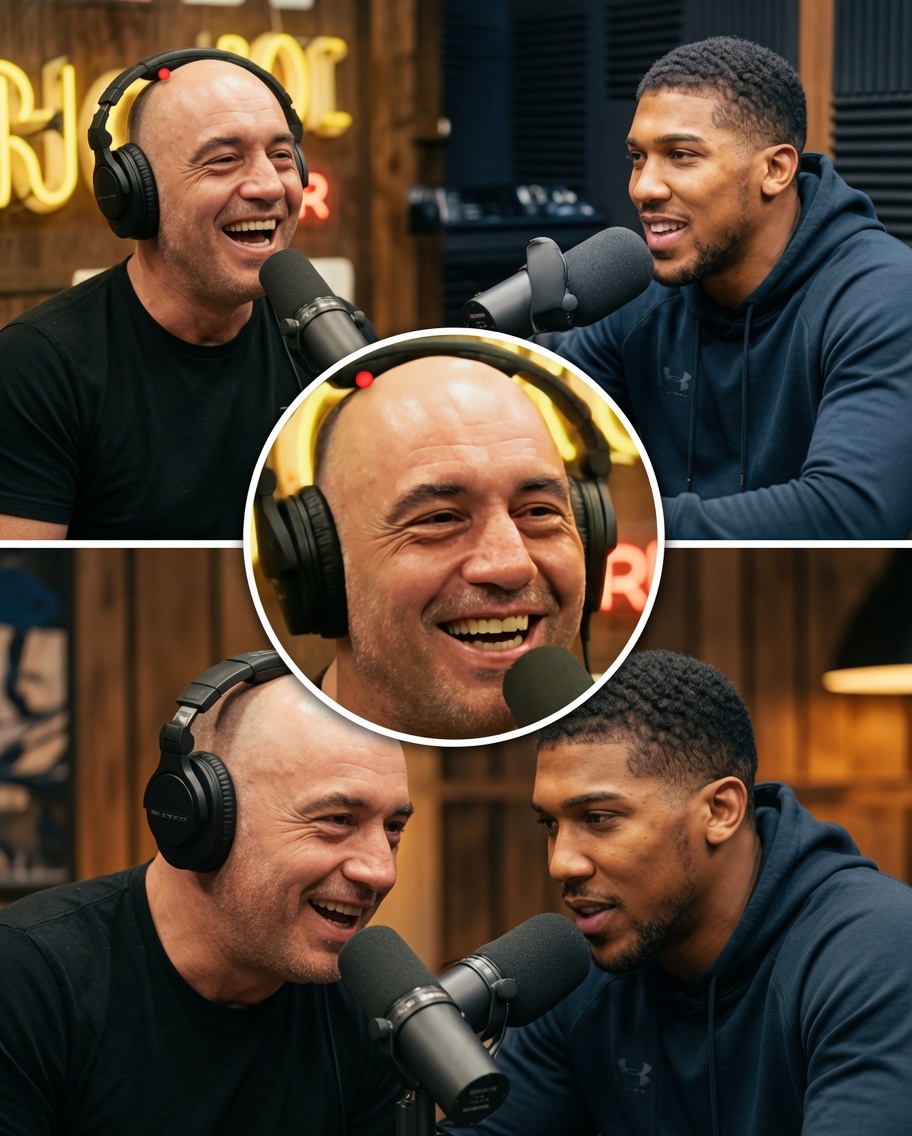
At ringside, UFC commentator Joe Rogan, a man who has witnessed nearly every iteration of combat sports carnage, appeared less like an excited spectator and more like a man watching a predicted catastrophe unfold. His reaction—a mix of chilling laughter and grim resignation—hinted at a secret the industry had been holding: everyone involved knew the outcome before the first punch was thrown. As Rogan noted, real boxing has no interest in hype or social media followings. It operates on laws of physics, timing, and accumulated experience—factors that cannot be coached or “memed” into existence. By putting Paul in the ring with a heavyweight of Joshua’s pedigree, the promoters didn’t just invite risk; they orchestrated an inevitability.
Following the knockout, Joshua’s post-fight remarks sent a chill through the industry. Rather than gloating, he spoke with an eerie, measured calm. He suggested that the early finish was actually an act of “mercy.” He warned that had the fight continued, he would have dismantled Paul piece by piece—physically, mentally, and emotionally. This was not the language of a fighter celebrating a hard-fought victory; it was the tone of a champion who knew he was holding back a tidal wave of violence, signaling to the world that this was not a professional encounter, but a reprimand.
The financial windfall of the event has been staggering, but critics and industry analysts, including Simon Jordan, have raised the alarm. For them, the spectacle was a “dark day” for boxing. They argue that these crossover events blur the lines between genuine sporting competition and cheap entertainment, siphoning oxygen away from fighters who have dedicated their lives to the sport. As Jordan pointed out, Joshua—a legend in his own right—did not need this fight for his legacy. He gained nothing but a fatter bank account, while the sport lost a measure of its dignity. If a man who has already conquered the peak of the sport is being pulled into this circus, the questions must turn to those pulling the strings. Who is orchestrating these events, and what is their end game?
The comparison to Paul’s brother, Logan, also surfaced, and it was a scathing indictment of the entire influencer boxing model. Analysts were quick to point out that while Jake had at least taken the training seriously, any move to put Logan in the ring with an elite heavyweight would be nothing short of a comedy of errors. The ease with which Joshua handled Jake, despite his movement and attempts at defensive strategy, served as a stark reminder that when speed and knockout power coexist at the heavyweight level, there are no learning curves—only endings.
The fallout of this event extends well beyond the ring. There is a palpable sense that the “House of Cards” built around influencer boxing is beginning to shake. Legal analysts and insiders are hinting at “willful breaches” of contract and behind-the-scenes chaos that the public has yet to fully grasp. The lawsuit from platforms like Netflix is just the tip of the iceberg, suggesting that the professional expectations of corporate partners are no longer aligning with the volatility of the talent. When corporations start looking at lawsuits rather than marketing campaigns, the party is effectively over.
Furthermore, the “merciful knockout” narrative suggests that the promoters knew the danger, yet proceeded anyway. This points to a deeper, more cynical problem: the commodification of human safety. For those in power, the goal was likely never to find a challenger for Joshua, but to monetize the anticipation of a fall. The fact that the fight was framed as entertainment meant that viewers may have forgotten the underlying danger, and it took a shattered jaw to remind the world that boxing is not a performance—it is a struggle for survival.
As we look toward the future, the boxing world remains in a state of flux. The “Logan Paul rumors” and the speculation about other fights feel increasingly like desperate attempts to keep a dying flame alive. Analysts are clear: the public is starting to distinguish between novelty and legitimacy. Once that line is hardened, it becomes almost impossible to blur again. The bill for these events is starting to come due, not just in medical costs, but in the erosion of trust. When a sport starts to feel like a scripted, predetermined event, it loses its primary value: the uncertainty of the outcome.
In the end, the fight between Anthony Joshua and Jake Paul will be remembered not for the skills on display, but for the clarity it provided. It was the moment the illusion shattered. It forced an industry to look into the mirror and realize that no amount of money or marketing can override the fundamental laws of combat. Jake Paul may have earned his bank account, and he may have earned a sliver of respect for showing up, but he also provided the most painful lesson of his career. The industry is now left with the aftermath—the lawyers, the lawsuits, and the sobering reality that when you play with the heavyweights, you don’t just get a loss. You get a change that is, in every sense of the word, irrevocable. The next time the gloves are laced up in this arena, the atmosphere will be vastly different. The circus has left town, and the serious work of reclaiming the sport from the wreckage has only just begun.