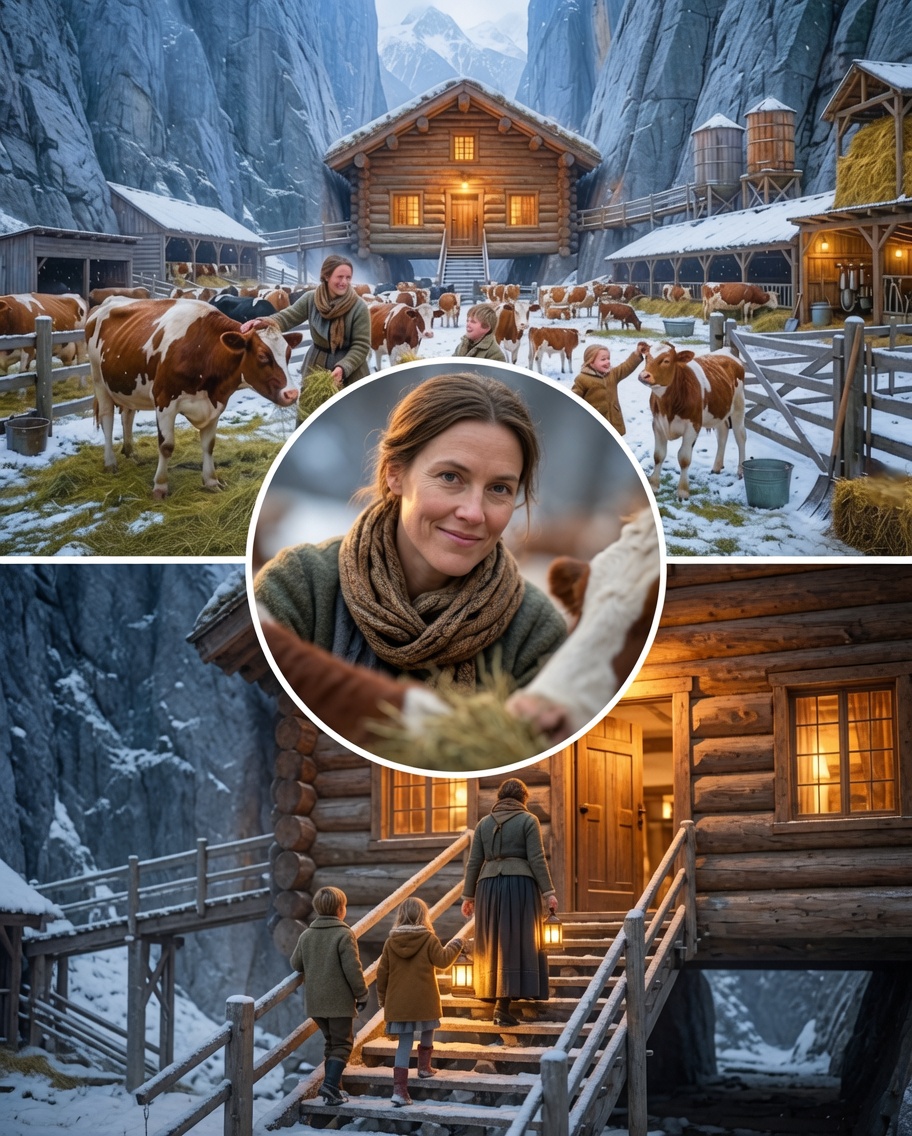
The Absaroka range of Montana territory did not welcome settlers. It tolerated them. And in the autumn of 1882, it was tolerating a woman who was doing something that made no sense at all. Britta Sundberg was not building on the flat, open ground where sensible people built. She was not building near the granite cliff for shelter, the way a practical homesteader might.
She was building inside the rock itself. A narrow vertical fissure split the granite face like a wound that had never healed. Barely 3 ft wide at its mouth, it tapered into darkness some 40 ft back. A place where a mountain lion might make its den, or where a man might hide from a sudden squall. It was not a place to build a home.
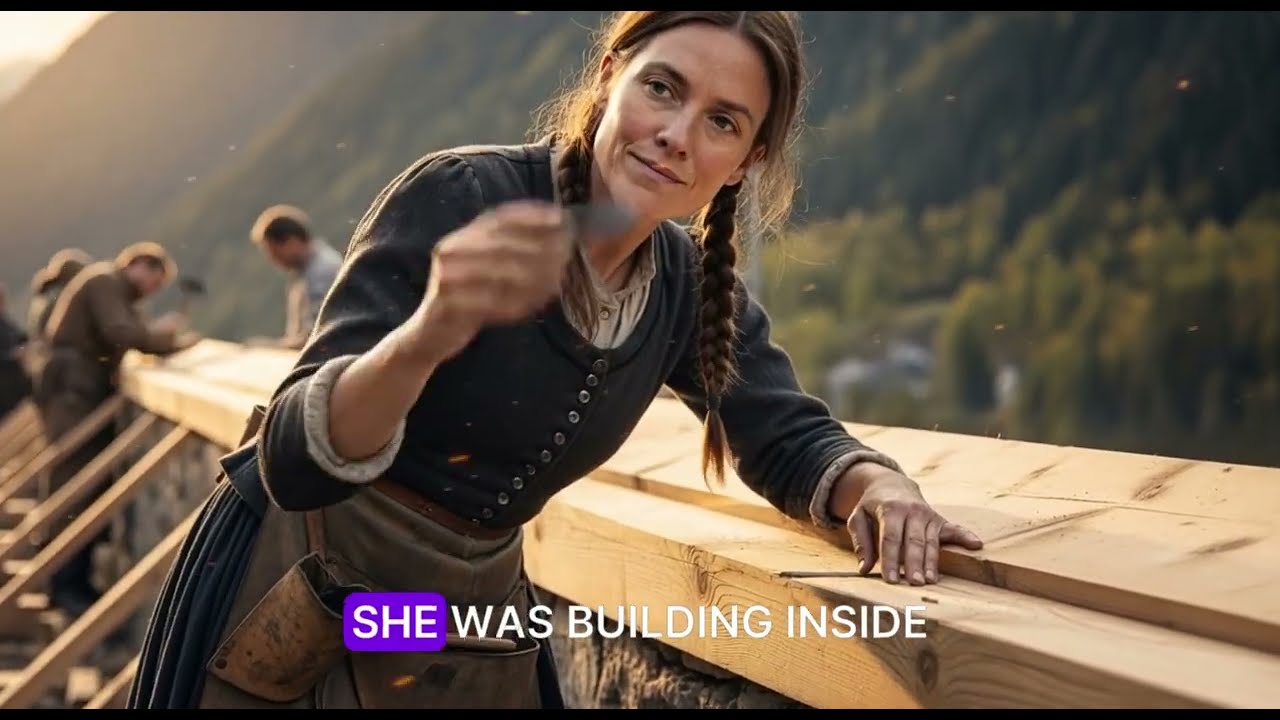
Yet there she stood, day after day, a 38-year-old widow with calloused hands and eyes that had seen too much death. She worked with a mason’s hammer and chisel, fitting hand-hewn timbers into the stone slot, wedging a cabin into the earth’s own crack. The other settlers thought her mad. Josiah Brennan watched from 20 paces away, his arms crossed over his chest, his face arranged in an expression of professional pity.
At 58, he had built more structures in this valley than any man alive. His cabins were sensible boxes set on stone footings, braced and chinked against the coming winter. He had buried three neighbors who had not built well enough. He knew what worked. This was not it. “She’s building a coffin for three,” he said, loud enough for the others to hear.
Silas Hadley and Dr. Horace Whitfield stood beside him, their breath fogging in the October air. “The widow’s lost her mind with grief. Come the first hard freeze, that rock will shift and crush that box like an egg.” Dr. Whitfield nodded, adjusting his spectacles. He was 52, educated back east, and considered himself an authority on matters both medical and mechanical.
“Structurally impossible,” he pronounced. “The thermal dynamics alone make it impractical. She will receive perhaps 1 hour of direct sunlight per day in winter. The space will be a cold, dark tomb.” Reverend Aldous Crane had joined them now, his Bible tucked under one arm. At 60, he had presided over more funerals than baptisms in this hard country.
He watched the widow work with troubled eyes. “Pride goeth before destruction,” he murmured, “and a haughty spirit before a fall.” Prudence Holloway, the 48-year-old wife of the general store owner, stood apart from the men, but close enough to hear everything. She considered herself the moral compass of the community, and she had opinions about everything.
“Poor thing has lost her mind,” she announced loud enough for anyone passing to hear. “Someone ought to take those children away before she kills them all.” Callum Sutter, 24 years old and possessed of more money than sense, saw entertainment where others saw tragedy. “Twenty dollars says that rock tomb collapses by Christmas,” he announced, pulling a coin from his pocket and flipping it in the air.
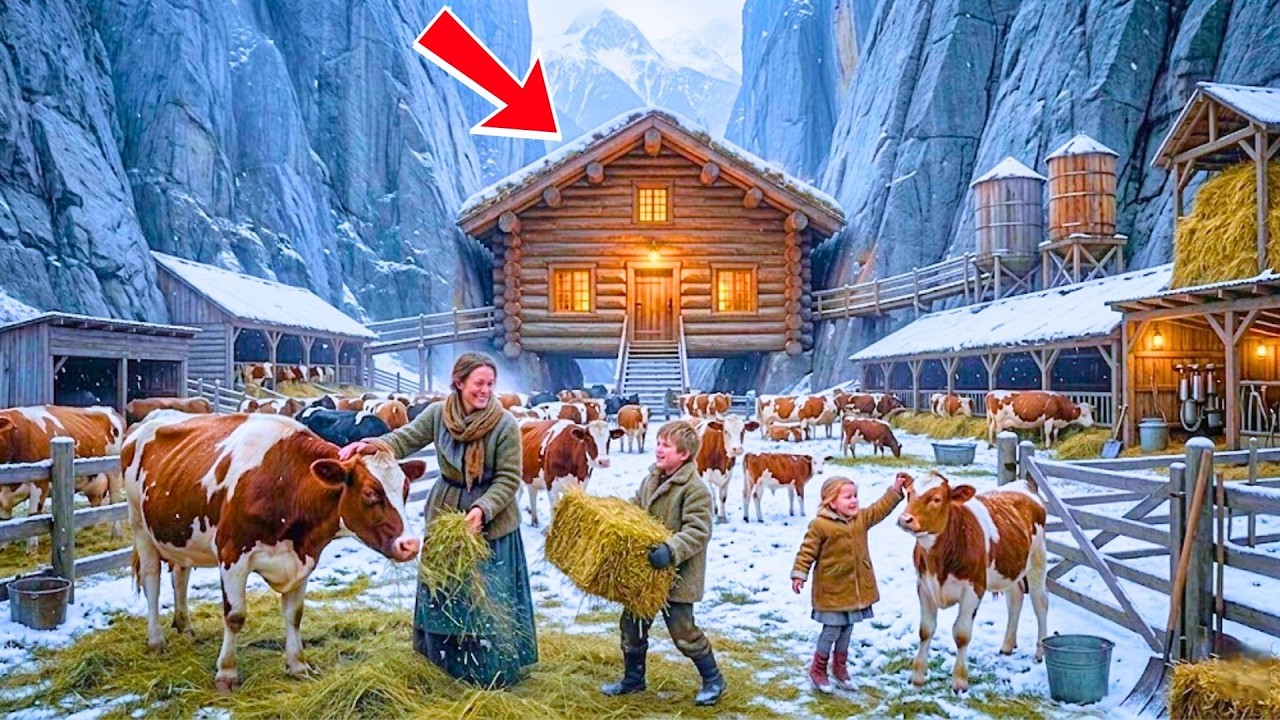
“Who wants action?” Britta Sundberg paused in her work. She wiped a line of sweat from her brow with the back of her wrist, though the air was cold enough to see her breath. She looked at the concerned, mocking faces of her neighbors. She had heard every word. She heard everything, though she rarely responded. At her feet, a gray dog lay watching.
Odin was a Norwegian Elkhound, 4 years old with a thick double coat and eyes that missed nothing. When Josiah Brennan took a step closer, the dog’s ears flattened, and a low rumble built in his chest. Britta looked at the perfect, seamless joint she had just made between wood and rock. She looked back at Brennan. “You will see,” she said, her Swiss accent thickened the simple words, made them sound like a prophecy rather than a promise.
Then she turned back to her work, lifting her adze to shape the next timber. The mockery would last all through the autumn. The validation would last a lifetime. What did this Swiss Alpine mason, a woman who thought in terms of pressure and stillness, understand about the physics of convection that a lifetime of frontier carpentry had missed? To understand that, you must first understand what had brought her to this crevice in the rock.
You must understand what she had lost and what she had learned from that loss. Britta Sundberg had not always been alone. She had come to Montana territory in the spring of 1880 with her husband Ivar and their two children, Gunnar and Asta. Ivar was a mason like his father and grandfather before him, trained in the Bernese Alps of Switzerland, where buildings did not stand on the land so much as they grew from it.
His hands knew the heft of granite, the grain of limestone, the precise way a dry-stacked stone wall could breathe, yet hold back a dozen feet of snow. Britta had learned the trade at his side. In Switzerland, it was unusual for a woman to work stone, but Ivar had seen something in her.
Patience, precision, the ability to see solutions where others saw only problems. He had taught her everything he knew, and she had absorbed it all. They had left Switzerland for the promise of land. The pamphlets sent by the railroad companies had shown green valleys and endless opportunity. They had not shown the wind. Their first full winter, the winter of 1881 to 1882, was the education.
They had built a small conventional cabin, following the advice of Josiah Brennan himself. A single room, 16 by 20 ft, with a loft for the children. They had chinked it with mud and grass, stacked cords of cottonwood by the door, and believed they were prepared. They were not. That winter descended not as a gentle blanket of snow, but as a physical assault.
The wind was not weather in Montana. It was a predator. It found every microscopic crack in the chinking and forced a blade of cold air through. At night, lying beside Ivar under a mountain of blankets and buffalo robes, Britta could hear the nails in the roof sheathing groaning under the strain. A high-pitched creak as the wood and metal contracted at different rates in the abyssal cold.
Some mornings they would wake to find the inside of their own door iced shut. The moisture from their breath had frozen it solid to the jamb. They had to use a kettle of hot water to melt their way out of their own home. Worst of all was the air itself. Inside the cabin, a space meant to be a sanctuary, their breath smoked. Little plumes of white vapor puffed from Gunnar and Asta as they huddled near the small iron stove.
The stove devoured wood at an astonishing rate, yet seemed to produce no meaningful warmth beyond a 3-ft radius. Ivar worked himself to exhaustion that winter. He rose before dawn to chop wood, spent his days repairing the endless damage the wind inflicted on their homestead, fell into bed each night with muscles screaming and lungs burning from the cold.
By February, the cough had started. By March, he could not rise from bed. By the first thaw of April, Britta was digging a grave in ground that was still half frozen, her children watching with hollow eyes. The wind tearing at her black dress like it wanted to claim her, too. Ivar Sundberg was buried on a hillside overlooking the valley.
He was 39 years old. He had survived winters in the Alps that would have killed any man in Montana, but the Alps had taught him how to work with the mountains. Montana had given him no such wisdom. He had not died of the cold. He had died of fighting it. That spring, as the valley thawed and the other settlers repaired their wind-battered roofs, Britta Sundberg did not grieve in the way people expected.
She did not weep openly or seek comfort in the church or collapse into the arms of sympathetic neighbors. She walked. For weeks, she walked the land around her homestead. She did not look at the good timber or the fertile soil. She looked at the rock formations. She studied the way the wind flowed over the landscape like water in a riverbed.
She watched it shear over the tops of ridges and form eddies behind outcroppings. She was searching not for a place to build, but for a place of calm. Her father had taught her this in the Alps when she was young, before she met Ivar, before she learned the mason’s trade at his side. She had learned to read the wind.
“Do not fight the mountain,” her father had said, “become part of the mountain.” Gunnar, 12 years old and trying desperately to be the man of the house, did not understand. “What are you doing, Mama?” he asked one afternoon, finding her standing at the base of the granite cliff, her eyes closed, her face tilted toward the sky.
The wind was blowing 40 mph, strong enough to make him stagger, but his mother stood perfectly still. “What are you looking for?” “Silence,” she said. “There is no silence here,” he said. “The wind never stops.” Britta opened her eyes. She looked at her son, this boy who looked so much like his father, who was trying so hard to fill shoes that were far too large.
“Come,” she said. She led him along the base of the cliff until they reached the fissure. It was an unremarkable crack in the rock, barely wide enough for a person to enter, the kind of place you might walk past a hundred times without noticing. “Stand here,” Britta said, positioning Gunnar at the mouth of the crevice.
The boy stood, bracing himself against the gale. “Now step inside.” Gunnar took three steps into the fissure and stopped. The wind, which had been tearing at his coat and stinging his eyes, simply ceased. Not diminished, ceased. The air inside the crevice was perfectly, impossibly still. He could hear his own heartbeat.
“Mama,” he whispered, “how?” Britta stepped in beside him. The fissure was narrow, the walls of granite rising 20 ft on either side. At the back, 40 ft in, the crack tapered to nothing. “The wind cannot turn corners,” she said. “It flows like a river. This crevice is a harbor, and I am going to build our home here.
” Gunnar stared at her. His first reaction was not wonder. it was fear. “Mama,” he said slowly, “This is not how people build. Mr. Brennan, he builds proper cabins. Everyone builds proper cabins. If you do this, people will think you are crazy.” Britta met her son’s eyes. “Let them think what they want. I am not building to impress them.
I am building to keep you and your sister alive.” “But what if they are right? What if it does not work?” “It will work. How do you know?” “Because my father built like this, and his father before him, and his father before that. This knowledge is older than America, Gunnar. It comes from people who had to survive without modern tools, without proper cabins, without anything except their eyes and their hands and their understanding of the world.
” She put her hand on his shoulder. “I know you are scared. I am scared, too. But I trust what my father taught me. I trust myself, and I need you to trust me, too.” Gunnar was silent for a long moment, then he nodded slowly. “I will try,” he said. The decision was announced to no one. Britta simply began working.
She started by preparing the rock itself. With her mason’s hammer in a set of chisels, she spent the first 2 weeks smoothing the two parallel faces of the crevice. She was not trying to make them perfectly flat, but to remove any sharp protrusions or loose flakes that could create pressure points against her timbers.
This was the work that Josiah Brennan and the others mistook for foolishness. They saw a woman chipping away at a mountain when she should have been raising walls. They did not understand that she was preparing her true foundation. The granite itself would be her walls. The mountain would be her fortress. She needed only to seal the openings.
Within days, word had spread through the settlement. Prudence Holloway made sure of that. “The widow has lost her mind,” she announced at the store counter, loud enough for everyone to hear. “She is building some kind of cave dwelling, like a savage. Someone ought to intervene.” >> [clears throat] >> The words reached Britta within a day.
She did not respond. Callum Sutter made good on his betting scheme. 15 men took the wager against Britta, putting up money that her structure would fail before spring. Only two bet in her favor. Old Tobias Hartwell was one of them. At 78, he was the oldest man in the valley, a former miner who had spent his youth in the copper mines of Cornwall before emigrating to America.
He had seen things underground that most men never saw. He understood rock in ways that carpenters never could. “The woman knows what she is doing,” he said, counting out his coins. “Round things last. The mountain knows.” Klaus Meyer, the German blacksmith, was the other. He said nothing at all, just placed his money down with a quiet nod.
He recognized the techniques Britta was using. He had seen similar work in the Alpine regions of his homeland. He knew it was not madness. He also began quietly reducing his prices when Britta came to buy nails and hinges. Prudence Holloway noticed and made sure everyone knew about that, too. “Helping a madwoman,” she clucked.
“What does that say about his judgment?” Klaus ignored her. He had learned long ago that the loudest voices were rarely the wisest. If you have ever had to keep working when everyone around you said you were wrong, you know how Britta felt that summer. There is a special kind of loneliness in being the only one who can see what you are building.
If you have experienced that, I would love to hear your story in the comments. By midsummer, Britta had begun fitting the first timbers into place. Her technique was unlike anything the frontier carpenters had ever seen. A standard cabin was built of uniform logs, the gaps filled with chinking. Britta was creating a chinkless seal.
She would lay a log in place, its raw surface inches from the stone. Then, using a small compass-like tool called a scriber, she would trace the rock’s profile onto the log. With painstaking care, using a drawknife and an adze, she would carve away the wood until the log nested against the stone as if it had grown there.
The process was achingly slow. A single log could take a full day. Micah Garrett, a 16-year-old orphan who worked odd jobs around the settlement, had begun watching from a respectful distance. Unlike the mockers, he came with genuine curiosity. After a week of silent observation, he finally worked up the courage to speak.
“Why do you do it that way, ma’am?” he asked. “Would it not be faster to just the gaps?” Britta did not stop her work, but she answered, “A seam of chinking is a seam for the wind. The wind finds every crack. It does not need much. A gap the width of a hair will let the cold pour through.” She held up the log she had been shaping, showing him how it fit against the rock.
“Wood against stone, no gaps, no cracks, no wind.” Micah nodded slowly. He was beginning to understand. “What about the other side?” he asked. “The gap between your wall and the rock?” Britta almost smiled. “That is the secret,” she said. “That gap is my best insulation. I do not understand. What is the best insulator in the world, boy?” Micah thought.
“Wool? Straw?” Britta shook her head. “Air. Still air. Air that cannot move.” She set down her tools and faced him fully. “In a normal cabin, the wind blows against the walls and strips away the heat. Convection, like blowing on hot soup to cool it. But air that is trapped, air that cannot move, that air holds heat instead of stealing it.
” She pointed to the narrow gap between her wooden wall and the granite face. “This space will be filled with air that cannot flow. The wind cannot reach it. The wind cannot steal what it cannot touch. I am building a house inside a house made of stone. The space between them is my insulation.” Micah stared at the 2-in gap.
He had thought it was wasted space, a sign of poor craftsmanship. It was the most important part of the design. From that day forward, Micah came every afternoon after his other work was done. He asked questions and Britta answered them. He began to help, carrying tools, holding timbers in place. He was not paid, and he did not ask to be.
He was learning something more valuable than money. In early October, a man came to see Britta. His name was Ephraim Moss, and he owned the largest ranch in the valley. He was 45 years old with cold eyes and a thin smile that never reached them. “Mrs. Solberg,” he said, removing his hat in a gesture of false respect.
“I have come to make you an offer.” Britta did not stop her work. She was fitting the door frame, a critical junction that had to be perfectly sealed. “I know you are struggling,” Moss continued. “A widow alone with two young children, this homestead is too much for you. I am prepared to offer you a fair price for the land.
You could take your children somewhere safer, somewhere with better prospects.” Britta straightened. She looked at Moss for a long moment. His eyes were calculating, his smile thin. She understood perfectly what he was offering. “This land belonged to my husband,” she said. “He is buried here. I will not sell.” Moss’s smile flickered.
“Think carefully, Mrs. Solberg. Winter is coming. Your structure is unconventional. If it fails, you will be left with nothing. I am offering you security.” “You are offering me a fraction of what this land is worth, and you are betting I will fail.” The false friendliness drained from Moss’s face. “Winter will change your mind,” he said coldly.
“When that rock pile collapses, I will be here to take the land off your hands.” He looked at the crevice cabin with contempt. “One way or another.” He rode away without another word. Britta watched him go. Odin growled softly at his departing back. She turned back to her work. The door frame would be finished by nightfall.
The crisis came in the middle of October, when the aspen leaves had turned gold, and the nights were already dropping below freezing. Asta had always been the fragile one. At 7 years old, she had her mother’s fair hair, but none of her mother’s constitution. The winter that had killed her father had nearly killed her, too.
She had spent 3 months coughing, 3 months with a rattle in her chest that would not clear. She had survived, but her lungs had never fully recovered. Now, as autumn tightened its grip, the cough returned. Britta woke one night to the sound of it, a deep, wet, tearing sound that seemed too large to come from such a small body.
She lit a candle and found Asta sitting up in her bed, her face flushed, her eyes bright with fever. The next morning, she wrapped Asta in blankets and took her to Dr. Whitfield. The doctor listened to Asta’s chest with his stethoscope. He had her breathe deeply, which triggered a coughing fit that lasted nearly a minute.
He looked in her throat, felt her forehead, and then sat back with a grave expression. “The lungs are compromised,” he said. “The illness from last winter did lasting damage. She is susceptible to respiratory infections.” “What can be done?” Britta asked. Whitfield shook his head. “She needs warmth, consistent warmth.
Dry air, no drafts.” He paused, glancing at Britta. “I understand your living situation is unusual, a cabin in a rock crevice, from what I hear.” Britta said nothing. “I must be blunt, Mrs. Solberg. A conventional cabin would be difficult enough for a child in her condition. But what you are building,” he spread his hands, “it is cold, dark, and damp.
The rock walls will sweat moisture. The air will be stagnant. If you try to winter in that structure, this child may not survive until spring.” Britta felt the words like a blow to the chest. She looked at Asta, who was sitting quietly, too tired to play, too weak to complain. “How long does she have?” Britta asked.
“If her condition worsens?” Whitfield shook his head slowly. “Weeks. Perhaps less if she is exposed to severe cold.” Britta lifted Asta into her arms. The child weighed almost nothing. “Thank you, Doctor,” she said. She walked out into the October wind, her daughter’s head resting against her shoulder. The cabin had to be finished before the first snow.
Not eventually, not hopefully, had to be. Her daughter’s life depended on it. She had 5 weeks. The next morning Britta was working before dawn. Gunner found her there when he woke, already fitting timbers by lantern light. He watched from the mouth of the crevice, this 12-year-old boy who had spent the last 6 months wrestling with doubt.
He had not fully believed in his mother’s project. Part of him had wondered if the skeptics were right, if she really had lost her mind with grief. He had gone through the motions of support, but his heart had not been in it. Now watching her work in the darkness, her breath fogging, her hands raw and red, he finally understood.
She was not building something strange. She was building something to keep them alive. “Mama,” he said. She did not stop working. “Mama, I want to help.” She paused then. She turned to look at him. In the lantern light, he could see the exhaustion in her face, the grief she never showed, the fear she never spoke.
“Asta is sick,” he said. “I know. I heard you talking to yourself last night. I know we have to finish before winter.” He stepped forward into the crevice, into the harbor of stillness. “I was wrong to doubt you. I was scared, scared you were wrong, scared we would lose you like we lost Papa.” Britta set down her tools.
She crossed to her son and put her hands on his shoulders. “I was scared, too,” she said softly. “Every day I am scared, but I know what I am building. I know it will work. I know it because my father taught me, and his father taught him, and his father before that. This is not madness, Gunner. This is knowledge, old knowledge that people have forgotten.
” Gunner nodded. His eyes were wet, but he did not wipe them. “Teach me,” he said. “Have you ever had a moment when a child you love finally understood you? When the distance between you suddenly closed? Hold on to that feeling. It is one of the most precious things in this world.” From that day they worked together.
Gunner was not skilled, but he was strong and willing. He learned to hold timbers in place while his mother scribed them. He learned to swing an adze, rough at first, then with increasing precision. He learned the way his mother talked to the wood, coaxing it into shapes that seemed impossible. Micah Garrett came every afternoon, adding his labor to theirs.
Klaus Meyer closed his forge early some days to help with the heavier lifting. Even old Tobias Hartwell hobbled up on his bad leg, offering not labor, but wisdom, advice [clears throat] on how to read the grain of a timber, memories of construction techniques from the old country, encouragement when the work seemed endless.
The skeptics still came to watch. Josiah Brennan stood at the mouth of the crevice one afternoon, watching the progress with narrowed eyes. The structure was nearly complete now. The walls were sealed, the roof was on, only finishing work remained. “Might actually stand through the winter,” he admitted grudgingly. “But it will not be livable.
Mark my words. That rock will sweat, the air will not move, and come February, you will be begging to move into a proper cabin.” Britta did not respond. She was fitting the last of the window frames, small openings with thick glass and tight seals. Brennan shook his head and walked away. Three days later, the first snow fell.
The cabin was finished on the last day of October. Britta stood at the entrance with her children, looking at what they had built together. From outside, it was almost invisible. A door and two small windows set into a granite cliff. The roof merged with the rock above, covered with sod and already beginning to blend with the native vegetation.
In a few years, it would be indistinguishable from the landscape. Inside, it was a different world. The space was narrow, but not cramped. The 30-ft depth gave them room for a cooking area near the front, a living space in the middle, and sleeping quarters in the back. The granite walls rose on either side, solid and eternal.
The timber front and back walls were tight, not a crack visible. The small windows let in light that reflected off the pale stone, filling the space with a soft glow. Britta lit the small iron stove she had installed in the center of the space. It was a quarter the size of the stove in their old cabin, barely large enough to heat a normal room.
She fed it a handful of kindling. Within an hour, the temperature inside had risen to 60°. Outside, it was 28° and falling. Gunner put his hand on the granite wall. “It is warm,” he said, surprised. “The rock is warm.” Britta nodded. “The rock is always 54°. In summer, it feels cool. In winter, it feels warm. It is the same temperature always.
The earth does not change like the air.” Asta was sitting on her new bed, her cough quiet for the first time in days. The air inside the cabin was warm, dry, and perfectly still. No drafts, no cold spots, no wind knifing through hidden cracks. “I like it here, Mama,” she said. “It feels safe.” Britta looked at her daughter, at her son, at [clears throat] Odin settling onto his rug with a contented sigh.
“It is safe,” she said. “The safest place in Montana.” November brought the first test. A cold snap descended on the valley, temperatures dropping to 10° below zero for five consecutive days. The wind howled through the settlement at 40 mph, constant and merciless. At the Brennan homestead, the family huddled around their stove, burning wood at a furious rate.
The corners of their cabin were rimed with frost. The windows were opaque with ice. Josiah’s wife complained of drafts that cut like knives, no matter how much he chinked the walls. At the Dawson homestead, similar scenes. Five people crowded into a single room, burning through their wood pile at an alarming rate, fighting a battle they could not win.
At the crevice cabin, Britta sat by her small stove, mending one of Asta’s dresses. The fire burned low and steady, consuming wood at a fraction of the rate she had used the previous winter. The temperature inside held steady. Asta was reading a book, Gunner was playing checkers with himself, and Odin was dreaming by the fire, his paws twitching.
The sound of the wind was a distant murmur, like a river heard through stone. Inside the crevice, inside the harbor, the storm did not exist. On the fifth day, Prudence Holloway came to visit, ostensibly to check on the welfare of the children. She knocked on the door, bracing herself against the cold. When Britta opened it, a wave of warmth spilled out, and Prudence’s mouth fell open.
The interior was nothing like what she had expected. It was warm. It was bright, the light from the windows reflecting off the pale granite. The air smelled of wood smoke and baking bread. The children were healthy and pink-cheeked, not the pale, shivering waifs she had imagined. “I came to see if you needed anything,” Prudence stammered. Britta stood aside.
“Would you like some tea?” Prudence stepped inside. She looked around at the stone walls, the snug wooden seals, the small stove radiating gentle heat into the narrow space. She had expected squalor. She had expected desperation. She found neither. “I do not understand,” she said finally. “How is it so warm? Your stove is barely burning.” Britta poured two cups of tea.
“The wind cannot reach us here,” she said simply. “The rock holds its temperature. The air does not move. We are not fighting winter, Mrs. Holloway. We are hiding from it.” Prudence drank her tea in silence. When she left 20 minutes later, she did not know what to say to anyone. So she said nothing at all.
The skeptics noticed her silence. They wondered what she had seen. December brought mild weather, and the settlement relaxed. Perhaps the winter would be kind. Then on January 15th, 1883, the sky turned a color that old Tobias Hartwell recognized immediately. He found Britta outside her cabin, gathering the last of her stored herbs.
“Storm coming,” he said, his voice grave. “Bad one. I have seen that sky only twice in 78 years. Both times, people died.” Britta looked up at the clouds. They were a bruised purple-gray, moving with unnatural speed from the northwest. “How long?” she asked. “Day, maybe two before it hits.” Tobias looked at the crevice cabin, at the door set into the rock.
“You will be all right in there.” “Better than all right. But the others?” He shook his head slowly. Britta nodded. She went inside to prepare. The storm arrived on January 18th. It did not come as snow, it came as wind. The storm that descended on the Absaroka Valley in January of 1883 was not a blizzard in the traditional sense.
It was what the old-timers called a ground blizzard, the most vicious weapon in winter’s arsenal. For the first 3 days, the snowfall was almost modest, perhaps 6 in in total. But the wind, the wind was a monster. It came from the northwest at a steady 60 mph, with gusts reaching 75. At those speeds, snow does not fall.
It flies horizontally. The 6 in that had fallen were picked up and hurled across the landscape like bullets of ice. Visibility dropped to zero. A person could not see their own hand in front of their face. The temperature plunged to 30 below, and with the wind chill, exposed skin would freeze solid in 3 minutes.
The first casualty was Edgar Morrison’s milk cow. She had wandered to the far corner of her paddock when the storm hit. And by the time Edgar realized she was missing, it was too late. They found her 3 days later, frozen upright, her eyes open, ice crystals coating her lashes. The second casualty was nearly Ezra Dawson.
Ezra was 9 years old, the youngest of the Dawson family’s five children. On the fifth day of the storm, with the wood pile running dangerously low, his father Thomas made the decision to dig out the emergency store of fuel from the lean-to behind the house. “I will be back in 10 minutes,” Thomas told his wife. “Keep the children inside.
” Ezra watched his father disappear into the white wall of wind and snow. 10 minutes passed, then 20, then an hour. Martha Dawson was trying to decide whether to go after her husband when the door burst open and Thomas staggered in, his face white with frostbite, his hands shaking. “The lean-to,” he gasped, “buried. 6 ft of snow packed like ice.
I could not dig it out.” He collapsed by the stove, and Martha realized with horror that they had perhaps one day of fuel remaining. No one noticed that Ezra had slipped out the door. The boy had one thought in his head, simple and deadly. He would help his father. He would dig out the wood. He was small, but he was strong for his age, and he could not bear to see the fear in his mother’s eyes.
He made it perhaps 50 ft before he lost all sense of direction. The world was white, not white like snow on a calm day, but white like the inside of a cloud, white like blindness. The wind tore at his coat, spun him around, drove ice into his eyes until he could not open them.
He stumbled forward, or what he thought was forward, calling for his father. The wind swallowed his voice. He fell, rose, fell again. His hands, inadequately gloved, were already numb. He was going to die. He knew it with the simple clarity of a child. He was going to die, and no one would find him until spring. Then through the roar of the wind, he heard something.
A bark, sharp, insistent, cutting through the storm like a blade. A gray shape materialized out of the whiteness. Odin, the Norwegian Elkhound, planted himself in front of the boy, barking, then turned and began to walk. When Ezra did not follow, the dog came back, grabbed the boy’s coat in his teeth, and pulled. Ezra stumbled after the dog, too cold to think, too frozen to do anything but follow.
The world was still white, still howling, but now there was a guide, a gray ghost leading him through the storm. He did not know how long they walked. It felt like hours, though it could not have been more than minutes. Then suddenly the wind stopped, not diminished, stopped. Ezra opened his ice-crusted eyes and saw a door, a wooden door set into a wall of granite, and in that door, a woman standing with a lantern, her face sharp with concern.
“Come inside,” Brita Solberg said. “Quickly now.” She pulled the boy into the warmth, and Ezra Dawson began to cry. Inside the Crevice Cabin, the storm did not exist. Brita stripped off Ezra’s frozen outer clothes and wrapped him in a wool blanket. She sat him by the stove, examined his hands and feet for frostbite, and forced warm broth between his chattering teeth.
“How did you find me?” Ezra asked when he could speak again. “I was lost.” “Odin found you,” Brita said. She was rubbing the boy’s fingers, trying to restore circulation. He has been pacing by the door all afternoon. He knew something was wrong. The dog sat nearby, watching the boy with calm eyes. His thick coat was crusted with ice, but he seemed unbothered.
He had done what he was born to do. Asta brought another blanket. Gunnar added wood to the stove, though it barely needed it. The temperature inside the cabin held steady, as it had for weeks. “My family,” Ezra said suddenly. “They do not know where I am. They will think I am dead.” Brita nodded.
“We cannot go out in this. No one could survive more than minutes in that wind. We will have to wait.” “Wait for what?” “For the storm to break, or for someone to come looking.” Neither happened that night. The storm continued to rage, a white monster that had swallowed the world. Ezra slept by the fire, warmer than he had been in days, dreaming of his mother’s face.
In the Dawson cabin, Martha wept. The storm continued for 9 more days. It was not continuous snow, but it might as well have been. The wind never dropped below 40 mph. Fresh snow fell on the seventh day, another foot, and the wind immediately picked it up and redistributed into massive drifts. Some houses had drifts up to their rooftops.
Others were scoured down to bare ground. The temperature varied between 15 and 40 below zero. At those temperatures, with that wind, exposed flesh would freeze in under 2 minutes. Frostbite was not a risk, it was a certainty. In the settlement, chaos reigned. The Brennan house lost a section of roof on the sixth day.
The wind found a weak point in the sheathing and tore it open like a wound. Snow poured in, covering half the living space. Josiah nailed a tarpaulin over the gap, but the cold poured through. His family huddled in the remaining half of the cabin, burning furniture to stay alive. The Holloway store ran out of kerosene on the eighth day.
Prudence and her husband Cornelius sat in the darkness, wrapped in every blanket they owned, rationing the last of their firewood. Dr. Whitfield’s cabin, the one he had proclaimed thermally superior, developed a crack in the chimney. Smoke filled the interior, and he had to choose between freezing and suffocating.
He chose freezing, opening a window to vent the smoke, and watched the temperature inside drop to 15°. Reverend Crane’s church, built with the congregation’s donations and his own faith, collapsed on the ninth day. The weight of the snow and the force of the wind were too much for the pitched roof. It came down at 3:00 in the morning with a sound like thunder, and only by the grace of God was no one inside.
Ephraim Moss locked himself in his ranch house and refused to let anyone else in, even when his own hired hands came begging for shelter. Callum Sutter, the young man who had bet $20 against Brita’s cabin, was trapped in the saloon with seven other men. They burned the bar, the tables, and finally the piano to keep from freezing.
And in the Crevice Cabin, Brita Solberg and her children lived as if winter was a rumor happening to someone else. 14 days in a storm. Have you ever been trapped somewhere waiting for the world to change? The hours stretch, the minutes crawl, and you learn things about yourself that you never knew. If you have a story like that, share it in the comments.
We are all in this together. On the 12th day, Josiah Brennan made a decision. His family could not survive another night in their damaged cabin. His wife was showing signs of frostbite on her feet. His two children, a boy of 10 and a girl of 15, had not stopped shivering in 3 days. They were burning the last of their chairs, and after that, there would be nothing left.
He remembered the widow’s crevice. He remembered the warmth that had spilled out when Prudence Holloway opened that door. He remembered his own words, “coffin for three, cold, dark tomb.” Pride was a luxury he could no longer afford. He wrapped his family in everything they had left.
He tied a rope around his own waist, then around his wife, then around each child. If they became separated in the whiteout, at least they would be tethered together. “Stay close,” he said. “Step where I step. Do not let go for anything.” They stepped out into the storm. The distance from Brennan’s cabin to the crevice was perhaps 200 ft.
In normal conditions, a walk of less than a minute. In the storm, it took 45 minutes, and three times Brennan was certain they were walking in circles. But he knew the land. He had lived here for 35 years. He kept the wind at a certain angle on his face, knowing that if it shifted, he was turning wrong. He counted his steps.
He prayed, something he had not done in years. And then, miraculously, the wind stopped. One moment he was staggering against the gale, snow blinding him, his wife’s weight dragging at the rope. The next he was standing in utter stillness. The roar of the storm suddenly muted to a distant hum.
He wiped the ice from his eyes and saw the crevice, the harbor, the door. He stumbled forward and pounded on the wood. The door opened, and warmth flooded out like a living thing. Brita Solberg stood there, her face unsurprised, as if she had been expecting him. “Come in,” she said. Josiah Brennan, master carpenter, most respected builder in the valley, the man who had called her mad, stepped into the warmth and felt tears freeze on his cheeks before they could fall.
The interior of the Crevice Cabin was unlike anything Brennan had imagined. He had expected darkness, dampness, misery. He found light, warmth, and comfort. The stone walls glowed softly in the lamplight, their pale granite reflecting the flame, and filling the narrow space with gentle illumination. The air was warm and dry, comfortable enough to move without a coat, but not stifling.
A small stove burned in the center of the space, its flame low and steady, consuming wood at a pace that seemed impossibly slow. Asta Solberg was sitting on a bed near the back, reading a book. She looked up when the door opened, her cheeks pink with health, her eyes bright. The child who Dr.
Whitfield had said would not survive the winter. Gunner was at a small table working on some kind of wood carving. He set it down and moved to help the newcomers with their frozen coats. And in the corner, little Ezra Dawson sat wrapped in blankets, a cup of warm milk in his hands. Brennan stared. The Dawson boy? He is alive? He wandered out into the storm 7 days ago, Britta said.
Our dog found him. She did not elaborate. She was helping Brennan’s wife to a chair, examining her frostbitten feet with practiced hands. Brennan’s children, Nathaniel and Clara, stood just inside the door, their eyes wide. They had been shivering for so long that they did not know how to stop, even in the warmth. Sit, Britta said. All of you.
There is room. Over the next 2 days more people came. The Dawsons arrived next, following the route Brennan had taken, desperate to find their lost son. Thomas Dawson wept when he saw Ezra alive and healthy, wept without shame or embarrassment. Martha Dawson embraced Britta with a ferocity that startled them both.
Thank you, she whispered. Thank you. Dr. Whitfield came the following morning. His face blue with cold, his spectacles fogged and cracked. He said nothing when he entered. He simply stood by the stove, absorbing warmth, his certainties dissolving around him. Prudence and Cornelius Holloway arrived that afternoon, having abandoned their store to the cold.
Prudence, who had gossiped so viciously about the widow’s madness, sat in a corner and would not meet anyone’s eyes. Reverend Crane came at dusk, his church destroyed, his faith shaken. He sat apart from the others, his Bible in his hands, murmuring prayers that no one could hear. Callum Sutter dragged himself in near midnight, alone, having walked from the saloon through drifts that reached his chest. He had lost his bet.
He had lost far more than that. He had lost his certainty that he understood how the world worked. 14 people in a space built for four. It should have been miserable. It should have been suffocating. It was neither. The crevice cabin had something that no other structure in the settlement possessed. It had stable air. The warmth did not fight against the cold because the cold could not enter.
The small stove burning slowly easily maintained a comfortable temperature for everyone. They slept in shifts. They shared food. They talked in low voices about the storm outside and the miracle they were living inside. 14 people in a stone quarter, sharing warmth, sharing food, sharing the humbling realization that they had been wrong.
Have you ever been in a situation where you had to rely on someone you had doubted? Someone you had dismissed? It changes you. If you have a story like that, we would love to hear it in the comments. On the 13th night, with everyone present, Britta finally explained. The wind is not your enemy, she said. They were gathered around her, 14 survivors in a stone quarter, listening with the attention of people who have had their assumptions shattered.
The wind is only doing what wind does. It moves. It flows like a river. And like a river, it carries things away. Heat, warmth, life. She drew in the air with her finger, sketching invisible diagrams. A normal cabin has four walls exposed to the wind. The stove heats the inside, but the heat conducts through the walls and the wind strips it away.
Convection. The faster the wind blows, the faster your heat disappears. You are trying to stay warm while standing in a cold river. Dr. Whitfield was nodding slowly, his professional resistance finally crumbling. This cabin has only one wall exposed to the wind. The sides are granite.
The back is buried in the crevice. The wind can blow against this mountain for a thousand years, and it will not take 1° of warmth from inside. But the cold, Josiah Brennan said, the rock should be cold. It should freeze us. Britta shook her head. The rock is not cold. The rock is 54°, always. That is the temperature of the earth below the frost line.
In summer, the rock feels cool. In winter, it feels warm. It does not change. It cannot change. She pointed to the narrow gap between her wooden walls and the stone. And this, this is the real secret. Air that does not move does not carry heat away. I have trapped air between my walls and the rock. The wind cannot touch it.
It cannot steal what it cannot reach. There was silence in the cabin. Outside, the storm still raged, but in here, in this harbor carved from stone, the laws of physics had been bent in their favor. The storm broke on the morning of February 1st, 14 days after it had begun. Britta was the first to notice.
She had been awake for hours, as she always was, checking on the stove, checking on the children, checking on the 14 souls who had come to her for shelter. At some point in the gray predawn hours, she realized that the sound had changed. The constant roar of wind had faded. The pressure against the door had eased.
The world outside, which had been a howling white void for 2 weeks, had gone quiet. She opened the door. The cold that rushed in was brutal, perhaps 25° below zero, but it was still cold. Calm cold. The wind had died. Outside, the world was transformed. Drifts rose 15 ft in some places, sculpted into fantastic shapes by 2 weeks of relentless wind.
The settlement was buried. Rooftops poked up from the snow like islands in a white sea. The sky was a pale crystalline blue, scrubbed clean by the storm. And on the granite face of the crevice, something remarkable. Josiah Brennan stepped out behind Britta, squinting in the sudden brightness. He looked at the cliff face and stopped.
The rock was covered in frost. A thick crystalline fur of ice coated every surface, climbing 20 ft into the air. The moisture in the stone had frozen and refrozen over 2 weeks, building up layer after layer of hoarfrost. But the frost did not cover the entire cliff. It stopped in a perfect, razor-sharp vertical line.
To the left of the line, frosted rock, white and glittering. To the right of the line, the wooden doorframe of Britta’s cabin, brown and bare. On the wood, there was no frost, none at all. The narrow gap between the cabin and the rock had maintained just enough warmth, just enough stillness, to prevent ice from forming.
It was a photograph of physics, a perfect demonstration of everything Britta had tried to explain. Brennan reached out and touched the frost-free wood. It was cool, but not cold. The boundary between frozen and unfrozen was absolute, a line drawn by the laws of thermodynamics. He turned to Britta.
I was wrong, he said. His voice was hoarse, but steady. I called you mad. I said you were building a tomb. I was wrong. He looked around at the stone walls, the wooden seals, the small stove barely burning. You did not build a house, Mrs. Solberg. You built a harbor. The others emerged one by one, blinking in the bright light, stunned by what they saw.
Dr. Whitfield stepped forward, his cracked spectacles sitting crooked on his nose. He looked at the frost line, at the cabin, at Britta. Mrs. Solberg, he said, his voice barely above a whisper. I told you the thermodynamics were wrong. I told you the rock would be a heat sink. I was educated at Harvard.
I have a medical degree and an understanding of physics that I considered superior to anyone in this valley. He paused, his eyes on the perfect line where frost met bare wood. I was a fool. The rock is not a heat sink. It is exactly what you said it was. I apologize. Britta nodded, accepting the apology without gloating.
Reverend Crane cleared his throat. He had been silent for most of the 2 weeks, wrestling with something. I quoted scripture at you, he said. Pride goeth before destruction. I thought you were the proud one. He shook his head slowly. It was me. I was the proud one. I thought I knew God’s will, and I used his words to mock a widow trying to save her children.
That is a sin I will carry with me. Prudence Holloway, who had spent the entire stay avoiding everyone’s eyes, finally spoke. I told people you had lost your mind, she said, her voice small. I suggested someone should take your children away. She looked at Asta, healthy and pink-cheeked, standing in the doorway.
I was wrong. I was cruel. I do not expect you to forgive me, but I am sorry. Even Callum Sutter, the young man who had bet $20 against her, found his voice. I made a joke of your work, he said. I treated your survival like entertainment. He reached into his pocket and pulled out a folded bill. This is the $20 I won from the bet.
I want you to have it. For the children. It is not enough, but it is something. Britta looked at the money, then at the young man’s face. She saw genuine shame there, genuine regret. Keep your money, she said. But remember this feeling. Remember what it cost you to be wrong. And next time someone does something you do not understand, ask questions before you mock.
Callum nodded, his face red. Yes, ma’am, he said. I will. The aftermath of the storm revealed the true cost of 2 weeks of winter warfare. 23 people died across four counties. Some froze in their homes when their fuel ran out. Others were found huddled together in their beds, having simply given up. A few died trying to reach neighbors or supplies lost in the whiteout.
Their bodies not discovered until spring. Hundreds of cattle perished. The ranchers who had not adequately sheltered their herds lost everything. Ephraim Moss, who had locked himself in his house and refused help to anyone, emerged to find that 60% of his cattle had frozen in the fields. Buildings collapsed throughout the region.
Reverend Crane’s church was the most notable, but dozens of barns, sheds, and even houses succumbed to the weight of snow and the force of wind. In Britta Solberg’s crevice cabin, 14 people had survived without a single case of serious frostbite. Not one. The news spread quickly, carried by the survivors themselves.
Josiah Brennan told the story to anyone who would listen, no longer ashamed to admit he had been wrong. Dr. Whitfield wrote a letter to a medical journal in Philadelphia describing the remarkable thermal properties of the structure and the health of the children who had wintered inside. Even Prudence Holloway began telling a different story.
Ephraim Moss never came to see the cabin. He never apologized. He simply sold his ranch and moved to California unable to face the woman he had tried to cheat. “Some people cannot learn,” old Tobias Hartwell observed. “They would rather leave than admit they were wrong.” Britta did not waste time thinking about Ephraim Moss.
She had too much work to do. The spring of 1883 was a season of rebuilding, but it was also a season of learning. Josiah Brennan came to Britta in late March, his hat in his hands. He had never been a humble man, but the storm had humbled him. “I would like you to teach me,” he said, “what you know, how you build. I have been constructing cabins for 35 years, and none of them kept anyone as safe as your crevice kept us.
” Britta looked at the man who had mocked her, who had called her work a coffin and a tomb. She saw no mockery now, only a carpenter who had finally understood the limits of his knowledge. “I cannot teach you to build like this everywhere,” she said. “This design needs a crevice, a rock face. Most places do not have that.
” “But the principles,” Brennan said, “the still air, the thermal mass, the reduction of exposed surface, those principles can be applied anywhere.” Britta considered this. He was right. The specific design was unique to her location, but the ideas behind it were universal. “Very well,” she said.
“I will teach you what my father taught me.” That summer, three new structures were built in the valley using Britta’s principles. The first was a new home for the Dawson family. Their old cabin had been damaged beyond repair, and they wanted something better. Britta helped them find a south-facing hillside where they could build into the slope using the earth itself as two of their walls.
They dug a rectangular cut into the hill, lined it with stone, and built a timber front. The result was a house that was half underground, half exposed, with earth berms on three sides and a single face open to the sun. It was not as dramatic as the crevice cabin, but it worked on the same principles, reduced exposure, thermal mass, still air.
The second structure was a shelter for Klaus Meyer’s horses. The blacksmith had lost two animals in the storm, and he was determined not to lose more. He built a stable against a granite boulder using the rock as one wall and creating a double-wall timber structure on the other sides.
The horses that sheltered there that winter used half the feed of horses in conventional stables. They stayed warmer with less energy. The third structure was old Tobias Hartwell’s final gift to the valley. Tobias died in September of 1883 peacefully in his sleep at the age of 79. But before he died, he worked with Britta to design a community shelter, a place where anyone caught in a storm could find refuge.
They chose a spot at the center of the settlement where a natural depression in the land was backed by a low cliff. They dug into the slope, lined the excavation with stone, and built a heavy timber structure into the opening. It was larger than Britta’s crevice cabin, with a massive fireplace and benches along the walls.
Tobias paid for the materials himself using most of his life savings. “When I was young in Cornwall,” he told Britta, “there were places in the mines where you could shelter from collapse. I always thought someone should build such places above ground for the storms instead of the cave-ins.” He died two weeks after the shelter was completed.
He never saw it used, but it was used many times in the years that followed. The Hartwell shelter, as it came to be called, saved at least 30 lives over the next three decades. The kindness of strangers can change the world. A man who was not born in this valley, who came from across an ocean, spent his last dollars building a shelter for people he would never meet.
If that does not give you faith in humanity, I do not know what will. Klaus Meyer never sought recognition for his role in Britta’s survival. The German blacksmith had quietly reduced his prices when others were raising theirs. He had helped lift the heaviest timbers when Britta’s arms were too tired. He had never asked for thanks, never mentioned what he had done, but Britta remembered.
In 1886, when Klaus’s forge was destroyed by a fire, it was Britta who organized the rebuilding. She designed a new structure using her principles, with thick stone walls and a ventilation system that would keep the workspace comfortable. When Klaus protested that he could not afford such elaborate construction, Britta simply said, “You helped me when I had nothing.
This is how we do things in the mountains. We remember.” The new forge stood for 40 years. Klaus worked there until his death in 1911, and his son worked there after him. At Klaus’s funeral, his son spoke about the fire and the rebuilding. “My father never talked about what he did for Mrs.
Solberg,” the younger Meyer said, “but she talked about it. She told everyone who would listen. She said that kindness shown in silence is the truest kindness because it expects nothing in return. My father was a kind man, and Mrs. Solberg made sure the world knew it.” By 1885, 12 structures in the region had been built using what people were beginning to call the Solberg method.
Some were true crevice cabins like Britta’s original, wedged into natural rock formations. Others were earth-sheltered homes dug into hillsides. A few were conventional cabins modified with Britta’s principles. Double walls with air gaps, reduced window exposure, heavy thermal mass. None of them were identical.
Each was adapted to its specific location, its specific materials, its specific needs. But all of them shared the same fundamental understanding. Do not fight the environment. Work with it. Britta taught freely. She never charged for her knowledge, never tried to profit from her methods.
She taught Josiah Brennan, who had mocked her, and Micah Garrett, who had believed in her from the start. She taught women and men, young and old, newcomers and old-timers. She taught anyone who wanted to learn. The years passed. Astrid Solberg, the sickly child who Dr. Whitfield had said would not survive the winter, grew stronger with each passing year.
The crevice cabin, with its stable temperature and dry air, proved to be exactly what her damaged lungs needed. By 1885, she could run and play like any other child. By 1890, she was helping her mother teach the Solberg method to newcomers. Gunner Solberg became a master mason in his own right. He learned everything his mother knew, and then he learned from Josiah Brennan, and then he traveled to other territories to study how different people built in different climates.
He returned with new ideas, new techniques, new ways to adapt the old knowledge to new situations. By 1890, he had built eight structures using the Solberg method. By 1895, he had trained 12 apprentices. By 1900, he was the most respected builder in Montana. Micah Garrett, the orphan who had first asked questions when everyone else was mocking, became a builder himself.
He specialized in earth-sheltered homes, structures that used the stable temperature of the earth as insulation. He married a school teacher from Bozeman and had four children. He taught all of them to build. Ezra Dawson, the boy who had nearly died in the storm and been saved by a dog named Odin, grew up to become a veterinarian.
He specialized in working animals, the horses and cattle and dogs that made frontier life possible. He was known throughout the territory for his skill and his compassion, but most of all for one peculiarity. He always kept Norwegian elkhounds. Every dog he ever owned was the same breed as Odin, the gray ghost who had found him in the whiteout and led him to safety.
He bred them, trained them, and gave them to families who lived in remote areas. “A good dog can save your life,” he would tell people. “I know because one saved mine.” When Ezra was an old man, he visited Britta’s grave one last time. He stood at the mouth of the crevice looking at the two headstones, the woman and the dog who had saved him.
He had brought flowers for both of them. Odin, the Norwegian elkhound who had saved Ezra Dawson’s life in the storm, lived to the remarkable age of 13. He died in the spring of 1891 peacefully beside the stove he had spent so many winters guarding. Britta buried him at the mouth of the crevice in a spot where the morning sun would warm his grave.
The marker was a flat piece of granite into which Gunner carved the words, “Odin, faithful friend in the longest winter.” If you have ever lost a pet who was more than a pet, who was a member of your family, you know how Britta felt that spring. Some losses never fully heal, but the love that causes that pain, that love is worth everything.
In 1903, 20 years after the great storm, a reporter from the Helena Independent came to the valley to write a story about frontier construction techniques. He had heard rumors of unusual buildings, structures that defied conventional wisdom, homes that stayed warm with almost no fuel. He had come to investigate.
Britta Salberg was 59 years old when the reporter arrived. Her hair was silver now, her hands gnarled from decades of work, but her eyes were as sharp as ever. She showed him the crevice cabin first. The structure was unchanged from 1882, the same narrow doors set into the granite, the same small windows, the same timber walls fitted seamlessly against the rock.
The only difference was the patina of age, the way the wood had silvered and the sod roof had become indistinguishable from the surrounding landscape. Inside the temperature was steady and comfortable, exactly as it had been for 20 years. “Remarkable,” the reporter said, scribbling notes. “And you say the temperature has been stable for two decades?” “Winter and summer,” Britta said.
“The rock does not change.” She took him to see the other structures, the Dawson home, still occupied by grandchildren now, the community shelter that Tobias Hartwell had built, half a dozen other homes scattered through the valley, each one a variation on the same principles. The reporter interviewed Josiah Brennan, now 93 years old and mostly confined to a chair by his fireplace.
“I called her mad,” Brennan said, his voice thin but clear. “I said she was building a coffin. I have built 200 structures in my life, Mr. Reporter. Every single one of them was inferior to that widow’s crevice cabin.” He leaned forward in his chair. “You want to know what I learned from Britta Salberg? I learned that experience is not the same as wisdom.
I had 35 years of experience when that woman arrived. I had been building in Montana longer than she had been alive, and I did not know a single thing about staying warm.” The reporter asked if Brennan would be willing to say this publicly, in front of the town. Brennan laughed, a dry, rattling sound. “Son,” he said, “I have been saying it publicly for 20 years.
Every time someone new comes to this valley, I tell them the story. I take them to the crevice cabin. I show them the frost line on the rock, and I tell them that a widow with no formal training taught me more about building than 35 years of experience ever did.” He leaned back. “You want a quote for your newspaper? Here is your quote.
Put it in big letters. Josiah Brennan, master carpenter, says that Britta Salberg is the finest builder he has ever known, and he is not ashamed to admit he was wrong about her. He is proud to have learned from her. Print that.” The reporter printed it, word for word. The newspaper story ran in March of 1903 under the headline, The Widow Who Tamed the Wind.
It described Britta’s crevice cabin in detail. It explained the principles of thermal mass and still air in language that ordinary readers could understand. It quoted Josiah Brennan and Dr. Whitfield and Reverend Crane, all of whom had once been skeptics and were now believers. The story was reprinted in newspapers across Montana, then across the West, then in Eastern papers that were always hungry for tales of frontier ingenuity.
Letters began arriving at Britta’s homestead, requests for advice, invitations to speak at universities. Britta ignored most of them. She was not interested in fame or money. She was interested in the same thing she had always been interested in, keeping people safe. But she did accept one invitation. In the autumn of 1903, a professor from Montana State University wrote to ask if he could bring a group of engineering students to study her buildings.
He was teaching a course on thermodynamics and wanted his students to see practical applications. Britta agreed. The students arrived on a crisp October day, 15 young men in city clothes, most of whom had never been west of Minneapolis. They looked at the crevice cabin with skepticism. They had studied heat transfer in textbooks.
They knew the equations, the formulas, the laws. They did not think a widow with no formal education could teach them anything. Britta did not try to convince them with words. She simply showed them. She brought them into the crevice cabin and let them measure the temperature, steady and comfortable, exactly as she had said.
She showed them the gap between the wooden wall and the granite, and explained the principle of still air. She took them outside and showed them the frost line from previous winters, still faintly visible on the rock, the perfect boundary between frozen and unfrozen. And then she said something that the professor would later quote in every lecture he gave for the rest of his career.
“Your textbooks will tell you how heat moves,” Britta said. “Conduction, convection, radiation. These are true things, but your textbooks cannot tell you how to think about a place. They cannot tell you to stand in the wind and feel where it wants to go. They cannot tell you to touch the rock and feel how it holds the warmth of the earth.
Knowledge is not wisdom. Wisdom is using knowledge to solve problems that have never been solved before.” The students were silent. “My father taught me to read the mountains,” Britta continued. “His father taught him. His father taught him. This knowledge is older than your universities.
It comes from people who had to survive without equations, without textbooks, without anything except their eyes and their hands and their minds. Do not think that because you have formulas, you are smarter than they were. You are not. You are standing on their shoulders.” Britta Salberg lived to be 81 years old. She died in the spring of 1925 in the crevice cabin she had built 43 years earlier.
Asta was with her and Gunner and half a dozen grandchildren who had grown up hearing stories of the great storm and the grandmother who had saved everyone. She was buried beside Odin at the mouth of the crevice in the spot where the morning sun would warm her grave. The marker was another piece of flat granite into which Gunner carved the words, Britta Salberg, 1844 to 1925.
She did not fight the mountain, she became part of it. The crevice cabin still stands today. In 1978, 96 years after Britta built it, a team of engineers from Montana State University conducted a formal study of the structure. They brought modern instruments, sensors that could measure temperature to a hundredth of a degree, air flow detectors that could sense movement invisible to human perception.
Their findings confirmed everything Britta had known instinctively. The cabin maintained a steady interior temperature year-round, varying by less than 2° between summer and winter. The air movement inside the cabin was essentially zero. The gap between the wooden walls and the granite created a perfect thermal barrier.
The fuel consumption required to maintain comfortable temperatures was less than 1/4 that of a conventional cabin of similar size. The structure showed no signs of deterioration, no rot, no settling, no damage from the countless storms that had swept through the valley in nearly a century. The engineers published their findings in a paper titled Vernacular Architecture in Passive Thermal Design, a case study from Montana.
The paper was cited hundreds of times. It became a foundational text in the field of sustainable architecture. Britta Salberg never saw any of this. She had been dead for more than 50 years by the time the paper was published, but she did not need validation from engineers. She had never needed it. She had known from the day she stood in that crevice and felt the wind die that she was right.
The Salberg method, as it came to be called, influenced generations of builders. The principles that Britta taught, the ideas that her father had taught her, became foundational concepts in modern sustainable architecture. Thermal mass, air gaps, earth sheltering, reduced exposure. These are now standard considerations in energy-efficient design.
The passive house movement, which emerged in Germany in the 1990s, uses many of the same principles that Britta applied in 1882. Super-insulated walls, minimal air infiltration, thermal mass for temperature stability, but the core insight remains unchanged. Do not fight the environment, work with it. In Antarctica, research stations are built partially underground using the stable temperature of the ice as insulation.
In Arizona, earth-sheltered homes use the cool temperature of the earth to reduce air conditioning loads. In Scandinavia, where Britta’s ancestors lived, traditional building techniques are being studied and revived. All of these developments trace back, in one way or another, to the principles that a Swiss widow applied in a Montana crevice in 1882.
If you have watched this far, you have spent time with a remarkable woman, a woman who was called mad, who was mocked and dismissed, who was told that she did not understand how things were done, a woman who listened to all of that and then went out and built something that outlasted all of her critics. What can we learn from Britta Salberg? Perhaps this, that the loudest voices are not always the wisest, that experience without curiosity is just repetition, that sometimes the people who see farthest are the ones standing at the margins,
looking at problems from angles that the experts have never considered. Britta Salberg was not trying to prove anyone wrong. She was trying to keep her children alive. And in doing so, she taught everyone around her something they would never have learned otherwise. There is a final story worth telling. In 1920, five years before Britta died, a young woman came to the valley asking questions about the crevice cabin.
She was an architecture student from back east, one of the the women admitted to her program, and she had read about the Solberg structures in an old newspaper article. Britta, then 76 years old, showed her around just as she had shown the engineering students 17 years earlier. She explained the principles, pointed out the frost line, described the great storm and the 14 days in the crevice.
The young woman listened carefully. She took notes. She asked intelligent questions. At the end of the tour, she asked one more question. “Mrs. Solberg,” she said, “if you could go back to 1882, knowing everything you know now, would you do anything differently?” Britta thought about this for a long time. “No,” she said finally.
“I would do exactly what I did. I would trust my father. I would trust myself. I would trust the mountain.” She paused. “But I would not listen to the people who told me I was wrong, not even for a moment, not even when they sounded very sure of themselves. I wasted time doubting, wondering if they might be right.
They were not right. I was right, and I should have known it from the beginning.” The young woman nodded. She understood. She went back east and finished her degree. She became an architect, one of the first prominent women in the profession. She designed buildings all over the country, and in every one of them, she incorporated the principles she had learned from a widow in Montana.
She never forgot what Britta told her that day. She never listened to the people who told her she was wrong. The wind still blows through the Absaroka Valley. It sweeps down from the mountains in winter, howling and relentless, just as it did in 1882. It sculpts the snow into drifts, tears at rooftops, and searches for any crack or crevice where it can drive its cold blade.
But there is one place it cannot reach. At the base of a granite cliff, a narrow fissure opens into the rock. Inside that fissure, a cabin stands. Its walls are timber, fitted so precisely against the stone that you cannot slide a piece of paper between them. Its roof is covered with sod, indistinguishable from the hillside.
Its door is