
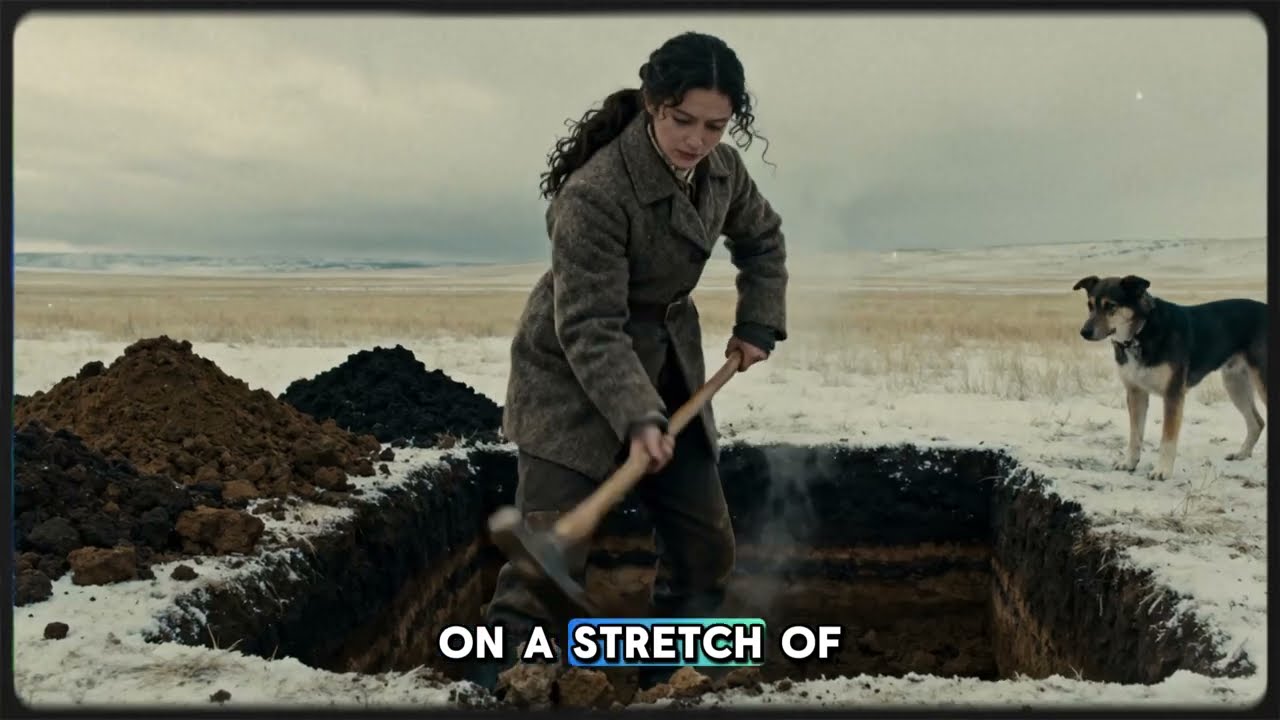
On a stretch of prairie so flat that you could watch your dog run away for 3 days, a woman was digging her own grave. At least that’s what the neighbors said when they rode past and saw her waist-deep in a rectangular pit, throwing shovelfuls of frozen earth onto a pile that grew larger with each passing day.
They crossed themselves and whispered prayers for the widow who had clearly lost her mind to grief. They didn’t stop to ask what she was building. They didn’t want to know. Her name was Moira Callahan, and she wasn’t digging a grave. She was digging a home. 6 months earlier, she had buried her husband Patrick and both of their children in the small cemetery behind the church in Dodge City.
Three pine boxes lowered into the ground on a morning so bright and cloudless that it seemed like a cruel joke. Cholera had taken them in 4 days, moving through their soddy like a scythe through wheat, leaving only Moira standing because God, in his infinite [clears throat] wisdom, had decided that watching her family die wasn’t punishment enough.
She should have died with them. Some nights, lying alone in the soddy that still smelled like her children, she wished she had. The grief was a physical thing, a weight on her chest that made breathing feel like labor and sleeping feel impossible. She would find herself standing at the graves for hours, talking to headstones that never answered, asking questions that had no good answers.
Why them and not me? What am I supposed to do now? How do I live in a world that doesn’t have them in it? The soddy provided no comfort. Every corner held memories. The spot where Patrick had read to the children by candlelight, the shelf where Mary had kept her collection of prairie flowers pressed between pages of the family Bible, the tiny bed where Thomas had slept with his thumb in his mouth and his blanket clutched to his chest.
Moira couldn’t look at any of it without feeling the grief rise up and threaten to drown her. So, she decided to build something new. Something that had never held her family, never witnessed their laughter or their deaths. Something that would be hers alone, for better or worse. The idea came from a book Patrick had brought home 2 years earlier, a traveler’s account of the ancient stone structures of Ireland, the beehive huts and underground chambers where monks had lived and prayed a thousand years ago.
Patrick had been proud of his Irish heritage, even though he’d been born in Boston and had never seen the green hills his grandparents spoke of with such longing. He had shown Moira the illustrations, pointing to the corbeled stone roofs that had stood for centuries without mortar or nails. Our ancestors knew how to build, he had said.
They didn’t need lumber or fancy materials, just stone and patience and knowledge passed down through generations. Moira had thought about those illustrations during the long nights after the funerals, when sleep wouldn’t come and the soddy walls seemed to close in around her. The prairie had no trees for lumber, but it had stone, endless deposits of flat limestone that broke naturally into slabs perfect for building.
It had earth that stayed a constant temperature below the frost line, warmer than any above-ground structure could manage. It had wind that would destroy any conventional building she might attempt, but couldn’t touch something buried beneath its reach. And it had her, a woman with nothing left to lose and nowhere else to go.
She started digging in September, when the summer heat had broken, but the ground hadn’t yet frozen solid. The site she chose was a quarter mile from the soddy, far enough that she couldn’t see it from where she worked, close enough that she could return for supplies and shelter during the construction. Her dog Finn, a shepherd mix who had somehow avoided the cholera that killed everyone else, followed her to the new site each morning and lay watching as she dug.
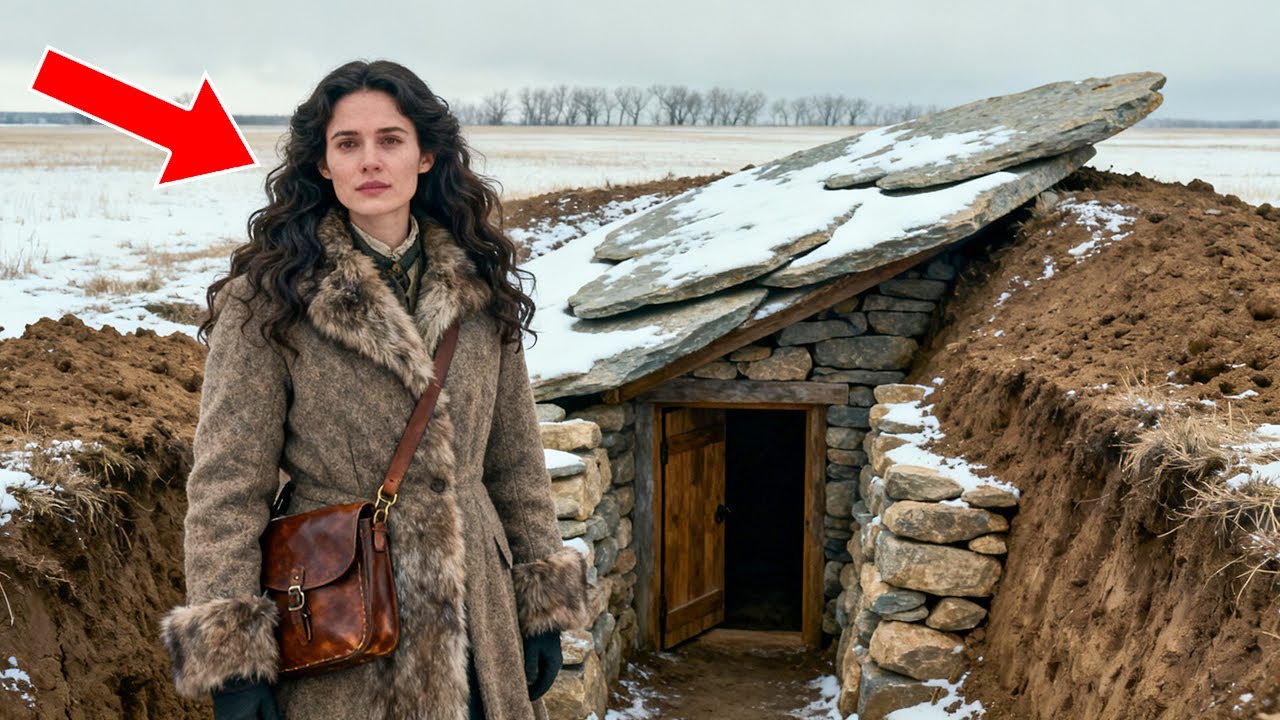
The dimensions came from the book Patrick had shown her. 8 ft wide, 12 ft long, 6 ft deep, enough space for a sleeping platform, a small stove, storage for supplies. The walls would be lined with stone to prevent collapse. The roof would be corbeled limestone, each layer projecting slightly inward until they met at the center, then covered with large flat slabs and buried under a mound of earth for insulation.
It was ambitious for a woman working alone. It might have been ambitious for a crew of experienced builders, but Moira had time, all the time in the world, now that everyone she loved was gone, and she had the cold clarity that comes when you’ve already lost everything that matters. The first week was the hardest.
The ground resisted her shovel, packed tight by years of prairie grass roots that formed a mat inches thick. Her hands blistered, then bled, then calloused over into something tougher than the skin she’d been born with. Her shoulders screamed each night, muscles burning from labor they’d never been asked to perform.
She fell into bed exhausted and woke before dawn, unable to sleep more than a few hours, because the nightmares always found her eventually. In the nightmares, she was back in the soddy, watching Patrick’s face go gray as the fever took hold, watching Mary cry for water that wouldn’t stay down, watching Thomas stop breathing with a sound so small that she almost missed it.
She would wake gasping, reaching for children who weren’t there, and lie in the darkness until morning, because going back to sleep meant going back to that room. The digging was a mercy. It gave her something to do with her hands, her body, her mind. It gave her a reason to get up each morning that had nothing to do with the past and everything to do with the future.
The hole in the ground grew deeper and somehow, impossibly, the hole in her chest grew smaller. By the end of September, the pit was complete, a neat rectangle carved from the prairie, its walls showing the layers of soil and clay and limestone that made up the bones of the land. Moira stood at the bottom and looked up at the sky, feeling for the first time in months that she might actually survive this.
The stonework began in October. The limestone deposits she had found ran along a creek bed 2 miles east, flat slabs that split cleanly when she wedged her chisel into the natural fracture lines. She loaded them onto a sledge Patrick had built for hauling supplies, hitched it to their remaining horse, a stolid mare named Bessie who had pulled the family wagon all the way from Missouri, and made the trip twice a day, morning and afternoon, until her hands cracked from the cold and her back felt like it might never straighten again.
The neighbors finally stopped to talk on the third week of October. Samuel Bright was a cattle rancher who had claimed the section north of Moira’s homestead. He was a practical man, not given to gossip or speculation, but even he couldn’t ride past the strange construction site without asking questions. He dismounted at the edge of the pit and looked down at Moira, who was fitting flat stones against the earthen walls with a precision that surprised him.
Mrs. Callahan, he said, removing his hat. I was sorry to hear about Patrick and the little ones. A terrible thing. Moira didn’t stop working. Thank you, Mr. Bright. The folks in town are concerned about you being out here alone, about what you’re building. They think I’m digging my own grave. Samuel had the grace to look embarrassed.
Some do. Moira finally looked up at him, her face streaked with dust and sweat despite the cold. It’s a shelter, Mr. Bright, underground with a stone roof, the kind they built in Ireland a thousand years ago. It’ll stay warm in winter without burning through a cord of wood a week, and it’ll stay cool in summer without roasting me alive like that soddy does.
An underground house? An underground room, enough for me and Finn. That’s all I need now. Samuel studied the pit, the neatly stacked stones, the evidence of weeks of careful labor. He was a man who respected hard work, even when he didn’t understand its purpose. That stone roof, he said slowly, how do you plan to keep it from collapsing? Mora smiled.
The first smile that had crossed her face since the funerals. The same way the Irish did. Each layer projects a little further than the last until they meet in the middle. The weight of the stones holds them in place. No mortar needed. No timber required. Just gravity and geometry. And you learned this from a book? I learned it from my husband.
He learned it from a book. The knowledge goes back further than either of us. Samuel was quiet for a moment processing this. Then he nodded. You need help hauling stone? The offer surprised her. Prairie people minded their own business. It was a point of pride in communities where privacy was hard to come by and everyone knew everyone else’s affairs.
Help was offered during emergencies. Not during ordinary labor. Why? She asked. Because you’re my neighbor. Because your husband was a good man who would have helped me if our situations were reversed. Because He paused. Choosing his words carefully. Because building something is better than the alternative. I’d rather help you build than watch you give up.
Mora felt tears prick at her eyes. An emotion she had thought burned out of her weeks ago. She blinked them back and nodded. I could use help with the roof stones. They’re heavier than what I can lift alone. Samuel came back the next day with his two grown sons and the three of them spent a week hauling the massive limestone slabs that would form the outer layer of the roof.
They didn’t talk much. Prairie men weren’t given to unnecessary conversation. But their presence was a comfort that Mora hadn’t expected. She found herself looking forward to their arrival each morning. The sound of their horses and the low rumble of their voices as they discussed the day’s work. On the last day of hauling Samuel’s younger son Daniel lingered after his father and brother had ridden home.
He was 22. A quiet young man with his father’s practical nature and his mother’s kind eyes. He had lost his own wife to childbirth two years earlier and understood something about grief that his father and brother untouched by that particular loss could not. My father thinks you’re brave. Daniel said. Building something new instead of letting the grief win.
Mora wiped her hands on her skirt leaving streaks of limestone dust. I don’t feel brave. I feel like I’m barely holding on. That’s what brave is. Daniel said. Holding on when everything in you wants to let go. He rode away before she could respond. But his words stayed with her through the night. Through the nightmares.
Through the dawn that found her back at the pit with her tools and her determination. November brought the cold in earnest. Temperatures dropping below freezing and staying there. Wind that cut through clothing like it wasn’t there. Snow that arrived in horizontal sheets and piled into drifts higher than a man’s head.
Most construction would have stopped for the season waiting for spring and warmer weather. Mora kept building. The wall stones were complete now rising from the pit floor to just below ground level creating a stone-lined chamber that would resist collapse for centuries if she did the work properly. The corbeling began on the first day of November.
Each layer of stones projecting about 2 inches further inward than the one below gradually closing the gap between the walls like a flower closing at sunset. The technique required patience and precision that Mora hadn’t known she possessed. Each stone had to be selected for its shape and weight. Tested in position. Adjusted until it sat exactly right.
Then wedged firmly in place before the next stone could be added. A single mistake could bring the entire structure down burying her under tons of limestone that would become her actual grave instead of the symbolic one her neighbors had imagined. The physics of corbeling were counterintuitive but elegant once understood.
Each stone projected inward just far enough that its center of gravity remained over the wall below. Typically about 2 inches per layer. Too much projection and the stone would tip inward and fall. Too little and the dome would never close. The weight of the stones above actually strengthened the structure pressing each layer tighter against the ones below creating a compression that made the whole stronger than the sum of its parts.
Mora had studied the illustrations in Patrick’s book until she could see them with her eyes closed. She had practiced on small models made of flat river stones building miniature domes in the prairie grass until she understood how the forces balanced. The real construction was simply the model scaled up. The same principles.
The same techniques. The same patient attention to each individual stone. The cold actually helped in some ways. The frozen ground held firm around the pit walls preventing the caving that might have plagued a summer excavation. The stones cold and dry seated together more precisely than they might have in wet conditions.
And the discomfort kept her focused. Kept her from dwelling on memories that served no purpose when there was work to be done. She made mistakes. She learned from them. Twice she had to disassemble sections of the corbeling and start again. Once because the stones were too heavy for the layer below. Once because she had rushed and left gaps that would have let in water and cold air.
The second time she sat at the bottom of the pit and cried. Not for her family for once but for herself. For the exhaustion that seemed to have no end. For the doubt that crept in whenever she allowed herself to think about what she was doing and why. Finn climbed down the ladder she had built and pressed against her side.
His warm weight a comfort that required no words. She buried her face in his fur and let herself weep until there was nothing left. Then wiped her eyes and got back to work. The neighbors came to watch as the roof neared completion. Not just Samuel and his sons but others who had heard about the widow building an underground house from stone.
>> [clears throat] >> They stood at the edge of the pit and stared down at the dome taking shape. The increasingly small circle of sky visible through the corbeled opening. The woman at the center who moved with a confidence that seemed impossible given what she had lost. She’s going to bury herself alive. Someone muttered.
She’s going to make it. Daniel Bright replied and his voice carried a certainty that silenced the doubters. The final capstones went into place on November 28th. A day so cold that Mora’s fingers went numb despite her gloves and her breath froze on her scarf. The largest slabs some weighing more than 200 pounds required a system of ropes and levers that she had designed after studying the way the Egyptians had built their pyramids.
Daniel had returned to help along with his father and brother. And together they maneuvered each massive stone into position filling the opening at the top of the dome until no light remained inside. Then came the earth. Bucket by bucket she covered the stone roof with the soil she had excavated months before piling it higher and higher until the shelter was invisible from more than a few yards away.
Just a mound in the prairie indistinguishable from the natural swells of the landscape. She moved in on December the 1st. The interior was small but complete. A sleeping platform built from salvaged lumber. A tiny cast iron stove vented through a pipe that emerged from the earth 20 feet away to prevent downdrafts.
Storage niches carved into the stone walls. A floor of packed earth covered with straw and canvas. The wooden door set into the stone framed entrance faced southeast to catch the morning sun and avoid the worst of the winter winds. The first night she lay on her sleeping platform and listened to the silence. No wind howling through gaps in the walls.
No cold creeping in from every direction. No memories lurking in every corner. Because these corners had never known her family. Had never witnessed anything but her own labor and determination. The temperature inside was 48°, maintained by the earth itself without any fire at all. When she lit the small stove, just enough to take the edge off the chill, the space warmed to a comfortable 55° within an hour.
The stone walls absorbed the heat and radiated it back slowly, steadily through the night. She slept without nightmares for the first time since the cholera. The winter of 1887-1888 would be remembered as one of the worst in Kansas history. The blizzards came in January, one after another, burying the prairie under snow that reached depths of 10 ft in places.
Temperatures dropped to 50° below zero during the worst of it. Cold enough to freeze cattle standing in fields. Cold enough to kill anyone caught outside without shelter for more than a few minutes. Mora’s neighbors suffered terribly. The Hendersons, who lived in a frame house 2 mi south, burned through their entire winter’s supply of firewood by mid-February and had to be rescued by a supply party from town.
The Morrison family lost three children to hypothermia when their sod roof collapsed under the weight of snow. Samuel Bright lost a hundred head of cattle, nearly half his herd, frozen in a pasture they couldn’t reach through the drifts. Mora lost nothing. Her underground shelter maintained its temperature throughout the worst of the cold.
The earth itself providing insulation that no above-ground structure could match. The snow that buried the entrance she cleared each morning, digging a short tunnel to the surface, then sealing it again each night. The small stove burned a fraction of the fuel her neighbors consumed. The stone walls holding heat so efficiently that she sometimes let the fire die completely and still woke warm.
Daniel Bright arrived at her shelter during a brief break in the storms, having followed the thin wisp of smoke from her stovepipe to find the hidden entrance beneath its blanket of snow. He descended into her underground room and stood amazed at the warmth that greeted him. The impossible comfort of a space that should have been a frozen tomb.
52°, he said, reading the thermometer she had hung from a nail. It’s 50 below outside and you’re sitting here in 52° with barely any fire. The earth doesn’t know it’s winter, Mora said. 6 ft down, it’s the same temperature year round. 55° in summer, 55° in winter. All I have to do is stay below the frost line and the cold can’t touch me.
My father’s house is barely above freezing with the fire going full blast. My mother hasn’t been warm since November. Mora hesitated, then made a decision she hadn’t known she was capable of making. Bring them here. Your parents. Anyone else who needs shelter. There’s room enough and I have supplies. Daniel’s expression shifted.
Something moving behind his eyes that Mora couldn’t quite read. You would do that? After everything you’ve been through? Because of everything I’ve been through. I know what it’s like to watch people you love die when you can’t do anything to stop it. If I can stop it now for someone else, maybe that’s why I survived when my family didn’t.
Maybe that’s what I’m supposed to do with this life I didn’t ask for. Daniel brought his parents the next day along with his brother’s family, eight people in total, crowded into a space built for one. They slept in shifts, shared meals cooked on the tiny stove, passed the long winter days telling stories and playing cards and simply surviving together.
The children thought it was an adventure, a fairy tale about living underground like dwarves in the old stories. The adults knew how close they had come to dying and couldn’t quite believe they were warm. Mora found herself laughing again, something she had thought lost forever with her family. She found herself caring about people she had barely known before the crisis brought them together.
She found herself looking forward to each day instead of dreading it because each day now held purpose and connection and the simple joy of keeping people alive who might otherwise have died. The children were the hardest part. Samuel’s grandchildren were close to the ages Mary and Thomas had been and watching them play in the underground shelter, making shadow puppets by candlelight, begging for stories before bed, brought back memories that cut like broken glass.
But it also brought something unexpected, a kind of healing that came from proximity to life rather than death. These children weren’t hers, would never replace the ones she had lost, but their laughter filled spaces that had been empty for too long. Daniel’s mother, a woman named Ruth who had initially regarded Mora with the suspicion common to prairie wives confronted with widows, thawed during those cramped winter weeks.
She taught Mora recipes she had brought from Ireland, songs in a language neither of them spoke but both remembered from childhood. She told stories about Daniel as a boy, stories that embarrassed him and delighted Mora in equal measure. By the time the storms broke, Ruth had become something like a friend, perhaps even something like family.
You saved us, Ruth said on the day they left, holding Mora’s hands in her own weathered grip. Not just our lives, you saved us from giving up, from thinking the world had nothing left to offer. The shelter saved you, Mora said. I just built it. You built it when everyone said you were crazy. That’s the part that matters.
The storms finally broke in late February and her guests returned to their own homes to assess the damage and begin rebuilding. But something had changed during those weeks of shared survival. Mora was no longer the crazy widow who had buried herself in the ground. She was the woman who had saved the Bright family.
She was the woman whose strange Irish construction had proved itself when everything else failed. Spring came late that year, but it came eventually, melting the snow and revealing a prairie scarred by the winter’s violence. The dead cattle had to be burned. The collapsed buildings had to be rebuilt. The graves had to be dug for those who hadn’t survived.
But Mora’s shelter stood unchanged, the stone roof bearing the weight of earth and memory with equal ease. She climbed out on the first warm day of March and stood blinking in the sunshine, Finn pressing against her legs, the prairie stretching endlessly in every direction. She was still here. Against all odds, against all reason, against everything she had believed possible in those dark days after the funerals.
She was still here. Daniel Bright came to visit that afternoon, bringing seeds for her garden and an offer that surprised her even more than his father’s offer of help had surprised her months before. I’m not asking you to forget them, he said, sitting on the mound of earth that covered her stone roof. I’m not asking you to stop loving them or stop grieving them.
I’m just asking if you might have room for something new, someone new, eventually, when you’re ready. Mora looked at him, this quiet young man who had lost his own wife, who understood grief in ways that others couldn’t, who had stood by her through a winter that should have killed them both. I don’t know if I’ll ever be ready, she said honestly.
That’s fair. I’ll wait. You might be waiting a long time. I’ve got nothing but time and you’ve got an underground house that apparently survives anything nature can throw at it. Seems like between the two of us, we’ve got patience covered. Mora laughed, a real laugh, surprised out of her by his gentle humor. It felt strange laughing.
It felt almost like betrayal, but it also felt like something she had been missing without knowing it. A piece of herself returning from wherever it had gone when she buried her family. You can wait, she said finally. No promises, but you can wait. Daniel waited. Two years later, they married in a small ceremony attended by his family and the neighbors who had once thought her mad.
They built a proper house above ground using techniques Maura had learned from her underground shelter. Thick walls, deep foundations, a design that worked with the prairie instead of fighting it. But they kept the shelter, too. The stone room beneath the earth where Maura had saved herself and then saved others.
It became a root cellar, a storm shelter, a place of last resort when the prairie turned hostile and survival required returning to the earth that had protected her when nothing else could. Maura lived to be 87 years old, long enough to see her grandchildren and great-grandchildren, long enough to tell the story of the terrible winter and the stone roof so many times that it became legend.
She never forgot Patrick and Mary and Thomas. Their photographs hung in her home until the day she died. Their graves visited every anniversary with fresh flowers from her garden. But she made room for new love alongside the old grief. She built a life from the ruins of the one she had lost. She proved that survival wasn’t betrayal, that moving forward didn’t mean leaving behind.
The underground shelter still stands on that Kansas prairie more than a century after Maura Callahan dug the first shovelful of frozen earth. The stone roof has never leaked, never collapsed, never failed in any way. Visitors sometimes find it, guided by descendants who know the story, and they stand amazed at the craftsmanship of a grieving widow who taught herself ancient techniques from a book her husband had loved.
They say she’s buried nearby next to Daniel on a hillside that overlooks the prairie where she almost died and somehow learned to live again. They say the stone above her grave came from the same deposit as her shelter’s roof, flat Kansas limestone that splits cleanly and holds together for centuries. They say that when the winter winds blow across the prairie, you can still hear her voice in the howling telling the story of the woman who buried herself in the earth and found in that burial a way back to life.
The earth remembers. The stones remember. And as long as the shelter stands, so will the memory of Maura Callahan, the widow who dug her own grave and made it a home instead.