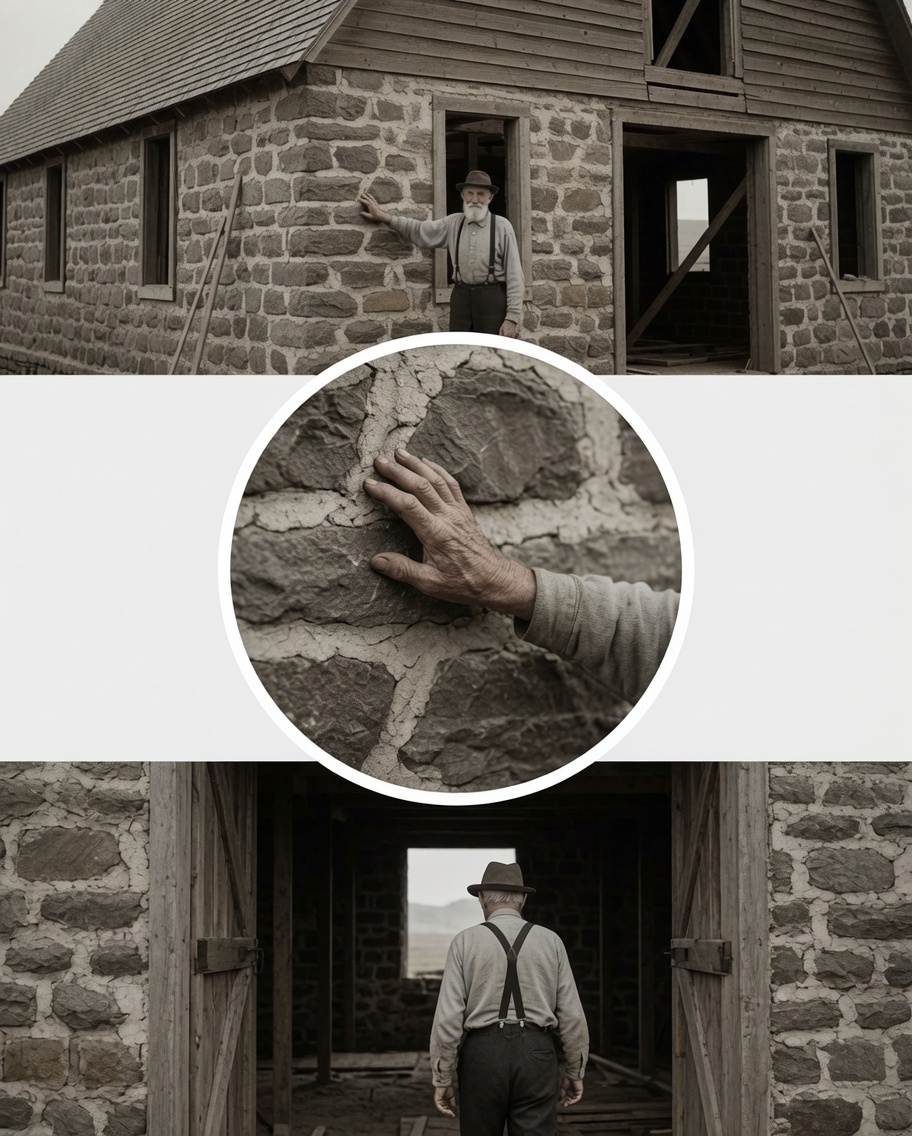
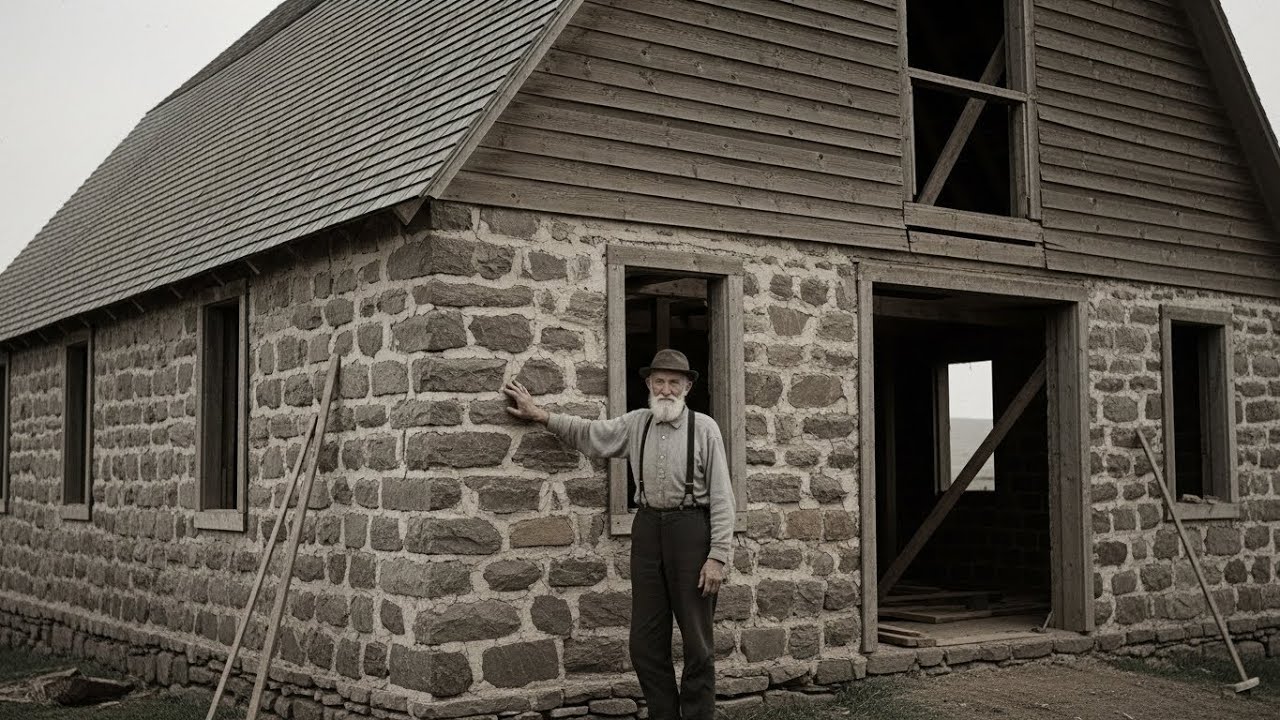
The winter of 1873 came early to southeastern Montana territory, and Jacob Reinhardt was building something his neighbors couldn’t understand. Not just a barn, every homesteader had a barn. Jacob was constructing a second wall 18 in outside the first, creating a gap that seemed to serve no purpose whatsoever.
His nearest neighbor, Thomas Grayson, rode over on a Tuesday morning in late October and watched the German immigrant haul stones to fill the space between the walls with nothing but prairie rocks and dried clay. “You planning to defend that barn against the sue?” Grayson asked. 40 years of frontier life making his voice flat as the plains themselves.
Jacob didn’t look up from his work against something worse than arrows and the comment spread through the 14 families scattered across the Powder River Valley like wildfire through August grass. By the end of the week, three more men had ridden out to Jacob’s claim. a quarter section homestead he’d been breaking for two years now, ever since he’d walked away from the Northern Pacific Rail Crew with enough saved wages to file a claim.
They found him mixing clay with straw, packing it methodically into the gap between his barn walls. Samuel Puit arrived first, a man who’d survived the winter of 1867 in a Nebraska sod house so cold his wife had lost three toes to frostbite. He’d seen construction methods that worked and methods that killed, and this looked like a waste of time that could be spent cutting firewood or hunting meat.
That gap you’re leaving, you know, winds just going to howl through there come January. Double walls don’t mean nothing if you got air moving between them. No air will move, Jacob said, his English still carrying the thick accent of Bavaria. Stone and clay, solid, Puit shook his head. Then you’re just building two thin walls instead of one thick one.
Same amount of material, half the strength each. The third visitor was Margaret Chen, whose husband had died the previous spring, breaking his leg in a gopher hole, leaving her with two children and 40 head of cattle she couldn’t afford to lose. She’d been ranching with her father in California before moving east. and she knew livestock shelter mattered more than house comfort when your entire future depended on animals surviving until spring carving.
Those cattle need ventilation, Mr. Reinhardt. You seal up a barn too tight, the moisture from their breathing will freeze on the walls, make it colder inside than out. The outer wall breathes, Jacob said. The inner wall holds heat. The fourth skeptic didn’t arrive on horseback. William Black Feather walked 15 miles from his family’s winter camp, a Lakota man who’d learned construction from his father, who’d learned it from French trappers who’d learned it from experience that killed the slow learners. He studied Jacob’s work for 20
minutes without speaking, then said, “Your building for cold you haven’t seen yet.” “I’ve seen it,” Jacob replied. My uncle’s farm, Saxony, 50 below in the winter of 1862. He lost everything. Cattle, sheep, three fingers. The next year he built like this, lost nothing. Black Feather nodded slowly. 50 below comes here, too.
Not every winter, but it comes. The other three settlers exchanged glances. Montana could hit 20 below, 30 in a bad year, but 50 seemed impossible. The kind of number foreigners threw around when they didn’t understand American measurements. If you’re watching this because you value the kind of traditional wisdom that kept people alive when being wrong meant death, consider subscribing.
We are documenting the frontier techniques that modern agriculture has forgotten, one story at a time. Yakob finished his doublewalled barn on November 18th, 1873. The structure measured 32 feet by 24 ft with walls that were in total 29 in thick. Two walls of stacked stone, each 7 in wide, with 15 in of packed rock and clay mixture between them.
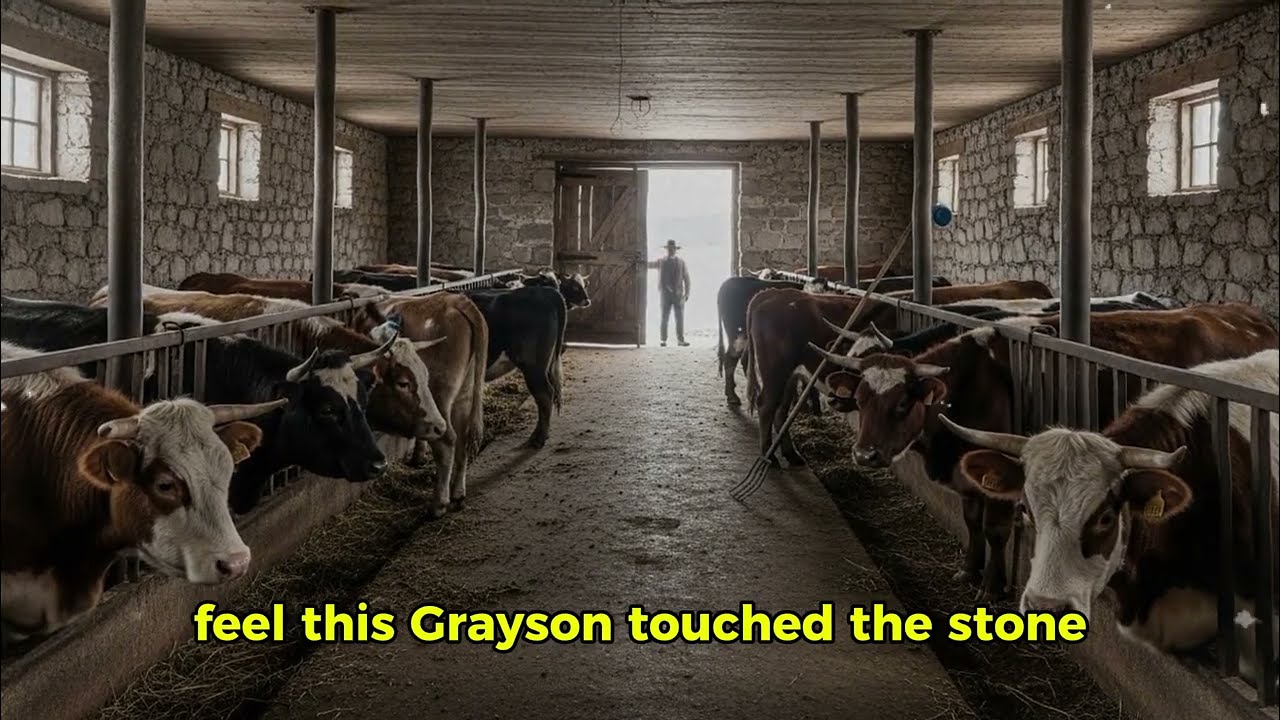
The roof was standard sod over pine logs he’d hauled from the mountains 40 mi west. The door was double hung, two layers with a 6-in gap, same principle as the walls. Inside, he’d built feeding troughs along both long walls and a central aisle wide enough for a man to walk with a pitchfork.
The floor was compacted earth mixed with lime and animal blood, dried hard as stone. His neighbors called it Reinhardt’s fortress. Some said it with humor. Some said it with the edge that comes when a man’s spending time on foolishness instead of proper preparation. And that foolishness might get his family killed come January. December arrived mild.
Temperatures held steady around 15° F. Cold enough for ice, but warm enough for men to work outside without frostbite risk. The cattle grazed on dried grass. They could still pour through the shallow snow to reach. YaKob moved his 17 head into the barn at night, let them out to graze during the day. The routine was standard.
Every homesteader did the same. Thomas Grayson stopped by on December 20th, Christmas week, bringing a bottle of whiskey as a peace offering. Look, Yakob, I’m not saying your barn’s bad. It’s solid work. I’m just saying all that extra time filling those walls, you could have built a second shelter or cut more firewood or a dozen other things.
They were standing in the barn and Jacob pressed his palm against the inner wall. Feel this. Grayson touched the stone. It was faintly warm, not from any fire, but from the body heat of 17 cattle standing in their stalls. The temperature inside the barn was 43° measured on a thermometer Yakob had bought from a catalog for.75.
Outside the December air was holding at 16°. That’s a 27° difference. Jakob said my uncle in Saxony, he measured 35° difference. When the real cold comes, that difference means life. if it comes,” Grayson said. But his voice carried less certainty than before. The real cold came on January 9th, 1874, riding down from Canada on winds that hit the Montana Plains at 40 mph.
The temperature dropped from 18° at dawn to -4° by noon, and it kept dropping. By midnight, Samuel Puit’s thermometer, the mercury kind that cost $3 and was accurate to within one degree, read -23° F. By dawn on January 10th, -37. The cattle knew before the people did. At 6:00 in the morning, Jacob found his 17 head bunched against the barn door, lowing in a way he’d never heard before, a sound that wasn’t hunger or thirst, but pure instinct.
He opened the door, and they pushed inside so fast he had to jump back to avoid being trampled. He got them into their stalls, threw down hay, and went back outside to check the chickens in their smaller coupe. The cold hit his lungs like broken glass. His eyes watered and the tears froze on his cheeks before he could wipe them away.
The chickens were in their coupe, a standard structure built against the south side of his house for shared warmth, and three of his 12 hens were already dead. He grabbed the remaining nine and carried them in his coat into the house where his wife Anna was feeding their two children near the stove. How cold? She asked.
Colder than I felt since we left Hamburg, he said, and Anna’s face went white because Hamburg was cold enough to freeze the harbor solid. By noon on January 10th, the temperature reached -46° F. The wind had stopped. It was too cold for wind. The air itself too frozen to move properly. In the silence, you could hear trees exploding as the sap inside them froze and expanded, splitting trunks like rifle shots.
Samuel Puit’s barn lost six cattle out of 22. The animals had frozen where they stood, despite the haline shelter and the shared body heat. Margaret Chen lost 11 out of 40. And by the time you’re listening to this, you understand why a widow with two children and a quarter section claim couldn’t afford that kind of loss.
Thomas Grayson lost his entire herd. 33 cattle dead between midnight and dawn on January 10th in a barn he’d built the same way he’d built three others in Nebraska, with solid log walls and good ventilation and every technique that had worked for 20 years. He found them frozen in their stalls, ice crusted around their nostrils, where their final breaths had condensed and frozen instantly in the negative 46° air that had seeped through every gap, every crack, every space in the logs where chinking had dried and shrunk. Jacob’s
barn with its double walls and 15 in of packed stone and clay held at 19° Fahrenheit inside while the outside air reached -46, a 65° difference. His 17 head of cattle stood in their stalls, breathing calmly, their body heat trapped by walls that gave it nowhere to go. The thermometer hanging from the center rafter, one of Yakob’s small extravagances, a device he checked three times daily and recorded in a leather journal he’d started keeping the day he filed his claim, showed the number clearly.
19°, cold enough to remind you winter existed, but not cold enough to kill. The cold held for 6 days. On January 11th, the temperature dropped to -51° Fahrenheit at dawn, the coldest temperature ever recorded in that part of Montana territory, though the official records wouldn’t be compiled for another 40 years.
William Black Feather’s family, camped in earth lodges built partially underground with double layers of buffalo hide and earth walls, survived with minimal loss. They brought Jacob a deer haunchch on January 12th as thanks for advice he’d given Black Feather about wall insulation, and Black Feather spent an hour examining the barn’s construction with the intensity of a man who understood that knowledge like this could save lives.
The French trappers built like this, Black Feather said, pressing his hand against the inner wall. But they use smaller buildings. I didn’t know it would work this large. Larger is better, Jacob said. More animals, more heat. More heat. Thicker walls protect it better. Like a stone that takes all day to heat by the fire, but stays warm all night after.
It’s worth pausing here because if you’re still watching, you’re the kind of person who understands that wisdom isn’t about complexity. It’s about understanding principles that work across contexts. Consider hitting that like button. Not for me, but to tell YouTube’s algorithm that practical knowledge matters.
That the experience of people who built with their hands and survived by their wits deserves to be shared with others who value that approach to life. The science behind Jacob’s design wasn’t new in 1873, though he wouldn’t have called it science. Thermal mass, the ability of dense materials like stone and clay to absorb heat slowly and release it slowly, was a principle ancient Romans understood when they built their bathous.
The air gap wasn’t really an air gap at all, but 15 in of solid material with thousands of tiny air pockets trapped between rocks and clay particles. Each pocket acted as an insulator, breaking the path cold could travel from outside to inside. The result was a wall with an R value, a measurement of insulation effectiveness that wouldn’t be invented until the 1930s of approximately R18 compared to R3 or R4 for a standard 7in log wall.
Jakob’s uncle in Saxony had learned the technique from medieval church builders who’d learned it from Roman engineers who’d learned it from somebody else lost to history. Knowledge that worked survived. Knowledge that failed killed people and the people who held it disappeared from the chain of transmission. By January the 16th, when the temperature finally climbed back to -12°, which felt warm enough that men could work outside again without immediate frostbite risk, the damage across the Powder River Valley was clear.
Of the 14 homesteading families, three had lost their entire herds. Five had lost more than half. Four had lost between 20 and 40%. Only Jacob and William Black Feather’s extended family had lost nothing. Margaret Chen showed up at Jacob’s door on January 18th with her two children. She’d lost 11 cattle, but 29 had survived, and she needed those 29 to survive until spring carving, or she’d lose the claim.
Her barn was standard construction, and another cold snap like the one they just survived would finish her. Could you? She started, then stopped. Pride was a currency you could spend on the frontier, but only if you had surplus. She had none. Could my cattle shelter in your barn until spring? I can pay you in carving percentage or work or no payment, Jacob said.
Bring them this afternoon. We’ll make room. Samuel Puit arrived the next day with his remaining 16 cattle. Thomas Grayson showed up the day after that, having bought four replacement head from a ranch 40 mi south, unwilling to let his claim fail over pride. By January 25th, Jacob’s barn held 43 head of cattle belonging to four different families, packed more tightly than ideal, but surviving in 19 to 24° interior temperatures, while the outside air ranged from -5 to positive8° F.
The barn became a community center by necessity. The men took turns checking cattle overnight, which meant gathering in the relatively warm space, which meant talking. Margaret Chen brought coffee in a tin pot one night. Samuel Puit brought his fiddle another night, though the cold made the strings sound strange, and the men agreed music could wait for warmer weather.
Thomas Grayson brought his pride, which was harder to carry than the coffee or the fiddle, and set it down carefully one night in late January when Jacob was shoveling manure from the stalls. “I was wrong,” Grayson said. “The barn was lit by two kerosene lanterns, and the shadows made the men’s faces look older than they were.
I’ve built four barns in my life. Every one of them worked until this winter. I thought experience meant knowing what worked. Experience means knowing what worked before, Jacob said. Wisdom means knowing what works next. By February, word of Jakob’s barn had spread beyond the 14 families in the immediate valley.
A homesteader from 60 mi north rode down to examine the construction, took measurements, asked questions for 3 hours, and rode back with a leather journal full of sketches. A cattle rancher from the territorial capital sent his foreman to investigate whether the design would scale to a 100 head operation. Two separate families planning to file claims that spring made the trip to see the barn before they built their own shelters.
Understanding that survival came before speed. William Black Feather brought his father to see it in March, after the worst cold had passed, but before spring thor made travel impossible through mud. His father was 73 years old and had seen the northern plains through 50 winters, and he spent an hour running his hands over the walls, feeling the texture of the clay and stone mixture, asking about mixing ratios and curing time, and whether the technique would work with earth instead of stone if stone wasn’t available. It will work with anything
that has mass, Jacob said. Earth, stone, brick, adobe. The principle is the same. Make it thick. Make it dense. Trap the heat inside. The old man nodded. My grandfather’s grandfather built earth lodges this way. We forgot after we started moving with the buffalo. Movement meant we couldn’t build thick walls. We built for speed instead.
But this, he gestured at the barn. This remembers what we forgot. Spring came late in 1874, which was typical for Montana. The cattle that had survived the winter in Jacob’s barn emerged thin but alive, and carving happened in April, and by May, the 14 families had a collective count of 67 new calves from the 43 head that had sheltered together.
Margaret Chen’s herd recovered to 34 head by summer’s end. Samuel Puit rebuilt his operation to 18 head. Thomas Grayson reached 21 head and started construction on a new barn. This one with double walls and a 15-in gap he filled with stone and clay mixture he learned to make from watching Jacob work.
The technique spread quietly the way practical knowledge spreads among people who need it. There were no newspaper articles, no official recognition, no patents or territorial proclamations. But by the winter of 1875, 11 families in the Powder River Valley had barns or shelters built with double walls. By 1876, the technique had reached ranching operations as far south as Wyoming territory and as far west as Idaho.
A cattle operation near Fort Benton built a barn using the principle scaled up to hold 200 head with walls 36 in thick and an R value that kept interior temperatures above freezing even when the outside air hit -40. The winter of 1876 came hard again. Not as severe as 1874, but cold enough to hit -35° in late January.
The cattle losses in the Powder River Valley were minimal, less than 5% across all families, compared to 30 to 40% losses in valleys where the insulation technique hadn’t spread yet. The difference wasn’t subtle. It was survival versus failure, measured in headcounts and spring calves, and whether families could hold their claims for the 5 years required to convert them from homesteads to deed property.
Jakob Reinhardt proved up his claim in 1878, having survived the required 5 years of residence and improvement. His herd had grown to 43 head. He’d added two additional buildings using the double wall technique, a root cellar that stayed at 45° year round without ice and a chicken coupe that kept his birds alive through three more brutal winters.
His children, a son and daughter, grew up understanding that wisdom meant learning from people who’d survived what you hadn’t yet faced. The barn still stands, though not in its original location. In 1883, Jakob sold his claim to a ranching operation expanding into the territory and moved his family to Helena, where his skills as a builder were in demand for the territorial capital’s growth.
The barn was dismantled carefully and rebuilt on the ranch’s central property where it served as livestock shelter until 1923. In 1924, during a period of modernization that saw many frontier era structures demolished or abandoned, a structural engineer from the Montana State College agriculture program examined the barn, took detailed measurements, and wrote a technical paper on historical insulation techniques.
His measurements confirmed an R value of R17.6, six, comparable to modern insulated walls built with materials that didn’t exist in 1873. That paper sat in academic archives until 1974 when an energy crisis made insulation suddenly fashionable again, and builders started looking backward for techniques that had worked before petroleum based foam became standard.
Several Montana contractors began incorporating thermal mass principles into residential construction, marketing it as new technology until researchers pointed out the technique was medieval in origin and frontier proven. The barn itself was moved a final time in 1976 to the Montana Historical Society’s Outdoor Museum in Helena, where it still stands today, surrounded by interpretive signs that explain thermal mass and our values to visitors who mostly just marvel that anybody survived Montana winters with nothing but stone and
determination. If you’ve made it this far, you’re exactly the kind of person who keeps knowledge like this alive. Consider subscribing to this channel, not because I’m entertaining, but because preserving these stories means preserving the wisdom of people who built solutions that worked across generations without patents or publicity, using nothing but observation and the willingness to learn from those who’d survived longer than they had.
The principle behind Jacob’s barn appears in dozens of cultures across thousands of years. PBlo builders in the American Southwest used adobe walls 30 in thick for the same reason. Thermal mass breaks the heat transfer between outside and inside air. Norwegian farmhouses from the 1600s use double walls filled with sawdust or dry moss.
Chinese rammed earth construction created walls 18 to 36 in thick using nothing but compressed soil. Japanese mink houses used thick earthn walls mixed with straw and clay. None of these cultures knew the others existed. Yet they all arrived at the same solution because the principle was sound and the alternatives failed.
The modern construction industry measures this in R values, BTUs, and heat transfer coefficients. But the farmers and homesteaders who used it measured results in simpler terms. Did your animals live through winter? Or didn’t they? That binary outcome drove innovation faster than any research grant because failure meant losing not just your livestock, but your claim, your investment, your family’s future.
and sometimes your family’s lives. There’s something humbling about standing in that barn today, running your hand over walls that kept cattle alive at -51° using nothing but rock, clay, and understanding. The tourist brochure calls it primitive technology. The engineering paper calls it effective passive thermal regulation.
JaKob Reinhardt would have called it common sense learned from his uncle who learned it from somebody else in a chain of knowledge that stretches back further than records track. What gets lost in modern discussions of sustainability and energy efficiency is that none of this is new.
People have been surviving cold that could kill them in minutes for thousands of years. And they did it by observing what worked, sharing that knowledge and building with whatever materials the land provided. The frontier wasn’t romantic. It was brutal. And it killed people who made mistakes. But it also created laboratories where innovation was measured not in patents but in survival rates and where knowledge spread not through journals but through the simple fact of neighbors watching what kept other neighbors alive. Thomas Grayson rebuilt his
operation after losing everything in 1874. And by 1880 he was running 50 head of cattle on two sections of deed land. He built three more barns in his life, every one of them with double walls. Samuel Puit moved to Oregon in 1879 and built a dairy barn using the same principle, adjusted for the wetter climate by drilling drainage holes in the outer wall.
Margaret Chen expanded her herd to 60 head by 1881, built a second barn for the overflow, and eventually bought out two neighboring claims from families who couldn’t survive the isolation and weather. Her children ran the ranch until 1937 when drought and depression forced a sail. William Black Feather’s family moved north in 1877, part of the general migration after treaties pushed the Lakota onto reduced reservation lands.
But the thermal mass principle went with them. His sons built earth lodges on the standing rock reservation using double earth walls that kept interior temperatures survivable through winters that killed people in governmentissued wooden structures. The knowledge spread through reservation communities, adapted to materials available, and survived in places where official history claims native building techniques were abandoned for modern housing.
Jakob himself lived to age 71, dying in Helena in 1914, having built or consulted on over 40 structures using thermal mass principles. His obituary in the Helena Independent described him as a pioneer builder and mentioned his innovations in a single paragraph. His journal, the one he started keeping when he filed his claim in 1871, ended up in the Montana Historical Society archives.
300 pages of weather observations, construction notes, and the quiet documentation of a life lived by the principle that wisdom comes from watching, learning, and building based on what works rather than what seems right. The story of Jacob’s barn isn’t about genius or heroism. It’s about paying attention to what works and being willing to look foolish in October to stay alive in January.
His neighbors laughed because they’d survived without double walls before. They stopped laughing when the temperature hit -46, and their experience proved insufficient against conditions they hadn’t yet faced. The difference between experience and wisdom is that experience tells you what worked last time while wisdom asks whether this time might be different.
That question, might this time be different? Is worth carrying forward. Climate is changing now in ways frontier settlers didn’t have to consider, but the principle holds. Build for the worst you can imagine. Then build a little stronger because the worst you can imagine might not be the worst that comes. Use materials the land provides.
Create thermal mass between you and the killing cold. Share what works. Learn from people who survived what you haven’t faced yet. Stay humble about what you don’t know. And if you value that kind of practical wisdom passed down through generations, not because it was written in textbooks, but because it kept people alive when being wrong meant death, then hit that like button and let this story reach someone else who needs to hear it.
Not every innovation needs to be new. Sometimes the most valuable knowledge is the kind that worked 150 years ago, still works today, and will work again when everything we think is permanent proves temporary. JaKob Reinhardt built a barn with double walls in 1873. And in 1874, it saved his cattle when the temperature hit -51°.
That’s the story. The rest, the spread of knowledge, the adaptation across cultures, the quiet documentation in journals and measurements is just evidence that wisdom doesn’t need publicity. It just needs to work. And when it works, when 17 head of cattle survive cold that kills everything around them, neighbors stop laughing and start building.
That’s how knowledge moves across frontiers. One barn at a time, one winter survived, one neighbor paying attention. The double wall barn stands in Helena today. A structure built to solve a problem most modern Americans never face using principles most architects have forgotten by a man whose name appears in historical society archives, but not history books.
If that seems like failure of recognition, you’re missing the point. Yakob didn’t build for recognition. He built so his cattle wouldn’t freeze, so his family could hold their claim, so his children would grow up knowing that survival comes from observation, adaptation, and the willingness to build something everyone else thinks is foolish until the moment it proves necessary.
That’s the legacy worth preserving. Not the man, but the mindset. Not the barn, but the principle. Not the story, but the lesson. Build thick walls between you and the cold. Whatever form that cold takes, literal cold, economic cold, the cold isolation of being wrong when everyone else agrees with each other, build for it.
Learn from those who survived it. Share what works. And when your neighbors laugh, build anyway. Winter always comes. The only question is whether you’ll be ready when it