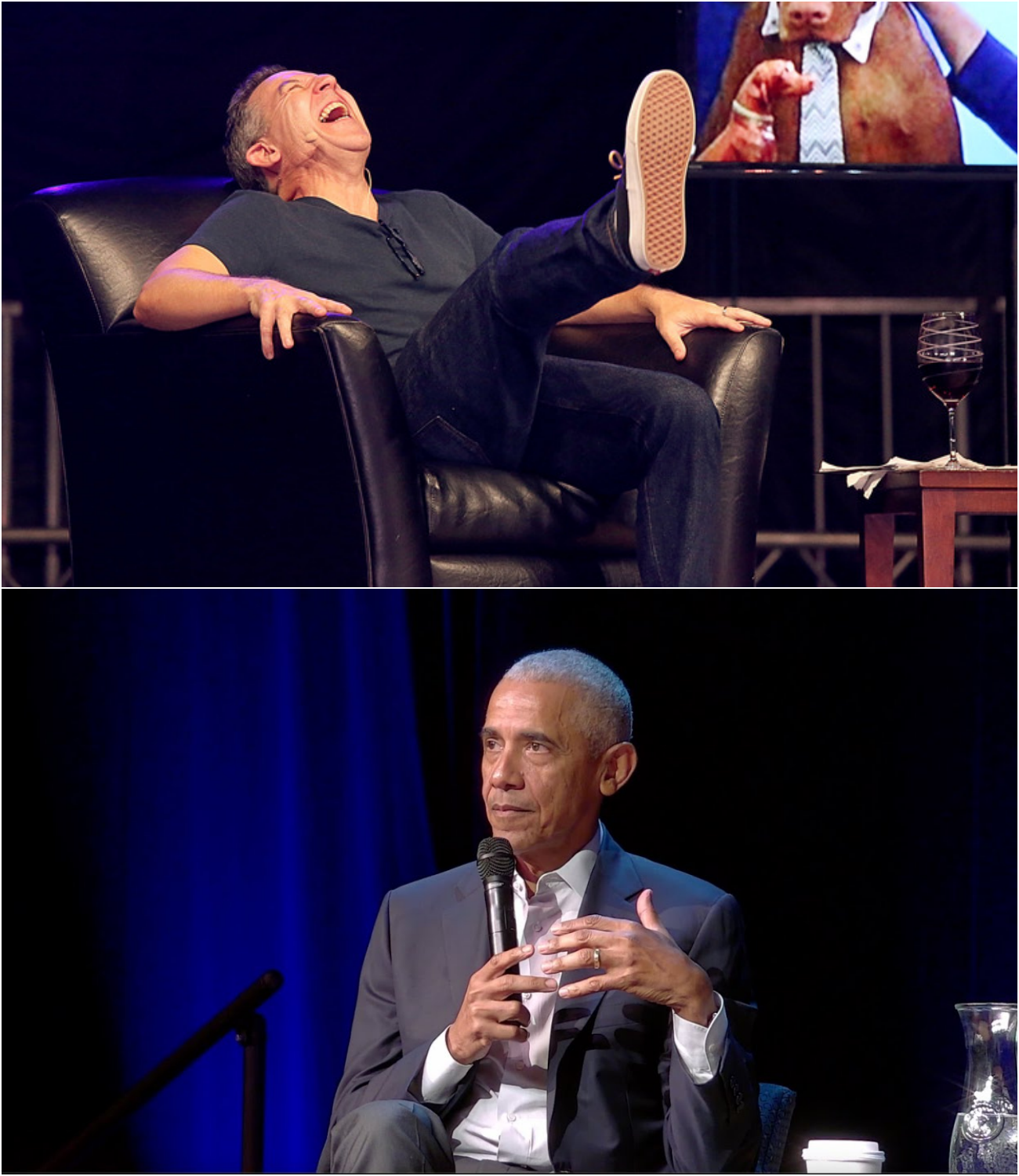
The modern political landscape has long been dominated by carefully constructed narratives, masterfully curated public images, and the calculated use of media stagecraft. For nearly two decades, the legacy of former President Barack Obama has stood as an almost untouchable monument within mainstream political discourse, widely celebrated for its soaring rhetoric, cinematic optimism, and an overarching promise of “hope and change.” However, a spectacular and highly volatile clash unfolded on live television as political commentator and satirist Greg Gutfeld launched a relentless, zero-mercy rhetorical assault directly at the heart of that very legacy. With razor-sharp sarcasm, an unwavering reliance on inconvenient historical receipts, and a complete refusal to play by the established rules of journalistic deference, Gutfeld effectively bypassed decades of media worship to ask the fundamental question that corporate news outlets have spent years avoiding: What did the hope and change era actually fix for the American people?
The broadcast, which quickly sent shockwaves across social media platforms, represented much more than a standard partisan debate; it was a fundamental deconstruction of what Gutfeld terms “theater governance.” For eight years, the American public was treated to a masterfully produced political production that often felt more like a high-budget Netflix original series with a near-perfect approval rating than a traditional presidential administration. Every speech was meticulously choreographed, every poetic pause was perfectly timed, and every public reaction was deliberately delayed just long enough to project an aura of deep, intellectual thoughtfulness. Yet, beneath this flawless exterior of designer cardigans, soft lighting, and perfectly rehearsed smirks, a vastly different reality was quietly unfolding across Main Street America—one characterized by flatlining wages, expanding government surveillance, economic stagnation, and deep cultural division.

Gutfeld’s critique began by addressing the intense, ongoing debate surrounding economic ownership. Following recent public claims by former President Obama taking credit for subsequent economic booms, the discussion quickly turned into a high-stakes battle over political legacy. Gutfeld argued that the corporate media and the political establishment have finally run out of room to deny tangible economic successes, forcing them to pivot from denying positive results to desperately quibbling over who deserves the credit. The reality, as Gutfeld sharply pointed out, is that true economic revival was achieved precisely by rolling back the restrictive regulations, heavy taxes, and bureaucratic burdens that defined the previous eight years. The attempt to claim retroactive credit for an economic landscape that flourished only after those original policies were systematically dismantled represents a profound level of political audacity.
To understand the depth of this unfiltered clash, one must examine the specific policy pillars that Gutfeld systematically dismantled during the broadcast. Chief among them was the infamous trillion-dollar economic stimulus plan—a massive injection of taxpayer capital that was initially sold to the public as a glorious, life-saving adrenaline shot for a crashing nation. Gutfeld colorfully compared the entire endeavor to pouring a single gallon of Gatorade onto a raging forest fire and expressing profound shock when the trees continued to burn. Instead of sparking genuine, long-term economic growth, the historic stimulus resulted in what he described as a trillion-dollar pity party that left ordinary citizens with almost nothing to show for it. The primary tangible remnants of that massive expenditure were the ubiquitous, decorative roadside signs bragging about federal recovery projects—signs that, in a twist of supreme bureaucratic irony, often cost more to manufacture and install than the actual short-term jobs they were advertising to the public.
The dismantling continued with an unapologetic look at the administration’s self-proclaimed crown jewel: the Affordable Care Act. While celebrated by political elites as a monumental triumph of compassionate governance, Gutfeld reframed it as a crown of thorns for millions of middle-class Americans who were left to navigate skyrocketing deductibles and collapsing options. The initial digital rollout of the healthcare platform looked as though it had been hastily designed by interns who had never touched a computer, serving as a perfect metaphor for the policy itself. Americans were famously and repeatedly promised that if they liked their doctor, they could keep their doctor. Years later, citizens are still searching for those lost doctors, many of whom were forced out of networks by an overly centralized system. The true, unvarnished tagline of the Affordable Care Act, Gutfeld insisted, was simple: Congratulations, you are now thoroughly confused and financially bankrupt.
Beyond domestic policy, the broadcast took aim at the stark contradictions embedded within the administration’s celebrated foreign policy and humanitarian record. The awarding of the Nobel Peace Prize early in the presidency remains one of the most glaring examples of elite sycophancy in modern history—the political equivalent of handing an individual a gold medal simply for showing up to a race wearing a shiny, expensive tracksuit. While the international community and fawning media panels gave standing ovations for poetic anti-war rhetoric, the actual administration quietly oversaw a massive escalation in drone warfare, where the catastrophic bombing of a wedding party or civilian infrastructure was routinely treated as a minor, unfortunate scheduling inconvenience.
Similarly, the highly sensitive issue of immigration enforcement revealed a deep chasm between public messaging and structural reality. While the administration was consistently painted as the most compassionate and welcoming leadership in modern history, the hard data tells a radically different story. The administration deported more individuals than any other presidency in modern American history. Furthermore, the controversial cages used to hold migrant children at the southern border—structures that would later spark intense moral outrage during subsequent administrations—were originally designed, built, and utilized during the Obama tenure. The only difference, Gutfeld noted with biting irony, was that the original administration performed these actions under soft, flattering lighting accompanied by a gentle, sorrowful piano soundtrack playing quietly in the background, entirely shielding them from mainstream media criticism.
This brings the conversation to the golden age of journalistic bootlicking. For eight long years, the traditional press corp completely abandoned its constitutional role as an objective watchdog, transforming instead into an outsourced, highly enthusiastic public relations firm for the executive branch. Every single executive move was labeled historic, every glaring administrative mistake was framed as a deeply nuanced strategic calculation, and every policy disaster was excused as an act of profound, misunderstood brilliance. Gutfeld joked that if the president had sneezed, MSNBC would have immediately assembled a full panel of experts to explain how the sneeze represented a revolutionary, ground-breaking approach to climate science. This total abdication of journalistic responsibility allowed major scandals—ranging from the weaponization of the IRS against political opponents to the Fast and Furious gun-running debacle, the Department of Justice overreaches, and the tragedy in Benghazi—to be quietly tucked away like embarrassing family secrets, locked safely in the basement under a heavy blanket behind a refrigerator.

Perhaps the most damaging and enduring aspect of this legacy, however, is the deliberate cultivation of modern identity politics and culture war battles. While the public rhetoric always emphasized national unity, hope, and bringing people together, the actual operational playbook was built entirely on division and distraction. By weaponizing political correctness and expanding the reach of the administrative state, the administration laid the exact structural blueprint for the cancel culture mobs, selective moral outrage, and virtue-signaling lectures that dominate contemporary American life. Disagreement was gradually transformed into a moral failing, and traditional sarcasm became an act of outright political rebellion. The administration installed a permanent gift shop within the D.C. swamp, expanding corporate surveillance through the NSA and allowing weaponized identity politics to systematically infiltrate every major American institution, from kindergarten classrooms to Fortune 500 corporate boardrooms.
Ultimately, Greg Gutfeld’s live television monologue was not merely an exercise in political entertainment or an effort to roast a prominent public figure for sport. Rather, it was a profound and necessary act of cultural iconoclasm. By forcing a mirror directly in front of the masterfully managed branding and the Instagram-perfect photo opportunities, Gutfeld exposed the massive, uncomfortable, and highly damaging gap between what the American public was promised and what they were actually forced to endure. History does not remember perfectly timed rhetorical pauses, poetic speeches, or multimillion-dollar Netflix production deals; history ultimately remembers tangible results. When the layers of fawning media coverage, celebrity endorsements, and tearful farewell speeches are stripped away, what remains is a political legacy built far more on manufactured mythology than on historical reality. Gutfeld’s raw, unfiltered commentary serves as a stark reminder that the most disruptive and dangerous thing one can do to a beautifully constructed illusion is to simply stand up and tell the unvarnished truth.