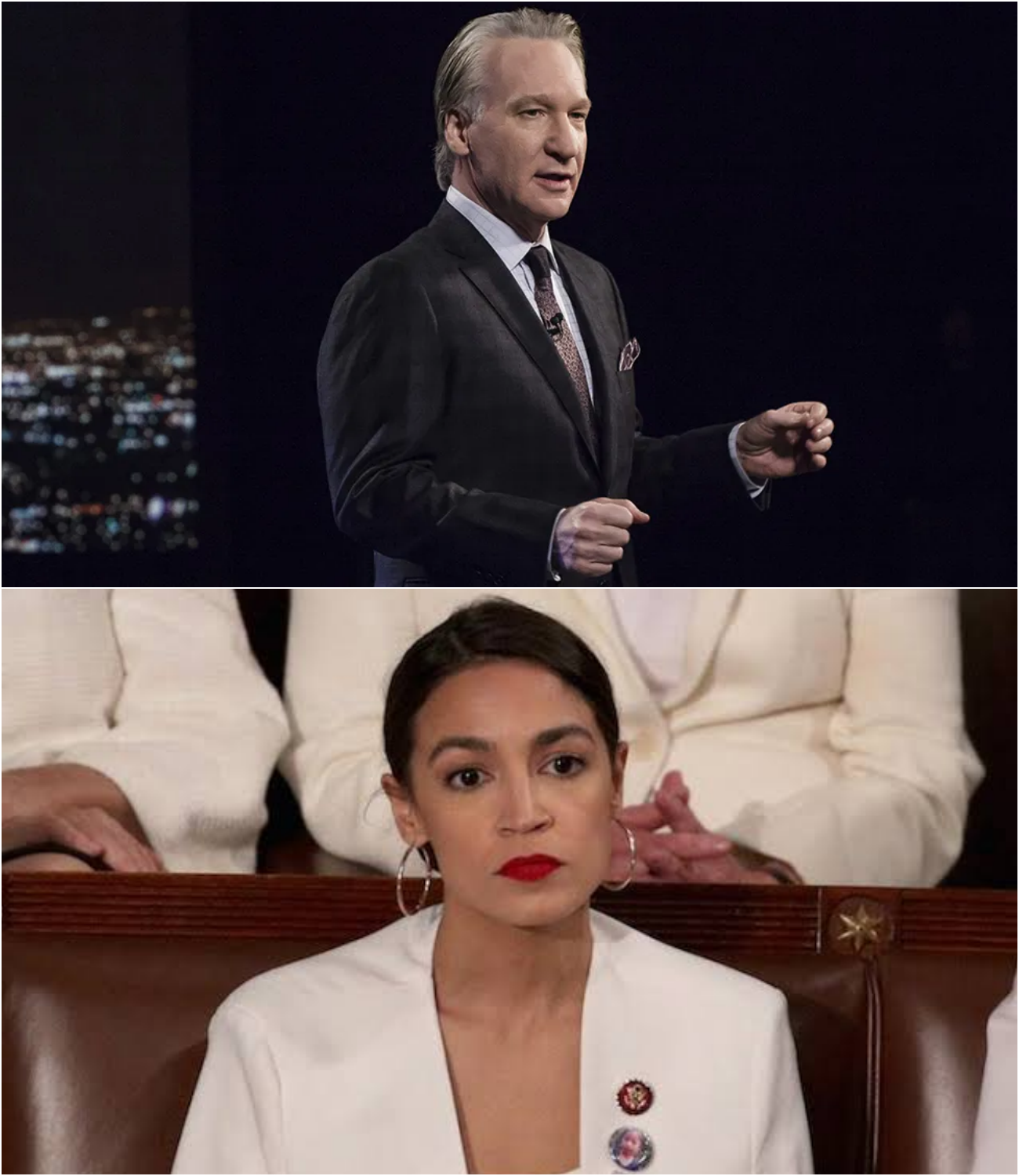
The American political landscape is undergoing a silent yet seismic shift, and the fractures within the Democratic Party are no longer possible to hide behind polished campaign ads or record-breaking small-dollar fundraising numbers. For years, the progressive wing of the party, championed by high-profile figures like New York Congresswoman Alexandria Ocasio-Cortez (AOC) and Senator Bernie Sanders, has operated under the assumption that massive rally crowds and viral social media moments inevitably translate to national political dominance. However, a series of sobering electoral realities and a growing sense of voter fatigue have begun to tell a vastly different story.
Stepping directly into this ideological battlefield is veteran comedian and political commentator Bill Maher. Known for his blunt, unfiltered, and often controversial takes on Real Time with Bill Maher, he has emerged as one of the most vocal critics of what he describes as the “plainly insane excesses of the left.” In a series of sharp, analytical takedowns, Maher has taken direct aim at AOC’s core talking points, dismantling the progressive narrative and highlighting what he believes is a fatal blind spot that could cost the Democratic Party its future.

The Mirage of Momentum: Why Crowds and Cash Don’t Equal Votes
One of the most persistent illusions in modern politics is that crowd size and campaign revenue are the ultimate indicators of electoral success. During discussions surrounding the horizon for the 2028 Democratic primary, political analysts often point to Bernie Sanders and AOC as the natural frontrunners because they consistently attract the largest, most energetic crowds.
But as Bill Maher bluntly counters, “That doesn’t matter. It won’t sustain itself.”
Maher’s critique hits at a fundamental truth that history has proven time and again: enthusiasm among a passionate, localized base does not guarantee a broad national coalition. A candidate can fill stadiums in deep-blue urban centers, but those packed arenas represent only a fraction of the electorate needed to win a general election. The same principle applies to campaign finance. While AOC has famously outraised many of her congressional colleagues through small-dollar donations, and Vice President Kamala Harris smashed fundraising records in recent cycles, money cannot fix a fundamentally flawed or alienating message. When election day arrives, voters do not cast ballots based on a campaign’s bank balance; they vote based on whether a candidate’s vision aligns with their daily reality.
The “Woke” Backlash and the Semantic Retreat
A central pillar of Maher’s critique revolves around the shifting language of the progressive movement. Following recent Democratic losses, veteran political strategist James Carville laid the blame squarely on what he termed “stupid wokeness.” In response, AOC fired back, dismissing the word “woke” as a term used almost exclusively by older generations to discredit progressive ideas.
Maher was quick to call out the hypocrisy of this defense. Far from being an outdated term imposed by critics, “woke” was a label that progressives themselves proudly championed at marches, rallies, and policy rollouts for years. Last year, major publications even declared it the word of our era.
Maher argues that the sudden desire by progressives to distance themselves from the term is not a natural evolution of language, but a tactical retreat driven by public backlash. The term has become synonymous with a political elite that feels deeply disconnected from the real-world struggles of everyday citizens.
“Okay, fine,” Maher challenged on his show. “What word would you like us to use for the plainly insane excesses of the left that are not liberalism but something completely different?”
Maher pointedly argued that traditional liberalism does not encompass radical cultural shifts, such as renaming historic schools or teaching young children that they are inherently oppressors based on identity. By attempting to quietly drop the label while maintaining the exact same polarizing policies, progressives are failing to address the root cause of voter dissatisfaction. Changing the vocabulary does not erase the underlying policy, and everyday voters are smart enough to recognize the difference.
The Alienation of Working-Class and Minority Voters
Perhaps the most damaging consequence of the progressive ideological drift is the rapid erosion of support among demographic groups that have historically formed the backbone of the Democratic coalition. Maher highlighted a staggering trend: the mass defection of Latino and Asian-American voters away from the left.
A prime example of this disconnect is the aggressive pushing of academic, gender-neutral terms like “Latinx” by prominent liberals, including AOC and California Governor Gavin Newsom. Presented by elites as modern, inclusive, and progressive, the term was entirely alien to the vast majority of the Latino community it claimed to represent. National polls and street-level conversations revealed that a massive majority of Latino voters actively disliked or completely misunderstood the term.
While some politicians quietly dropped the phrasing after noticing the backlash, AOC continued to defend it, arguing that language and gender are fluid. Maher’s response was characteristically sharp: “Yes, and Latino voters are fluid.” This insistence on top-down cultural engineering over real listening has severely eroded trust, pushing an unprecedented number of working-class minority voters to identify with the Republican party.
A similar phenomenon is occurring within Asian-American communities, where Democratic support has plummeted significantly. Maher attributes this directly to misguided progressive policies implemented in deep-blue cities under the banner of “achieving equity.” In an effort to equalize outcomes, several school districts moved to eliminate advanced, merit-based academic programs—the very programs where hardworking Asian-American students historically excelled.
For parents who immigrate to the country with the hope that intense meritocratic effort will guarantee a better life for their children, this policy felt like a direct assault on their core values. As Maher noted, these parents don’t harbor racial animosity; they simply want a system that rewards hard work. When the Democratic Party acts as a lawyer for teachers’ unions rather than the students and parents, families begin looking for legal representation elsewhere.
Democratic Socialism vs. Mainstream Appeal
At its core, the tension within the left is an ideological battle over the identity of the party itself. Figures like AOC and Zohran Mamdani often operate under the Democratic banner, but they openly identify as Democratic Socialists.
Maher emphasizes that this distinction is critical, and one that moderate voters are acutely aware of. While the United States already features popular, deeply embedded socialist elements like Social Security, Medicare, and veterans’ benefits, the platform of modern Democratic Socialists extends into far more radical territory, including calls for entirely open borders and government-run grocery stores.
For the average American voter, who is currently navigating inflation, economic uncertainty, and concerns over neighborhood safety, these proposals feel less like progress and more like dangerous extremism. Maher contends that national elections are won in the sensible center, not on the radical fringes. The American electorate is currently begging both major political parties for stability, practicality, and common-sense solutions.
When a politician focuses entirely on abstract cultural trends and radical economic restructurings, they do not just lose the debate—they completely alienate the voters required to build a winning coalition. If the Democratic Party allows its national ticket to be driven exclusively by the ideological fervor of its most progressive wing, it risks repeating catastrophic electoral blunders. True political power lies not in how loudly a base can cheer, but in how effectively a leader can reassure the broader public that their everyday lives, their families, and their values are safe in their hands.