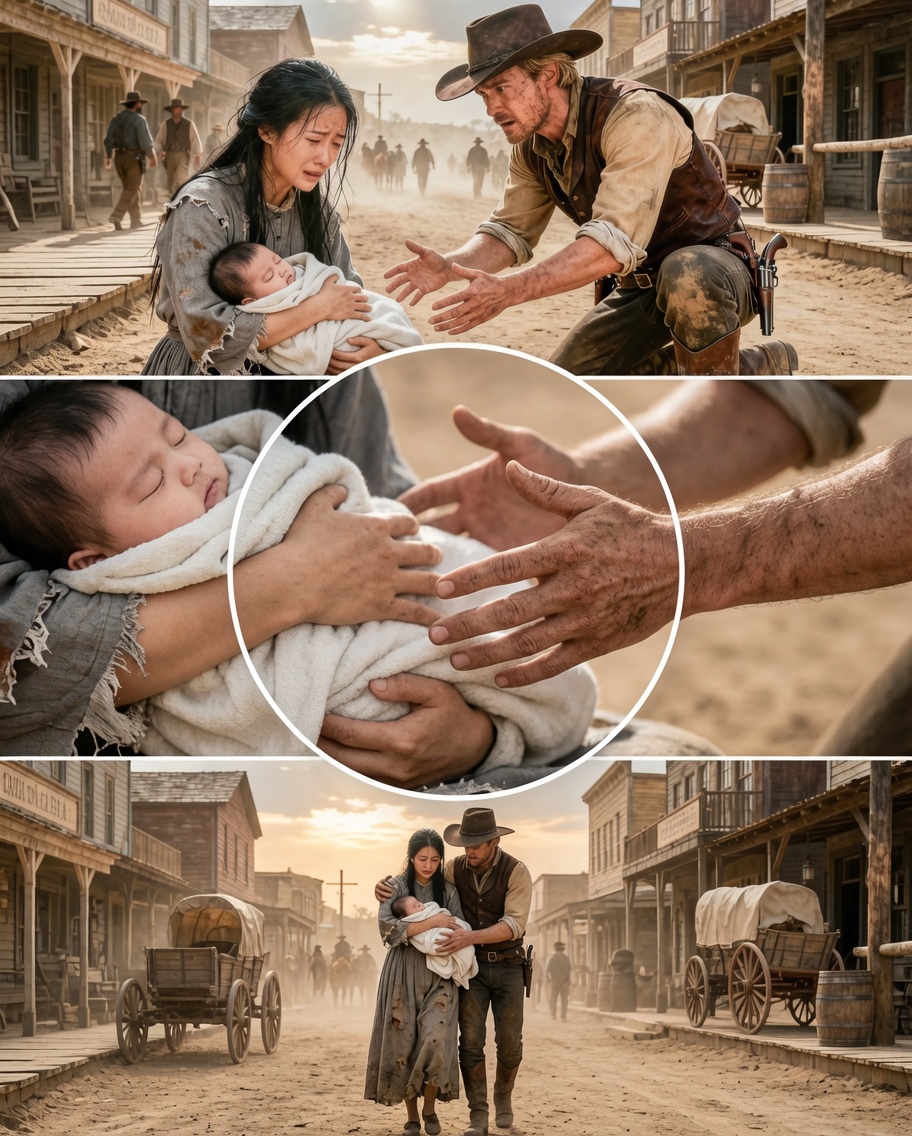
The auctioneer’s voice was a hammer pounding the hot summer air, and May clutched her son so tightly he whimpered against her shoulder. The dust of Argenta Nevada settled in a fine brown film on her worn gray dress, on the sweaty faces of the men in the crowd, and on the raw timber of the platform where she stood.
It was 1872, and she was property again. Her husband, Liang, had died working on the railroad trestle over the Humboldt River, leaving behind a debt to a man who dealt in freight and flesh with equal indifference. That man was Jedediah Croft, and it was his voice now, smooth and oiled like a new gun, that was selling her future for pocket change.
“Next, we have a fine piece of domestic help,” Croft announced, his smile not reaching his cold, pale eyes. “Healthy, young, about 25, quiet temperament, comes with an encumbrance.” He gestured dismissively at the baby in her arms. “But the boy is sturdy. He’ll earn his keep in a few years. What am I bid for this pair? An indenture of 5 years to clear a debt of $200.
Who will start the bidding at 50?” Silence. The men shuffled their feet. A woman in a calico bonnet pulled her husband back a step. A Chinese woman was one thing. A Chinese woman with a baby was another. She was a burden, a mouth to feed that could not yet work. May’s heart hammered against her ribs. She looked out at the sea of faces, a blur of suspicion and disinterest.
They saw her as a curiosity, an animal to be inspected. They did not see the terror that was a cold stone in her belly. They did not see the ghost of Liang, his kind face smiling as he promised her a life in the gold mountain of America. This dusty, cruel place was not gold. It was a grave. “Fifty dollars, gentlemen.
” Croft repeated, his patience thinning. “She can cook, clean, launder, strong back for farm work.” “Twenty dollars.” A rough voice called from the back. It was a freighter, his face red from the sun and whiskey. Laughter rippled through the crowd. “Twenty-five.” Another man countered, a store owner with a pinched face and a reputation for working his help to bone.
Croft’s gaze swept the crowd looking for a serious buyer. His eyes landed on a man standing alone near the livery stable, away from the main press of bodies. The man was tall and lean, dressed in practical canvas trousers and a faded blue shirt. He wasn’t a townsman. His face was weathered by sun and wind, his hands broad and calloused.
He looked like the land itself, quiet, patient, and hard. He hadn’t said a word, just watched with an unnerving stillness. “Thirty.” The freighter grumbled. “Thirty-five.” Said the store owner. May squeezed her eyes shut. She could feel the men’s eyes on her, appraising her teeth, her hands, the strength in her arms.
She was being priced like a mule. She felt Bao stir against her, his small hand reaching up to touch her cheek. His warmth was the only real thing in the world. For him, she had endured the voyage across the ocean. For him, she had endured the loss of Liang. For him, she would endure anything. But the thought of her son growing up as a slave to one of these cruel men was a pain sharper than any grief.
A desperate idea, born of pure terror, seized her. She could not save herself, but perhaps she could save him. She took a half step forward, her voice a raw, broken thing. “Take him,” she cried out, her English clumsy but clear. She held Bao out, a terrible offering. “Take my son, not me. He is strong. He will work hard.
Please.” A shocked hush fell over the crowd. A woman gasped. Even Croft looked momentarily taken aback. This was not part of the performance. The men stared, not with pity, but with a morbid fascination. They were watching a mother try to sell her own child to save him from herself. “Take him, not me,” she pleaded again, tears finally breaking free and tracing paths through the dust on her cheeks.
The lone rancher by the livery stable, who had been watching with that same quiet intensity, finally moved. He took a step forward, and then another. His boots making soft thuds in the thick dust. The crowd parted for him slightly, murmuring. He stopped a few feet from the platform, his gaze fixed on May. He looked at her tear-streaked face, then down at the small, bewildered child in her arms.
For a long moment, he said nothing. He just looked. And in his eyes, May saw not the hunger or contempt of the other men, but something else. Something she could not name. He seemed to freeze, caught in the gravity of her desperate plea. The store owner, eager to close his deal, called out, “$40 for the woman alone. He can keep the boy.
” The rancher’s jaw tightened. He finally lifted his head, his voice low, but carrying with absolute clarity in the sudden quiet. “$200.” The crowd went dead silent. Jedediah Croft’s smile faltered. “200?” “Sir, the bidding is at $200.” The rancher repeated, his eyes never leaving May. “For them both.” He pulled a worn leather purse from his pocket.
The clink of coin heavy and final. “Cash to clear the debt in full. The indenture is finished.” He wasn’t buying a servant for 5 years. He was buying their freedom. The air crackled with the sheer impossibility of it. Croft, recovering quickly, saw only the money. “Sold!” he declared, his hammer voice booming. “To Mr. Arthur Hayes for $200.
” Arthur Hayes. The name meant nothing to May. All she knew was that the ground beneath her feet had just shifted. She pulled Beau back against her chest, her arms trembling. The tall, quiet man walked to the edge of the platform and held up a hand to help her down. His hand was rough, but his grip was surprisingly steady.
She took it, her fingers barely brushing his, and stepped down from the block. From one life and into another she could not possibly imagine. She did not know if she had just been saved or sold to a different kind of master. But as Arthur Hayes led her and her son away from the gaping crowd, she knew one thing for certain.
Nothing would ever be the same. He had not just bought her labor, he had answered her prayer. And in doing so, he had bought her entire world. The wagon ride to Arthur Hayes’ ranch was a silent, jarring affair. The wheels groaned over the rutted track, and the sun beat down with a merciless intensity. May sat on the buckboard, one arm wrapped protectively around Beau, the other gripping the splintered wood of the seat.
Arthur sat beside her, handling the reins with an easy, practiced competence. He had not spoken more than a handful of words to her since leaving Argenta. At the general store, he had bought a sack of flour, beans, smoked bacon, and a small tin of sweetened milk, a luxury that made her breath catch in her throat.
He simply placed the items in the back of the wagon and said, “For the boy.” Jedediah Croft had been there, leaning against the store’s porch railing. His eyes, like chips of ice, had followed them. “Quite the purchase, Hayes,” Croft had said, his voice dripping with false cordiality. “Hope you know what you’re doing.
That’s a lot of land to work by your lonesome, and now with additions.” Arthur had simply finished loading the wagon, his movements deliberate. He met Croft’s gaze. “I know my business, Croft.” “Do you?” Croft pushed himself off the railing. “Some might say spending your last dollar on damaged goods isn’t good business at all.
” A coldness settled in May’s stomach. Arthur’s face remained impassive, but she saw a muscle jump in his jaw. “They’re not goods,” he said, his voice quiet but hard as granite. “And it wasn’t my last dollar. He climbed onto the wagon and flicked the reins, leaving Croft standing there with a sour look on his face.
The confrontation lingered in the air between them, unspoken. It confirmed what May already suspected. Arthur’s act had made him an enemy. And by extension, it had made her one, too. The fear she’d felt on the auction block returned. A familiar bitter taste in her mouth. The land grew more rugged as they traveled, the sagebrush plains giving way to rolling hills dotted with juniper and pine.
After another hour, they crested a ridge and Arthur pointed with his chin. There. Below them, nestled in a shallow valley, was a small homestead. A simple clapboard house, a sturdy-looking barn, and a web of corrals set beside a creek that snaked through a meadow of tall grass. It was isolated, miles from any other sign of life.
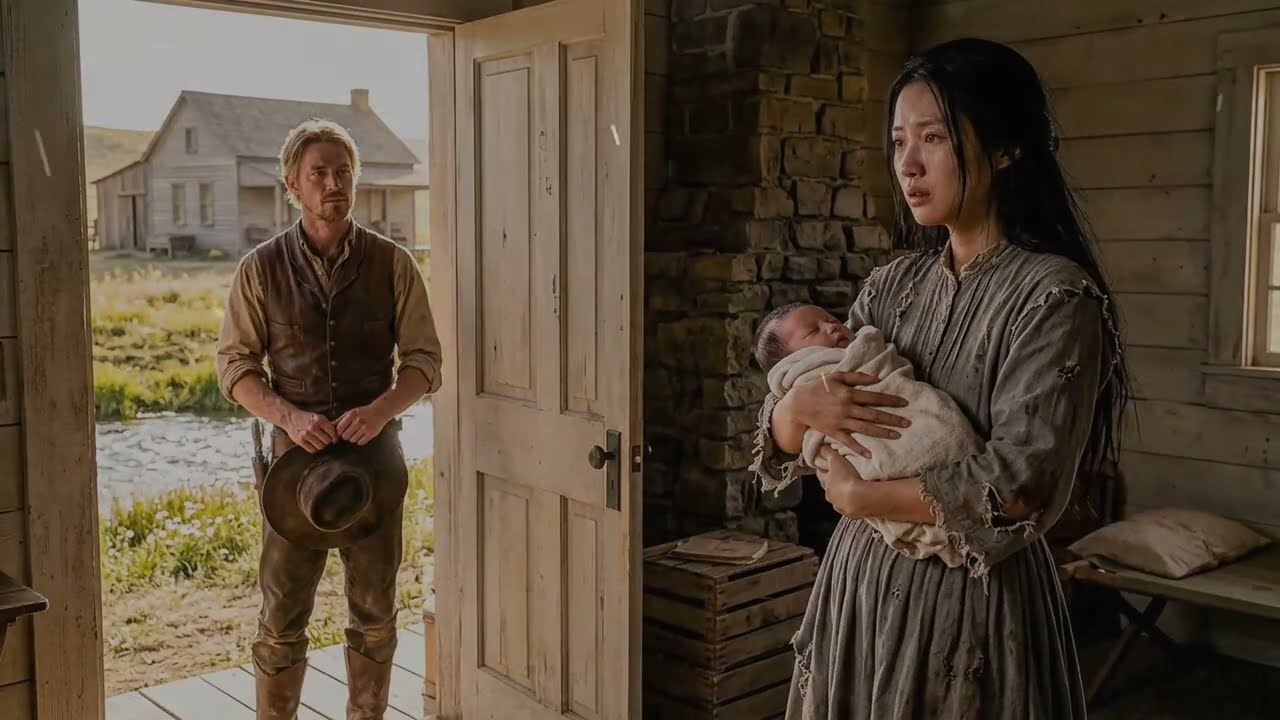
A profound loneliness seemed to hang over the place. When they arrived, Arthur didn’t lead her to the main house. Instead, he stopped the wagon in front of a small separate cabin set a respectful distance away near the creek. It was little more than a single room, but it had a stone chimney, a proper door, and a small porch.
“This is yours,” he said climbing down. “It’s not much, but it’s clean. The well is over there. Water is sweet.” May slid down from the wagon, her legs stiff. She looked from the cabin to the main house. She had expected to sleep on a pallet in a kitchen or a barn. This was different. This was a home, however small.
Arthur began unloading her meager belongings, a single cloth-wrapped bundle, along with the supplies he’d purchased. He carried them inside the cabin for her. The interior was sparse, but tidy. There was a cot in one corner, a small table with two chairs, and a cold fireplace. He set the supplies on the table.
“The wood pile’s behind the house,” he said, his back to her. “I’ll be in the barn if you need anything.” He paused at the door, turning to look at her and Beau, who was now awake and peering at him with wide, curious eyes. “You’re not a servant, ma’am,” he said, his voice gruff, as if the words were uncomfortable in his mouth.
“I needed help on the ranch. You You needed help off that platform. We’ll call it an even trade. You cook, keep the house, tend to garden. In return, you and the boy have a roof and food. No indenture. You’re free to leave whenever you wish.” He left before she could respond, closing the door softly behind him.
May stood in the middle of the small room, stunned into silence. Free to leave? The concept was so foreign, she couldn’t fully grasp it. Where would she go? She had nothing, no one. Still, the words echoed in the quiet cabin, a flicker of light in a long, darkness. Days turned into a week, then two. A quiet rhythm established itself.
May rose before dawn, lighting the fire in the main house’s kitchen, and preparing breakfast. Arthur would already be out, tending to his small herd of cattle, or mending fences. They ate their meals in the same room, but at separate tables, a silent acknowledgement of the gap between their worlds. He never gave her orders, just stated what needed doing.
The fences on the north pasture need checking. We’ll be branding next week. She found he was a man of deep silences, but his actions spoke a language she was beginning to understand. He repaired a loose step on her cabin porch without being asked. He built a small shaded pen near the house where Beau could play safely while she worked in the garden she had started.
He would sometimes watch her son, a strange, wistful expression on his face. One evening, Beau toddled over to him and offered him a smooth, gray stone. Arthur froze, then slowly reached out and took it. His large, rough fingers closing around the small object as if it were precious. He looked at May, and for the first time she saw a profound sadness in his eyes, a loneliness that mirrored her own.
The valley was peaceful, but the peace felt fragile. The memory of Croft’s threat was a constant shadow. One afternoon, while hanging laundry on a line stretched between two trees, May saw it. A dark, coiled shape in the tall grass near the pen where Beau was playing. A rattlesnake sunning itself, its head raised and alert.
Her blood ran cold. The snake was between her and her son. Beau, oblivious, reached for a bright yellow wildflower just inches from the deadly coil. There was no time to think, no time to call for Arthur, who was mending tack in the barn. May reacted with pure instinct. She snatched the nearest weapon, a heavy laundry pole used to prop up the line.
With a cry that was half warning, half prayer, she lunged forward, placing her body between the snake and the pen. She brought the pole down with all her strength, a desperate, clumsy strike. The snake writhed, striking at the wood. She struck again and again, her arms screaming with the effort, her vision blurring with panic.
The barn door flew open. Arthur came running, a pitchfork in his hands. He stopped short, taking in the scene. May, panting and trembling, standing over the dead snake, the laundry pole still gripped in her white-knuckled hands. Bao, startled by the commotion, had begun to cry. Arthur slowly lowered the pitchfork.
He walked over, his eyes going from the snake to her face. He knelt and checked on Bao, his hands gentle as he soothed the crying child. Then he stood and looked at her. “You’re all right?” he asked, his voice strained. She could only nod, her throat too tight for words. He looked at the snake, then back at her, and a new understanding dawned in his eyes.
He had seen her desperation on the auction block, but now he had seen her strength. He had seen the fierce, protective core of her. He had bought a victim, but he was slowly discovering he had brought home a survivor. Later that evening, as she swept the floor of her cabin, a small, folded piece of paper fell from the hem of her dress, where she had sewn it for safekeeping.
It was one of the few things she had managed to keep from Liang’s possessions. She bent to pick it up, but Arthur was standing in the open doorway. He had seen it fall. He stepped inside, his shadow falling across the floor, and picked it up before she could. He unfolded the worn, creased paper. Most of it was covered in the elegant, complex strokes of Chinese characters, but at the bottom, a name was written in careful, practiced English script.
Arthur’s breath hitched. He did not yet know that the paper in his hand held the truth to a conspiracy of greed and murder. He only knew the name, and it was enough to make the blood drain from his face. Written on the paper, clear as day, was the signature of Samuel Blackwood, the cattle baron who owned nearly everything in the territory and was rumored to own Jedediah Croft as well.
The silence in the small cabin was thick with unspoken questions. Arthur held the paper, his thumb tracing the English signature at the bottom. The name Samuel Blackwood was a weight in the room, a name associated with power, wealth, and a ruthlessness that was legendary in the Nevada Territory. He was a man who bought politicians and controlled water rights with equal ease.
Finding his name on a document belonging to a penniless Chinese widow made no sense. “Where did you get this?” Arthur asked. His voice was quiet, without accusation, but it held a new and urgent intensity. Mei looked at his face, at the deep lines of concern etched around his eyes. In the week she had been on his ranch, he had never been unkind.
He had been distant, yes, and wrapped in his own solitude, but he had treated her with a respect she had not known since Liang’s death. He had protected her, provided for her, and asked for nothing more than the work of her hands in return. She decided in that moment to trust him. “It belonged to my husband,” she said, her voice barely a whisper.
She gestured to the chair at the small table, and after a moment’s hesitation, he sat. She remained standing, as if the story was too heavy to tell from a resting position. “Li Ang, my husband, he was not just a laborer,” she began. “In our village, he was a scholar. He learned English from a missionary. He was clever.
He saw things.” She wrung her hands, gathering her courage. “Mr. Croft hired many men from my country to work on the railroad. He paid them in script, not real money. Script they could only use at his store for food and supplies at prices that were double what they should be. The men fell into debt quickly.” Arthur nodded slowly.
It was a common and cruel practice. “Go on.” “The debt was the trap,” May continued, her voice gaining strength. “Under the Homestead Act, a man can claim 160 acres of land. He must live on it and improve it. Many of our men, they wanted this, a piece of America. Mr. Croft told them he would help. He used their debt to file the claims for them in their names.
He told them they were landowners.” She paused, taking a shaky breath. “But it was a lie. The land he filed for was worthless rock, miles from water. The men could not live there. They had to stay and work for the railroad to pay the debt. When they could not make the homestead improvements, they would be in default. Mr.
Croft would then pay their debt to the land office, a few dollars, and the claim would become his. He was collecting homesteads piece by piece, using my people as names on paper.” Arthur’s face was grim. “And Blackwood?” He asked, tapping the document. “That was the part Liang discovered.” she said. “The claims Croft was gathering were not random.
They all surrounded the creeks and springs in this valley. He was not collecting land. He was collecting water for Samuel Blackwood. Blackwood wanted to control all the grazing land, and to do that, he needed all the water. This paper it is a copy of a deed, a fraudulent one. Liang said the signature was forged. It transfers one of the defaulted homesteads from Mr.
Croft directly to a company owned by Mr. Blackwood. It is the proof that connects them.” The story tumbled out of her, a torrent of grief and injustice. Liang was going to take this proof to the US Marshall in Carson City. He had saved enough real money for the trip, but the day before he was to leave, there was an accident at the trestle.
A rope snapped. “They said he was careless, but he was never careless.” Her voice broke. “Mr. Croft came to our tent the next day. He said Liang owed him $200. He took everything. He said I would have to work off the debt. He wanted to sell me to someone far away, someone who would not ask questions, where I could never tell this story.
” Arthur stared at the paper, then at her. Everything clicked into place. The auction, Croft’s eagerness to be rid of her, his sneering threat at the store. He hadn’t bought a servant and her child. He had bought the only two witnesses to a massive land and water fraud scheme, a scheme that likely included murder.
He had painted a target on his own back. As if summoned by the thought, the sound of hoofbeats echoed from the valley road, steady and approaching fast. It was too late in the day for a neighbor. Arthur stood, his movements swift and sure. He walked to the window and peered out into the twilight. Three riders were coming up the track.
He recognized the man in the lead instantly. Jedediah Croft. “Stay inside.” Arthur said to May, his voice low and commanding. “Bar the door and stay away from the window.” He walked out of her cabin and onto his own porch, taking up a position near the door of his house. He didn’t reach for the rifle mounted over the mantelpiece.
He simply stood there waiting, his arms crossed over his chest. He looked like a man defending his home, which May realized with a sudden startling clarity, was exactly what he was doing. Croft and his two hired men reined in their horses a few yards from the porch. The men with him were rough-looking, their hands resting near the pistols on their hips.
“Evening, Hayes.” Croft said, his smile thin and predatory in the fading light. “Sorry to call on you so late.” “What do you want, Croft?” Arthur’s tone was flat, leaving no room for pleasantries. “Just some business to clear up.” Croft said, swinging down from his horse. “Seems there was a mistake with the paperwork on my former property.
A legal oversight. I’m afraid the sale wasn’t valid. I’m here to collect the woman and the child and refund your money, of course.” It was a flimsy excuse and both men knew it. This was not about paperwork. This was about silencing a witness. “There was no mistake.” Arthur said calmly. “The debt is paid. I have the bill of sale signed by you.
They’re not your property anymore.” Croft’s smile vanished. “Now, listen to me, Hayes. You’re a simple rancher. You don’t want to get involved in affairs that don’t concern you. This is a business matter between me and the woman. Give her to me and you can go back to your quiet life. Inside her cabin, May held Bow close, her heart pounding against her ribs.
She could hear every word. She was the cause of this. She had brought this danger to this good man’s door. It would be so easy for him. Hand her over, save himself. No one would fault him for it. It was a sensible thing to do. But Arthur Hayes did not move. He looked at Croft, then his gaze flickered for a second toward her cabin where she and her son were hidden.
He had made a choice on the auction block. A choice born of a decency he likely couldn’t explain. Now, he was being asked to make it again. But this time, the price wasn’t money. The price was his own safety. Perhaps his own life. He uncrossed his arms. “This is my land, Croft.” He said. His voice ringing with a finality that sent a chill down May’s spine.
“And those are my people. They’re not going anywhere. I think it’s time for you to leave.” Croft’s face hardened into a mask of fury. “You’ve made a terrible mistake, Hayes.” He turned to his men. “Get them.” But before they could move, Arthur took one step back into his house and emerged a moment later with the rifle.
He didn’t point it. He just held it, its long barrel resting in the crook of his arm. It was a clear, unambiguous statement. “I said, leave.” Arthur repeated, his voice as cold and hard as the stone of the mountains that surrounded them. The two hired men looked at Croft, then at the rifle, and their resolve seemed to waver.
They were paid to intimidate, not to die. After a long, tense moment, Croft spat on the ground. “This isn’t over,” he snarled, and swung himself back into the saddle. He and his men wheeled their horses around and galloped away, their departure leaving a ringing silence in their wake. Arthur stood on the porch, watching them go until they were nothing but specs in the darkness.
He had made his stand. He had chosen them, and now they would face the consequences together. Three months later, the autumn sun cast a golden light over the valley. The aspen trees along the creek were a riot of yellow, and a crispness in the air hinted at the coming winter. The ranch, which had once seemed so lonely, now felt alive.
A large, thriving garden, fenced against deer, was heavy with the last of the season’s squash and beans. Rows of preserved vegetables lined the shelves in the cool pantry of the main house, a testament to Mae’s tireless work. The day after the confrontation, before Croft could act, Arthur had ridden the 20 miles to Argenta.
He didn’t go to the sheriff, who was known to be in Croft’s pocket. He went to the telegraph office and sent a detailed message to the territorial marshal in Carson City, outlining everything Mae had told him, and naming Jedediah Croft and Samuel Blackwood. He knew it was a gamble. A rancher’s word against a powerful man’s was thin currency.
But Mae’s story, combined with the fraudulent deed, was enough. The marshal, it turned out, was already building a case against Blackwood for other matters. The telegraph was the piece of the puzzle he needed. He arrived in Argenta 2 weeks later with a pair of deputies. The investigation was swift and brutal.
Faced with the evidence of the forged deed and the testimony of other Chinese workers whom the marshal tracked down, Croft’s empire of debt and fraud collapsed. He and his men were arrested, charged not only with fraud but with the murder of Liang. Samuel Blackwood, insulated by layers of money and lawyers, escaped indictment, but his hold on the valley was broken.
The town’s opinion, as fickle as the prairie wind, shifted. Arthur Hayes, the quiet, reclusive rancher, was no longer seen as the fool who’d overpaid for useless help. He was the man who had stood up to Jedediah Croft when no one else dared. The nods he received in town were no longer tinged with pity, but with a grudging respect.
They still looked at May with curiosity, but the open hostility was gone, replaced by a wary acknowledgement. She was no longer just the Chinese woman. She was Arthur Hayes’ partner, and he had proven he would defend what was his. One cool afternoon, Arthur returned from a trip to the county seat, his horse dusty from the trail.
He found May in the garden showing Bao the difference between a smooth pumpkin and a rough-skinned squash. The boy, now steady on his feet, laughed and patted the large orange gourd. A sense of peace had settled over them, a quiet domesticity forged in shared danger and mutual reliance. Arthur walked over, a thick envelope in his hand.
“This came,” he said, holding it out to her. She wiped her hands on her apron and took it. Inside was a crisp, official-looking document from the territorial land office. It was the deed to the homestead. She scanned the legal language until she found the names. It read Arthur Hayes and Mae Lien as joint tenants with right of survivorship.
Her breath caught. Her name on a piece of America. Not as property, but as an owner. >> She looked up at him, her eyes shining with unshed tears. “Why?” she whispered. He looked away toward the mountains that rimmed their valley. “A man I knew once told me that a home isn’t the land you own, but the people you share it with,” he said, his voice rough with an emotion he rarely showed.
“My wife, Sarah, she died of fever 5 years ago. This place has been quiet ever since. Too quiet.” He finally met her gaze. “You and the boy, you made it a home again.” He had lost a family. She had lost a family. And here, in this remote valley, they had somehow, against all odds, started to build a new one together.
The paper in her hand wasn’t just a legal document. It was a promise. It was proof that her husband’s dream had not died with him. She thought back to the auction block, to the dust and the heat and the utter despair. She had offered up her son to save him. But this quiet, steady man had seen their worth when no one else had.
He hadn’t chosen one or the other. He had chosen them both. He had bought a family, and in doing so, had found his own. Mae looked at the deed, at her name written beside his, and then at her son, who was now trying to hug the giant pumpkin. The sun was setting, painting the sky in hues of orange and purple. It was the color of a bruise, but also the color of a promise.
A promise of a new day. And that brings us to the end of this one. If you stayed with me all the way through, thank you. Stories like this one only get told because folks like you sit down and listen. If you liked what you heard, go ahead and hit that like button. And if you want more stories from the old frontier, subscribe so you don’t miss the next one.
Until then, take care of yourself. And thanks again for being here.