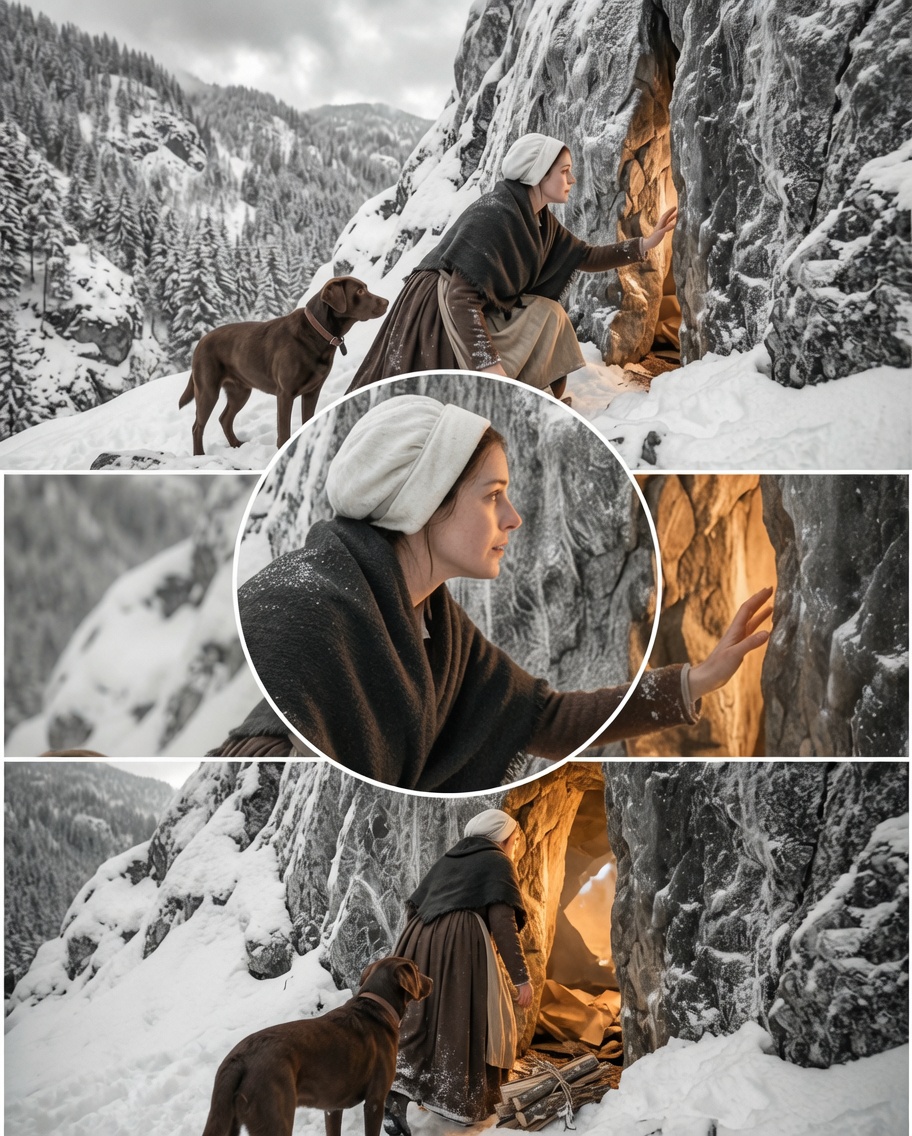
The wind of Montana did not announce itself. It arrived without warning, slipping through the gap where the cabin door no longer sat flush against its frame, curling around the baseboards, finding every weakness in the walls the way water found cracks in old stone. Clara Holt had lived with drafts before. She had lived with worse.
But this particular cold, the kind that settled in at the end of November and refused to negotiate, was different from the cold of previous winters. It had weight. It pressed down on the roof, filled the corners of rooms, and made the simple act of breathing feel like a small transaction with something larger and indifferent.
She stood at the kitchen window with both hands wrapped around a mug that had gone lukewarm 20 minutes ago. Outside the snow had been falling since Tuesday. This was Thursday. The yard, if you could call it that, just a rough clearing between the cabin and the tree line, had disappeared under 18 inches of white.
The fence posts she used to navigate by were buried to their caps. The wood pile was a long white shape along the south wall, and she did not need to go outside to know it was nearly gone. She had watched it go log by log over the past 4 days. The brace she had rigged for the door, a length of 2 by 4 wedged at an angle between the handle and the floor, held it shut well enough when the wind came from the north.
When it shifted west, the door breathed. She could feel it from across the room, that faint pulse of cold air moving through the kitchen like something alive. The broken hinge was her own fault. She had meant to replace it in October. October had gotten away from her the way months had a tendency to do since Daniel.
She set the mug down on the counter, not because she was done with it, but because holding something warm and losing it to the air felt like a small defeat she did not want to repeat. The propane burner on the stove still She had enough propane for cooking maybe 10 days if she was careful. But the wood stove in the main room was the only thing standing between her and a night that would drop to 22 below.
Without it, the cabin would cool to dangerous within 3 hours. She had done the math more than once. It was the kind of math that became very simple when the stakes were clear. Two days of food. That was what remained in the pantry after she had taken her careful inventory the morning before. Canned beans, a partial bag of oats, some dried lentils, a jar of peanut butter that was more than half empty.
She had been eating less than she needed for the past week, not out of discipline, but out of the quiet arithmetic of a person who understood that supplies did not replenish themselves. And the road into Millhaven had been closed since Monday. 35 miles of mountain highway under 2 ft of snow with drifts that could reach the roof of a truck in the passes.
No one was coming in. No one was going out. The priority was simple as priorities became when they narrowed down to survival. No fire meant no warmth. No warmth meant the third night would be the last one she would feel. So the priority was wood and the wood she needed was in the forest and the forest was 200 yards beyond the door that would not close properly against a west wind.
Clara was not a person who spent time frightened. She had worked emergency intake at St. Marcus County Medical for 6 years before she and Daniel moved out here. An emergency intake did not produce people who frightened easily. It produced people who assessed, who moved quickly in the right direction, who understood that emotion was information but not instruction.
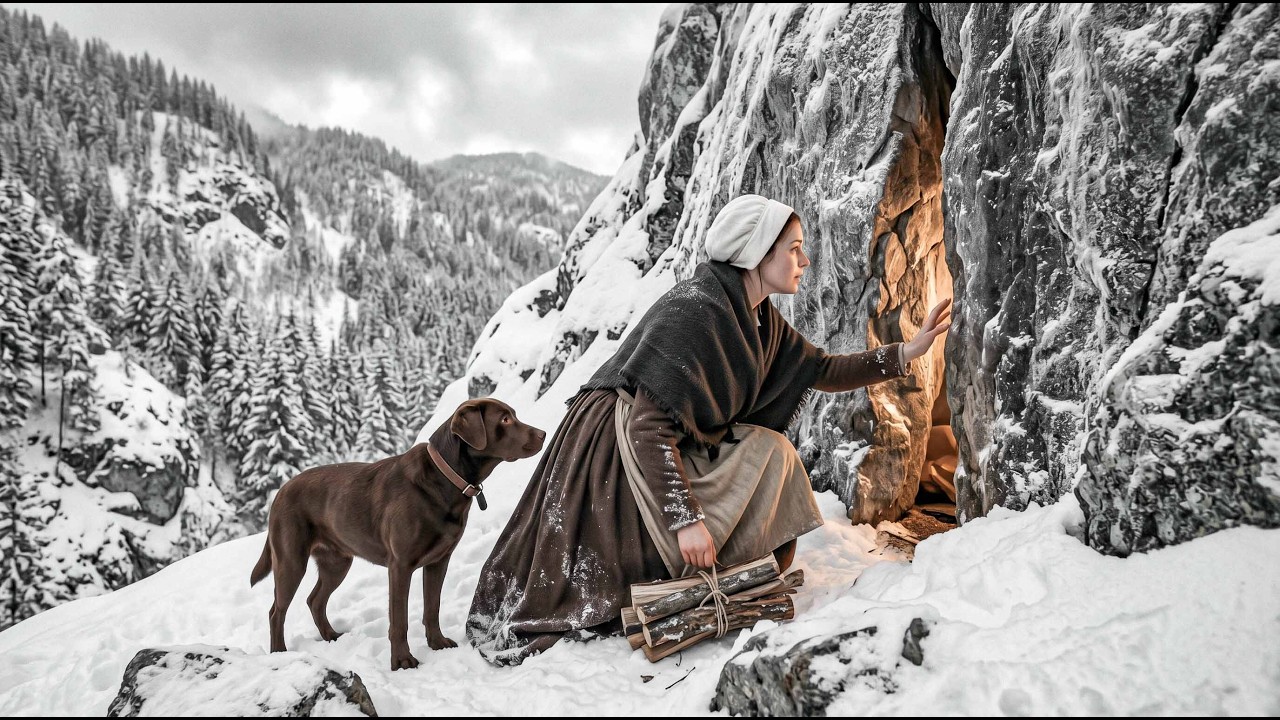
What she felt standing at that window was not fear in the ordinary sense. It was the specific and clarifying awareness that the situation had a shape, that the shape was getting smaller, and that she needed to move before it closed entirely. She thought about Daniel for the same reason she always thought about him when decisions had weight.
Not because thinking about him helped, but because she had not yet learned how to stop. He had been the one who understood this land, who had mapped the tree lines and the seasonal creek beds, who had known instinctively which direction to walk when the light was wrong. She had learned from watching him, which was not the same as knowing.
She knew enough. She knew the slope of the terrain east of the cabin, knew where the deadfall tended to collect along the ridge after a storm, knew how to read the way snow settled differently between open ground and tree cover. She knew enough to go out, find what she needed, and come back. What she could not allow herself to think about, what she had trained herself through 11 months of practice not to dwell on, was the image of Daniel on the floor of the back bedroom 3 days after he had fallen from the loft ladder, unable to reach
the door, unable to do anything but wait. She had been 40 miles away working a double shift because two of the night nurses had called out sick. She had not known. That was the fact she carried like a stone in her chest. She had not known, and knowing would have changed everything, and there was no mathematics in the world that resolved that equation into something bearable.
She was not going to wait. That was what she understood standing at the window on the third morning without enough wood. Whatever happened, she was not going to be the person who sat still and waited for the situation to resolve itself. She put the mug in the sink, pulled on her second wool sweater, then her canvas work jacket, then the heavy outer coat that had been Daniel’s, and still fit her wrong across the shoulders, but was warmer than anything she owned.
She pulled the wool cap down over her ears, wrapped the scarf twice around her neck, worked her fingers into the insulated gloves one at a time. She picked up the small hatchet from beside the door, lifted the 2 by 4 brace, and stepped outside before the west wind could change her mind. The cold landed on her face like a flat hand.
Not a slap, something steadier than that, something that pressed and stayed. The temperature had dropped overnight, and the air had that particular quality that came with dry cold, the kind that pulled moisture from the skin and made the inside of the nose ache on the first breath. She stood on the step for a moment, orienting herself. The sky was a uniform white-gray, the color of old ash, giving no indication of where the sun might be behind it.
She had perhaps 5 hours of usable light, maybe less if the cloud cover thickened. She moved around the south wall of the cabin toward the tree line, her boots punching through the top crust of the snow with each step, sinking to mid-calf. It was slow going. She kept her breathing even, her stride deliberate, not fighting the terrain, but working with it the way she had learned to walk in deep snow.
Weight forward, slightly lifting each foot clear before placing it. Conserving energy was not optional. It was the difference between making it back and not. The area immediately inside the tree line had already been picked over. She had taken every piece of fallen timber within easy reach over the past 2 weeks.
What remained required going deeper, past the first ridge of spruce, into the section of forest where the old-growth timber had more deadfall and the ground was less predictable under the snow. She moved in that direction, not rushing, watching the ground ahead of her for the telltale slight depressions that indicated hidden branches or rocks that could turn an ankle.
She worked for an hour. The hatchet was useful for splitting larger pieces and trimming branches, less useful for actually felling anything. But she found enough of fallen birch that had come down recently enough that the wood was still dry underneath the bark, three lengths of pine that had snapped partway up the trunk and leaned against a neighboring tree.
She stripped what she could, split what needed splitting, began building a bundle she could carry. It wasn’t enough. She knew it as she was doing it, the way she had always known when a situation was moving in the wrong direction, even before the numbers confirmed it. The bundle she was building would give her tonight.
Maybe tomorrow morning. After that, the problem would be exactly where it was now. She pressed deeper into the forest, the trees growing closer together. The snow between them less disturbed, the silence more complete. The wind dropped here, blocked by the spruce. It was the kind of quiet that had its own texture, a stillness that felt less like absence and more like presence.
The forest holding its breath around her. She moved more carefully now, her footsteps the only sound, the crunch of her weight on the snow surface, loud in a way it hadn’t been in the open. She had gone farther than she intended. Not lost, she kept a sense of direction through the angle of the light and the slope of the ground, but farther than it was comfortable given the remaining daylight.
She stopped beside a large spruce, steadied her bundle against the trunk, and assessed. The light had taken on the flat quality that preceded the afternoon’s early decline. She needed to turn back. That was when she saw it. At the base of a rocky outcropping, 30 yards to her right, there was a line of darkness along the ground where snow had failed to accumulate.
Not a gap caused by wind or overhang, the rock above it did not project far enough to create that effect. Something beneath was generating warmth, disrupting the freeze pattern. She stood still for a long moment looking at it. The rational explanation was geological. There were thermal features throughout this part of the Rockies, seeps and vents that stayed warmer than the surrounding ground through winter.
She knew this. She also knew that the warm she could feel from 30 yards away, even through the insulation of her coat, was not coming from a geological seep. It was too steady, too concentrated. She could smell it then, faint enough that she might have dismissed it a moment earlier when she was moving wood smoke, not old smoke, not the ghost of a fire that had burned days ago.
Fresh smoke, the kind that still carried resin and heat in it. Clara did not move toward the opening immediately. She stood where she was watching. The calculus of the situation was specific. She was alone in a forest in extreme cold with a bundle of wood insufficient to keep her alive, and 30 yards away something was producing warmth that should not exist.
The right response was not to rush toward it. The right response was to observe first. She waited 3 minutes by her own counting, watching the dark line at the base of the rock for movement, for sound, for any indication of what she might be walking toward. There was no movement. The only sound was the occasional soft impact of snow falling from a high branch.
No animal sounds, not a good indicator either way, because animals went quiet around fires as readily as they went quiet around threats. What she noticed in those 3 minutes of watching was the absence of tracks. Fresh snow had been falling intermittently since morning. The ground immediately around the opening was smooth undisturbed.
Whatever was generating that warmth had not come or gone recently. Whoever or whatever was in there had been in there for some time. She set her bundle of wood against the spruce trunk. She would come back for it. She moved toward the opening in a straight line, not circling, not creeping. She was not going to approach this like a threat she intended to ambush.
She was going to approach it like a person who needed shelter and was willing to be seen doing so. The opening in the rock was narrower than she had expected from a distance. It was roughly the width of her shoulders at its widest point. A horizontal crack in the granite face that angled downward and inward. The rock around it was dark with moisture that had frozen and thawed repeatedly, the surface rough with crystals.
The warmth coming from inside was unmistakable. Now, not the faint seep she might have imagined from 30 yards away, but a genuine steady exhalation of heated air that touched her face and made her eyes want to close in relief. She crouched in front of the opening. The crack angled downward for about 5 ft before from what she could see in the dim light, it widen.
She could not see past the angle. She could hear nothing from inside. She could smell the smoke more clearly now and underneath it, something she identified after a moment as coffee or the memory of coffee, the kind of smell that attached itself to surfaces over months and years of use. Someone had been here long enough for the rock itself to smell like a kitchen.
She leaned in and called not loudly, “Hello.” The word went in and the rock took it. She waited. Nothing came back. She tried again 1 degree louder. “I’m not looking for trouble. I came in from the cold.” Still nothing audible. but the warmth did not change, did not falter, which meant the fire was still burning, which meant someone had been tending it recently enough that it had not declined.
Clara made her decision the way she made most decisions, by eliminating the options that were worse. Going back to the cabin with insufficient wood was going to result in a specific outcome within 48 hours. Going into the opening was going to result in an unknown outcome, which was statistically preferable. She lowered herself onto her stomach, pushed her arms into the gap, and began to move forward.
The rock pressed in on both sides, rough against her coat, catching on the canvas in a way that required her to adjust her angle twice. For a stretch of about 4 ft, she could feel the weight of the stone close around her, and she understood in a clear and physical way what it would mean to become stuck here between the frozen world behind her and the unknown in front.
She kept moving. The angle of the crack was working in her favor. The downward slope meant she was moving with gravity. The warmth increased steadily as she progressed, and the darkness ahead of her shifted from absolute black to something dimmer than dark, a quality of light that was not quite visible, but was no longer nothing.
The rock released her. The crack opened not suddenly, but progressively, the ceiling rising, the walls drawing back until she was kneeling in a space large enough to lift her head, and then her shoulders, and then to push herself upright with her hands on the stone floor. She stayed in a crouch, letting her eyes adjust.
The space was larger than the entrance had any right to produce. The ceiling at the center was perhaps 6 ft, dropping at the edges where the rock curved back toward the floor. The dimensions were roughly 4 by 5 m, not a cave in the dramatic sense, not a cathedral of stone, but a room. A room someone had made into something deliberate.
A small cast iron stove occupied the center. Its legs sitting on a flat section of rock that had been leveled with smaller stones packed into the gaps. The stove pipe ran upward at an angle following a natural fissure in the ceiling that she could see had been widened slightly, worked out by hand over time to allow the pipe to pass through.
Against the left wall, firewood was stacked in even rows, the pieces cut to uniform length, the stack beginning tight at the bottom and maintaining its order all the way up. Someone had spent real time on that stack. It was not the work of a person in a hurry. Against the right wall, a series of rough shelves had been secured to the rock using bolts driven into the stone, and on the shelves stood glass jars sealed with metal lids.
She could see dried beans, what looked like oats, smaller jars with dried leaves inside that might have been herbs, two jars of something amber colored she couldn’t identify from across the room. Along the far wall, in the deepest part of the space where the ceiling dropped lowest over a flat section of floor, a narrow bed frame made from lashed timber held a mattress, not a sleeping bag, a mattress thin but real covered with two wool blankets folded back over a pillow.
Clara stood in the center of the room and turned slowly, taking all of it in. She did not touch anything. She let her eyes go over the shelves, the stove, the wood pile, the bed. Whoever had built this had built it over a long period of time, with intention, with knowledge of what it meant to survive a winter in mountain terrain.
The vent in the ceiling was the detail that told her the most. Cutting through rock to pass a stove pipe without creating a visible smoke column above the outcropping that required not only physical effort but foresight. This was not a shelter thrown together in an emergency. This was the result of planning that had begun in another season entirely.
She picked up one of the glass jars from the shelf dried pinto beans, a full quart of them. The lids seated tight and sealed properly. She held it for a moment feeling the weight. Then she set it back exactly where it had been. Not because she wasn’t hungry, because it wasn’t hers. The sound reached her a half second before she processed what it was.
From behind the heavy cloth hanging across the back section of the room, a curtain of some kind thick wool or canvas suspended from a rod of bent pipe that had been fastened to the rock wall. There was the sound of breathing. Not regular breathing. Breathing that had a pattern of interruption. A slight catch, a controlled exhalation that was the breath of someone managing pain. Clara did not move immediately.
She stood with her weight balanced, her hands at her sides, and she listened to that breathing and thought about what it told her. An animal would not be silent in the presence of a stranger and a fire prey animals fled. Predators responded. A person in severe distress might not be able to respond vocally. A person who was conscious and choosing silence was communicating something specific.
She moved toward the curtain stopping one step away. I’m not a threat. I came in from the cold from the east side of the outcropping. If there’s someone behind there, I need you to know I’m not going to take anything. Her voice came out steadier than she expected, the voice she had used in intake when someone needed to feel that the person across from them was not going to be undone by whatever came next.
The breathing changed, not in volume and quality. It became more deliberate, more controlled, someone adjusting. Then a voice came through the curtain, low and rough, the voice of someone who had not spoken in some time. “Step back, center of the room. Stand where I can see you when I open this.” She stepped back. The curtain moved, not thrown open, drawn aside slowly with the careful movement of someone managing a physical limitation.
The man who looked out at her from the well was somewhere in his late 50s, heavy-set through the shoulders, with a face that had been weathered to a particular kind of permanence that came from years of outdoor work in variable conditions. He was lying on the bed, propped on one elbow, and even at this distance, even in the dim firelight, she could see that his right leg was wrong.
The angle at which it lay relative to his body, the swelling visible even through the denim of his work pants, the way he had positioned himself with the leg slightly elevated on a folded blanket, all of it was immediately legible to someone who had spent six years seeing what happened to bodies when bones moved in directions they were not designed to move.
He was looking at her the way she was looking at him, with the careful assessment of a person who understood that a wrong reading of the situation carried a cost they could not afford. His eyes moved over her quickly, taking in her coat, her gloves, her empty hands, the hatchet on her belt that she had forgotten she was wearing.
His gaze stayed on the hatchet for one beat longer than everything else, then moved back to her face. “You came through the crevice alone.” Not a question. “Yes.” “You didn’t take anything off the shelf.” Also not a question. He had heard her put the jar back. “No.” And he held her gaze for a long moment. She did not look away from it.
Then he said in the tone of someone accepting a situation rather than welcoming it, “Eli Marsh. This is my place.” And she understood that he had just told her something important, not just his name, but the framework within which whatever came next would operate, his place, his rules. “Clara Holt, my cabin is about 2 mi west.
The door is broken and I’ve been out of firewood since yesterday.” Eli Marsh looked at her for another moment. Then his gaze shifted past her toward the stove where the fire had settled into a lower burn than it should have been, and back to her. “The wood needs tending.” He said it without inflection, without request, just information.
She walked to the stove, opened the small door, looked at the coals still hot, still viable, but the last piece of wood added had burned down to a length that would not last another hour. She took two pieces from the stack against the wall, fed them in, and carefully adjusted the damper. The fire took hold of the new wood within 30 seconds.
The warmth in the room increased perceptibly. When she turned back, Eli was watching her from the gap in the curtain. “You know what you’re doing with a fire?” he said. “I know enough.” She moved toward the curtain, stopping at a respectful distance. “That leg needs to be splinted. How long has it been since you could put weight on it?” Something moved behind his eyes, not quite surprise, but a recalibration.
“4 days. I’ve been in here 5 days total. The injury happened on the first day.” The clarification landed simply, without drama. She ran through the clinical implications. 4 days of immobility with an unsplinted tibial fracture meant the bone had been moving against itself with every breath, every shift, every small adjustment.
The soft tissue damage alone was going to take weeks to fully assess. The risk of nerve damage from the swelling depended on how well he had managed to keep the limb elevated. I have supplies in my bag, two straight branches from outside, some cord. It won’t be a proper cast, but it will hold the bone still and reduce your pain significantly.
She paused. I’m a nurse. Was emergency medicine. Eli’s expression did not change in any dramatic way. He held her gaze, ran whatever calculation he was running behind those steady weathered eyes, and then said, “What do you want for it?” “I want to stay until the storm breaks. One night, maybe two.
After that, I’ll go back to my cabin or figure something else out.” “That’s all?” “That’s all.” He was quiet for what felt like a full minute. The fire crackled behind her. The wind outside, barely audible through the rock, shifted in pitch and then settled. In that long silence, she understood something about him.
That silence was not evasion. It was processing and rushing. It would cost her whatever credibility she had built by not taking anything off the shelf. His voice, when it came, was not warm. It was not hostile, either. It was the voice of someone making a decision on the basis of information rather than feeling due the splint.
She went through the crevice again to retrieve the hatchet and two of the straightest branches from her wood bundle. When she came back, she found him sitting up on the edge of the bed, his jaw set, his hands gripping the bed frame, the posture of someone who had decided to endure something and was not going to discuss how much it cost.
She worked efficiently the way she had worked in intake, no excess movement, no unnecessary narration of what she was doing, just the task. The branch splints, padded with strips of cloth she cut from the lining of her own bag, were not elegant. They were functional. When she finished tying off the cord and sat back, the change in his face was slight but real.
The particular easing that came when something that had been moving and grinding for 4 days was finally held still. He breathed out through his nose. Long, controlled. “How did it happen?” she asked, not looking at him, putting her remaining supplies back in her bag. “I was cutting timber about 200 m north of here. Storm came in early before the forecast window.
A pine went the wrong way. Took me 40 minutes to get free.” He said this without drama, the way a person described a mechanical problem that had since been addressed. “I made it back, lit the fire with my last match.” She looked up at that. “Your last match?” “I used it on the first day as soon as I got back.
I was cold enough that I didn’t want to gamble on saving it.” He paused. “If the fire goes out now, it stays out.” She had already noticed this, had noticed the absence of any secondary ignition source on the shelves, the lack of a lighter or striker on the surfaces she could see. The fire was the only one. It had to remain the only one.
“Then we make sure it doesn’t go out,” she said. The word came out before she weighed it, not a slip, not a mistake, but she heard the weight of it land in the room. Eli heard it, too. He did not comment on it. He shifted on the bed, settling his splinted leg onto the folded blanket, and looked at the stove with a satisfied expression of someone reassessing a problem they had been working on alone for too long.
Outside, without either of them hearing it clearly, the wind changed direction again. It came now from the northwest, and it carried with it the sound of something that was not weather. A quality of motion that moved against the rhythm of the storm rather than with it. Clara heard it in the back of her awareness and filed it without response.
The fire needed watching. She was warm for the first time in 3 days and warmth was a resource she was not going to squander on worrying about wind. She sat near the stove with her back against the wall and let the heat come into her hands, her feet, the cold core of her that had been clenching against the temperature for so long it had forgotten how to relax.
Eli lay back on the bed behind the curtain which he had left half open. Neither of them spoke for a long time. It was not uncomfortable this silence. It had the quality of two people who understood that not every moment needed to be filled, that sometimes the most useful thing you could offer another person was the decency of not requiring them to perform.
She was almost asleep, genuinely deeply almost asleep for the first time in days, when she heard it again. Clearer this time. Not wind, not a branch falling under the weight of accumulated snow. Something that had rhythm, had intention, had the particular cadence of weight moving through a landscape that offered resistance.
She opened her eyes and stared at the stone ceiling and she did not say to herself that it was nothing. She said to herself that she did not yet know what it was. That was the honest version. That was the version that would serve her better when morning came and whatever was moving out there in the dark either revealed itself or didn’t.
She closed her eyes again but sleep was somewhere farther away now and the space between her and it was occupied by the quiet persistent sound of something moving through the snow at the edge of her hearing, steady and unhurried as if it had all the time in the world and knew exactly where it was going.
She was still awake when the sound stopped. Not faded, stopped. One moment it was there at the edge of perception, the next the silence was complete. The kind of silence that felt less like absence than like something holding its breath. She lay still for several minutes after that listening. Nothing came back. Eventually she allowed herself the conclusion that whatever had been moving out there had moved on, that it bore no particular relationship to the crevice in the rock or the warmth leaking faintly from inside it, that the world
outside was full of motion that had nothing to do with her. She allowed herself this because the alternative lying awake the entire night cataloging threats she could not assess was a form of anxiety she could not afford. Rest was a resource the same way food and firewood were resources. Squandering it had a cost. She slept.
When she woke the quality of light through the vent at the ceiling had changed from black to gray, which meant morning. The fire had dropped but not died. Eli must have added wood during the night or the stove was better calibrated than she had given it credit for. She sat up slowly, her back stiff from the stone floor, her joints registering the complaint that sleeping on rock filed even when the temperature was reasonable.
She pulled her coat tighter and sat for a moment orienting herself. The curtain across the back of the room was still half open. Eli was asleep or appeared to be. She could hear his breathing slower and more even than it had been the night before the interrupted quality mostly gone from it. The splint was doing its job. She noted this with professional satisfaction and let him sleep.
She moved quietly to the shelves and stood in front of them doing what she had not allowed herself to do the night before, actually counting. 11 jars on the upper shelf. Eight of them sealed, three with cloth covers tied with twine. Four jars on the lower shelf, larger, heavier. Two cans of something she could not identify without picking them up.
A tin box whose contents she could only guess at. The firewood along the left wall, she walked the length of the stack estimating volume. The pieces were cut to roughly 16 in stacked tight the pile beginning at the floor and reaching to about shoulder height, perhaps 6 ft in length. She did the arithmetic carefully.
For one person maintaining a fire at survival level rather than comfort level, the stack represented eight days. Perhaps 10 if the outside temperature rose above zero during the day and the stove could be run lower. For two people, she and Eli, the math shifted to four or five days depending on how well the stove managed.
Food she estimated at six days for one person eating minimally, which meant roughly three for two. She stored these numbers and did not revisit them again. The calculation was done, the baseline was set, and what mattered now was finding ways to change the inputs rather than re-examining the same equation. Outside the storm was still producing.
She could hear it now that she was fully awake, not the howl of peak storm, but the steady working sound of sustained snowfall and wind across open terrain. The road into Millhaven would not open today. She had no basis for thinking it would open tomorrow. The people who maintain the mountain roads in this part of Montana were competent, but they were also realistic about what equipment it could achieve against 4 ft of snow in a January pass.
She heard Eli shift behind the curtain. He was awake. You counted the wood, he said. Yes. What’s your number? Four days for both of us if we’re careful with the stove. Maybe five. I won’t run those numbers again. I’ll run them when something changes. A pause, good. He paused again. I miscalculated when the storm would break.
I thought 3 days maximum based on the front pattern. I’ve been in here 5 days total. She absorbed this. He had planned for a scenario that turned out to be shorter than the actual event. It was not carelessness. It was the specific failure of being right about most things for long enough that the exceptions became less imaginable.
She had seen this in emergency medicine. The patient who managed a chronic condition successfully for years until the one time they miscalculated. The competence that preceded the failure was not responsible for it, but it also could not prevent it. The cabin I came from, she said, if I could get back to it, there’s a small amount of wood I hadn’t used yet.
Enough for a day, maybe a day and a half. She looked at the stove thinking. The question is whether the round trip cost more than it gains. In this weather, 2 miles each way is 4 hours minimum. You’d burn more calories than you’d bring back. He said this without condescension, just geometry. We need a different calculation. She turned toward the curtain.
Then tell me what you know about the area within a half mile of here. Deadfall, other structures, anything that could supplement the wood supply. Eli was quiet for a moment. She heard him moving on the bed adjusting his leg. There’s a section of old growth spruce about a third of a mile northeast. Storm damage accumulates there.
The trees are tall enough and far enough apart that when one falls, it falls clean without being caught by its neighbors. I’ve cut from there before. The wood is good. He paused. But I can’t go there. I can. Another pause. You’d need to find it, cut what you can carry, make multiple trips. It’s not straightforward terrain.” “Draw me a map.
” She found a piece of paper in her bag, the back of a letter she had been meaning to respond to and hadn’t, and a pen. She brought it to the curtain. Eli took it and drew without hesitation, his hand moving with the confidence of someone rendering a landscape he had walked hundreds of times. He marked the outcropping, the direction of the slope, a dry creek bed that could be followed northeast.
Two landmarks, a distinctive double-trunk spruce and a rock formation he called the chair that would indicate she was near the deadfall section. He handed the paper back. She looked at it, clear, functional, everything she needed. “You’ve spent a lot of time in there,” she said, meaning the territory on the paper. “20 years.
” He said it the way people said things that had accumulated so gradually they no longer felt like time, they just felt like condition. “I came out here from Wyoming. Thought I’d stay a season.” The pause that followed was not incomplete. It was the pause of someone who had already finished the story in their head and was deciding whether to share the conclusion.
He did not share it. She folded the map and put it in her coat pocket. “I’ll go this morning before the light drops.” She began repacking her bag, checking the cord, making sure the hatchet was secure on her belt. “You didn’t sleep enough,” Eli said. “I slept enough to function.” She was at the crevice crouching. “I’ll add wood to the stove before I go.
Don’t let it drop below half.” She said this knowing he could not easily reach the stove from the bed and knowing he knew she knew this. It was not a criticism. It was information delivered straight the way she had learned that straight delivery respected people more than softening did. She went through the crevice into the cold.
The world outside had changed overnight in the way Montana winters sometimes changed. Not dramatically, not with the arrival of clear sky, but with a shift in the quality of the cold itself, a settling from active storm to steady accumulation. The snow was still falling, but without the wind energy it had carried the day before. The flakes were larger, slower.
The visibility was better. She could see 30 yards clearly, 50 with some definition. She moved northeast following the slope Eli’s map described using the creek bed as her guide. The walking was difficult, fresh overnight snow on top of the existing pack, a soft surface that gave way unpredictably, but she moved at a pace she could sustain.
She found the double trunk spruce after 20 minutes. She found the deadfall section beyond it. She worked for an hour and 40 minutes cutting and trimming, building two loads that she cashed along the creek bed before making two trips back to the outcropping. By the time she pulled the second load through the crevice, the light outside had shifted toward afternoon, and she was sweating inside her coat despite the cold, which was exactly the kind of warmth that needed to be managed carefully. Overheating in winter
was a threat as specific as freezing because sweat-wet clothing lost its insulating properties rapidly. She added the new wood to the stack against the wall, not a complete solution, but enough to push the arithmetic from four days toward seven. The shape of the problem had improved in a direction that mattered.
Eli was awake when she came back, sitting up straighter than the night before, the splinted leg still elevated, but his shoulders less braced, less rigid. The pain was manageable now. She could see it in the way he held himself. “You found it,” he said looking at the wood. “Your map was accurate.” She hung her coat on a hook she had noticed the night before, letting it begin to dry in the warmth.
“Have you eaten anything today?” “Some oats. There’s a small pot on the stove.” She looked at tin pot, the kind designed for camp use, sitting on the top of the stove with a lid over it. She lifted the lid. Oatmeal cooked down to a thick consistency, still warm. She found a second cup on the shelf near the stove.
He had left it there, she understood, for her. She ladled some into the cup, took a spoon from the small wooden caddy on the shelf, and sat near the stove to eat. It was plain oatmeal, nothing added, cooked with water rather than any kind of milk. It was the best thing she had tasted in a week. They were quiet through the eating.
It was the quiet of people who had passed the first stage of mutual assessment and arrived at a provisional agreement. Not trust, not friendship, but a working understanding that the other person was not going to make things worse. In emergency medicine, she had learned to recognize this moment in relationships between patients and their families, between colleagues working a complicated case, between anyone who had been thrown together by circumstance and needed to function.
It had a texture, this provisional agreement. It was not comfortable, exactly, but it was stable. She set the cup down. “When the road opens, you’ll need x-rays, possibly a plate in the tibia depending on the fracture geometry.” She paused. “Do you have someone to contact in Mill Haven or elsewhere?” Eli looked at the stove.
The quality of the silence that followed was different from the silences before. It had a specific weight to it. “A son in Bozeman. We don’t talk regularly.” She did not press. “The county search and rescue will start working the roads when the storm breaks. You’ll be on their list when someone realizes you’re out here.
No one knows I’m out here. She absorbed this without showing what she felt about it, which was a recognition too close and too sharp to be purely professional. No one knew. He had gone into the forest before the storm, and no one had known to look for him when the storm extended past its expected duration. She thought of Daniel, and then she moved that thought away because now was not the time for it.
They’ll find the outcropping eventually, and she said, “And I’ll tell them when the road opens.” She met his eyes when she said this, making clear it was not an offer, but a commitment. Eli looked at her for a long moment. Something shifted in his expression. Not gratitude, exactly, which was too soft a word for whatever he was capable of in a situation where gratitude felt like a concession.
It was closer to acknowledgement, recognition that she had offered something real and meant it. “You’re staying another night,” he said, not a question. “If that’s all right.” He looked at the stove, at the new wood stacked against the wall, at the organized surfaces of his carefully constructed shelter that now contained a second person, and her coat, and her bag, and her handwriting on the corner of a letter.
“It’s all right,” he said. The afternoon light faded early as it always did in January at this latitude. She added wood to the stove, checked the damper, sat back against the wall. Eli drifted towards sleep in the way of people whose bodies were spending significant resources on healing. Not peacefully, not suddenly, but in stages, his sentences getting shorter, the intervals between them longer until the intervals were all that was left.
Outside in the last gray light before dark, something moved through the snow at the edge of the tree line. Not one thing, several. Their paths crossed and separated in the way of people who were moving together, but not in formation, people who were navigating terrain rather than following a plan. Their tracks were irregular, uneven, the gait pattern of exhaustion.
Inside the outcropping, Clara was looking at the ceiling of the stone room, listening to Eli’s breathing settle into sleep, thinking about the morning in the light and the road that was still 35 miles of impassable snow away. She thought about the sound she had heard the night before. The sound that had been there and then it stopped.
The sound that had not been weather. She had told herself it was nothing. She was no longer certain that was the honest version. She woke before the light changed, not from a sound, from the absence of one. The particular silence that had settled over the outcropping in the hour before dawn had a different quality than the silence of deep night and her body recognized it before her mind caught up.
She lay still for a moment cataloging the fire was low, but present. The warmth in the room had dropped several degrees. Eli’s breathing from behind the curtain was even. The storm outside had shifted again during the night. She could feel it in the pressure of the air in the way the vent above the stove pulled differently.
The draft changed. Not stopping. Changing. She fed the stove without lighting a lamp. Working by the dim orange glow from the grate, placing two pieces of wood with care to avoid the sharp crack of fresh timber dropping onto coals. The fire took hold quietly. She put the lid back on the ash box, adjusted the damper to its morning position, and sat back on her heels while the warmth began to rebuild.
She heard Eli shift on the bed. He did not speak immediately, which she had already learned was his pattern. He woke fully before committing to words, taking his time between consciousness and conversation, she respected this. She had the same tendency. Snow stopped. His voice was rough from sleep clearing as he spoke. Sometime in the last 2 hours.
She had not registered this consciously, but she knew he was right. The absence of the sustained soft percussion of active snowfall, the change in the acoustic character of the silence. Does that change the road timeline? Depends on what’s behind the front. If there’s a secondary system following, they won’t push equipment until it passes.
If it’s clearing, could be 2 3 days before they reach the mountain roads. A pause. I wouldn’t count on two. Three days then. She stored this and moved on. I’m going back out this morning. There’s more deadfall in the section you mapped. I can make one more carry before the light drops. Your legs held up yesterday.
The question was practical, not solicitous. He was assessing a resource. They held up. Then go early. The snow will cross by midday if it stays clear, which makes the walking easier, but also means any tracks you leave will be more visible, more defined. She looked up from the stove.
This was a new dimension to the situation, one he had not raised before. You’re concerned about tracks. Eli was quiet for a moment in the way of someone deciding how much context to provide. This section of the Rattlesnake Wilderness doesn’t get much winter traffic, but it gets some. Hunters who aren’t paying attention to the season, people who are lost, people who are looking for something specific.
He paused. Visible tracks from an outcropping that appears otherwise unmarked led curious people to the outcropping. She understood what he was protecting. This place was not on any map she had ever seen. He had built it with deliberate concealment as part of the design, the vent that diffused smoke the entrance that looked like a geological feature rather than an opening.
He had built it to be missed. “I’ll vary my return path,” she said. “Come back from a different angle. Come back from the northeast, same as the deadfall section. Your tracks will read as heading away from this position, not toward it.” It was a small thing, this instruction, but it told her something she filed without comment, that for Eli, the security of this place was not incidental.
It was foundational. Whatever had driven him to build a hidden shelter in a wilderness area and stock it with months of supplies was not simply a preference for solitude. It was something with more structure than that, more need behind it. She did not ask. She pulled on her coat. Outside, the air had the quality she associated with the aftermath of major snowfall in mountain terrain, a stillness that was almost physical.
The world compressed under its new white weight, the sky pale at the horizon and moving toward a thin winter blue overhead. The temperature had dropped in the clear air, colder than yesterday by several degrees, but the absence of wind made it manageable. Her breath came out in clean white plumes and dissipated quickly.
She worked the deadfall section for 2 hours, moving efficiently, her muscles finding their rhythm faster than the day before. She made 1 and 1/2 carries back to the outcropping, the half being a load she cashed inside the crevice, but did not fully transfer to the wood stack, leaving it within easy reach. On her second pass through the forest, she went wider than necessary, mapping the terrain in the way she had mapped emergency departments when she started somewhere new, noting exit points, observing lines of sight, building a
picture she might need later. It was on the wider path that she saw them. Tracks, not hers. Coming from the south, moving northeast along the creek bed she used as her landmark. The stride pattern uneven in a way that was consistent with multiple people. Different leg lengths, different levels of fatigue. The tracks were fresh, the edges still crisp, the bottom not yet consolidated by temperature change.
These had been made this morning within the last 3 hours. She crouched beside them studying. Three distinct stride patterns at minimum, possibly four. The smallest set, shorter stride, lighter impression suggested either a shorter person or someone young. None of the tracks showed the purposeful, organized movement of someone who knew where they were going.
They showed the overlapping, sometimes backtracking pattern of people navigating by feel, moving in a general direction without a specific destination. She stood and followed the tracks with her eyes to the northeast. They continued past her cache point and disappeared into the next stand of timber. They had not turned toward the outcropping. They had not found it.
Not yet. She retrieved her cached wood, took the return path Eli had specified northeast first, then curving west in a wide arc that brought her back to the crevice from an angle that her outbound tracks did not indicate. She went through quickly. Eli heard her come in. He had been awake, she could tell from the quality of his stillness, a different stillness than sleep.
“You found something,” he said before she spoke. “Tracks, south to northeast along the creek bed. Three, maybe four people moving without direction.” She set the wood down and turned to face the curtain. “They’re not close, but they’re in the area.” Uh The silence that followed was not the silence of someone processing new information.
It was the silence of someone confirming information they had half expected. How fresh? Two hours, maybe less. He exhaled through his nose. They’ll circle. People who are lost in winter terrain circle back toward water features when they have exhausted other options. The creek bed runs within a hundred meters of this position.
He paused. They’ll come closer before they move on or find something else. Or they won’t move on, she said. She was not being pessimistic, she was being complete. Lost people in extreme cold had a limited decision tree. Move and expend heat or stop and wait. Neither option had an unlimited run time.
Eli’s voice when it came was careful in the way of someone choosing to offer information he would prefer to keep. There’s no lock on the crevice. There’s nothing on the exterior that says stay out. He paused. I built this place so no one would find it. That’s been my only security. She looked at the curtain. Then we need to think about what we do if they find it.
I know what I want to do. Tell me. Nothing. Stay quiet. Let them pass. She stood with that for a moment. If they’re in the state those tracks suggest fatigued, no clear direction in temperatures that are dropping, they may not have the capacity to pass. They may not get far enough to pass. She kept her voice neutral, factual because she knew that tone was the only one he could hear without shutting down.
I’ve worked emergency intake. I know what hypothermia looks like at stage two. I know what it looks like at stage three. The difference between them is about 90 minutes in conditions like today’s. Eli said nothing. The fire crackled in the stove. I’m not telling you what to decide, she continued.
This is your place, but I want you to have the full information. Another long silence. Then, you’ve already decided. She had. She recognized this about herself without apology. There were certain calculations she had completed so many times and so many variations that the outcome arrived before she consciously ran the numbers.
A person in stage two hypothermia within 100 m of shelter she was occupying was not a situation she could elect to ignore. This was not virtue. It was the specific inflexibility of someone who had watched people die from delays that did not have to happen. I’ll wait to see if they come, she said. If they do, I’ll go to the entrance.
I’ll talk to them first before anything else. You don’t have to do anything you’re not comfortable with. Eli made a sound that was not quite a word. She understood it as provisional. She set about preparing the room for the possibility of company, not dramatically, just moving her bag to the side, checking the firewood level, making sure there was enough water in the small metal container near the stove to heat if it was needed.
Small adjustments. The kind of preparation that cost nothing if it wasn’t needed. She was near the crevice listening when the sound reached her. Not movement this time, a voice. Indistinct at a distance, but human, calling out in the way people called out when they were no longer certain anyone would answer. She moved to the crevice opening, crouched, looked out through the gap.
Three figures at the edge of the tree line 40 m out. Moving toward the outcropping in a loose group, the two larger ones together, the smallest one slightly behind. Their body language was unmistakable. Heads down against the cold, motions slow to the mechanical pace of people whose bodies were running on reserves.
One of the larger one stopped, turned to look back at the small one, went back and put a hand on the small one’s shoulder. The gesture was concerned in a way that did not need interpretation. The one she identified as the oldest heavy set through the coat, moving with a deliberate economy of someone who had once been trained to conserve himself, raised his head and looked directly at the outcropping. He stopped walking.
He stood very still. Then he raised one hand, palm outward, fingers together, held it there. She heard Eli’s voice from inside low. “What are they doing?” “One of them just stopped. He’s signaling.” She watched the man’s hand. He held the position for several seconds, then brought his hand down, slowly turned to the others, said something she couldn’t hear.
Then he faced the outcropping again, walked to the nearest tree, a large spruce about 30 m from the crevice, and knocked against the trunk with his knuckle three times, stopped two times. She felt the pattern land in her chest before she fully processed it. Not a formal SOS, a variation, an adaptation, the kind of improvised communication that someone used when they knew the principle but not the exact protocol.
Someone who had been trained in search contexts, who understood that the point was pattern recognition rather than precise code. She turned back to Eli. “He knows what he’s doing. That knock sequence, he’s announcing non-threat intent to anyone who might be inside.” Eli’s silence had a different texture now.
Not resistance, something closer to recalculation. “Military,” he said, “or SAR.” “One of the two.” She looked at the crevice opening, then back at the curtain. “The small one. I think it’s a kid.” The pause that followed was brief. Eli’s voice when it came had shifted by a degree that she registered but could not name precisely something harder than warmth, less than warmth but with warmth somewhere in its history.
Bring the kid in first. She went through the crevice before she could give herself time to reconsider the logistics. The cold outside hit her without the buffer of preparation, but she was already moving, already straightening up from the opening, already visible to the three figures who had stopped 20 m away. The oldest one went very still when he saw her.
Not a freeze of threat response, but the particular stillness of someone who had been looking for a sign of life for long enough that seeing one required a moment of recalibration. She did not raise her hands. She was not performing surrender. She met the older man’s eyes across the snow and kept her voice at a pitch that carried without echoing.
How long have you been out here? The older man’s jaw worked for a moment. Since this morning. We camped overnight in a snow shelter about 2 miles south when it got too dark to keep moving. Our truck went off Route 83 about 9 miles south of here. No injuries, but the truck’s done. He paused. My grandson is cold.
She looked at the youngest figure. What she could see of his face between the hat and scarf was pale in a way that registered on her clinical awareness with immediate urgency. Not the healthy pallor of someone cold from exertion, but the waxy slack pallor that preceded the involuntary shutdown of peripheral circulation. His movements, even standing still, had that quality of fine tremor that was not visible but present in the slight irregularity of how he held himself.
She crossed the distance between them without waiting for further conversation, reached the boy, put both hands on either side of his face. Cold. Not just surface cold, the kind of cold that had been working inward for hours. She pressed two fingers to the side of his neck. His pulse was present but slower than it should be.
What’s his name? Danny. The older man was right beside her now, his hand on the boy’s shoulder. He’s 17. He didn’t tell me his hands went numb until about an hour ago. 17. Old enough to know better, young enough to not want to be the reason the group slowed down. She had treated this calculation many times in different forms.
He needs to be warm now, not in 5 minutes. She looked at the older man. My name is Clara Holt. There’s a sheltered space in that rock face. It’s warm. You’re going in first with the boy. The others follow. The older man did not hesitate, which told her something about him. Ray Cutler. The other man is Tom Briggs.
He was at the same truck stop when the storm hit. We’ve been moving together since we left the shelter this morning. He looked at her steadily. There’s no one else, just the three of us. She nodded once, held his gaze for a beat to register that she had heard the specific clarification, then turned back to the crevice.
She helped Danny through, first guiding him with her hands on his shoulders, keeping him moving forward through the tight section. He was smaller than she expected when she had him in motion. The layering of his clothing had made him look more substantial at a distance. Through the crevice into the warmth.
She heard the sound he made when the heated air reached his face. Not a word, not quite a sound, something that came from a part of him that had stopped expecting relief. She got him to the stove. He sank onto the floor beside it with the complete physical compliance of someone whose legs had been holding a decision for hours and were glad to surrender it.
She pulled off his gloves first. His hands were white from the fingertips to the second knuckle frostnip. Not frostbite, the distinction significant and dependent on how quickly she acted. She closed both his hands inside hers, pressed them together, and breathed across her thumbs onto his fingers. Ray came through the crevice, then Tom, a man in his mid-40s who carried himself with the compact efficiency of someone who worked with his hands professionally, who took in the room in a single sweep of the eyes and then
looked at where he could be useful. She respected this immediately. From behind the curtain, Eli’s voice flat, “How many?” “Three,” she said. “One is 17 presenting with frostnip, early signs of stage two hypothermia. The others are cold but functional.” A pause, then deliberately, “The boy stays near the stove.
” It was not permission, exactly. It was acknowledgement that the situation had expanded past what his resistance could hold. She understood the difference between those two things. Danny’s hands were already warming, the fingertips shifting from white to the mottled pink red of returning circulation, which was painful, a fact she could read in the tightening of his jaw.
She kept her hands around his. “This is going to hurt for a few minutes. That’s good. That’s what you want to feel.” His eyes, dark with exhaustion, looked up at her from under the brim of his cap. She held his gaze. “You’re going to be all right.” She watched something in his face relax by a fraction. Not relief, not safety, not yet, but the small release of someone who has handed a problem to someone else who seems equipped to hold it.
She recognized the weight of that transfer. She had been receiving it for years. Ray was standing near the entrance giving the space in the stove and the curtain his attention in methodical rotation. He had understood the layout immediately where the warmth was, where the exit was, where the unknown quantity was. He did not press toward the curtain.
He stood where he had been placed by circumstance and waited for further information, which was exactly what she needed him to do. Tom sat near the wall opposite the wood stack, his back against the stone, his eyes moving between Danny and the room’s contents with the expression of someone doing inventory. He was already useful without being asked, which she filed as a quality she would want later.
She turned to Ray, keeping her voice low. Tell me exactly what you saw in the 24 hours before you found this position. Everything that seemed relevant. Ray answered with the concision of someone accustomed to accurate reporting under pressure. Their truck had gone off Route 83 the previous afternoon. They had supplies for a day trip, not an emergency.
When darkness came too fast, he had built a simple snow shelter and they had waited out the night. At first light, they had begun moving north using the slope of the terrain and the creek bed as navigation guides. Danny had said nothing about his hands going numb until Ray noticed him tucking them inside his coat during a rest stop.
She listened without interrupting. When he finished, she said, “You kept good discipline.” Ray’s expression shifted slightly, not pride, more the particular reaction of someone who had expected to be criticized for something. “We should have stayed with the truck.” “Probably, but you’re here.” She met his eyes.
“That’s the part that matters now.” She was moving to check Danny’s feet, the next priority when Ray touched her arm lightly, barely a contact, his voice dropping below what the room could carry. There’s something else. Someone was behind us from about the time we left the snow shelters this morning. I saw movement twice in my peripheral.
Not an animal the way it moved. He paused. I have enough time in the field to know when something is tracking me. She kept her expression still. Did it approach? No, stayed back. Far enough that I couldn’t get a clear look. His eyes were direct, entirely serious. I’m not prone to imagination about this kind of thing.
She believed him without qualification. You think it followed you here? I think it followed our tracks. Those tracks lead here now. She stood with this information and let it settle fully before responding to any piece of it. Someone behind them, not approaching, not withdrawing, maintaining distance. Not animal behavior.
Human behavior, specifically the behavior of a person who wanted to know where they were going without being seen to follow. The range of explanations was not unlimited, but it was wide enough that she was not willing to assign a narrative to it yet. She crossed to the curtain, leaned close to it without pulling it open.
Eli, one more thing. Ray believes someone tracked them here from Route 83. Single individual, didn’t approach, maybe outside now. The silence from behind the curtain had a specific density. Then? I know. A pause. I’ve been hearing something at the north edge of the rock for the past half hour. She straightened up.
The information rearranged the room’s geometry. What had been a shelter problem had acquired an additional dimension. The warmth inside the rock, the light from the stove, the tracks in the snow leading from the forest to the outcropping, these were no longer just the evidence of their presence. They were potentially an invitation to whoever was outside.
She looked at the stove, at the thin line of firelight visible through the grate. She adjusted the damper to its lowest functional setting, not extinguishing the fire, not reducing it below the threshold that would allow the room’s temperature to hold, but cutting the glow by half. The room dimmed. The shadows at the edges of the stone walls deepened.
Ray was watching her. Tom had looked up from the floor. Danny, still warming beside the stove, followed her eyes to the curtain. She spoke at a level that carried to all of them. Someone may be outside. We don’t know their intention. We’re going to stay quiet and stay where we are while I find out. Tom’s voice, the first words he had spoken since entering.
You’re going to go look. He said it without inflection, but she heard in it the specific recognition of someone confirming what they were already prepared to do themselves if asked. Yes. She met his eyes briefly. Keep Danny warm. Ray, stay near the entrance, but don’t block it. She looked at both of them with the clarity of someone who needed them to understand rather than agree.
Whatever we hear next, we don’t react until I get back. She went to the crevice. The cold from outside was seeping through even at this distance, and she could feel the temperature differential between the warmth behind her and the wall of cold ahead as a physical boundary she was about to cross. She stopped at the opening, listened.
Wind slight, snow compacting somewhere above her, the weight of new accumulation shifting on the rock surface. Then distinct from these, a sound below the specific compressed crunch of weight on crusted snow moving slowly not moving away. She went through the crevice and stood in the cold outside the rock face.
The light was at mid-afternoon level. The sun invisible behind an even overcast that had moved in from the west during her morning work. The outcropping’s exterior looked as it always had a section of granite ledge, unremarkable offering nothing to the eye that would suggest an interior. She scanned the tree line.
Nothing moved. She looked left along the rock face where Eli had said the sound was coming from the north edge of the outcropping. A section of rock that extended perhaps 10 m past the crevice before angling back into the hillside. She moved along the base of the rock toward that section placing her feet carefully keeping the stone to her back.
At the corner of the outcropping she stopped. Looked around the edge. A man stood at the north face of the rock, his back to her, one hand pressed flat against the stone. He was alone. Tall, broad through the coat, his posture that of someone listening rather than doing. Leaning slightly forward, head angled toward the rock as if trying to determine what lay behind it.
He had tracked them here, had located the rock, had found the section where the warmth was most perceptible from outside. He was reading the rock the way she had read the snow around the crevice entrance on her first day. He heard her. She knew the exact moment because his posture changed. The listening lean became the stillness of someone caught in an act they had not intended to be caught in.
He turned slowly, not threatening, not rushing. His face was weathered in the way of men who spent long seasons outdoors. His eyes red-rimmed from cold. His beard carrying ice crystals that had accumulated over hours of exposure. He was cold in the comprehensive way. Cold that had gone past the acute phase and into the settled systemic cold of someone who had been without adequate shelter for longer than a single night.
She put him in his early 50s, experienced outdoorsman based on his gear and his movement, but pushed well past the point where experience could compensate for the physical reality of the temperature. His hands came up palms out slow. The gesture of someone who understood exactly what his position looked like.
I’m not here to cause trouble. His voice was rougher than it should have been, dehydrated, cold thickened, the voice of someone who had not spoken to anyone in some time. I’ve been following them since the truck went off the road yesterday. I spent the night in the open. I didn’t know how to ask to come with them without He stopped, looked at the rock, then back at her.
I didn’t know if they’d say yes. She studied him across the distance of 10 ft. The math of his physical state was simple and immediate. He was closer to dangerous exposure than any of the three inside. His hands hanging at his sides now were unsteady with a fine tremor that was not from adrenaline. His color was wrong in the specific way that signaled core temperature compromise.
What’s your name? Frank. Frank Dolan. He held her gaze without the deflection of someone with active concealment to maintain. I was at a pull-off on 83 when the storm hit. Solo. Wrong equipment for what it turned into. She made her assessment. Then, there’s a way into the rock. You’re going to go through it ahead of me.
You’ll stay near the entrance when you get inside. You won’t approach the person in the back section without being told you can. She kept her voice even, neither warm nor cold. If you can work with those terms, come with me now. Frank Dolan did not pause to negotiate. He simply followed. She went through the crevice last.
When she straightened up inside the warm room, she saw Ray and Frank exchange a look. The look of two men who’d been aware of each other for more than 24 hours without direct contact, who were now in the same room for the first time. Ray’s expression was the controlled neutral of someone reserving judgment. Frank’s was the expression of someone who had expected a worse reception.
Tom had added wood to the stove during her absence. She could see it in the way the fire had strengthened the room warmer than she’d left it. Danny was sitting up straighter, his hands wrapped around a tin cup that held warm water. He watched Frank enter with a direct undisguised assessment of someone too tired for social performance.
From behind the curtain, Eli said nothing. He did not have to. His silence was present in the room, was accounted for by everyone in it, including Frank, who positioned himself near the crevice entrance without being told to do so a second time. He understood the architecture of the situation.
Clara moved to the center of the room. She looked at each of them in turn. Ray near the entrance, Tom against the wall, Danny by the stove, Frank at the edge. Five people in a space built for one heated by a stove with wood she had extended to seven days. She did not soften the arithmetic in her head. She just added it up with the new inputs.
Then she crossed to the curtain, pulled it open 6 in. Eli was sitting up on the bed back against the stone wall looking past her into the room with eyes that moved from face to face with the careful unhurried attention of someone who had spent a long time learning to read people quickly. His expression did not communicate welcome. It communicated assessment.
She kept her voice low enough that the full sentence was for him alone. “I need you to tell me what you actually want here, Eli. Not what you’d prefer. What you want.” He held her gaze for a long moment. Outside the curtain, the room was quiet in the specific way of people who understand that something is being decided and are waiting to learn what.
The fire in the stove worked steadily indifferent to all of it. Eli looked past her again out into the room. His room, his wood, his food, his shelter, his 20 years of understanding this land compressed into four walls of stone and a pipe running to the sky. He looked at Danny who had wrapped both hands around his cup with the careful deliberateness of someone still relearning the sensation of warmth in their fingers.
He looked at Frank who was watching the floor with the posture of someone prepared to be turned out. He looked at Ray who was looking back at him with the steady uncomplicated gaze of a man who had made peace with being seen. When he spoke, his voice was quiet enough that she had to lean slightly toward the curtain to catch it fully.
“Survival is the only thing that’s never a choice. Everything else is.” He let that sit for a breath. “They stay.” She straightened, turned back to the room. Everyone had heard enough to understand the decision had been made even if they hadn’t caught the words. She looked at Frank first because he was the most provisional. “You’re in.
Same conditions I gave you outside still apply until Eli decides otherwise.” Frank nodded once without performance. She looked at Ray. “You said you have food.” Ray reached into his coat. He had kept it on which she noted as the action of someone experienced enough to know you didn’t surrender your insulation until a warm space had proven itself.
He produced a cloth bag tied at the top. Inside dried meat vacuum sealed in two packets, a small tube of peanut butter, nearly full a handful of energy bars still in their wrappers. He set it near the stove without being asked. It’s what we had for a day trip. Tom from his position against the wall produced a second contribution, a flat tin of smoked salmon still sealed.
Found it in the truck’s glove compartment when we were leaving. Seemed worth taking. She looked at what was on the floor beside the stove. Added to Eli’s stores properly rationed, it changed the food picture meaningfully enough to extend their window without requiring anyone to go hungry in ways that compromise function.
This was not solved, but it was better in the specific way that better mattered when it was the difference between a situation with options and a situation without them. She began dividing what was available into portions with the directness of someone who understood that the moment for asking permission had passed and the moment for making decisions had arrived.
No one objected. Ray watched her work with an expression she could not fully read, something between approval and relief. Tom had his eyes closed resting with the efficiency of a person who understood rest as strategy. Danny had put his cup down and was listing slightly towards sleep. Frank Dolan sat near the crevice with his hands between his knees and looked at the stove with an expression that she recognized from the intake ward, the expression of someone arriving at the precise moment they had stopped believing arrival was still possible.
She had seen it on faces that belonged to people who had been waiting for a diagnosis for a family member to come through surgery, for a night in the cold to end. It was not happiness. It was the suspension of the thing that had been holding everything else in place by force, the release of a tension that would take time to fully resolve.
She set aside a portion for Eli slightly larger than the others without marking it or explaining why. Because he was healing and she was not going to let that fact disappear into the collective arithmetic. She set it near the curtain without comment. Outside the rock, the afternoon was moving toward the flat gray of mountain dusk.
The temperature would drop another 8 to 10° before midnight. Whatever tracks they had all made in the snow would be consolidating in the cold, the edges hardening the evidence of their convergence on this point becoming more legible to anyone who passed through the area in the morning and chose to read the ground carefully.
Inside the fire held, the warmth held, the silence that fell across the room as people moved toward the rest they had all been deferring was not the silence of strangers tolerating proximity. It was the silence of people who had in the span of a few hours moved past the stage of being unknown to each other into something that did not yet have a name but occupied the same space where trust sometimes grew if the conditions were right.
She sat with her back against the wall near the stove, her legs stretched out, her eyes on the curtain. Eli had gone quiet again. She could hear his breathing from where she sat, steady, slower, the breath of someone who had spent five days alone making every decision alone and had just perhaps without fully intending to hand it a portion of that weight to someone else.
She thought of Frank’s words outside the rock that he had not known whether they would say yes and had followed at a distance rather than risk being turned away into an open night. She had heard that particular calculation before, not from strangers on a mountain but from patients who who too long to come in, who had sat with something serious because they were afraid of what the answer might be.
The cost of waiting to find out. Outside the rock, something moved through the last light. Not toward them this time, away, the sound diminishing, becoming indistinguishable from the ambient sounds of the forest settling into night. She listened to it go without moving, without waking anyone, without doing anything except noting that it had gone.
The fire crackled once sharply and then resumed its steady work. The night passed in layers. First, the deep cold hour before midnight, when the temperature outside dropped to its floor and the stove worked hardest, the metal ticking with thermal expansion. The room holding its warmth by the narrowest margin against what pressed in from the rock on all sides.
Then the middle hours, when the fire had found its rhythm and the room achieved a kind of equilibrium that allowed actual sleep rather than the vigilant half rest of the earlier evening. Then the pre-dawn hour, which Clara had always recognized by a quality she could not name precisely, a shift in the weight of darkness.
Something in the air pressure or the acoustic character of the space around her that announced morning before any light confirmed it. She was awake before anyone else. This was habitual, unelected, the residue of years of shift work that had rewired her relationship with sleep into something provisional. She lay still for several minutes listening to the room.
Ray’s breathing from near the entrance, slow, disciplined, even in sleep, the breathing of someone whose body had been trained to rest efficiently. Tom against the far wall, one arm across his face. Danny curled near the stove with his coat pulled over his shoulders like a second blanket, his color better than the evening before, the waxy quality gone from his face.
Frank near the crevice, sitting upright with his back against the rock asleep in the posture of someone who had not trusted himself to lie flat in an unfamiliar place. From behind the curtain nothing. Eli’s breathing was too quiet to carry this far, but the absence of the controlled tension she associated with his waking state told her he was asleep.
She had been monitoring this without consciously deciding to the particular attention she gave to patients who were healing whose rest was a form of treatment that could not be interrupted without cost. She rose without sound, fed the stove two pieces of wood with the practiced economy of someone doing it for the fourth time in two days, adjusted the damper.
The fire brightened. She put the small pot on the top surface with water from the container near the wall and waited for it to heat standing close enough to the stove to feel it on the front of her legs. Ray woke when she set his portion near his hand. He sat up in the smooth practice motion of someone who did not linger between sleep states, looked at the portion, looked at her.
“You’ve done this before.” He said, meaning the allocation, the calculation, the managing of insufficient resources across multiple people without making the insufficiency itself the subject of every conversation. “Emergency medicine.” She moved back to the stove. “You learn to solve for what’s in front of you rather than what you wish was in front of you.
” He was quiet for a moment. “22 years in the army taught me the same thing different context.” He picked up his portion. “My grandson is going to be all right.” “His circulation is restored. His core temperature is normal. He’s going to be tired for a few days after this and his hands may be sensitive to cold for the rest of the winter.
” She met Ray’s eyes directly. “He’s going to be all right.” Something in Ray’s face released not dramatically, not with the sudden dissolution of a person who had been holding themselves together by will. It was subtler than that, the microscopic relaxation of a musculature that had been locked against an unwanted outcome for long enough that it had forgotten what ease felt like.
She recognized it. She had seen it hundreds of times in waiting rooms, in hallways outside surgical suites, on the faces of people who had been braced for the worst version. Tom woke on his own a few minutes later. Ate his portion without comment, looked at the wood stack with the appraising eye of someone already calculating the morning’s work.
Frank woke last among the outer group, startled briefly from his upright position against the rock before his eyes settled and he remembered where he was. He looked at the portion near his knee, then at Clara with an expression that was still waiting for the arrangement to be revoked. She did not revoke it.
She looked at him with a straightforward pragmatism she extended to everyone in the room. Not warmth exactly, not the false intimacy of people who had been through something together for 3 days instead of one night, but the professional regard she gave to anyone whose survival was now part of the problem she was working.
“Eat,” she said, “you need it.” Frank ate. Danny woke as the room filled with a particular morning energy of people who had survived the night and were orienting themselves to what came next. He sat up, looked around at the faces, took in the stove, the routine that had established itself overnight as if it had always existed.
“Is there coffee?” he asked, and the question was so ordinary, so entirely disconnected from the circumstances of the previous 24 hours that Tom made a sound that was the first version of a laugh the room had produced. There was no coffee. Clara told him so without apology. He accepted this with 17-year-old equanimity and ate his portion. The curtain moved.
Eli pulled it back fully, not halfway as it had been the night before, but completely hooking it aside on its rod so that the back section of the room was open to the front. It was a small architectural act, but it changed the room’s character immediately removing the division between his space and theirs, making the whole area visible and shared.
He was sitting up on the edge of the bed, the splinted leg extended, his hands on his knees. He looked at each person in the room with the same methodical attention he had given them through the gap the night before, but openly now, without the screen of fabric between his assessment and its subjects.
His eyes moved last to Clara. “What’s the wood situation?” “7 days at current consumption, possibly eight if the temperature moderates.” She held his gaze. “Tom can identify additional deadfall this morning if the light holds. The section I worked yesterday still has viable material.” Eli considered this. Then to Tom without preamble, “There’s a blowdown section northeast about a third of a mile. Follow the creek bed.
Clara knows the way. The wood there is dry enough.” He paused. “Take the larger hatchet. It’s under the bed wrapped in canvas.” Tom moved to retrieve it without the self-consciousness of someone entering another person’s private space for the first time. He found the hatchet unwrapped. He checked the edge with his thumb, gave a small nod of approval at the quality of the tool.
“I’ll go with him.” Frank said from near the crevice. He said it simply without negotiation, without making it a request that required processing. He was offering labor in exchange for space, and the exchange was clear to everyone in the room. Eli looked at Frank for for long moment. Then he gave a single minimal nod.
Tom and Frank went through the crevice together. The room was quieter with them gone, the remaining four people settling into the adjusted space. Ray moved closer to the stove without the careful perimeter keeping of the night before, and the change in his positioning signaled a shift in how he understood his standing in the room, still respectful of the established order, but no longer holding himself at the margin of it.
Danny, with the restless energy of a body that had recovered faster than the situation around it, had resolved, got to his feet, and began moving in the small circuit available to him. Stove, wall, shelf, stove. His eyes moved over the shelves with genuine curiosity, not the measuring look of someone calculating value, but the interest of a person who had never seen anything quite like this place.
He stopped at the far end of the shelf, at the section she had not examined closely, the corner where the stone wall curved back toward the rock ceiling, leaving a shadow that the firelight did not fully penetrate. He reached into the shadow, his fingers finding something by touch before his eyes confirmed it. He turned holding a small tin box, rectangular, the kind that might have held tobacco or sewing supplies in another context.
He looked at Clara first, not at Eli, which told her something about where he had located authority in the room overnight. She looked at Eli. He was watching the box with an expression she could not immediately read, not surprised, not alarmed, something more complicated. “Bring it here,” he said. Danny crossed the room and placed the tin in Eli’s hands.
Eli held it for a moment without opening it, his thumbs on the lid’s edge. The weight of the pause was not theatrical. It was the weight of a person handling something that had a specific significance he had not expected to share. Then he opened it. Inside a folded piece of paper, a small compass with a cracked crystal, three wooden matches sealed in a waterproof tube, a photograph face down.
He lifted the paper, first unfolded it. Clara could see from where she stood that it was handwritten, not a list, a letter. The kind of dense small handwriting that people used when they were filling space with something they needed to say. She did not ask what it was. She waited.
Eli refolded the paper, put it back. He picked up the photograph, looked at it for a moment with an expression that had no performance in it. Just the unguarded quality of someone alone with something private. And then the awareness that he was not alone, that five other people were in this room, adjusted his face into something more contained.
He turned the photograph face up on his knee. A woman middle-aged in the photo, standing at the edge of a tree line in summer light, laughing at something outside the frame. The easy unposed quality of someone who had not known the picture was being taken or had not cared. “My wife built the shelf system,” Eli said.
The room was very quiet. “She was better with the bolts than I was. I drew it out on paper, she figured out how to actually make it work in the rock.” He looked at the photograph for another moment. “Margaret. She died 6 years ago, middle of February. Heart, not the cold.” He said the last part as if the distinction mattered, as if he had been correcting the assumption for long enough that it came automatically now.
Clara felt the sentence settle into her chest with a precision that required a moment to absorb. She knew that particular loss, not the same loss, but the loss of the person who knew how to do the thing you couldn’t quite manage alone. The person whose absence left not just grief, but a specific technical incompetence in areas of your own life you had never needed to cover before.
She had not known how to sharpen a chainsaw properly until a year after Daniel died. She still did it worse than he had. Ray was looking at the photograph with the respectful distance of a man who understood that some things were not his to comment on. Danny was very still near the stove, his earlier restlessness resolved into the particular quality of attention that young people sometimes produced when they understood instinctively that something true was being said.
She crossed the room and sat on the floor near the bed, close enough to speak without raising her voice. “I want to tell you something,” she said. It was not a question, not a request for permission. He looked at her with the wariness of someone who had learned that people who announced forthcoming honesty were not always to be trusted with the form it took. She told him about Daniel.
Not the way she had been telling it to herself for 11 months, not the version with the accusation built into every sentence. The version where her absence was the central fact. The honest version, which was harder to say, that Daniel had been a person who managed alone as a point of pride, who would not have called even if he could have, who had built a life on the premise that needing help was a form of weakness he did not intend to demonstrate.
That the fall from the ladder was an accident. That the three days were the result of a philosophy, not a failure of her attention. She had not said this version aloud before. She had thought it in the middle of nights when the more comfortable version exhausted itself and something truer pushed through. But the thought and the words were different objects, and the words once out in the warm air of the stone room had a weight and a permanence that the thought never acquired.
Eli listened without moving. When she finished, he was quiet for a moment. Then, you’ve been blaming yourself for his choices. I’ve been blaming myself for not being there. That’s the same thing. He said it without softness, which was the only way it could have reached her. She had an immune response to comfort that had been operating continuously for nearly a year.
But this was not comfort. This was a structural observation about the thing she had been carrying, delivered by someone who had no investment in making her feel better. Which meant she could not dismiss it as someone trying to manage her. She sat with it. The fire crackled. Outside, faintly, she could hear the sound of Tom and Frank working in the dead fall section, the irregular percussion of hatchet on wood distant, but carrying in the cold air.
Eli looked at the photograph one more time, then placed it back in the tin, closed the lid, set it on the bed beside him. Margaret would have let them all in on the first night, he said. There was something in his voice she had not heard before, not warmth exactly, but the shadow that warmth left when it had been present and had not fully departed.
She would have had names before I’d even counted heads. You let them in, Claire said. You let them in. He met her eyes. I said yes, that’s different. She held his gaze for a moment. Why did you say yes? He was quiet long enough that she thought he might not answer. Then, because you put the jar back. He looked at the shelf at the specific spot where she had replaced the pinto beans on the first morning.
I watched you pick it up. You were hungry, I could see it. You put it back because it wasn’t yours. He paused. A person who does that when they think no one is watching, I know what that is. I can work with that. The words reached somewhere beneath the clinical composure she had maintained for two days, beneath the professional register she defaulted to under pressure, touching something she had almost forgotten was there.
The part of herself that was not a resource to be managed or a problem to be solved, but a person who needed occasionally to be seen accurately by someone who had no reason to see her at all. She did not say anything. She did not need to. Eli looked back at the tin box on the bed with the expression of someone who has said the true thing and is now giving it room.
Ray shifted near the stove giving the moment space without drawing attention to the giving of it. Danny was looking at the crevice with the focused expression of someone tracking the sound of work outside. He turned, “They’re coming back.” The rhythm of the hatchet had stopped. A few minutes later Tom came through the crevice first, pulling a substantial load of timber behind him by a length of cord he had found in the deadfall section.
Frank followed with a second load, his breathing controlled his movements, showing the particular efficiency of a man who had done hard physical work in cold weather before. They stacked the new wood against the existing pile without being directed. Tom’s eye found the section she had organized, continued the same system without comment.
The stack grew substantially. Nine days, possibly 10. The shape of the problem had changed again. Not solved, the road was still the road, the distance was still the distance, none of the fundamental constraints had disappeared. But 10 days of wood changed the register of the question from survival to endurance, which was a different kind of problem and one she was better equipped to manage.
She assembled the group’s combined navigation resources on the floor near the stove. Eli’s hand-drawn map on its piece of varnished canvas, Ray’s topographic memory of the terrain they had walked from Route 83, her own knowledge of the 2 miles between the outcropping and her cabin. She had Tom and Ray contribute what they knew about the truck’s exact position on 83.
The curve number, the approximate mile marker, the features of the surrounding terrain. Together these elements produced a picture more complete than any of them had alone. The picture showed three things clearly. First, Route 83 would be the county’s priority once equipment moved. Second, the outcropping was approximately 4 miles from the nearest section of the highway that was likely to be cleared first.
Third, a person on foot in improving conditions could cover 4 miles in 3 hours. This was viable. Not today, the temperature was still too low, the light too short, the risk of another weather system moving through before they cleared the terrain too real. But within the window of a 10-day supply, there would be a day when conditions permitted a walkout.
Eli listened to this analysis from the bed with the expression of someone evaluating work done on a project he understood. When she finished, he said, “There’s a road maintenance shed at the mile 17 marker on 83. County equipment stages there in winter.” He paused. “If a crew is working inbound from the south, that’s where they’ll start.
Mile 17 is about 3 and 1/2 miles from this position.” Ray absorbed this, recalibrated his mental map. “3 and 1/2 miles is 2 and 1/2 hours in good conditions. Less if the crust holds.” “We’d need to know when conditions are good enough for the move,” Tom said. It was the most words he had put together in one place since arriving, and the room paid attention accordingly.
She looked at Eli. “You’ve been reading this weather for 20 years. What are we looking at? He was quiet for a moment, looking at the ceiling vent as if he could read the sky through the rock above it. The front that brought this storm is moving northeast. There’s typically a secondary system that follows in January, but it usually comes 48 hours behind, sometimes 60.
If the secondary is weaker, which it often is, we could see a window of two to three days starting tomorrow. He paused. If the secondary is stronger, we might not see a viable window for 5 days. So, tomorrow or the day after, Ray said. Possibly. The temperature will tell us more than the sky will. Eli shifted his weight on the bed, recalibrated his leg.
If it rises above 15° Fahrenheit by mid-morning, the secondary is weak and moving fast. If it stays below 10, there’s more weather behind it. She took this into her thinking, placed it alongside the physical condition of the group. Danny walks out with Ray when the window opens. Tom goes with them. The three of you can cover 3 and 1/2 miles without difficulty.
She looked at Frank. You go with them. Frank looked up. He had been listening with the careful attention of someone not yet certain he was fully part of the conversation. What about you? She did not look at Eli when she answered. She looked at Frank directly. Someone needs to stay until the crew reaches this position.
Eli can’t walk 3 and 1/2 miles on that leg. She paused. I’ll stay until they send transport. The room was quiet for a moment. Ray looked at her with the eyes of someone who was revising an assessment he had made earlier and finding the revision improved his opinion. Danny was watching her with the uncomplicated respect of someone whose life she had helped preserve the previous afternoon, for whom the sentiment required no elaboration.
Tom said simply, “All right.” Frank said nothing. He looked at the floor with an expression that carried more than a single night’s weight. Something she recognized as a specific texture of a person who had been on the outside of things for long enough that being included in a plan, even at the margin, required a moment to absorb.
She moved back near the curtain, sat again near Eli this time, with her back against the wall at the foot of the bed rather than on the floor facing him, a slight shift in position that was not accidental. A closer proximity that she chose with full awareness of what she was choosing. He did not comment on it.
He simply made the marginal adjustment of someone acknowledging without words that another person had moved closer. “This place,” she said, “how long did it take?” “Parts of two summers. The stonework, clearing the floor, leveling it, building the stove base, that was the first summer. Margaret helped with that part.
” “The second summer was the shelf system, the vent, the waterproofing on the entrance.” He looked at the ceiling. “I didn’t know what I was building. I told myself it was a hunting shelter, an emergency cache.” He paused. “Margaret said I was building somewhere to be when the world got too small.” “She was usually right about that kind of thing.” “She was right,” Clara said.
He looked at her. The fire between them worked at steady arithmetic of heat and wood. “I came here to be alone,” he said. “I’ve been coming here for 5 years alone. Every time I thought about putting it on a map, telling someone where it was, I decided against it.” He paused. “I left that tin box on the shelf 8 months ago.
Put the compass in it, the matches, the coordinates of the nearest ranger station on that piece of paper.” Another pause, longer. “I didn’t know who I was leaving it for. I thought maybe I was leaving it for myself for some future version of me who couldn’t walk out and needed someone to find this place. He looked at Danny across the room at Ray at Frank’s lowered head.
Apparently I was leaving it for all of you. Clara felt the sentence settle into the room with the quality of something that had been true for a while before being said. The space between what a person builds and what they build it for was sometimes larger than they knew. And the gap closed in ways they had not planned.
Ray from near the stove spoke without making it a performance. My wife used to say that people who claimed not to need anyone are usually the ones who have the most to offer. She said the need and the capacity are the same muscle. The room absorbed this. Danny nodded with the solemn over agreement of someone young enough that the idea still seemed entirely new.
Not yet worn smooth by the years of evidence that would confirm or complicate it. The afternoon came on slowly, the light through the vent shifting in its qualities without brightening the day, moving toward its early close. Tom made a second trip to the deadfall section alone, a shorter trip adding enough to the wood supply to close the remaining uncertainty in the calculation.
Frank went with him on instinct rather than instruction, and she watched this happen with the quiet attention of someone noting a process that had not been designed but was functioning. While they were outside, she sat with Eli long enough to do a proper assessment of his leg, the first she had been able to do with the access and the light she needed.
She unwrapped the splint, carefully examined the swelling, ran her fingers along the tibial surface to map what she could feel without imaging. The fracture was clean, she could tell this much from the regularity of the swelling pattern, the absence of the asymmetric distortion that accompanied comminuted breaks.
A clean break healed well with proper immobilization. He would need imaging to confirm and potentially hardware to pin, but the outlook she formed in her hands that afternoon was cautiously good. She told him this in the same direct terms she would have used with any patient, not softened, not amplified, just the clinical picture as she had assessed it.
He listened without the defensiveness some people brought to medical information, the resistance of someone who did not want the news to be as significant as it was. He received it as information, which was what it was. “How long before I can walk on it?” he asked. “With proper treatment, 6 to 8 weeks partial weight bearing, 12 to full function.
You’ll have some stiffness in that joint for the rest of your life, but nothing that should keep you out of this terrain.” She began re-wrapping the splint. “Provided you don’t walk on it before it’s ready.” He looked at her hands working. “You’re going to say that again when I’m standing next to my truck thinking about it.
” “I’m going to say it as many times as the situation requires.” She tied off the cord, checked the tension. “Do you have a physician in Millhaven?” “There’s a clinic, Dr. Reeves. She’s competent. I’ll write down what I found so she has a baseline. It’ll save her an hour of intake.” She looked around for paper, found a second piece in her bag, the other half of the letter she had used for the map.
She wrote quickly using the shorthand of clinical notation capturing the injury timeline, her assessment findings, the splinting technique, the healing trajectory she was projecting. She folded it, handed it to Eli. He took it with both hands. Night came. The second night with the full group was different from the first in the way second nights were always different.
The acute strangeness of the situation had metabolized, replaced by a dull familiarity that was not comfort but was its practical equivalent. People arranged themselves in roughly the positions they had occupied the night before the room’s geography having already sorted itself into the allocations that suited each person’s specific needs.
Danny fell asleep first, the clean unconsciousness of a body that had used everything it had for the past 36 hours. Ray sat awake for a long while, his back against the wall, his eyes closed but his face bearing the alert stillness of someone who was resting rather than sleeping. Frank was already asleep near the crevice, his breathing the slow, even breathing of a man who had not slept properly in two nights.
Tom, before he slept, moved quietly to the stove and arranged the wood supply for the night, setting up the next several additions so they could be placed without the sound of rummaging. The pieces graduated in size to maintain a consistent burn through the cold hours. He did this without being asked, without indicating that he expected acknowledgement.
He simply did it because he had looked at the situation and seen what was needed. She watched him do it from across the room with the particular regard she reserved for people who acted from competence rather than from the need to be seen acting. She sat near the curtain long after the others were asleep close enough to hear Eli’s breathing present in a way she had not been present anywhere for a long time.
Not waiting, not on duty, not braced against the next thing. Just there. Eli spoke in the dark quietly enough not to disturb the room. You’ll go back to your cabin after this. I’ll go back to fix the door. She paused. After that, I don’t know yet. The hinge is probably the brace, not the hinge itself. If the frame is solid, it’s a 20-minute repair.
” He paused. “I owe you 2 weeks of mobility. When the leg heals, I can come and look at it.” She absorbed this, the offer made practically without sentiment, without the performance of gratitude that would have made it harder to accept. He was proposing an exchange of labor for labor services rendered for services rendered, which was the language he knew.
She understood this. She responded in kind, “I’ll hold you to that.” The fire worked through the small hours. Outside, the temperature climbing by 3° between midnight and 4:00 in the morning, a subtle shift that she was not awake to measure directly, but that she inferred the next morning from the quality of the air coming through the vent and the way the condensation patterns on the stone walls had changed overnight.
She knew before she checked anything that the window was opening. Eli was awake when she looked at him, sitting up with the alert face of someone whose body had also registered the change. “Temperature broke,” he said. “I think so.” She moved to the vent, held her hand below, it felt the air quality. “Warmer from outside than yesterday.
Not warm, still cold, still Montana January, but the secondary system had come through weak or it had not come at all. Today might be the day.” She woke Ray first, then Tom. She let Danny sleep another 30 minutes. His body was still completing something. Frank woke on his own, sitting up from his position near the crevice with the immediate orientation of someone who had been waiting for a change in conditions.
She told them what she believed about the temperature. Ray stood near the vent himself and read the air with the practiced attention of someone who had made decisions based on weather conditions for years. He looked at Tom. Tom nodded once. “We should move up by eight.” Ray said. “Before the light changes and before the temperature can reverse.
” She had already prepared portions from the remaining supplies, enough for each of them to carry for the walk out, sized for the calories needed for 3 and 1/2 miles in cold terrain. She had kept enough at the outcropping for herself and Eli 3 days, which was more than adequate given the windows timeline.
Danny was awake when she brought his portion. He ate quickly with the appetite of someone whose system had fully reestablished its baseline. He packed what little he had into his coat pockets, stood in the center of the room, looked around at the stone walls and the stone and the shelves with the expression of someone committing something to memory.
“I want to come back here.” He said to no one specifically. “In summer when it’s not” he gestured broadly at the conditions. “I want to see what it looks like.” Eli from the bed. “The creek runs well in June. The deadfall section is good habitat for deer.” He paused. “If you’re going to come back, learn the approach from the north.
It’s clear.” Danny looked at him with an expression that Clara recognized as the specific gratitude of someone who has been given a future to look forward to, not a vague future, but a specific one with a direction and a landmark. “I will.” He said. He meant it completely. Tom shook Eli’s hand before he left a firm direct handshake, nothing more, nothing less.
Eli took it without visible discomfort, which from him was the equivalent of a warmer gesture. Frank stood near the crevice and looked at Eli with the specific difficulty of a man who had something to say and had not found the form for it. Eli looked back at him with the same difficulty. What passed between them was not forgiveness.
It was too early for that or too late or both depending on how you measured time and what you thought forgiveness required. It was something smaller perhaps but not nothing. The acknowledgement that they were both still here that the fact of being here together carried weight of its own that whatever came later would come from people who had spent a cold night in the same shelter and divided the same food.
That was not nothing. In certain conditions it was the beginning of something that did not yet have a name. Frank went through the crevice without looking back. Tom followed. Danny last stopping at the opening to look one more time at the room at Clara. At Eli visible on the bed with the curtain pulled open.
“Thank you.” He said to both of them to the place itself. Then he was gone. Ray went through second to last pausing at the crevice with his face turned back toward the room. He looked at Clara with a direct regard of a man who communicated most clearly in the economy of few words. “You kept good watch.” He did not wait for her response.
He went through. The room was suddenly completely quiet. The stove worked. The fire crackled once. Outside through the stone she could hear their footsteps in the snow receding northeast. Four sets of boots in the crusted surface the sound clear in the cold air growing more distant until it became indistinguishable from the sounds of the forest and then became nothing.
She stood for a long moment in the center of the room. The space felt different with only two people in it not smaller but more precise. The way a conversation changed when the people in it were exactly the people who needed to be there. She turned to Eli. He was watching her from the bed with the steady unperformative attention he had given everything since she had arrived.
The attention of a man who saw clearly because he had stopped trying to see what he wanted and had started seeing what was there. “They’ll reach the road maintenance shed by noon,” she said earlier. “Ray moves well.” He paused. “The crew will come in tomorrow morning, possibly this afternoon if Ray reaches someone with a radio.
” She sat near the stove close enough to feel it on her face. The warmth was familiar now, entirely familiar, like the warmth of a place she had been coming to for longer than 3 days. She looked at the shelves, the jars in their ordered positions, the one she had picked up and put back on the first morning. The photograph was back in the tin box on the shelf, put there by Eli before the others woke.
Margaret laughing at the edge of a tree line in summer light. She thought about what Eli had said the night before, that she had been blaming herself for Daniel’s choices. She turned this over in the warmth of the room, held it the way you held a thing that had just changed temperature, testing it against what she knew, against the 11 months of evidence she had accumulated.
The honest answer was that he was right and she had known he was right for some time. And knowing it had not been enough to change anything, but being told it clearly by someone who had no stake in her feeling better was different from knowing it alone. Maybe that was what the knowing needed, not more time but witness.
The specific act of saying a true thing to someone who received it as true. Eli spoke from the bed quiet. “What did you tell yourself about last winter?” “About Daniel.” “That if I had been there, he would have lived.” “Do you still believe that?” She was quiet for a long moment. The fire worked. Outside the mountain held its immense white silence over everything.
“I believe he would have had a better chance.” She paused. “I’ve been working on the difference between those two things. Eli said nothing. He did not need to. He had asked the question, she had answered it honestly, and the question had done its work. He looked at the ceiling then with the expression of a man who understood patience not as the absence of urgency, but as the presence of a longer view.
She stayed near the stove for several hours moving through the practical tasks that remain. The fire management, the food, the water, the small maintenance of a space that needed to continue functioning until it was no longer needed. Eli slept through the late morning, the deep sleep of a body that had been permitted finally to prioritize healing over vigilance.
She let him sleep without interruption. In the early afternoon, she heard a distant mechanical, unmistakably the sound of a diesel engine working against terrain. She crossed to the crevice, went through, stood outside in the cold and listened. It was coming from the south, from the direction of Route 83, moving slowly but consistently.
The sound of equipment on a cleared road moving toward a secondary route, moving toward them. She went back inside. “They’re coming.” Eli woke at her voice fully and immediately. He sat up, looked at her face to read what was in it. He saw what was there in the particular set of his jaw, the tension he had carried since she had known him, the braced quality of a man who had been managing alone for long enough that it had become physiological.
Relaxed by a degree that she suspected he was not aware of. She helped him into his coat, his boots, the left one, the right, not possible over the splint. She fashioned a covering for the splinted foot from a canvas bag she found under the bed, tying it at the ankle with cord. He accepted this assistance with the particular grace of someone who had made peace with accepting it not easily, not without cost, but genuinely.
She could tell the difference. The engine sound had grown into a presence by the time the rescue team found the outcropping. Two men in insulated gear carrying a folding litter moving through the snow with the economical confidence of people who did this specific work regularly. One of them, dark-coated, broad through the shoulders, stopped at the crevice opening and looked at it with a professional’s respect for an unusual situation.
“Ms. Holt.” His voice carried a slight Montana flatness that she had come to associate with people who had grown up in places where words were measured against the cost of sending them into cold air. “Here.” She came out through the crevice. “The patient is inside. Tibial fracture, day nine, field splinted.
He can’t come through the crevice without assistance.” The rescue team adapted without discussion. This was also what competence looked like. The absence of the meeting that incompetence required before action. They rigged a short hauling system using the litter straps, went in through the crevice one at a time, managed Eli through the narrow section with the careful coordination of people who had moved injured bodies through difficult terrain before.
She directed where she could, moved when they needed the space, let their expertise operate where it was better than hers. Eli emerged from the crevice into the winter air for the first time in nine days. He lay on the litter and looked up at the sky, still pale, still the flat winter white of high cloud cover, giving no comfort except the comfort of being sky rather than stone ceiling.
She watched his face as he looked at it. Nothing dramatic, no visible emotion of the kind that made for a clear reading. Just a man looking at the sky after nine days of not seeing it, taking in what it told him. She went back through the crevice one last time. Alone in the room, she made sure the fire was at its proper level.
Not banked, not high, the setting that would allow it to burn steadily through the afternoon without requiring attention. The wood Tom had arranged was positioned for easy access. The shelves were undisturbed, the jars in their ordered positions. She picked up the tin box from the shelf, opened it.
Inside with the compass, the matches, the photograph, the letter. She placed the paper map that Eli had drawn for her on their first morning, the one she had carried in her coat pocket through two days of work in the deadfall section, the one that had led her to the wood that had changed the arithmetic from no options to options. She folded it carefully, fitted it into the box, closed the lid, set it back in its place on the shelf.
She did not know if this was the right decision. She knew that the box had served as something between an emergency resource and a message that Eli had placed there for a future he could not specify, for people he had not yet met. Adding the map to it felt like the right kind of addition, like continuing something rather than ending it.
She took one more look at the room, the fire working at the stove, the wood stacked against the wall, the shelves holding their patient supply against an uncertain future. The curtain pulled to the side, the bed neatly covered the impression of a head on the pillow, the only evidence that someone had been here for days alone waiting, managing.
She turned and went through the crevice for the last time. Outside the mountain held its cold enormous quiet over everything. The rescue team was already moving with Eli on the litter, following the route they had broken through the snow from their vehicle. She fell in behind them, her boots finding the packed trail their passage had created.
Easier walking than any she had done in three days. She looked back once at the outcropping. From the outside, it was what it had always appeared to be, an unremarkable section of granite ledge at the base of a hillside offering nothing to the eye that would suggest what lay inside. No smoke visible from the vent.
No tracks near the entrance that didn’t lead away. It looked as it had looked to her on the first day, like a feature of the landscape, like geology, like nothing in particular. She turned back to the trail. Eli was on the litter ahead of her, his face turned to the side looking at the forest they were passing through, the spruce trees heavy with their white cargo.
The creek bed she had followed on her morning carries just visible as a depression in the snow to the north. She had walked this terrain multiple times over 3 days and it felt like territory now felt like a place she knew. Which was a different thing from a place she had survived. The diesel engine sound had sharpened into a specific location.
A vehicle 50 m ahead, visible through the trees now. A county search and rescue truck parked where the terrain allowed, its amber light turning slowly above the cab. Ray was standing near it with the posture of someone who had delivered on a specific commitment and was waiting to see it completed. Danny beside him, face fully restored to the color of a person who had been frightened and was no longer frightened, the uncomplicated relief of someone young enough that recovery still happened faster than experience could slow it down. Tom stood a little apart
as he had always stood a little apart watching the litters approach with a steady regard of a man who measured his contributions by outcomes rather than acknowledgement. Frank was near the truck, leaning against the fender, looking at the snow with an expression that she could not fully see from this distance, but that she understood to be the expression of someone who was still processing the fact of being here, still adjusting to the possibility that the arrangement had held.
The rescue team loaded Eli into the back of the truck with practiced efficiency. She climbed in after him. The interior was warmer than she expected, the heat working from a unit in the ceiling. The smell of the vehicle’s interior, rubber, metal, something that was neither clean nor dirty, but was simply the smell of equipment that spent its life in difficult conditions, entirely ordinary in the way that ordinary things became extraordinary after several days without them.
Eli lay on the litter, eyes on the ceiling of the truck. She sat on the bench beside him, her coat still on her hands in her lap. “First thing when you get to the clinic,” she said, “tell Dr. Reeves you’ve been off your feet for 9 days. She’ll want to check your lung sounds.” He turned his head to look at her. “You’re not coming to the clinic.
” “I’ll come later. I need to get back to my cabin, check the structure, make sure the heat can hold before dark.” He held her gaze. Something in his expression carried the weight of the room they had both just left. The weight of the fire still burning inside the rock. The weight of days of solitude resolved into something that still did not have a name, but was real in the way that things were real when multiple people had experienced them independently and none of them had questioned the experience.
“The cabin door,” he said, “when the leg is right.” “When the leg is right,” she confirmed. The truck began to move. Through the small rear window, she watched the tree line recede, the section of forest she had worked through twice a day for 3 days, becoming first a view and then a memory. The outcropping was not visible from the road.
It was too far east, too well concealed, but she knew the direction of it, could have pointed to it through the metal wall of the truck without hesitation. The road to Millhaven opened out from the forest track, widen, became the highway she had driven on in another season when the world had a different weight.
The surface had been cleared and sanded by the county equipment. The marks of the work fresh, the road passable in the way that roads were passable after major weather, functional but not ordinary. The extraordinary effort of ordinary equipment applied to the ordinary problem of keeping people connected to each other across difficult terrain.
She looked out the side window at the mountains. January white. January still the kind of cold that persisted and did not negotiate. Still there. All of it still there. She had come into the forest looking for enough wood to last three days. What she had found instead was six other people, one man’s carefully constructed solitude, one woman’s laughter at the edge of a tree line in summer light, the specific cost of pride, the specific cost of isolation, the specific relief of saying a true thing to someone who received it as true. She had not solved
winter. Winter remained in complete possession of the landscape outside the truck window. Unmoved by human arrangement, indifferent to the decisions made inside a stone room over three days of accumulated cold. But indifference was not the same as winning. The cold had not won. It had simply continued, which was what cold did, and what they had done was continue also, not the same as winning either, but the necessary precondition for everything that came after.
The truck moved south on Route 83. The mountains held their white distances on either side. Somewhere in the rock behind her, a fire was still burning, patient, self-sustaining, giving its heat to an empty room that had been for several days something more than empty, and would carry that in its walls the way places carried the weight of what had happened inside them quietly, without announcement for longer than anyone who had been there would know.