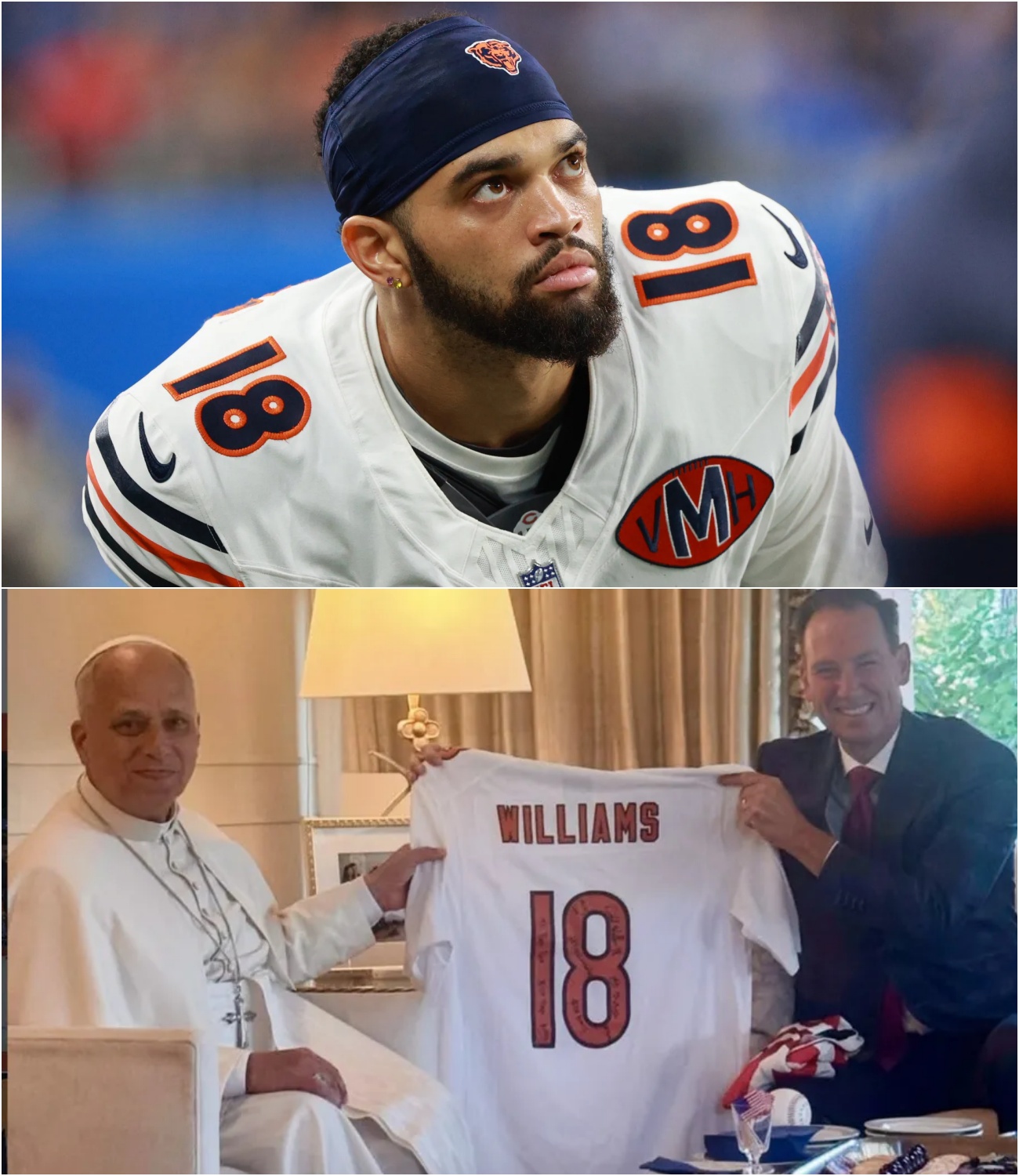
In the quiet, hallowed corridors of the Vatican, an artifact of American obsession has just taken up residence. It is not a centuries-old manuscript, nor is it a newly discovered Renaissance painting. It is a piece of polyester, stitched with brightly colored numbers, and signed with a black Sharpie.
But the story behind how a Chicago Bears jersey ended up in the hands of Pope Leo XIV is not just a heartwarming tale of hometown pride. It is a fascinating collision of deep personal faith, international diplomacy, and what might be the most spectacular, multi-million-dollar corporate leak in the history of modern sports. What began as a gesture of spiritual respect from a 24-year-old quarterback to the spiritual leader of the Catholic Church has inadvertently set the internet on fire, exposing the highly guarded mechanics of NFL merchandising and reminding us of the powerful, psychological overlap between sports fandom and religious devotion.
To understand the sheer magnitude of this moment, we must first look at the man receiving the gift. Born Robert Francis Prevost, Pope Leo XIV is not just the leader of the global Catholic Church; he is a historical anomaly. He is the first American-born pontiff in the church’s two-millennia history. But long before he donned the white papal vestments, he was wrapped in the civic identity of a city defined by its grit, its bitter winds, and its unwavering, almost painful devotion to its sports teams: Chicago.
Pope Leo is a man who bleeds navy and orange. His Vatican quarters are slowly morphing into a shrine to the Windy City. He currently possesses the final-out baseball from Game 1 of the 2005 World Series (hand-delivered by former catcher A.J. Pierzynski), a bat used by White Sox legend Nellie Fox, and a custom Bulls jersey gifted by broadcaster Chuck Swirsky. So, when the U.S. Ambassador to the Holy See, Brian Burch, arrived at the Vatican over the Fourth of July weekend carrying a gift from Chicago Bears superstar Caleb Williams, it felt like a natural, if not beautiful, continuation of the Pope’s earthly passions.

Yet, it was the specific, intimate details of this gift that elevated it from a PR stunt to a profoundly human moment. Caleb Williams didn’t just scrawl his signature on the fabric. Above his iconic No. 18, he wrote four letters: “AMDG.”
For the uninitiated, AMDG stands for Ad majorem Dei gloriam, a Latin phrase translating to “For the greater glory of God.” It is the foundational motto of the Society of Jesus. For Williams, this was no generic religious platitude. It was a deeply personal nod to his formative years at Gonzaga College High School in Washington, D.C., an institution founded by Jesuits in 1821. In a hyper-commercialized sports landscape where athletes are often reduced to walking billboards, this four-letter inscription was a quiet, vulnerable revelation. It was a young man utilizing his massive platform to connect with the Holy Father not as a celebrity, but as a believer paying homage to his roots. It was raw. It was authentic.
And then, the internet completely lost its mind.
As the Caleb Cares Foundation proudly posted the photo of Pope Leo holding the jersey, the emotional resonance of the moment was entirely hijacked by a jarring visual anomaly. The millions of die-hard football fans scrolling through X (formerly Twitter) didn’t focus on the Pope’s smile or the beautiful Latin inscription. They focused on the fabric.
The jersey was white. But the numbers were orange, outlined in a striking blue. The traditional, iconic sleeve stripes that have defined the Chicago Bears’ aesthetic for generations were nowhere to be found.
Within minutes, the sentiment shifted from spiritual awe to forensic investigation. The jersey Caleb Williams had sent to the Vatican was not a uniform the Chicago Bears had ever worn on a football field. It didn’t exist in the team’s current rotation.
The realization hit the sports world like a shockwave. Had Caleb Williams just leaked Nike’s top-secret “Rivalries” uniform to the Pope?
For context, the NFL and Nike treat new uniform releases with the kind of operational security usually reserved for nuclear launch codes. The “Rivalries” program, a highly lucrative initiative outfitting divisions with alternate jerseys over a four-year rollout, is slated to feature the NFC North in the 2026 season. Rumors had been swirling for months that the Bears would debut a special alternate look during their blockbuster Christmas Day matchup against the Green Bay Packers. Millions of dollars in marketing campaigns, meticulously planned release trailers, and perfectly timed retail drops depend on absolute secrecy.
And yet, here was the Vicar of Christ, standing in the Vatican, casually holding up what appeared to be the NFL’s most fiercely guarded secret.
The psychological whiplash of this event is exactly what makes it so virally potent. It triggers a profound “information gap” in our brains. On one hand, you have the sacred, slow-moving tradition of the Catholic Church. On the other, you have the hyper-fast, fiercely monetized hype-machine of modern sports fashion. When those two worlds crash into a single JPEG, our minds scramble to make sense of the dissonance.
Did Williams know what he was doing? Some skeptics argue that this was no accident. In the era of stealth marketing, what better way to generate astronomical, organic buzz for a new jersey than to have the Pope himself “accidentally” debut it? It circumvents traditional advertising entirely, transforming a product launch into a global cultural moment. Other, more grounded voices suggest a simpler truth: the Bears’ Pro Shop sells a “Tundra White” fashion jersey that closely resembles this design, and Williams simply chose a white jersey to aesthetically match the Pope’s traditional white cassock.

Regardless of whether it was a divine mistake or a stroke of marketing genius, the “Vatican Leak” forces us to confront a deeper, sociological truth about modern society. Why do we care so much about what colors a team wears?
The answer lies in the very nature of what sports have become. For millions of people, professional sports operate as a secular religion. Stadiums are our cathedrals. Sundays are reserved for communal gathering. We experience agonizing suffering, transcendent joy, and unwavering loyalty. And the jerseys? The jerseys are our vestments. They signal to the world who we are, what we believe in, and whose side we are on.
When Caleb Williams sent that piece of fabric to Pope Leo XIV, he was bridging a gap between the spiritual and the secular. He took the vestment of Chicago’s modern religion and offered it to the leader of its ancient one.
As that orange and white jersey takes its place somewhere deep within the Vatican’s archives, it stands as far more than a piece of sports memorabilia. It is a testament to a young athlete honoring his Jesuit roots, a hometown Pope refusing to let go of his city, and a digital culture that can turn a sacred gesture into an international sports conspiracy in a matter of seconds. In the end, whether the jersey makes its debut on the gridiron this Christmas Day or remains a Vatican exclusive, one thing is certain: Caleb Williams didn’t just give the Pope a gift. He gave the world an unforgettable story.