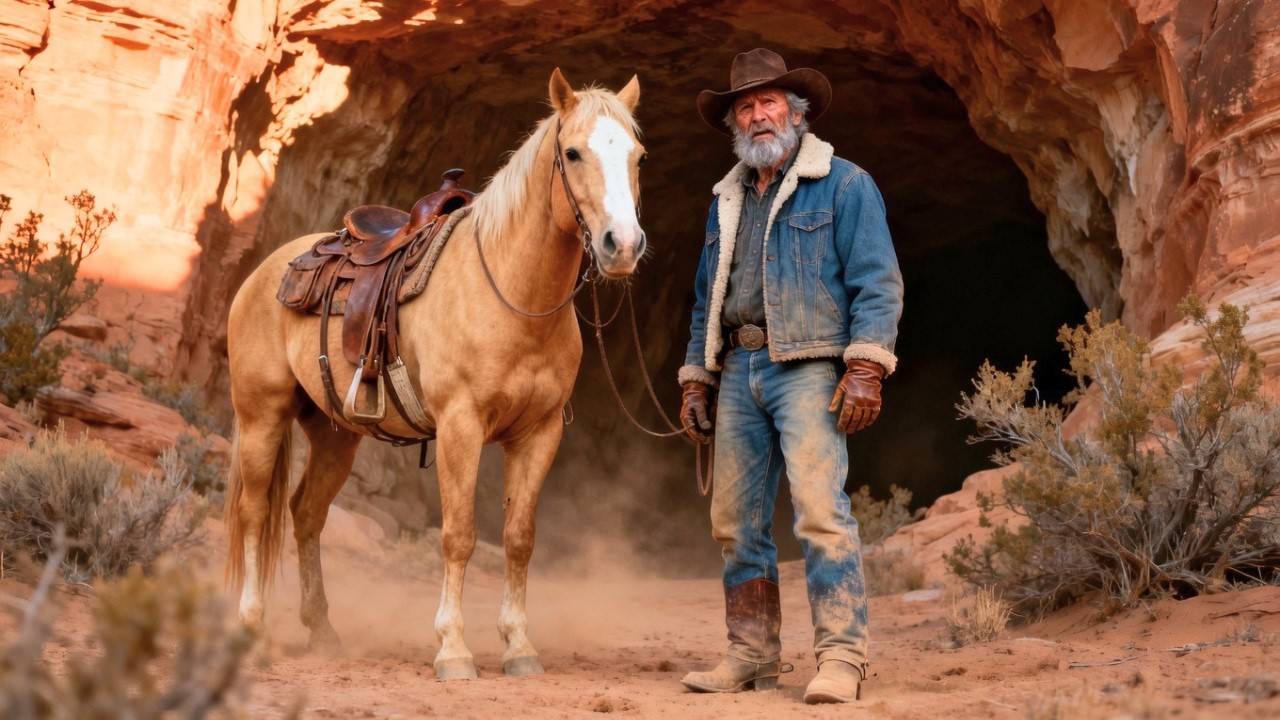
The Palomino wouldn’t stop screaming. Wade Coulter tightened his grip on the reins as Rustler’s hooves scraped against stone, eyes rolling white with terror. They’d stumbled into something hidden, a crack in the canyon wall, a smell of kerosene and unwashed fear drifting through juniper shadows. Then Wade saw her.
A teenage girl with a water bucket frozen mid-step, staring at him like he was a ghost. Before he could speak, boots crunched gravel behind her. A man stepped out holding a rifle. Wade recognized the face instantly. Garrett Boone, the hero who’d spent 4 years searching for two missing girls. And suddenly, Wade understood why they were never found.
Like this video and drop a comment with your city so I can see how far this story travels. Let’s get started. Wade Coulter learned early that the desert didn’t forgive mistakes. 63 years old, back bent from decades working cattle under a sun that bleached bones white, he’d survived drought, rattlesnakes, market crashes that killed neighboring ranches, and the slow death of his wife from cancer 5 years back.
What he hadn’t survived was loneliness. It sat in his chest like a stone, heavy and cold, turning every sunrise into another day of silence broken only by wind and the occasional bawl of a steer. His ranch sat 12 miles outside Black Hollow, a town barely worth the name, population 847 when folks bothered counting, which wasn’t often.
The kind of place where everyone knew your business, but nobody talked about it unless forced. Main Street consisted of a feed store, a diner with cracked vinyl booths, a post office that closed at 3, and a bar called the Dust where men went to forget things they couldn’t change. Black Hollow had been forgetting for 4 years now.
Two girls vanished like smoke. 13-year-old Lila Mercer disappeared first walking home from a friend’s house on a September evening when the sky turned orange and the temperature dropped fast. Her parents called police at midnight. By dawn, volunteers were combing sagebrush and arroyos, shouting her name until their voices cracked.
They found nothing. Not a shoe, not a hair tie, not a single thread of evidence that Layla Mercer had ever walked that road. 18 months later, 11-year-old Eden Vale went missing from her own backyard. One minute playing with chalk on the driveway, her mother inside making dinner. The next minute, gone. Vanished so completely it felt like the earth had swallowed her whole.
The FBI came, brought dogs, helicopters, ground penetrating radar. They interviewed everyone twice, checked backgrounds, searched properties, turned the whole county inside out, and found nothing but dust and heartbreak. After 2 years, the search team stopped coming. The news vans left. The FBI scaled back to a cold case file reviewed quarterly by agents who’d never set foot in Black Hollow.
Families held memorials without bodies. Parents aged overnight. Marriages shattered. Siblings grew up shadowed by ghosts they’d never properly buried. The town changed, too. Stopped trusting. Stopped hoping. Folks looked at each other differently now, wondering which neighbor might be hiding something terrible behind a friendly wave.
Kids didn’t play outside after dark anymore. The school installed cameras. People bought guns they’d never needed before. Wade remembered when Layla went missing. He joined the search parties those first desperate weeks, riding Rustler through canyons and washes until both of them could barely stand. He’d known the Mercers slightly, hardworking ranch family struggling like everyone else.
Layla had been a quiet kid, loved horses, worked odd jobs mucking stables to save money for her own someday. That detail stuck with Wade for reasons he couldn’t explain. A girl who loved horses. When Eden Vale disappeared, something broke in Wade that hadn’t fully healed from losing his wife.
He stopped joining searches, stopped going to town except for supplies. Let the silence of his ranch swallow him whole because at least silence was honest. It didn’t pretend to offer hope when there wasn’t any. His only real companion was Rustler, the palomino gelding he’d bought four years back at a livestock auction nobody else wanted to attend.
The horse had been skinny, nervous, covered in old rope burns and bite marks from other animals. The auctioneer couldn’t get a decent bid. Wade watched the fear in that horse’s eyes and saw something familiar. The look of a creature that had stopped expecting kindness. He paid $200. Loaded the trembling animal into his trailer and brought him home.
It took 6 months before Rustler would approach without flinching. Another year before the horse stopped spooking at sudden movements. But gradually, something like trust developed between them. Wade talked to Rustler the way he’d once talked to his wife. Rambling observations about weather and cattle and the small frustrations of keeping a ranch running alone.
The horse listened with intelligent brown eyes that seemed to understand loneliness as a language all its own. Now, four years later, Rustler was the closest thing Wade had to family. The horse knew the fence lines better than Wade did, could sense a storm building hours before clouds appeared, and had an uncanny ability to find cattle that had wandered into brush so thick a man couldn’t follow.
Which made the horse’s behavior that October morning so unsettling. Wade had been riding the northern boundary checking fence posts damaged by summer storms. Cold air bit through his canvas jacket. The sky looked thin and pale, the way it did before winter settled in for real. He’d planned to finish the section and head back for coffee, maybe spend the afternoon fixing the barn door that had been sticking since August.
Rustler had other ideas. They were approaching Blackstone Canyon when the horse suddenly stopped dead. Ears pinned flat, nostrils flaring like he’d caught scent of a mountain lion. “Easy.” Wade said, patting the horse’s neck. “What’s got into you?” Blackstone Canyon wasn’t a place folks visited voluntarily.
Steep walls, loose rock, dead-end ravines that all looked the same. The Shoshone who’d lived here generations back considered it cursed. Bad spirits, bad luck, bad everything. Modern ranchers avoided it for practical reasons. Treacherous footing, no water, nothing worth grazing. A rider could break his neck in there and not be found for months.
Rustler trembled, muscles bunching beneath Wade’s legs. Then the horse did something he’d never done before, refused a direct command. Wade touched heels to the palomino’s sides, clicked his tongue, tried reins and voice. Rustler wouldn’t budge forward. Instead, the horse sidled sideways, pulling hard toward a thick stand of juniper trees Wade had ridden past a hundred times without noticing anything unusual.
“The hell’s wrong with you?” Wade muttered, but something in the horse’s behavior made his skin prickle. Animals knew things. Wade had seen it before, cattle refusing to cross a wash hours before flash floods hit, dogs barking at empty air before earthquakes. His wife used to tease him about it, called it his mystic rancher nonsense. But living alone in wild country taught a man to pay attention when nature acted wrong.
Rustler pawed the ground, whining low in his throat. The sound reminded Wade of a dog trying to dig something up. “All right.” Wade said quietly. “Show me.” He gave the horse his head. Rustler moved immediately, not toward the canyon proper, but angling along the base of the cliff where juniper and scrub oak grew so dense it looked impenetrable.
The horse pushed through branches that scraped Wade’s legs, following something Wade couldn’t see or smell. They traveled maybe 50 yards before Rustler stopped again. This time the horse stood rigid, staring at what looked like solid rock face half hidden behind twisted juniper trunks. Wade dismounted, knees cracking.
Up close, he could see what his eyes had missed from a distance. A vertical crack in the stone, maybe 18 inches wide, nearly invisible unless you knew where to look. Wind whispered through the gap, carrying a smell that didn’t belong in open desert. Kerosene, unwashed fabric, something else underneath, faint but distinct.
Fear. Wade’s hand moved automatically to the rifle in his saddle scabbard. He pulled it free, checked the load, then turned back to the crack in the rock. “Stay.” He told Rustler. The horse snorted, but didn’t follow as Wade squeezed sideways into the gap. Rough stone scraped his jacket. The passage angled left, then right, descending slightly.
After 20 feet it opened into a narrow defile he’d never known existed. A hidden fold in the canyon walls sheltered from above, invisible from any normal approach. And there, tucked against the far wall where juniper shadows fell deepest, was a door. Not a cave entrance, an actual door. Weathered plywood reinforced with two-by-fours, fitted into a frame someone had bolted directly into living rock.
A padlock hung from the hasp, recently oiled. Wade’s heart started hammering. This wasn’t some old prospector’s cache or forgotten hunter’s shelter. This was new, maintained, hidden with purpose. He should leave, ride back to town, call Sheriff Briggs, let people with badges and backup handle whatever this was. But his feet wouldn’t move, because he was thinking about two missing girls and four years of empty searching in a town that had stopped believing in answers.
Wade reached for the door handle. It wasn’t locked. The door swung inward on silent hinges, revealing steps carved into stone descending into darkness. Artificial light glowed somewhere below, electric, not flame. Wade smelled that kerosene smell stronger now, mixed with human sweat and something cooking, beans maybe, coffee.
Someone lived down there. Wade’s hands were shaking. He forced them steady on the rifle, took one breath, then started down. The stairs were steep, cut rough but serviceable. 12 steps to a landing, turn, 12 more. The walls changed from natural stone to something reinforced, timber supports, corrugated metal panels, the kind of construction that required planning and effort and materials hauled in secretly over time.
At the bottom, the passage opened into a space that made Wade’s breath catch. It was a bunker, maybe 30 ft across, carved and built into the canyon bedrock like something from a war movie. Shelves lined the walls stocked with canned goods, water jugs, ammunition boxes. A propane stove sat in one corner, vented through a pipe that had to run up through the rock to disperse smoke somewhere invisible from above.
Sleeping bags on pallets, books, a folding table and chairs, kerosene lamps providing backup light to the battery-powered LED fixtures. And in the center of the room, frozen in place with a water bucket gripped in both hands, was a teenage girl. She stared at Wade like he was a hallucination.
Long dark hair tangled past her shoulders. Thin, too thin, wearing clothes that had been washed and rewashed until colors faded to gray. Bare feet on cold stone. Eyes huge in a face that had seen too much fear and not enough sun. Wade’s mouth went dry. His mind struggled to catch up with what his eyes were seeing. The girl’s lips moved.
No sound came out. “It’s okay,” Wade said, barely whispering. I’m not I’m here to help. She dropped the bucket. Water splashed across stone. Her whole body started shaking and then boots crunched gravel behind her. Don’t move. Wade spun. A man stood in a second doorway Wade hadn’t noticed. Another passage leading deeper into the rock.
The man held a hunting rifle pointed directly at Wade’s chest. Not waving it around, not shouting, just calm, steady, finger outside the trigger guard, but close enough. Wade recognized him immediately. Garrett Boone, 51 years old, former Army Ranger, volunteer firefighter, the man who’d organized search parties for both missing girls.
The hero who’d spent years comforting grieving parents, coordinating with law enforcement, giving interviews about never giving up hope. Wade had seen him dozens of times at community meetings, standing beside the sheriff, promising families they’d find answers. Garrett looked different now, thinner, beard grown wild, eyes hard and bright with something that might have been madness or might have been clarity.
Wade couldn’t tell which. Wade Coulter, Garrett said quietly. Didn’t expect to see you out here. Wade’s hands tightened on his rifle, still pointed at the floor. The girl hadn’t moved. She stood between them, terrified into silence. Garrett. Wade kept his voice level. What the hell is this? Survival, Garrett said. What it’s always been.
Where’s the other girl? Safe. They’re both safe. Safe? The word came out harsh. You kidnapped them. Garrett’s expression didn’t change. I saved them. There’s a difference. Put the gun down, Garrett. You first. They stood there, two armed men in a buried room lit by electric light, with a terrified girl between them and four years of lies slowly unraveling.
Wade glanced at the girl again. She was crying now, silent tears running down her face. Up close, he could see the resemblance to photos he’d seen on missing posters, though those had shown a younger child, 13 years old, smiling at a school camera. “Lila Mercer,” Wade said softly. The girl’s eyes widened.
Like hearing her own name spoken by a stranger was magic or horror or both. “You can’t take her,” Garrett said. “I won’t let you.” “The whole county’s been searching for 4 years. The county’s been dying for 4 years.” Garrett’s voice stayed calm, reasonable, which somehow made it worse. “Collapsing. You’ve seen it, Wade.
The corruption, the violence, the system’s falling apart. I did what I had to do.” “You stole children.” “I protected them.” Wade’s mind raced. The bunker wasn’t something thrown together in panic. This had been planned, constructed over months or years. Supplies stockpiled, ventilation engineered. Garrett hadn’t just hidden two girls.
He’d built them a prison and convinced himself it was salvation. “Where’s Eden?” Wade asked. “Sleeping, in the back.” Garrett gestured with his chin toward the second passage. “Don’t wake her. She’s been sick.” “She needs a doctor.” “I’ve taken care of her. I’ve taken care of both of them.” Garrett’s finger moved closer to the trigger.
“Which is more than the world out there would do. You know how it is, Wade. You’ve been alone long enough to see what people really are when nobody’s watching.” “I’m watching now,” Wade said. “Then you understand,” Garrett said. “You’re a smart man. You’ve seen the news, the riots, the corruption.
Society’s eating itself alive. These girls don’t need to be part of that. They’re better off here, protected, safe from all the poison out there.” Wade looked at Lila again. The fear in her eyes wasn’t the fear of danger outside. It was the fear of a prisoner who’d been told lies for so long she didn’t know what truth looked like anymore.
“They deserve to choose.” Wade said. “They’re children. Layla’s 17 now. Eden’s 15. They’re not children anymore, Garrett, and you know it.” Something flickered across Garrett’s face. Anger or shame, Wade couldn’t tell. “You should leave.” Garrett said. “Forget you saw this. Go back to your ranch, Wade. This doesn’t concern you.
” “Can’t do that.” “Then I’ll have to make sure you don’t talk.” The threat hung in the air between them. Wade’s finger moved closer to his own trigger. His mind calculated angles, distances, the risk of crossfire with Layla standing between them. Then Rustler screamed. Not a whinny. A full-throated scream of terror and rage that echoed down the stone passage loud enough to make Layla gasp and Garrett’s eyes flicked toward the entrance. Wade didn’t hesitate.
He lunged sideways, shoving Layla behind a shelf stacked with canned goods, and bolted for the stairs. Garrett fired. The shot punched through metal and stone with a sound like thunder in the enclosed space. Wade felt the bullet crack past his shoulder, too close. He didn’t turn around. He took the stairs three at a time, rifle clutched against his chest, lungs burning.
Rustler screamed again. Wade burst out of his hidden doorway into cold desert air. The palomino was wheeling in circles, eyes rolling white, yanking against the reins Wade had looped around a juniper branch. The horse must have heard the gunshot, panicked, tried to bolt. Wade grabbed the reins, jammed his rifle into the scabbard, and threw himself into the saddle.
Rustler didn’t need encouragement. The horse spun and crashed back through the juniper thicket at a full gallop, branches whipping Wade’s face. Behind them, Garrett Boone appeared at the hidden entrance, rifle raised. Wade kicked Rustler harder. The horse stretched into a run that felt like flying and falling at the same time, hooves hammering stone and dirt as they raced away from Blackstone Canyon toward open desert.
Another shot cracked the air. Wade didn’t know if Garrett was aiming to kill or warn. He didn’t stop to find out. They ran for 10 minutes before Wade risked slowing down. His hand shook so badly he could barely hold the reins. Rustler’s sides heaved, foam flecking his neck, but the horse kept moving, putting distance between them and the nightmare hidden in stone.
Wade’s mind spun. He’d just found two missing girls. And the man who took them was the same man the whole county had trusted to lead the search. He pulled his phone from his pocket. No signal this far out. He’d have to reach higher ground, get to the ridge where service sometimes worked on clear days.
But even as he urged Rustler toward the ridge trail, Wade knew what would happen next. He’d call the sheriff. They’d organize a response. And Garrett Boone, the hero everyone believed in, would have time to prepare for what was coming, or worse, time to make sure nobody ever found those girls again. Wade looked back toward Blackstone Canyon, hidden now behind layers of rock and distance.
Somewhere in that darkness, Lila Mercer and Edenvale waited. Hoping or not hoping, believing rescue was possible or believing nothing would ever change. Rustler’s ears swiveled back, listening for pursuit. Come on. Wade whispered to the horse. We got to move. They climbed toward the ridge as the pale October sun climbed with them, and Wade Coulter tried not to think about what would happen if he was too late.
The ridge took 20 minutes to reach at the punishing pace Wade pushed. Rustler’s breathing sounded ragged, foam coating the bit, but the horse didn’t slow until Wade pulled back on the reins at the highest point where cell signal sometimes flickered into existence. Wade’s hand shook so badly it took three tries to unlock his phone. Two bars.
Not great, but maybe enough. He pulled up Sheriff Nolan Briggs’ direct number and pressed call. It rang four times. Wade’s heart hammered against his ribs. Briggs? Nolan, it’s Wade Coulter. Wade? What’s You sound out of breath. Everything all right? No. Wade forced the words out between gasps. I found them. The girls.
Lila Mercer and Eden Vale? They’re alive. Silence on the other end. Long enough that Wade thought the connection had dropped. Nolan? I’m here. The sheriff’s voice had gone flat, careful. Wade, I need you to slow down and tell me exactly what you saw. I saw Lila Mercer in an underground bunker in Blackstone Canyon. Hidden entrance built into the rock.
Garrett Boone’s got them down there. Another pause. Garrett Boone? I know how it sounds. Wade, Garrett’s been leading search efforts for 4 years. He’s the one who I know what he’s been doing. Wade’s voice cracked. That’s the whole damn point. He’s been pretending to search while keeping them locked up like animals.
I saw her, Nolan. I saw Lila, and Garrett tried to shoot me when I ran. Garrett shot at you? Missed by inches. I’ve got a palomino here about to drop dead from running and a rifle that still smells like gunpowder from being too close to return fire. Wade wiped sweat from his face with a shaking hand. I’m not making this up.
The sheriff’s breathing changed. Where are you right now? North ridge above Blackstone, maybe 3 miles from the entrance. Can you get back to your ranch? I can try. Do that. Don’t go back to the canyon. Don’t call anyone else. I’m mobilizing units now. Briggs’ voice had shifted into command mode. Wade, I need you to understand something.
If this is what you say it is, Garrett’s going to know we’re coming. He’ll have time to prepare or run or or kill them, Wade finished. Yeah. Wade looked back toward the canyon, hidden behind layers of stone and desert scrub. Somewhere in that darkness, two girls waited. And the man holding them captive was a trained soldier who’d been planning for this moment probably since the day he took them.
How long before you can get units out here? Wade asked. 45 minutes minimum. I need to make calls, coordinate with state police, get tactical teams rolling. This isn’t something I can handle with three deputies and good intentions. 45 minutes is a long time. I know. Briggs paused. Wade, promise me you won’t do anything stupid.
I’m 63 years old and I just got shot at. Stupid’s already happened. Promise me anyway. Wade closed his eyes. I’ll head back to the ranch. Good. I’ll call you when we’re moving. And Wade, if what you’re saying is true, you just saved two lives today. The line went dead. Wade stood there holding his phone, watching the signal bars flicker, and tried to believe that was true.
But all he could see was Layla Mercer’s terrified face and the cold calculation in Garrett Boone’s eyes. Rustler shifted beneath him, still breathing hard. Wade patted the horse’s neck. Come on, boy. Let’s get you home. They descended the ridge at a walk, giving the palomino time to recover. Wade’s mind wouldn’t stop spinning.
He kept replaying the moment he’d seen Layla, the way she dropped that water bucket like her hands had forgotten how to hold things. The bunker itself, meticulously constructed, stocked for long-term survival. Garrett hadn’t built that in a few weeks. This was years of planning, preparation, obsession.
And nobody had noticed. Not the FBI, not the sheriff’s department, not the dozens of volunteers who’d searched Blackstone Canyon and found nothing because they’d never thought to look for something hidden that carefully. How many times had Garrett stood beside grieving parents promising them answers while two kidnapped girls lived 30 ft beneath the ground he walked on.
Wade’s stomach turned. He’d known Garrett slightly before this, the way everyone in a small town knows everyone else. Respected him even. The man who’d served his country, who volunteered his time, who never gave up when everyone else had stopped believing. The perfect disguise for a monster.
By the time Wade reached his ranch, the sun had climbed higher and the temperature had dropped into the low 40s. He untacked Wrestler, rubbed the horse down despite his own exhaustion, made sure water and feed were accessible. The palomino stood in the barn doorway, sides still heaving, staring back toward the direction they’d come from.
“I know.” Wade said quietly. “But there’s nothing we can do right now except wait.” He walked to the house, grabbed the rifle from where he’d leaned it against the porch railing, and went inside. The kitchen smelled like old coffee and loneliness. Wade put the rifle on the table, filled the electric kettle, and stood at the window watching the northern horizon like he could see through miles of rock to the nightmare hidden beneath.
His phone rang 32 minutes later. “We’re rolling.” Briggs said without preamble. “I’ve got 12 deputies, state police tactical unit, two helicopters, and the FBI field office sending agents. We’ll be at the canyon entrance in 20 minutes.” “What do you need me to do?” “Stay put. If this goes wrong.” “It won’t.” “If it does.” Briggs continued.
“I need someone who knows what they saw. Someone who can testify about what’s down there.” Wade gripped the phone tighter. “Nolan, you bring those girls home alive.” “That’s the plan.” The line went dead again. Wade set the phone down and stared at it like the device might ring again with better news or worse news or any news at all.
Minutes crawled past. He made coffee he didn’t drink, checked the rifle he didn’t need, walked circles through his small house like a caged animal. 43 minutes after Briggs’s call, Wade’s phone lit up with a text message. In position, no visual on suspect, attempting contact. Wade grabbed his truck keys.
He knew he’d been told to stay put, knew he’d promised, but sitting in his kitchen drinking cold coffee while two girls he’d seen with his own eyes waited for rescue felt impossible. He’d spent 4 years doing nothing while they suffered. He wasn’t doing nothing anymore. The drive to Blackstone Canyon took 18 minutes.
Wade parked his truck a half mile out where the road turned to dirt track, then hiked the rest of the way on foot. He could see the tactical vehicles before he reached the canyon rim. Three sheriff’s SUVs, two unmarked state police cars, a tactical van, and a helicopter circling overhead like a metal vulture.
Yellow tape blocked the main approach. Wade skirted around staying low using scrub and rock for cover. He’d hunted these hills for 40 years. He knew ways in that flatlanders with GPS would never find. He reached a vantage point above the hidden entrance just as Sheriff Briggs’ amplified voice echoed through the canyon. “Garrett Boone, this is Sheriff Nolan Briggs.
We have the location surrounded. Send the girls out and come out yourself with your hands visible. Nobody needs to get hurt today.” Silence. Wind whistled through rock formations. The helicopter circled lower. Briggs tried again. “Garrett, we know you’re down there. We know about the bunker. We know about Lila and Eden.
This ends now one way or another. Make it easy.” For a long moment, nothing happened. Then a single rifle shot cracked the air. Officers scattered taking cover behind vehicles and rock. The helicopter banked hard right, climbing fast. Return fire didn’t come, just that one shot fired into empty air like a warning or a promise. “Hold fire.” Briggs shouted.
“Hold your fire.” Wade’s hands gripped the rock he was hiding behind. From his position, he could just see the hidden entrance through the juniper trees. No movement, no sign of Garrett or the girls. Then he realized what he was actually seeing. The entrance wasn’t just hidden anymore. Garrett had reinforced it. Metal sheets bolted across the opening.
Firing ports cut at angles that would make approach nearly impossible without taking casualties. Fresh sandbags stacked behind the door. This wasn’t something thrown together in 45 minutes. Garrett had been ready for this scenario long before Wade stumbled into his bunker. “We’ve got a fortified position.
” A tactical commander’s voice crackled over radio. Wade couldn’t see the man, but could hear him clearly in the canyon’s acoustics. “Multiple firing angles, limited approach vectors. If he’s got supplies down there, this could turn into a siege.” “What are the breach options?” Briggs asked. “Limited. We’d need explosives to take the door, and we don’t know the bunker layout.
Could collapse the whole structure on top of the hostages.” “So, what do we do?” “We wait. We negotiate. We don’t give him a reason to hurt those girls.” Wade closed his eyes. Waiting. The story of the last 4 years. Waiting for clues that never came. Waiting for leads that went nowhere. Waiting for two missing girls to somehow come home.
He’d found them, and now law enforcement was talking about waiting again. Movement caught his eye. Below, near the tactical van, Sheriff Briggs was on a phone, probably talking to FBI negotiators or crisis management experts. Other officers had established a perimeter, rifles trained on the bunker entrance from multiple angles.
The helicopter maintained distance overhead filming everything. And inside that bunker, Layla and Eden waited in darkness with a man who’d convinced himself he was saving them from a world that had come looking anyway. Wade’s phone buzzed. Text from Briggs. Saw your truck. Get the hell out of here. Wade didn’t respond.
He stayed low watching, trying to think of something useful to do besides hide behind a rock while trained professionals did their jobs. Then Garrett’s voice echoed from the bunker, amplified somehow, probably a battery-powered speaker. You shouldn’t have come, Sheriff. Briggs grabbed a bullhorn. Garrett, send the girls out.
Whatever you think you’re protecting them from, this isn’t the answer. You don’t understand what’s coming. None of you do. Then explain it to me. But first, let those girls go. They’re safer here than they’ll ever be out there. Briggs glanced at the tactical commander who shook his head slightly. No clear shot. No safe breach. No good options.
Garrett, you’ve been watching the news for years, Briggs said changing tactics. You know how these situations end. You served your country. You’re a good man who made bad choices. Don’t make this worse. I’m not a good man. Garrett’s voice came back quieter now. Good men don’t do what needs to be done.
They follow rules and watch everything collapse around them. I stopped being good 4 years ago when I decided to act instead of wait. You kidnapped children. I saved them from what’s coming. From the riots and the corruption and the systems failing. From predators and traffickers and all the poison you pretend doesn’t exist because acknowledging it means admitting you can’t stop it.
Wade felt something cold settle in his chest. Garrett wasn’t ranting. He wasn’t out of control. He genuinely believed every word he was saying. Believed it so completely that 4 years of imprisonment looked like protection, He captivity looked like salvation. Let me talk to Layla, Briggs said.
Let me hear her voice. Know she’s okay. Silence. Garrett, if you’ve hurt those girls, I’ve never hurt them. Garrett’s voice had gone hard. I fed them, clothed them, kept them safe and healthy while the world outside tears itself apart. You want to hear Layla’s voice? Ask yourself why she hasn’t screamed for help yet. Briggs looked at the tactical commander again.
The man’s expression said everything. They were dealing with a true believer, which made negotiation nearly impossible. True believers didn’t compromise. They martyred themselves and took hostages with them. Wade’s mind raced. He thought about Layla’s face when he’d said her name, the way recognition had flashed across her features like lightning.
She’d been terrified, but she’d also been awake, present, not the broken shell of a person that four years of captivity should have produced. What had Garrett told them? What lies had he woven to make imprisonment seem like safety? Rustler’s scream echoed in Wade’s memory. The way the horse had panicked at the bunker entrance, desperate to escape or desperate to reach something.
Animals knew things humans missed. Maybe Rustler had sensed more than just danger. Maybe the horse had recognized Wade’s breath caught. He pulled out his phone, sent a text to Briggs. Need to talk. Important. 30 seconds later his phone rang. Wade, I told you to leave. The horse, Wade interrupted. Rustler.
He’s a palomino gelding I bought four years ago at auction. Nobody wanted him. He’d been abused, neglected, half starved. I don’t see how I What if he belonged to one of the girls before? What if Layla’s family had to sell him after she disappeared? Financial troubles or just couldn’t keep a horse when their daughter was missing.
Animals remember scents, Nolan. Rustler went crazy at that bunker. Not just scared, desperate. Like he recognized something. Briggs was quiet for a moment. You think the horse knew Layla? I think it’s possible. And if it is, maybe that’s how we reach her. Show her something from before. Something that proves the world she came from is still real, still waiting.
That’s a hell of a long shot. You got better ideas? Briggs didn’t answer. In the background, Wade could hear the tactical commander talking about containment strategies and supply logistics. “If we bring the horse out here,” Briggs said slowly, “Garrett might see it as an escalation, might panic.
Or Layla might see it, might remember.” “And if you’re wrong about the horse recognizing her, then we’re exactly where we are now. Stuck outside while a crazy man holds two girls hostage.” Briggs exhaled hard. “All right. But I’m not asking you to bring that horse anywhere near an active tactical situation.
You understand? You bring Rustler to the perimeter checkpoint, we see if it changes anything, and then you get out.” “Deal.” Wade ended the call and started working his way back to his truck, moving carefully to avoid drawing attention from either the police perimeter or Garrett’s potential firing positions. It took 15 minutes to reach the vehicle, another 20 to drive back to his ranch.
Rustler stood in the barn exactly where Wade had left him, ears forward, watching the driveway like he’d been expecting this. “We’re going back,” Wade said, grabbing the halter and lead rope. “Don’t make me regret this.” The horse loaded into the trailer without hesitation, which felt like a small miracle given how exhausted they both were.
Wade climbed back into the truck, hands gripping the wheel tight enough to hurt, and drove back toward Blackstone Canyon with a kidnapped girl’s horse in tow and no clear idea what he was actually trying to accomplish. The checkpoint deputy tried to stop him a half mile from the tactical site. Road’s closed, sir.
Active police situation. Sheriff Briggs is expecting me. Wade Colter. Call him. The deputy spoke into his radio, listened, then waved Wade through with an expression that suggested he thought everyone involved had lost their minds. Wade parked where Briggs indicated, away from the main approach, but still visible from the canyon entrance if someone was looking.
He unloaded Rustler slowly, let the horse smell the air and get his bearings. The palomino’s head came up immediately, ears swiveling toward the canyon, nostrils flaring. Easy. Wade murmured. Briggs approached, keeping his voice low. This is the craziest thing I’ve agreed to in 20 years of law enforcement. You’re welcome. Tactical wants to know what you’re doing.
Honestly, I’m not sure. But that horse is reacting to something, and I’d rather try this than sit around waiting for Garrett to do something worse. Briggs studied Rustler, then Wade. You really think this animal remembers a girl from 4 years ago? Horses remember trauma. Why not love? Before Briggs could respond, Rustler whinnied.
Not the scream from earlier, but a long calling sound that carried across the canyon like a question waiting for an answer. And from somewhere deep in the bunker, muffled and distant, but unmistakable, came a sound that made every officer in hearing distance freeze. A girl crying out. Not words, just a raw sound of recognition and desperate hope.
Briggs grabbed his radio. Did anyone else hear that? Confirmations crackled back from multiple positions. They’d all heard it. Rustler whinnied again, louder, pulling against Wade’s grip on the lead rope. The horse wanted to move toward the canyon, toward whatever he recognized in that crying voice. Inside the bunker, Garrett Boone’s amplified voice cut through the moment like a knife.
What did you bring? Briggs raised the bullhorn. Just a horse, Garrett. Nothing threatening. Why? Because maybe someone down there wants to see him. Silence. Long enough that Wade wondered if Garrett had retreated deeper into the bunker, dragging the girls somewhere they couldn’t see or hear or hope. Then Layla’s voice, faint but clear through whatever speaker system Garrett had rigged. Rusty? Wade’s throat tightened.
Rusty. That’s what she’d called him. Before he was Rustler, before the auction and the abuse and the long road to Wade’s ranch, he’d been Rusty, a girl’s horse. Layla’s horse. “She remembers,” Wade said to Briggs. “She remembers him.” Briggs lifted the bullhorn again. “Layla, Rusty’s here. He’s safe. He’s been waiting for you.
” Movement at the bunker entrance. Just a shadow, but definitely something shifting behind those metal reinforcements. Garrett’s voice came back tight with something that might have been anger or fear. “You’re trying to manipulate them.” “I’m showing them the truth,” Briggs said.
“The world they came from didn’t disappear, Garrett. It’s still here. Still waiting for them to come home.” “The world out there will destroy them.” “The world out there has been searching for 4 years,” Briggs interrupted. “Parents who never stopped hoping. A community that never forgot. And a horse that somehow found his way back to the girl who loved him.
You want to tell me that’s destruction?” No response. But Wade could see shadows moving behind the firing ports now. Someone was watching. Someone was close enough to the entrance to see Rustler standing in weak October sunlight, head high, calling for a girl he’d last seen 4 years ago. Rustler pulled harder against the lead rope.
Wade had to plant his feet to keep from being dragged forward. “Let me bring him closer,” Wade said to Briggs. “Absolutely not. You’re already too close to an active She needs to see him. Really see him. Not just hear his voice from a distance. Wade, Nolan, we’re running out of time. Garrett’s unraveling. I can hear it in his voice.
Either we give Layla a reason to fight back or we wait for this to end badly. Briggs looked at the tactical commander who shook his head firmly. Wade ignored both of them. He started walking toward the bunker entrance letting Rustler pull him forward, trusting the horse’s instincts more than any tactical manual. Wade, stop! Briggs shouted.
Wade didn’t stop. He walked past the police perimeter, past the sandbag positions, into open ground where Garrett could shoot him if he chose. Rustler moved beside him, no longer pulling but walking steady, ears forward, focused on something only the horse could sense. They got within 30 yards of the bunker entrance before Garrett’s voice crackled out again. That’s close enough.
Wade halted. Rustler stood trembling beside him, every muscle tensed. I’m just an old rancher with a horse, Wade called out. No weapon, no threat. Just here to show Layla that some things don’t change. Some things wait. You should have stayed away. Probably. But I’m 63 years old and stubborn as hell. Layla, if you can hear me, your horse came home.
Maybe it’s time you did, too. For a long moment, nothing. Then the metal door behind the reinforcements opened 6 inches. Just enough for a thin figure to slip through into the gap between interior darkness and afternoon light. Layla Mercer stood there, blinking in sunlight she hadn’t seen in 4 years, staring at a palomino horse that had somehow found her across time and distance and impossible odds.
Rustler nickered softly. The sound a mother horse makes to a frightened foal. And Layla started crying. Layla stood in that narrow gap between metal and stone, one hand gripping the door frame like she might collapse without it, the other pressed against her mouth. Tears streamed down her her catching what little sunlight filtered through the canyon walls.
She looked smaller than Wade remembered from the bunker, fragile in a way that had nothing to do with physical size and everything to do with 4 years of being told the world had ended. Rustler took three steps forward before Wade could tighten his grip on the lead rope. The horse moved carefully, head low, making soft sounds in his throat that Wade had never heard before.
Recognition sounds, memory sounds. Lila, get back inside. Garrett’s voice came from somewhere deeper in the bunker, tight with panic. You don’t know what’s out there. You don’t know what they’ll do to you. But Lila wasn’t listening. She took one shaking step forward, then another, moving like someone relearning how to walk.
Her bare feet made no sound on cold stone. She’d gotten maybe 10 ft from the bunker entrance when Rustler pulled free from Wade’s grip entirely and closed the distance between them. The horse stopped inches from Lila’s outstretched hand, waited, let her touch him first. He did. Her fingers found his muzzle, traced the white blaze running down his face.
The gesture looked automatic, muscle memory from years ago. Rustler leaned into her touch, eyes half-closed, and made that soft nickering sound again. “I thought you were gone.” Lila whispered. “I thought everything was gone.” Wade stayed back, giving them space. Behind him, he could hear tactical officers repositioning, probably getting clear shots now that the bunker door had opened.
Sheriff Briggs stood frozen with the bullhorn halfway to his mouth, like he’d forgotten what he’d meant to say. Then Garrett appeared in the doorway. He had his rifle, but it hung loose in one hand, pointed at the ground. He looked like a man watching his entire world view collapse in real time. “Lila, please.” Garrett said.
“You’re not thinking clearly. That horse, that man, they’re part of the system I protected you from. They’ll take you back out there and you’ll see. You’ll understand why I did this.” Lila turned slowly, her hand never left Rustler’s neck. You told me my parents were dead. I told you what you needed to hear to stay safe. You said everyone was dead.
The town, my family, everyone I knew. You showed me news stories about riots and diseases and said the world had ended. Her voice was shaking but growing stronger with each word. Was any of it true? Garrett’s face twisted. It was all true. Maybe not the specific details, but the pattern, the collapse, the danger, all of it’s real.
I didn’t lie about what’s happening out there. But my parents, Lila said. Are they alive? Silence. Garrett. Lila’s voice cracked. Are my parents alive? Yes. Garrett said quietly. They’re alive. Something broke in Lila’s expression. Not relief. Wade could see that from where he stood. It was rage, pure and simple. The kind that only comes from realizing you’ve been betrayed by someone you trusted.
You let them think I was dead for 4 years, Lila said. I let them think you were safe. You let them grieve while you kept me in a hole in the ground telling me lies. She took another step forward toward Garrett now, not away. Rustler moved with her, staying close. Eden and me, we believed you. We were scared and confused and you were the adult, the one who was supposed to know what was happening.
We trusted you. I was protecting you, Garrett said, but his voice had lost its certainty. From what? From my mother making breakfast? From my little brother learning to read? From Friday night football games and graduation and prom and every single thing you stole from me? Garrett raised the rifle slightly, not aiming at anyone, but the movement made every officer behind Wade tense.
Wade heard safeties clicking off, heard Briggs speak urgently into his radio. “Don’t!” Wade called out. “Garrett, don’t make this worse.” “It’s already worse,” Garrett said. “Four years of keeping them safe and she thinks I’m the monster.” “You are the monster,” Layla said. Her whole body was shaking now, but she didn’t back down.
“You kidnapped us. You locked us underground. You made us afraid of sunlight and other people and everything normal. That’s not protection. That’s not safety. That’s what a monster does when he wants to pretend he’s a hero.” “I served my country. I appreciate our I don’t care.” Layla’s voice rose. “I don’t care about your service or your beliefs or your reasons.
You took my life. You took Eden’s life. And you convinced yourself it was noble.” Movement in the bunker doorway. A smaller figure emerged. Eden Vale, 15 years old now, though she looked younger. Pale skin, eyes too large in a thin face, wearing the same kind of faded clothes as Layla. She moved like a frightened animal, staying close to the wall.
“Eden, go back inside,” Garrett said. Eden didn’t move. She was staring at Layla, at Rustler, at the armed officers positioned throughout the canyon. Her mouth opened, but no sound came out. “It’s okay,” Layla said, turning toward her. “It’s going to be okay.” “Is it true?” Eden’s voice was barely audible. “About the world? About it not being ended?” “Yes,” Layla said.
“He lied to us. About everything.” Eden looked at Garrett. Something in her expression made Wade’s chest hurt. The look of a child realizing the adulthood defined her entire reality had been lying the whole time. “You said my mom died in the plague,” Eden whispered. “You showed me the obituary.” “That was a different Sarah Vale,” Garrett said.
“I never said it was your mother’s specifically. You let me believe it.” Eden’s voice was getting louder. “You let me cry myself to sleep thinking everyone I loved was dead. You made me grateful to be locked in a bunker because at least I was alive.” “You are alive.” Garrett said desperately. “Both of you are alive and healthy and safe. Look at yourselves.
Look at what I gave you when the world out there would have destroyed you.” “The world out there has been looking for us.” Layla said. She gestured toward the officers, toward Wade, toward the helicopter still circling overhead. “All these people, all these resources, spent four years trying to find us. That doesn’t sound like a world that wanted to destroy us.
” Garrett’s hands tightened on the rifle. “You don’t understand. You’re not old enough to see the patterns, the way everything’s breaking down, the corruption, the violence, the lies.” “You want to talk about lies?” Layla cut him off. “You’re the one who’s been lying for four years straight, every day, every conversation, every time you told us we were safer with you than with our own families.
“I was trying to spare you.” “You were trying to control us.” Layla’s voice went cold. “And you convinced yourself it was love.” The words hung in the desert air like smoke. Garrett stood there, rifle in hand, looking at two girls he’d imprisoned for four years who were now staring at him like the stranger he’d always been.
Sheriff Briggs’ voice crackled through the bullhorn. “Garrett, put the weapon down. Let the girls walk out. This is your last chance to end this without more pain.” Garrett looked at Briggs, then back at Layla and Eden. “If I let you go, they’ll put me in prison for the rest of my life.” “You deserve prison.” Layla said.
“Maybe.” Garrett’s finger moved toward the trigger. “But I won’t let them take what I’ve built. I won’t let them prove me wrong.” Wade saw it happening before anyone else did. The shift in Garrett’s posture, the way his weight settled, the calculation in his eyes. This wasn’t a man preparing to surrender. This was a man preparing to die and take everything he’d built down with him.
“Gun!” Wade shouted, but Tactical was already moving. Garrett swung the rifle toward the nearest officer position. Three shots cracked the air simultaneously. Two from Tactical positions, one from Briggs himself. Garrett jerked backward, the rifle firing wildly into empty air before clattering to stone.
He hit the bunker wall and slid down, leaving a red smear behind him. Eden screamed. Lila grabbed her, pulled her close, both of them collapsing to the ground as officers swarmed forward. Wade lunged for Rustler’s lead rope as the horse reared, spooked by gunfire. The palomino came down hard, nearly trampling Wade before recognizing him and settling enough to be controlled.
“Secure the bunker!” Briggs shouted. “Medical to the entrance. Get those girls out of there.” Tactical officers poured through the bunker entrance, weapons raised, clearing rooms. Medics rushed forward with equipment. Wade held Rustler back, keeping the frightened horse from charging into the chaos. His ears rang from the gunshots.
His hands shook. On the ground near the bunker entrance, Lila held Eden while officers tried to separate them for medical evaluation. The younger girl was sobbing, face pressed against Lila’s shoulder, whole body trembling. Lila’s eyes were dry but vacant, like she’d gone somewhere internal where emotion couldn’t reach her.
A medic knelt beside them. “I need to check you both for injuries. Can you stand?” Lila nodded but didn’t move. “Take your time,” the medic said gently. “Nobody’s rushing you.” More officers emerged from the bunker. One of them approached Briggs, shaking his head. “He’s gone. Died before we could reach him.
” Briggs didn’t look surprised. “What else is down there?” “Supplies for years. Medical equipment, books, food stores, sleeping quarters, and journals. Dozens of journals where he documented everything. His reasoning, his plans, his justifications for keeping them. “Bag it all.” Briggs said. “Every scrap of paper, every piece of evidence.
” Wade finally got Rustler calmed enough to approach the bunker area. The horse was still trembling, but no longer fighting the lead rope. They moved slowly toward where Layla sat on cold stone with Eden clinging to her. Rustler lowered his head, snuffling at Layla’s hair. She looked up, saw the horse, and something in her expression cracked.
She reached up with one hand, the other still holding Eden, and touched Rustler’s muzzle again. “You came back.” she whispered. “How did you come back?” Wade cleared his throat. “Found him at auction 4 years ago. Nobody wanted him. Figured he deserved better.” “You bought my horse.” “Didn’t know he was yours.
Just saw an animal that needed help.” Layla’s eyes met his. “You’re the man from this morning. The one who found us.” “Wade Coulter. And yeah, stumbled on Garrett’s bunker by accident. Rustler here wouldn’t move forward until I followed him to that crack in the rock.” “He remembered.” Layla said. “Even after all this time, he remembered where I was.
” Wade didn’t correct her. Truth was, he had no idea if Rustler had actually remembered anything, or if the whole thing was coincidence. But the girl had been through enough without him taking away whatever comfort that belief provided. A medic brought blankets and wrapped them around both girls. Another offered water bottles.
Eden finally lifted her head from Layla’s shoulder, her face blotchy and swollen from crying. “Is he really dead?” Eden asked. The medic glanced at Briggs, who nodded. “Yes.” the medic said gently. “He can’t hurt you anymore.” Eden’s face crumpled again. “He said he loved us.” “He said he was protecting us.” “I know, the medic said.
But that wasn’t love. That was something else. Layla’s arm tightened around Eden. We’re going home, she said. Both of us. Back to our real families. What if they don’t want us anymore? Eden’s voice was small, childlike. What if four years is too long and they’ve moved on? They haven’t, Briggs said, kneeling beside them.
Your parents have been waiting every single day. They never stopped looking. They never stopped hoping. How do you know? Eden asked. Because I’ve talked to them at least once a month for four years. Your mother, Eden, Sarah Vail, she still puts flowers on your bed every week, fresh ones. Has done it every single week since you disappeared.
Eden started crying again, but differently this time. Not the panic sobbing from before, but something that sounded almost like relief. Briggs looked at Layla. And your family, Layla Mercer, they’ve kept your room exactly the same. Your mother wouldn’t let anyone touch it, said you’d want everything right where you left it when you came home.
When? Layla repeated. Not if. Your mother never said if, Briggs confirmed. Always when. The helicopter overhead banked lower, its spotlight illuminating the entire canyon entrance. News vans were probably already racing toward Black Hollow. Reporters scrambling for the story of two missing girls found alive after four years.
Wade could picture it. The media circus, the press conferences, the endless questions and cameras and people treating grief like entertainment. We need to transport you both to the hospital, the medic said. Get you checked out properly. Make sure you’re physically okay. I want to see my mom, Eden said. You will.
Soon as we clear you medically, we’ll bring your families in. Not at the hospital, Layla said suddenly. I don’t want to see my parents for the first time in four years under fluorescent lights with doctors watching. The medic looked at Briggs, uncertain. The sheriff considered then nodded. “We’ll arrange something, but medical evaluation isn’t optional.
You’ve both been through trauma. We need to make sure you’re healthy.” “After 4 years in a bunker, I think we’re past optimal health.” Layla said, but there was something almost like humor in her voice. Dark humor, bitter humor, but humor nonetheless. Wade watched tactical officers continuing to clear the bunker, bringing up boxes of supplies and documents.
One emerged carrying a stack of notebooks bound with rubber bands. Another carried what looked like a CB radio and antenna setup, probably how Garrett had monitored news broadcasts to select the stories he fed the girls, building his narrative of societal collapse. It was meticulous, calculated, the work of someone who’d planned this for longer than just the 4 years since Layla’s disappearance.
How long had Garrett been preparing? How long had he been watching those girls, waiting for the right moment to take them? The thought made Wade sick. “Mr. Colter?” Layla’s voice pulled him back. “Can Rustler stay with me? Just for a few more minutes?” Wade looked at the medics, at Briggs. The sheriff shrugged.
“Horse doesn’t seem to be bothering anyone.” Briggs said, “and if it helps, I don’t see the harm.” Wade handed the lead rope to Layla. She took it with her free hand, Eden still pressed against her side, and Rustler immediately lowered his head, resting his muzzle against Layla’s shoulder like they’d done this a thousand times before.
Maybe they had, Wade thought, before the world broke, before a monster in hero’s clothing decided to play savior. More vehicles arrived at the canyon perimeter. Wade could hear voices, see flashlights and headlights cutting through the growing dusk. The sun had started setting without anyone noticing, painting the canyon walls in shades of orange and red that looked almost violent.
A woman’s voice carried across the canyon, raw and desperate. Where are they? Where’s my daughter? Briggs stood. That’s Eden’s mother. I need to prepare them for this. He walked toward the perimeter leaving Wade with the girls and the horse and half a dozen officers still processing evidence. The medics had backed off slightly giving Layla and Eden space while staying close enough to intervene if needed.
What happens now? Eden asked. She’d stopped crying but still trembled under her blanket. Now you go home. Wade said. Back to your families, your lives. It won’t be easy. Probably won’t be smooth. But it’ll be yours again. Will you be there? Layla asked. You and Rustler? Wade hesitated. He was just a rancher who’d stumbled into something by accident. These girls didn’t need him.
They had families, professionals, support systems waiting to help them heal. But Layla was looking at him like he’d already become part of whatever story she’d tell herself about this day. The man who brought her horse back. The man who’d walked into a monster’s lair and walked out again to bring help. If you want us there, Wade said finally, we’ll be there.
Rustler nickered softly like agreeing to a contract neither of them fully understood. Voices rose near the perimeter. Eden’s mother pleading to see her daughter, officers trying to explain procedure and medical necessity, and all the bureaucratic barriers between a mother and her found child. Wade could see Briggs gesturing, explaining, trying to manage the situation.
I don’t want to wait, Eden said. I want to see my mom now. Soon, the medic promised. Very soon. Not soon enough, Layla said, but she was smiling slightly. Nothing’s going to be soon enough after 4 years. An officer approached Wade. Sheriff wants you to move the horse back to the perimeter.
We’re setting up a secure transport for the girls. Wade nodded, but when he reached for the lead rope, Layla didn’t let go. “Please,” she said, “just a little longer.” The officer looked uncomfortable. “Ma’am, we need to eat.” “Let her have the horse.” Briggs’s voice came from behind them. He’d returned from dealing with Eden’s mother.
“Five more minutes won’t hurt anything.” The officer retreated. Briggs sat down on a rock near the girls, looking exhausted. He’d aged 10 years in the last few hours. “Eden, your mother’s waiting at the checkpoint,” Briggs said. “Medical team’s going to do a quick evaluation here, then we’ll transport you to the hospital.
Your mom will meet you there.” “Why can’t she come here?” Eden asked. “Because this is still an active crime scene, and because we need to control the situation before it turns into chaos.” Briggs gestured toward the growing number of vehicles and people gathering at the perimeter. “Word’s spreading fast. By morning, every news outlet in the country is going to be here.
” “I don’t want to talk to reporters,” Layla said. “You won’t have to. We’ll protect you from that as much as possible, but I can’t make the attention disappear.” “Two missing girls found alive after 4 years. It’s a story people want to hear.” “It’s not a story,” Layla said quietly. “It’s our lives.” “I know.” Briggs rubbed his face.
“And I’m sorry for what’s coming. The questions, the attention, the way people will look at you like you’re something fragile or broken or miraculous. I’m sorry you have to go through that on top of everything else.” “At least we get to go through it in sunlight,” Eden said. She was looking up at the darkening sky, at stars beginning to emerge.
“I forgot how many stars there are.” “Garrett showed us pictures,” Layla said. “Told us the sky was too polluted now to see stars clearly. Said it was proof of how bad things had gotten.” “The sky’s the same as it’s always been,” Wade said. “Some nights clearer than others, but the stars haven’t gone anywhere.
Lila turned Rustler’s lead rope over in her hands. How much did he lie about? How much of what we believed was real? I don’t know, Briggs said. Investigators will go through everything he kept down there. Documents, news clippings, whatever he showed you. We’ll piece together what was truth and what was manipulation.
Does it matter? Lila asked. Real or fake, we still believed it. We still spent four years thinking the world had ended and we were the lucky ones who survived. Nobody had an answer for that. The medical team approached again, this time with a stretcher and more equipment. We really need to get them evaluated, the lead medic said. Both of them.
Transport’s ready. Lila finally handed the lead rope back to Wade. She stood slowly, helping Eden up. Both girls looked unsteady on their feet, like they weren’t used to walking on uneven ground. Will you bring Rustler to see me? Lila asked Wade. After all this settles down? If your parents are okay with it, yes.
They will be, Lila said with certainty. They loved Rusty almost as much as I did. Wade watched as medics guided both girls toward the waiting ambulance. Lila kept looking back at Rustler until they turned a corner and disappeared from view. The horse whinnied once, ears swiveling to track where she’d gone. You did good today, Briggs said, standing beside Wade.
That horse of yours, whatever made him act the way he did, it might have saved their lives. Garrett would have killed them, Wade said. It wasn’t a question. Eventually, yeah, I think so. Maybe not today, but when he finally accepted that his version of reality wasn’t sustainable. Briggs watched officers continuing to clear the bunker.
Four years is a long time to maintain a delusion. But we were closing in. Federal agents were re-examining the case, looking at volunteers who’d been involved in the searches. They would have found him eventually, not before he destroyed the evidence, Wade said. No, probably not. They stood in silence while the canyon slowly filled with artificial light, headlights, flashlights, spotlights from the helicopter still circling above.
The desert night had turned cold. Wade could see his breath. “What happens to Garrett’s body?” Wade asked. “County coroner will handle it. There’ll be an investigation into the shooting, but it was clean, justified. He raised a weapon toward officers.” Briggs sighed. “His family’s going to have questions, his friends, the people who thought he was a hero.
” “Let them have questions,” Wade said. “Better than letting them have illusions.” Briggs nodded. “I need your full statement, everything you saw, everything that happened. It’ll be part of the official record.” “Later,” Wade said. “Right now I need to get this horse home before he collapses.” “Yeah, go.
” Briggs clapped Wade’s shoulder. “And Wade, thank you for not following my orders to stay away, for bringing the horse, for giving those girls something to hold on to besides fear.” Wade didn’t trust himself to respond. He just nodded, tugged Rustler’s lead rope, and started the long walk back to his truck.
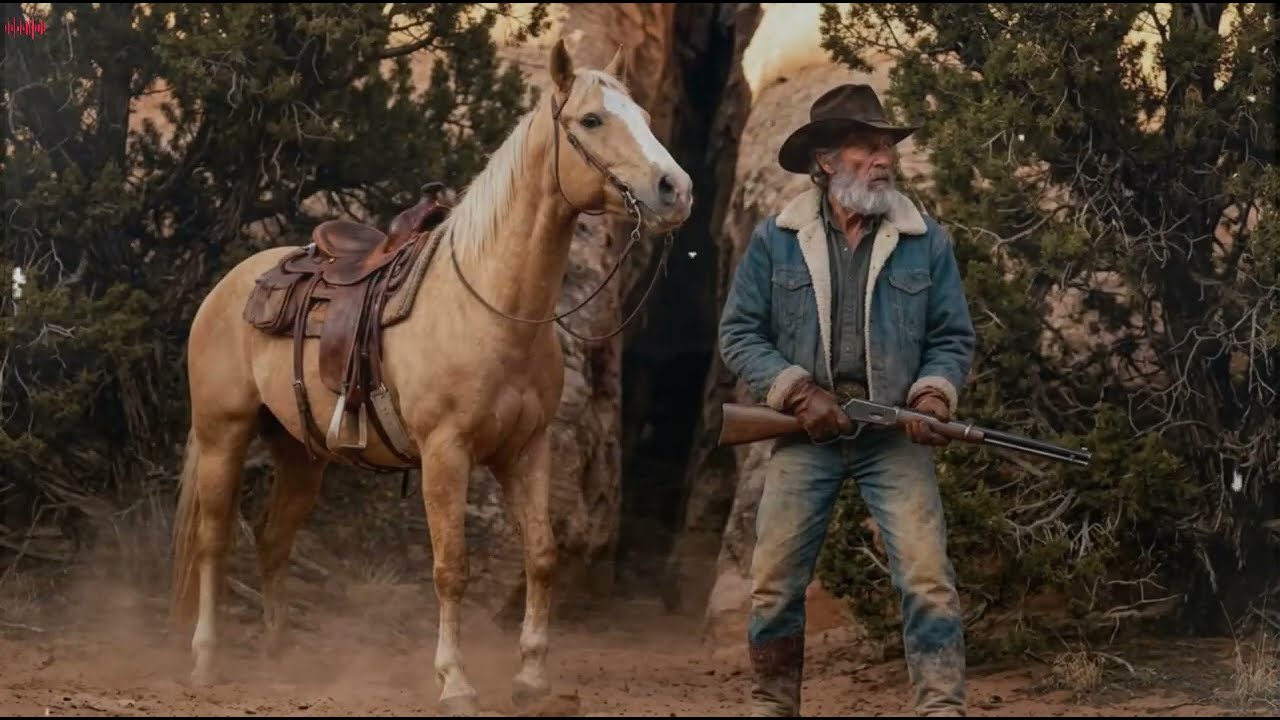
The palomino followed quietly, head down, exhausted. They’d both earned rest. They’d both survived something that should have killed them, Wade by seconds when Garrett fired that rifle, Rustler by whatever miracle had preserved him through auction and neglect to become the bridge between a girl’s past and her future. As they walked through the canyon, Wade thought about Lila’s face when she’d first seen Rustler, the way recognition had broken through four years of carefully constructed lies, the way a horse’s memory had proven more reliable than a
man’s promises. In the distance, he could hear Eden’s mother crying with relief, could hear radios crackling, officers coordinating, vehicles moving. The whole machinery of rescue and recovery grinding into motion. But back here in the shadows, it was just an old rancher and a horse that remembered, walking away from a nightmare that had finally ended.
Rustler whinnied softly. Wade patted the horse’s neck. “Yeah.” Wade said quietly. “We did all right today. We did all right.” They kept Layla and Eden at the county hospital for 3 days. Not because either girl was physically damaged beyond repair. Malnutrition, vitamin deficiencies, atrophied muscles from limited movement, but nothing doctors couldn’t fix with time and proper care.
They kept them because nobody knew how to handle two teenagers who’d spent 4 years believing civilization had collapsed while they ate canned beans in a bunker 50 ft underground. Wade visited on the second day. Brought Rustler in a trailer, parked in the hospital lot, and got stopped by security before he made it through the main entrance.
“Can’t bring livestock on hospital property.” The guard said. “I’m not bringing him inside. Just wanted the girl to see him through a window.” “What girl?” “Layla Mercer.” The guard’s expression changed. Everyone in the county knew about Layla and Eden now. The rescue had made national news. CNNN had run a special.
The FBI was holding press conferences. Black Hollow had transformed overnight from a forgotten desert town into the center of a media storm that showed no signs of stopping. “Let me check.” The guard said, reaching for his radio. 10 minutes later, a nurse led Wade to a third-floor window overlooking the parking lot. Layla stood there in hospital scrubs, thinner than she’d looked in the canyon, dark circles under her eyes.
Her mother stood beside her, Carol Mercer, a woman who looked like she’d aged 20 years in four. Her hand rested on Layla’s shoulder with the kind of touch that said she was still half convinced this was a dream she’d wake up from. “Mr. Colter,” Carol said when Wade approached. “They told me what you did, how you found them.” “Just stumbled into something,” Wade said. “Rustler did the real work.
” “The horse that used to be ours.” Carol’s voice broke. “We sold him after Layla disappeared. Couldn’t afford the feed, couldn’t stand looking at him knowing she’d never ride him again.” “And somehow he ended up with you.” “Sometimes things work out stranger than we expect,” Wade said. Layla was already at the window, pressing her palms against the glass.
Down in the parking lot, Rustler stood in the trailer, head visible over the side panels. The palomino was watching the hospital building like he knew she was in there somewhere. “Can I go down?” Layla asked. “Doctor said you’re not cleared for outside visits yet,” Carol said gently. “Maybe tomorrow.
” “Tomorrow?” Layla said it like she was testing the word. “That’s what Garrett always said. Tomorrow we’ll do this. Tomorrow we’ll do that. Tomorrow never came.” Carol’s hand tightened on her daughter’s shoulder. She didn’t say anything. What could she say? Wade cleared his throat. “I can bring Rustler back tomorrow, day after, however many days it takes.
” Layla turned from the window. “They’re saying I need therapy.” “Counseling.” “That Eden and I both have PTSD and trust issues and a whole list of things wrong with us now.” “Probably do,” Wade said. “Probably normal given what happened.” “But what if I don’t want to be normal?” Layla’s voice rose slightly. “What if I spent four years being told normal didn’t exist anymore, and now everyone expects me to just go back to being a regular 17-year-old girl who worries about homework and college applications?” Carol started to say something, but Wade
spoke first. “Then you don’t,” he said. “You figure out what you can handle and what you can’t, and you take it one day at a time. Nobody who’s been through what you went through is going to be the same person they were before. That’s not failure. That’s survival. Lila stared at him. Did you read that in a therapy book? Nope.
Lost my wife to cancer 5 years back. Spent months having people tell me I needed to move on, get back to normal, stop grieving so hard. Took me a long time to figure out that normal was gone, and I needed to build something new instead. Did you? Lila asked. Build something new? Wade thought about his ranch, the silence, the years of loneliness.
Working on it. Still working on it. A doctor appeared in the doorway. Lila, we need to run a few more tests. Blood work came back with some vitamin levels we want to recheck. Lila nodded, but didn’t move immediately. She looked at Wade. Will you really bring Rustler back tomorrow? I will. Promise? Promise. She finally turned away from the window and followed the doctor down the hall.
Carol stayed behind, watching her daughter disappear around a corner. She won’t talk about most of it, Carol said quietly. What happened down there? What he told them, how she survived. She’ll answer questions about basic facts, where she slept, what she ate, but nothing deeper. Nothing about what she was thinking or feeling.
Give her time, Wade said. Everyone keeps saying that, give her time, give her space, give her patience, but I’m her mother. I should be able to help her, and I don’t know how. Carol’s voice broke. I don’t know how to talk to my own daughter anymore. Wade didn’t have an answer for that. He just stood there while Carol cried quietly, one hand pressed over her mouth like she could hold the grief in if she tried hard enough.
Down in the parking lot, Rustler whinnied. The sound carried through the closed window, muffled but clear. Carol wiped her eyes. Thank you for bringing the horse. It’s the first time I’ve seen her smile since we found her. He’s hers if she wants him, Wade said. Whenever she’s ready. Carol looked surprised. We can’t afford Not asking you to buy him.
Just saying he belongs with her if that’s where he should be. Why would you do that? Wade shrugged. Because a horse chose a girl 4 years ago and never stopped choosing her. Seems wrong to get in the way of that. He left before Carol could respond. Took the elevator down, walked through the lobby past reporters who’d set up camp hoping for interviews, and climbed into his truck.
Rustler shifted in the trailer making the whole vehicle rock slightly. Easy, Wade said through the open rear window. We’ll come back tomorrow. The drive back to his ranch took 30 minutes. The desert looked the same as always, endless sage and rock, sky too big to comprehend, wind that never stopped. But somehow it felt different now.
Less empty. Like something had shifted in a way Wade couldn’t quite name. The media found him on the third day. A reporter from some national outlet parked at the end of his driveway and refused to leave until Wade answered questions about finding the girls. No comment, Wade said. People want to know how it felt to discover them, the reporter pressed.
To be the hero who I’m not a hero. I’m a rancher who got lucky. Now get off my property. The reporter left but two more showed up by evening. Then a TV crew the next morning. Wade stopped answering his door. Let them camp outside if they wanted. He had work to do, fences to fix, cattle to move, a horse to keep exercised because Layla still wasn’t cleared for visitors outside the hospital.
Sheriff Briggs called on the fifth day. FBI wants your full statement, Briggs said. Everything you saw in that bunker, everything Garrett said. They’re building a complete picture of what happened. When? Today if possible. They’re in town for 72 hours before heading back to the field office. Wade drove to the sheriff’s station and spent four hours answering questions from federal agents who recorded everything and showed no emotion.
They asked about the bunker layout, the supplies, Garrett’s exact words, the moment Wade had recognized him. They asked the same questions three different ways, checking for inconsistencies. By the time they finished, Wade felt wrung out. Exhausted in a way that had nothing to do with physical labor. “One more thing,” the lead agent said.
“We’ve been through Garrett Boone’s journals. He documented everything. His reasons for taking the girls, his belief system, his preparations. He truly believed he was saving them from societal collapse.” “That’s supposed to make me feel better?” Wade asked. “No, just explaining the psychology. Garrett wasn’t what we’d typically classify as a predator.
He didn’t abuse them sexually or physically. He fed them, educated them, kept them healthy by his own warped standards. In his mind, he was their protector.” “In his mind,” Wade said flatly. “Meanwhile, in reality, he kidnapped two children and destroyed their families.” “Yes,” the agent agreed. “Reality and delusion don’t always match up.
That’s what makes cases like this so disturbing.” Wade left the station and sat in his truck for 10 minutes, hands gripping the steering wheel, trying to process the idea that Garrett Boone had genuinely believed himself to be a hero right up until the moment officers shot him. Four years of imprisonment, four years of lies, all built on a foundation of absolute conviction that he was doing the right thing.
The hospital released Layla and Eden on the seventh day. Separate reunions, Layla going home with her parents and younger brother to their ranch outside town, Eden returning to her mother’s house closer to the center of Black Hollow. The media covered both like they were royal homecomings. Helicopters filmed the cars pulling up to homes.
Reporters shouted questions that went unanswered. Neighbors hung welcome banners and brought casseroles like food could somehow fix four years of trauma. Wade watched it on the news from his living room and felt sick. These weren’t stories. These were people trying to rebuild lives that had been shattered. He waited 2 weeks before calling the Mercer house.
Carol answered. Mr. Colter, we’ve been meaning to reach out. Not why I’m calling, Wade interrupted. Just wanted to check if Layla was ready to see Rustler. No pressure, just if she’s ready. Silence on the other end. Then Carol’s voice careful. She asks about him every day. But she won’t leave the house yet.
Won’t go outside unless her father or I are with her. The therapist says it’s normal that she needs time to feel safe in open spaces again. I could bring him to you, Wade offered, to your property. Let her see him without having to go anywhere. That would Yes. Thank you. When? Tomorrow morning work? Tomorrow’s perfect.
Wade arrived at the Mercer ranch at 9:00 the next morning with Rustler in the trailer. The property was smaller than Wade’s place. 30 acres, modest house, barn that needed paint. But it was clean, well maintained, the kind of ranch a family built with care over generations. Layla’s father, Tom Mercer, met Wade at the gate. He looked like a man who’d survived a war.
Exhausted relief in his eyes, movements careful like he was afraid everything would shatter if he moved too quickly. She’s inside, Tom said, watching from the window. Been standing there since dawn. Wade backed the trailer into the yard and dropped the ramp. Rustler stepped out carefully, blinking in morning sunlight.
The horse’s ears swiveled toward the house immediately. The front door opened. Layla stepped out onto the porch, barefoot, wearing jeans and an oversized sweater. She’d gained a little weight in 2 weeks, looked less skeletal, but her eyes still held that haunted quality that Wade suspected would take years to fade. Rusty. She said softly.
Rustler’s head came up. He pulled against the lead rope, trying to move toward her. Wade let him go. The palomino crossed the yard at a walk, then a trot, stopping just short of the porch. Layla came down the steps slowly, her mother hovering in the doorway behind her. When Layla reached Rustler, she buried her face in his neck and started crying.
Wade stayed back, giving them space. Tom stood beside him, arms crossed, staring at his daughter and the horse. She loved that animal, Tom said quietly. Before? Used to spend every free minute in the barn with him. When we had to sell him after she disappeared, his voice broke. Felt like we were giving up. Like we were admitting she wasn’t coming home.
You did what you had to do, Wade said. Doesn’t make it feel any better. They watched Layla move around Rustler, running her hands over his coat, checking his legs, touching his face like she was memorizing him all over again. The horse stood perfectly still, patient in the way animals are when they understand something important is happening.
Carol came out of the house carrying a brush. She handed it to Layla without a word. Layla took it and started brushing Rustler’s coat with slow, methodical strokes. Her hands shook at first, then steadied as muscle memory took over. How much? Tom asked Wade. How much what? For the horse. I can’t pay market value right now, but I can make installments.
He’s hers, Wade interrupted, not selling him, just returning him to where he belongs. Tom stared at Wade. That’s a $1,500 horse, minimum. That’s a horse that remembered a girl who loved him. Can’t put a price on that. Mr. Coulter, Wade, and I’m not arguing about this. You want to thank me? Take good care of him and let Layla ride when she’s ready.
Tom’s jaw worked like he wanted to argue, but couldn’t find the words. Finally, he just nodded. They stood in silence while Layla continued brushing Rustler. After a few minutes, her younger brother, Danny, maybe 9 years old, crept out of the house. He was staring at Layla like she was a ghost made solid. “Can I say hi?” Danny asked.
Layla looked up, smiled slightly. “Yeah. Come here.” Danny approached slowly. “I thought you were dead.” “I thought I was too for a while.” “Were you scared?” “Every day.” “Are you still scared?” Layla hesitated. “Sometimes, but less when I’m with Rusty.” Danny reached out carefully and touched the horse’s shoulder.
Rustler turned his head, sniffed the boy, then went back to standing still for Layla’s brushing. “He remembers you,” Danny said. “Mom said horses don’t remember stuff from that long ago, but he does, doesn’t he?” “Yeah,” Layla said. “He does.” Wade cleared his throat. “I should get going. Let you folks have time together.
” “Stay for coffee at least,” Carol called from the porch. “Please? It’s the least we can do.” Wade wanted to refuse, wanted to climb in his truck and drive back to the safety of his ranch where things were simple and nobody expected him to be anything other than a lonely old man with cattle and too much land. But Carol was looking at him with an expression that suggested saying no would hurt her somehow, so he nodded.
“Coffee sounds good.” They sat at the kitchen table, Wade, Tom, and Carol, while Layla stayed outside with Rustler and Danny. Through the window, Wade could see the girl and the horse, both of them settled into something that looked almost like peace. “Therapy’s not going well,” Carol said abruptly. Lila’s therapist says she’s resistant to processing trauma, won’t talk about her feelings, won’t engage with coping mechanisms, just sits there in silence for 50 minutes once a week.
Eden, too, Tom added. Talked to Sarah Vale yesterday. Eden won’t leave her mother’s side, follows her from room to room, sleeps in her bed, can’t stand being alone. They spent 4 years in a bunker being told the world ended, Wade said. Probably takes more than 2 weeks to undo that. The therapist wants to try group sessions, Carol continued.
Get Lila and Eden together so they can support each other, but Lila refuses, says she doesn’t want to see Eden. Why not? Won’t say. Just says she can’t. Wade sipped his coffee. It was terrible, weak and bitter at the same time, but he drank it anyway. Maybe they need different things, different ways of healing.
Eden wants her mother close, Lila wants space to figure things out alone. Or maybe they both need something nobody’s thought to offer yet, Tom said. Wade glanced at him. Like what? Like purpose, like something to do besides sit in therapy sessions talking about feelings. Tom leaned forward. Lila’s not a talker, never has been.
Even before all this, she processed things by doing, working with horses, fixing things, keeping her hands busy. Sitting still and talking about trauma goes against everything she is. Carol looked at her husband. What are you suggesting? I don’t know yet, but keeping her locked in the house except for therapy appointments isn’t helping.
She needs a reason to get up in the morning besides surviving. Wade thought about his own ranch, the years after his wife died, when he’d stopped caring about anything except the basic routines that kept him alive. Feeding cattle, fixing fences, small tasks that built into days that built into years. Not healing, exactly, but surviving until healing became possible.
She could work with horses, Wade said slowly, at my place or here. Exercise them, train them, whatever needs doing. Might help, might not, but it’s something besides therapy. Tom and Carol exchanged glances. We couldn’t pay you, Carol started. Not asking for payment, just offering space if she needs it. Why? Tom asked.
Not suspicious, just genuinely curious. Why do you care what happens to my daughter? Wade set down his coffee cup. Because I found her crying in a bunker and now I can’t stop thinking about whether she’s okay. Because Rustler chose her and that means something. Because I’m 63 years old and spent 5 years being lonely and maybe helping someone else not be lonely is worth the effort.
The honesty surprised even Wade. He hadn’t meant to say all that, hadn’t meant to admit that finding those girls had cracked something open in him that he’d kept sealed shut since his wife died. Carol reached across the table and squeezed Wade’s hand briefly. Thank you for everything. For finding her, for bringing Rustler back, for caring when you didn’t have to.
Wade nodded, not trusting his voice. Outside, Layla had stopped brushing. She was just standing next to Rustler now, forehead pressed against the horse’s neck, both of them still in the morning sun. The weeks that followed established a pattern. Wade would bring Rustler to the Mercer Ranch three times a week.
Layla would groom him, walk him around the property, gradually start riding again. Short rides at first, just circles in the yard, then longer ones, out to the fence lines, through the arroyos. She didn’t talk much during those sessions, mostly worked in silence while Wade checked fence posts or helped Tom with whatever needed doing on the property.
But slowly, bit by bit, Layla started looking less like a person trapped in their own head and more like someone remembering how to exist in the world. Eden’s recovery went differently. She started attending a support group for trauma survivors, started seeing a therapist who specialized in captivity cases. Her mother reported progress.
Eden was sleeping in her own room now, could be alone for short periods without panic attacks. But Eden and Lila still hadn’t seen each other since the hospital. Every time Wade asked about it, Lila would change the subject or walk away. Six weeks after the rescue, Wade was at the Mercer Ranch when Sheriff Briggs called.
“Got something you should know,” Briggs said. “FBI finished their investigation into Garrett Boone. Full report just came out. And?” “He’d been planning this for at least a decade. Had three other bunkers built in different locations before he settled on Blackstone Canyon. Was on watch list for survivalist extremist groups.
Had been flagged by federal agents twice for stockpiling supplies, but nothing illegal enough to warrant arrest.” Wade’s stomach turned. So they knew he was dangerous. “They knew he had extreme views. Didn’t know he’d act on them.” “That’s supposed to make it better?” “No. Just explaining how it happened. How a man like that could operate in plain sight for years while everyone trusted him.
” Briggs paused. “There’s more. Garrett kept detailed journals about why he chose Lila and Eden specifically. Not random selections. He’d been watching them for months. Why those two? Lila because she was isolated, rode alone frequently, predictable patterns. Eden because she played in an unfenced yard. He chose victims based on opportunity and vulnerability.
Then he positioned himself as the hero searching for them so nobody would suspect him.” Wade closed his eyes. “Does Lila know this?” “FBI’s recommending families be informed. Part of the healing process, they say. Understanding it wasn’t their fault.” “Their fault?” “How could anyone think trauma makes people blame themselves,” Briggs said.
Survivors think they should have seen warning signs, should have fought harder, should have done something different. FBI wants to make clear that Garrett engineered every aspect of this. The girls had zero chance of preventing what happened. After hanging up, Wade found Layla in the barn grooming Wrestler for the second time that day.
She looked up when he approached. “Something wrong?” she asked. “FBI finished their investigation into Garrett. Full report’s out.” Layla’s hands stilled on the brush. “And?” “He’d been planning this for years, watching you before he took you, chose you specifically because because I was easy to take,” Layla finished. “I know. I figured that out already.
” “It wasn’t your fault.” “Everyone keeps saying that.” Layla went back to brushing. “My therapist, my parents, the FBI agents who interviewed me, like if they say it enough times I’ll believe it. You don’t believe it?” “I believe Garrett was crazy. I believe he would have taken someone even if it wasn’t me. I believe a lot of things.
” She set the brush down. “What I can’t believe is that I survived 4 years in a hole in the ground and came out the other side. That’s the part that doesn’t make sense.” “What do you mean?” “I mean I should be more broken than I am. I should be non-functional, traumatized beyond repair. That’s what everyone expects.
They look at me like I’m made of glass, waiting for me to shatter.” Layla stroked Wrestler’s neck. “But I’m not shattering. I’m just existing, getting up every day, brushing this horse, eating meals, sleeping. Like my brain decided survival mode is permanent now.” “That’s not a bad thing,” Wade said. “Isn’t it? Shouldn’t I be falling apart? Shouldn’t I be processing and grieving and doing all the things they say I need to do to heal?” “Maybe healing looks different for everyone.
” Layla turned to face him fully. “Do ever think about her? Your wife? The subject change caught Wade off guard. Every day. Does it get easier? No, just different. The sharp edges dull down enough that you can handle them without bleeding. That’s what I’m afraid of, Lila said quietly. That four years in that bunker will dull down until it’s just something that happened to me instead of something that defined me.
And then, who am I? Wade didn’t have an answer for that. He just stood there in the barn while a 17-year-old girl asked questions that would take years to answer. Eden wants to see me, Lila said abruptly. Her therapist called mine, said it would be good for both of us to meet. Process together. What do you think? I think I spent four years with Eden in that bunker.
And I don’t want to spend another second looking at someone who reminds me of everything we lost. That’s fair. Lila looked surprised. You’re not going to tell me I should do it anyway? That it’s part of healing? Not my place to tell you what healing looks like. She smiled slightly. You’re not like other adults.
Most other adults probably have better ideas than I do. Doubt it. They worked in comfortable silence for a while. Lila grooming Rustler, Wade replacing a broken hinge on the barn door. The afternoon sun slanted through gaps in the walls, painting stripes across straw and dust. Tom appeared in the doorway. Wade, got a minute? They walked back to the house, leaving Lila with Rustler.
In the kitchen, Carol was making dinner while Danny did homework at the table. We’ve been talking, Tom said. About what comes next for Lila. She’s supposed to return to school in two weeks, but we don’t think she’s ready. Probably not, Wade agreed. So, we’re considering alternatives. Homeschooling, online classes, something that lets her move at her own pace.
Tom hesitated. But she needs more than academics. She needs purpose, something to work toward that isn’t just recovering from what happened.” Wade waited. “We were thinking about horses,” Carol said. “Not just riding, training, rehabilitating, working with animals the way she used to before. But we don’t have the resources or knowledge to set that up properly.
” “You want my help?” Wade said. “We want to know if you’d be willing to mentor her, teach her what you know about training horses, breaking difficult animals, rehabilitation work.” Tom met Wade’s eyes. “We can’t pay you. But if there’s any other arrangement” “Stop talking about payment,” Wade interrupted.
“If Lila wants to learn, I’ll teach her. Simple as that.” Carol’s eyes filled with tears. “You’ve already done so much.” “And I’ll do more if it helps. That girl deserves a chance to build something besides trauma. If horses are what she wants, then horses are what she’ll get.” Two days later, Lila started showing up at Wade’s ranch three mornings a week.
He taught her how to assess an animal’s temperament, how to establish trust with horses that had been abused or neglected, how to read body language that spoke louder than words. She was a quick learner, patient, and careful with instincts that couldn’t be taught. And slowly, week by week, the haunted look in her eyes began to fade.
Not disappearing entirely, Wade suspected it never would, but softening enough that she could smile occasionally without it looking painful. The rescue had changed Black Hollow, too. The town that had spent four years grieving now had to learn how to celebrate recovery without forgetting the cost. Families that had pulled apart began reconnecting.
People started talking to each other again, helping neighbors, rebuilding the community that Garrett Boone’s crime had fractured. But underneath the relief, something darker festered. The realization that evil had walked among them wearing a hero’s face. That they’d all been fooled. The trust itself had become a complicated thing requiring scrutiny and doubt.
Wade felt it every time he went to town for supplies. The way people looked at each other differently now, the way parents watched their children with heightened awareness, the way Black Hollow had learned the lesson that safety was an illusion and monsters didn’t always announce themselves. 3 months after the rescue, Wade stood in his barn watching Lila work with a traumatized mare someone had dropped off after reading about the Mercer girl who was training horses again.
The mare was skittish, underfed, covered in rope burns. Lila approached slowly, speaking in low tones, offering grain on an open palm. The mare hesitated, then stepped forward and took the grain. Lila smiled, a real smile this time, reaching her eyes. And Wade thought maybe healing wasn’t about forgetting or moving on or any of the things people said it was supposed to be.
Maybe healing was just finding moments where survival turned into something that looked almost like living. 6 months after the rescue, spring finally arrived in Black Hollow with the kind of warmth that made winter feel like something that had happened to different people in a different lifetime. The desert transformed overnight, wildflowers erupting from cracked earth, sage turning green at the tips, even the wind losing its sharp edge.
Wade woke early on a Saturday morning to find Lila already in his barn working with the traumatized mare they’d named Penny. The horse had arrived 3 weeks earlier, too thin and too scared to let anyone close. Now Penny stood while Lila brushed her coat, still nervous but no longer bolting at sudden movements. “You’re here early,” Wade said.
“Couldn’t sleep.” Lila didn’t look up from her work. “Thought I’d get a head start on feeding.” Wade studied her. She’d gained weight, filled out to something closer to healthy. Her hair had grown longer, pulled back in a ponytail that made her look younger than 17. But her eyes still carried that knowledge, the understanding that terrible things could happen to ordinary people and nobody would stop it in time.
Something on your mind? Wade asked. Lila set down the brush. My parents want to sell the ranch. What? Too many memories they said. Too hard to look at the property where Garrett used to come visit when he was pretending to search for me. They want a fresh start somewhere new. She ran her hand down Penny’s neck.
Somewhere that doesn’t remind them of what they lost. What about what they found? Wade said. Your home. That’s supposed to count for something. I think that’s part of the problem. I’m home, but I’m not the same girl who disappeared. They keep looking at me like they’re waiting for the old Lila to come back and she’s not coming back because she doesn’t exist anymore.
Wade leaned against the stall door. Where would they move? California maybe. Oregon. Somewhere with more rain, less desert. They asked what I thought. Lila finally looked at Wade. I don’t want to leave. Tell them that. I did. They said I need to think about my future, about college, about building a life that isn’t defined by what happened. She laughed bitterly.
Like I can just move to California and become a normal teenager who worries about boys and SAT scores. What do you want? Wade asked. I want to work with horses. I want to help animals that have been hurt. I want to wake up every morning and know that what I’m doing matters. Lila paused.
Is that crazy? To know exactly what I want at 17? No crazier than anything else. They worked in silence for a while, feeding horses, mucking stalls, doing the repetitive work that made ranching both meditation and punishment depending on the day. Around 9:00, Tom Mercer’s truck pulled into the driveway. Tom found them in the barn.
He looked tired, older than his 48 years, like the The had aged him in ways that wouldn’t reverse. Lila, we need to talk, Tom said. I’m working. It’s important. Lila set down the feed bucket with more force than necessary. If this is about moving again, it’s about Eden, Tom interrupted. Sarah Vale called this morning. Eden’s in the hospital.
The words hung in the air like smoke. Wade watched Lila’s face go carefully blank, the way it did when something hit too close to feelings she couldn’t afford to have. What happened? Lila asked. Panic attack that wouldn’t stop. She’s been having more of them lately, getting worse. Last night she couldn’t breathe, thought she was dying. Sarah took her to emergency.
Tom rubbed his face. Doctors are keeping her for observation, running tests to make sure it’s not physical. It’s not physical, Lila said quietly. It’s everything else. Sarah asked if you’d visit, said Eden keeps asking for you. No. Lila? I said, “No.” Lila’s voice hardened. I can’t help Eden. I can barely help myself.
You spent four years together. Exclusively. Four years in hell. Why would either of us want to relive that by looking at each other? Tom looked at Wade helplessly. Wade shook his head slightly. Not his fight. She’s alone, Tom said to Lila. Eden’s mother is trying. Therapists are trying, but she’s alone inside whatever Garrett did to her head.
And you’re the only person who understands what that feels like. Understanding doesn’t fix anything, Lila said. Maybe not, but it’s better than isolation. Lila turned away, arms crossed. I’ll think about it. Tom knew better than to push. He said goodbye to Wade and left, his truck kicking up dust on the gravel driveway. Lila stayed in the barn, standing motionless in the doorway, staring at nothing.
Wade gave her space, went to check fence lines in the north pasture, giving Layla time to process whatever she was processing. When he returned 2 hours later, she was gone. Left a note on his truck windshield written in careful handwriting. Thanks for letting me hide here. See you Monday.
The hospital visit happened 3 days later, though Wade only learned about it afterward. Layla showed up at his ranch on Monday morning looking exhausted, like she hadn’t slept. “I went to see Eden,” Layla said without preamble. “Yesterday afternoon.” Wade nodded, waiting. “She’s a mess, worse than me. Can’t sleep, can’t eat, jumps at every sound.
The doctors want to put her on medication, but Sarah’s worried about side effects.” Layla sat heavily on a hay bale. “We talked for maybe 10 minutes before I had to leave. I couldn’t handle it.” “What did you talk about?” “The bunker, mostly. What we remember, what we’re trying to forget. Eden asked if I still have nightmares about Garrett. I said yes.
She said she does, too, but in her nightmares, he’s still alive and he’s coming back for us.” Wade felt something cold settle in his chest. “What did you tell her?” “That he’s dead. That we watched them shoot him. That there’s no coming back from that.” Layla picked out a strand of hay. “But she doesn’t believe it, not really.
Part of her is still waiting for him to walk through the door and tell us it was all a test, that the real collapse is coming and we need to go back underground. That’s not rational.” “Nothing about this is rational.” Layla’s voice rose slightly. “We spent 4 years being told the world ended, and even though we know it was lies, our brains still believe parts of it.
Eden can’t shake the feeling that something terrible is about to happen, and honestly, neither can I.” “What are you afraid of?” Wade asked. “Everything. Nothing. I don’t know.” Layla stood, started pacing. “I’m afraid of staying in Black Hollow, where everyone knows what happened to me. I’m afraid of leaving because at least here people understand.
I’m afraid of getting better because what if getting better means forgetting what Garrett did and letting him win posthumously? I’m afraid of She stopped breathing hard. Of what? Wade prompted gently. Of being this forever. This broken, suspicious person who can’t trust anyone and can’t believe in good things because good things get taken away.
Wade let the words settle. Then he said, “You know what I think?” “What?” “I think Garrett took 4 years from you, but he doesn’t get to take the rest of your life unless you let him.” “That’s easier said than done.” “Everything worth doing is easier said than done.” Lila almost smiled. “Did you read that on a coffee mug?” “Probably.” “Point stands.
” She sat back down on the hay bale, some of the tension leaving her shoulders. “Eden asked if we could meet regularly. Not therapy sessions with counselors watching, just the two of us talking about whatever needs talking about.” “What did you say?” “I said I’d think about it.” Lila looked at Wade. “Would that be crazy?” “Two traumatized teenagers trying to fix each other?” “Might be the sanest thing either of you could do,” Wade said.
“Sometimes the only people who understand are the ones who survived the same thing.” Over the following weeks, Lila and Eden started meeting once a week at neutral locations. The park, the library, eventually at Wade’s ranch where they could work with horses while talking. Wade stayed out of their way giving them space but remaining available if needed.
He watched them gradually shift from awkward silence to tentative conversation to something that looked almost like friendship rebuilt from the ashes of shared trauma. They didn’t talk about Garrett much, Wade noticed. Mostly they talked about what came next, what they wanted their lives to look like, how to exist in a world that felt both familiar and alien.
Eden was worse off than Lila in most ways. More nightmares, more panic attacks, more difficulty functioning day-to-day. But she had something Lila didn’t, a willingness to be vulnerable, to ask for help, to admit when she was drowning. Lila kept everything locked down tight, only showing cracks when she thought nobody was watching.
Wade recognized it because he’d done the same thing after his wife died, built walls so high that nobody could reach the grief inside, then wondered why loneliness felt permanent. One afternoon in late spring, Wade found both girls in his barn working together to halter train a young colt someone had brought in for rehabilitation.
The colt was skittish, orphaned young, and handled badly afterward. Eden held the lead rope while Lila slowly approached with the halter. “Easy,” Lila murmured. “Nobody’s going to hurt you.” The colt’s ears flicked back and forth, uncertain. Lila stopped moving, letting the animal come to her. After a long moment, the colt stretched his neck forward and sniffed her hand.
“Good,” Eden said quietly. “He’s trusting you.” “He’s deciding whether to trust me,” Lila corrected. “Trust takes longer.” Wade watched them work. Two girls who’d been through hell helping an animal who’d been through his own version of the same thing. There was something poetic about it, though Wade would never say that out loud.
Poetry wasn’t his language. Action was. Which was why that evening, after both girls had gone home, Wade made a phone call to Tom Mercer. “I’ve got a proposition for you,” Wade said. “About the ranch.” “We’re still planning to sell, Dete.” “I know, and I’m planning to buy.” Silence on the other end.
Then Tom said, “Wade, you already have a ranch.” “I do, but I’m 63 years old with more land than I can work alone and no family to pass it to. Your place borders mine on the south side. Makes sense to combine them. Wade paused. But I want Layla to run the horse operation. Training, rehabilitation, whatever she wants to do with it.
Full partnership when she turns 18, assuming she wants it. That’s That’s incredibly generous. It’s practical. Girl’s got a gift with animals. Waste of potential to have her doing anything else. Wade leaned back in his chair. Plus, gives her a reason to stay in Black Hollow if she wants to. A future that isn’t about running away or trying to forget.
Tom was quiet for a long moment. I need to talk to Carol. And Layla. Talk to them. But Tom, your daughter knows what she wants. Maybe trust that she’s old enough to make her own decisions about what her life looks like. Even if those decisions are influenced by trauma. All our decisions are influenced by something, Wade said.
At least hers come with purpose. The conversation with Layla happened two days later. Wade laid out his proposal while they worked side by side fixing a broken fence post. You’re offering me a partnership? Layla asked, disbelief evident in her voice. I’m offering you a future doing what you’re good at. Details can be worked out later, but the basic idea is solid.
You train horses, I handle cattle, we build something together. Why would you do this? Wade hammered another nail into the post. Because you’re good at this work, and it’d be a shame to waste that. Because I need help managing two properties. Because maybe we both need something to build toward that isn’t about surviving what already happened.
Layla set down her tools. My parents think I should go to college, get a degree, become something respectable. You can be respectable and work with horses. They think I’m limiting myself. Are you? Wade asked. Or are you the only one who knows what you actually need? Layla didn’t answer immediately. She looked out across the desert at the fence line stretching toward distant mesas, at the sky so big it made human problems feel small by comparison.
I don’t know how to explain it to them, she said finally. That working with horses isn’t me giving up on a normal life. It’s me finding the only life that makes sense after everything that happened. Then tell them that. Use those words. What if they don’t understand? They’ll understand eventually, or they won’t, but it’s still your life to live.
Lila smiled slightly. You’re not like most adults. Thank God for that. The decision took another month of family discussions, arguments, tears, and eventual acceptance. Tom and Carol agreed to sell their ranch to Wade with the understanding that Lila would have full control over the horse training operation once she turned 18.
In the meantime, she’d work under Wade’s supervision, learning the business side of ranching alongside the animal handling she already excelled at. Eden’s path went differently. She decided to leave Black Hollow, enrolling in a residential treatment program in Arizona that specialized in trauma recovery. It was voluntary, not forced, and she made the decision herself after months of struggling to function in the town where she’d been taken.
I need to be somewhere that doesn’t know my story, Eden told Lila during their last meeting before she left. Somewhere I can be just a person instead of the girl who was rescued. They were sitting in Wade’s barn, both holding lead ropes attached to horses they’d been working with. Lila understood. Part of her wanted to leave, too, to escape the weight of everyone’s expectations and concerns.
Will you come back? Lila asked. I don’t know. Maybe. Depends on who I turn into when I’m not being reminded of what happened every day. Eden paused. Does that make me a coward? Makes you smart, Lila said. Knowing what you need is smart. You’re staying, though. Yeah. Because of the horses? Because of a lot of things.
The horses weighed the work. Because leaving feels like letting Garrett win. Lila stroked her horse’s neck. He wanted to cut us off from the world, make us believe home didn’t exist anymore. Staying here, building something here, it proves he was wrong. Eden smiled sadly. You’re braver than me. I’m not brave. I’m just stubborn.
Same thing sometimes. They hugged goodbye at the bus station, two girls who’d survived hell together and were now choosing different paths forward. Sarah Vale cried. Tom and Carol Mercer cried. Eden cried. Lila didn’t cry until later, alone in Wade’s barn with Rustler, letting the tears come where nobody could see them.
Summer arrived hot and relentless. The combined ranch operation took shape slowly. Paperwork filed, boundaries established, business plans drawn up with help from a lawyer Tom knew. Lila worked six days a week learning everything Wade could teach her about managing land, handling difficult animals, running a business that required both patience and pragmatism.
She was good at it, better than good. Had instincts for horses that Wade had seen maybe twice in his entire life. The ability to read an animal’s mood from tiny signals, to know when to push and when to wait, to establish trust with creatures that had every reason to distrust humans. Word spread. People started bringing horses from three counties over.
Animals with behavioral problems or trauma histories, horses that needed patience more than discipline. Lila worked with each one methodically, never rushing, never giving up. Her success rate was remarkable. By August, they had enough business to justify hiring help. Wade brought in a teenager from town, Marcus Chen, 18 years old, looking for work before college.
Marcus was quiet, competent, asked good questions, and followed instructions without needing his hand held. Watching Lyra teach Marcus how to approach a frightened horse made Wade realize something. She wasn’t just surviving anymore. She was building. Creating something from the wreckage of what had been taken from her.
One evening in early September, almost a year after the rescue, Wade found Lyra sitting on the fence rail watching the sunset over the desert. Rustler stood nearby grazing peacefully. “Penny got adopted today.” Lyra said as Wade approached. “Family from Phoenix, nice people, teenage daughter who wanted a project horse.
You did good work with her.” “She did good work trusting again.” Lyra was quiet for a moment. “You ever think about how much time we waste being afraid of things that haven’t happened yet?” “All the time.” Wade said. “Garrett had us convinced the world was ending. Every day underground we waited for the collapse he promised was coming.
Riots, plagues, societal breakdown. None of it happened, but we spent four years living like it was real.” She turned to look at Wade. “How much time did I waste being afraid of something that wasn’t true?” “It was true to you at the time, that’s what mattered.” “But it wasn’t real.” “And now I’m out here watching the sunset on a world that’s still standing, still functioning, still offering chances for people to build things.
” Lyra paused. “Eden called yesterday from Arizona. She’s doing better, sleeping through the night, making friends, working with a therapist who actually helps.” “That’s good.” “She asked if I was happy.” Wade waited. “I didn’t know how to answer.” Lyra continued, “because I’m not happy the way I was before.
That kind of innocent happiness doesn’t exist for me anymore. But I’m not miserable either. I’m something else, something that doesn’t have a name yet.” “Content maybe.” Wade offered. “Maybe.” Lyra smiled slightly. “Is that enough? Being content after everything? Being content is more than most people manage. I’d say it’s plenty.
They sat in silence while the sun painted the sky in shades of orange and purple. Rustler wandered over and nudged Layla’s leg looking for attention. She scratched behind his ears absently. You know what the weirdest part is? Layla said. I’m grateful. For what? For all of it. For Garrett taking me, for the four years underground, for the terror and confusion and all the bad parts.
She held up a hand before Wade could object. I know how that sounds. But hear me out. If none of that happened, I’d be a normal 21-year-old right now, probably in college studying something I didn’t care about, dating guys I didn’t like, trying to figure out who I was supposed to be. Instead, I already know.
I know exactly who I am and what I want and what matters to me. You’re saying Garrett did you a favor? No. What he did was evil. But the person I became because of it, the person who can help traumatized horses and understand fear and work harder than anyone because I already survived the worst thing I could imagine. That person has value.
That person matters. Wade felt something tighten in his chest. You would have mattered either way. Maybe. But I wouldn’t have known it. Layla hopped down from the fence. I need to check on the colt before dark. Thanks for listening to my philosophical rambling. Anytime. Wade watched her walk toward the barn, Rustler trailing behind her like a guardian.
The girl and the horse that had found each other across impossible odds, both of them carrying scars that would never fully heal, but learning to live with them anyway. That was the thing about survival, Wade realized. It wasn’t about erasing what happened or returning to who you were before. It was about building something new from the pieces that remained, finding purpose in the wreckage, choosing to matter even when everything told you that you shouldn’t.
3 months later in December, they held the official opening of what they decided to call Silver Wind Ranch, a name Layla had chosen because it sounded like hope and movement and possibility all at once. The event was small, just family and a few friends, nothing like the media circus that had followed the rescue. Tom and Carol came looking more settled now that the decision had been made and their daughter was thriving.
Danny came and spent the entire time in the barn with Marcus asking endless questions about horses. Sarah Vale made the drive from Arizona with Eden, who looked healthier than Wade had ever seen her. Weight restored, color in her face, eyes that didn’t constantly scan for danger. Sheriff Briggs stopped by bringing his wife and two kids.
Wade was surprised to see him out of uniform, smiling, looking almost relaxed. “Heard you’re doing good work out here,” Briggs said to Layla. “Trying to,” Layla replied. “More than trying. You’ve got three waiting lists for training spots. People calling my office asking for your contact info because they heard about the girl who rehabilitates broken horses.
” Briggs smiled. “Black Hollow needed some good news. You’re giving it to them.” After the guests left and the sun started setting, Wade found Layla and Eden standing together near Rustler’s paddock. They were talking quietly, hands resting on the fence rail, looking at peace in a way Wade hadn’t seen before. “Don’t miss it,” Eden was saying, “the bunker, I mean.
But I miss who we were together down there. The way we took care of each other when nobody else existed.” “We can still take care of each other,” Layla said, “just in sunlight instead of darkness.” “Yeah,” Eden smiled, “I like the sunlight better.” Wade started to turn away, give them privacy, but Layla called out to him.
“Wade, come here.” He approached. Both girls were looking at him with expressions he couldn’t quite read. We were talking, Eden said, about what we learned from everything that happened. And what did you learn? Wade asked. That monsters exist, Layla said. But so do people who stumble into canyons and bring horses back and offer partnerships to traumatized teenagers because they believe in second chances.
That heroes aren’t always who you expect, Eden added. Sometimes they’re 63-year-old ranchers who just refuse to give up. Wade felt his throat tighten. I’m not a hero, just did what anyone would do. That’s what heroes always say, Layla said. But here’s the thing, Wade. Most people wouldn’t have followed Rustler into that canyon.
Most people wouldn’t have risked getting shot to bring a horse to a bunker entrance. Most people wouldn’t have offered everything you’ve offered without asking for anything back. You’re giving me too much credit. We’re giving you exactly the right amount of credit, Eden interrupted. You saved our lives, not just by finding us, but by reminding us that the world still had good people in it.
That not every adult was lying. That trust was still possible even after it had been broken. Wade didn’t know what to say. He stood there, an old rancher who’d spent five years being lonely and the last year discovering that purpose could find you even when you’d stopped looking for it. Thank you, he finally managed, for letting me be part of your recovery.
You’re not part of it, Layla said. You’re the foundation it’s built on. They stood together watching the desert turn purple in the fading light. Rustler grazed nearby, occasionally lifting his head to check on Layla like he’d been doing for the past year. Other horses moved in their paddocks, rehabilitated animals waiting for adoption, new arrivals learning to trust again.
In the distance, Black Hollow spread across the desert floor, a small town that had survived grief and betrayal and learned that healing wasn’t linear or neat, but messy and complicated and worth fighting for anyway. Wade thought about the morning he’d ridden fence lines and stumbled into a nightmare. About the moment he’d seen Layla holding a water bucket with terror in her eyes.
About Garrett Boone, who’d believed himself to be a savior while being the villain of every story he touched. But mostly Wade thought about what came after. About two girls who refused to let trauma define them. About a community that slowly rebuilt trust. About a horse that remembered love across years of separation.
About the strange and unexpected ways that broken things could be made whole again if enough people cared enough to try. Eden left the next morning, headed back to Arizona and the life she was building there. Before she climbed into Sarah’s car, she hugged Layla tightly. “Come visit.” Eden said. “I will.” “Promise?” “Promise.
” They held each other for a long moment. Two survivors who understood that healing took different shapes for different people and both paths were valid. After they left, Layla found Wade in the barn. “I’ve been thinking.” she said, “About expansion. There are kids like me and Eden who need places to go, things to do, ways to heal that aren’t just therapy sessions and medication.
What if we built something for them here? A program where traumatized kids could work with traumatized horses. Both of them helping each other recover.” Wade considered. “That would take funding, resources, probably some kind of nonprofit structure. But it’s possible. Anything’s possible if you want it badly enough.
” Layla smiled. “Then let’s make it possible.” Over the following year, that’s exactly what they did. Applied for grants, filed paperwork, built additional facilities with help from volunteers who remembered what Black Hollow had lost and wanted to contribute to what it was building. By the second anniversary of the rescue, Silverwind Ranch had become something bigger than a horse training operation.
It was a recovery center, a second chance facility, a place where broken things, animals and people alike, could learn to be whole again. The first group of kids arrived in August, six teenagers from across the state, all carrying trauma of different kinds. Lila worked with them the same way she worked with horses, patient, firm, never pushing too hard, but never accepting defeat, either.
Wade watched it all come together and felt something he hadn’t felt in years. Not happiness, exactly. Something deeper than that. The knowledge that his life had mattered, that the random choices he’d made, buying a neglected horse at auction, following that horse into a hidden canyon, offering partnership to a traumatized girl, had rippled outward in ways he never could have predicted.
On a clear September evening, Wade sat on his porch watching the sunset. Rustler and Lila were in the arena, working with a new arrival, a mare someone had abandoned after she’d kicked a handler. Lila moved slowly, speaking in low tones, giving the mare space to decide trust was possible. Carol Mercer’s words from a year ago echoed in Wade’s memory.
“Thank you for caring when you didn’t have to.” But that was the thing, Wade realized. He did have to care. Not because anyone forced him, but because caring was what made survival turn into living. Because isolation was safe, but connection was what gave life meaning. Because somewhere between finding two girls in a bunker and building a ranch that helped traumatized kids heal, Wade had learned that the opposite of loneliness wasn’t company.
It was purpose. The desert wind picked up, carrying the smell of sage and dust and possibility. In the arena, the frightened mare took a tentative step toward Lila. The girl smiled, waiting, letting the animal come to her. And Wade understood that this was the lesson Garrett Boone had never learned.
The trust couldn’t be forced or faked or manufactured through fear. It had to be earned, rebuilt, chosen every single day by people and animals who decided that risk was worth taking if it meant not being alone. The mayor took another step. Then another. Finally stood close enough for Lila to touch her muzzle. In that moment, watching a girl who’d survived the unthinkable teach a horse to trust again, Wade felt something like peace settle over him.
Not the absence of pain. He’d always carry the weight of his wife’s death. Always remember the terror of that morning in Blackstone Canyon. But the presence of meaning. This was what healing looked like. Not perfect, not smooth, but real. A ranch where broken things learned to be whole. A girl who’d turned trauma into purpose.
A horse that had bridged past and future with nothing but instinct and love. A community that had survived evil and chosen to rebuild rather than collapse. And an old rancher who’d stumbled into someone else’s nightmare and discovered that heroism wasn’t about being fearless. It was about caring enough to act even when you were terrified.
To offer hope even when you’d lost your own. To believe that tomorrow could be better than yesterday if enough people refused to give up. Wade stood, joints cracking, and walked toward the arena. Lila saw him coming and smiled. “Want to help?” she called. “Always,” Wade said. And together, under a desert sky that had witnessed tragedy and triumph, they worked with a frightened horse until she wasn’t frightened anymore.
Just another animal learning that the world still had safe places. That trust was still possible. That even the most broken things could find their way back to something that looked like home. The wind carried the sound of their voices across empty land. And if anyone had been listening, they might have heard the sound of healing happening in real time. Not perfect.
Not easy. But happening anyway, one careful step at a time.