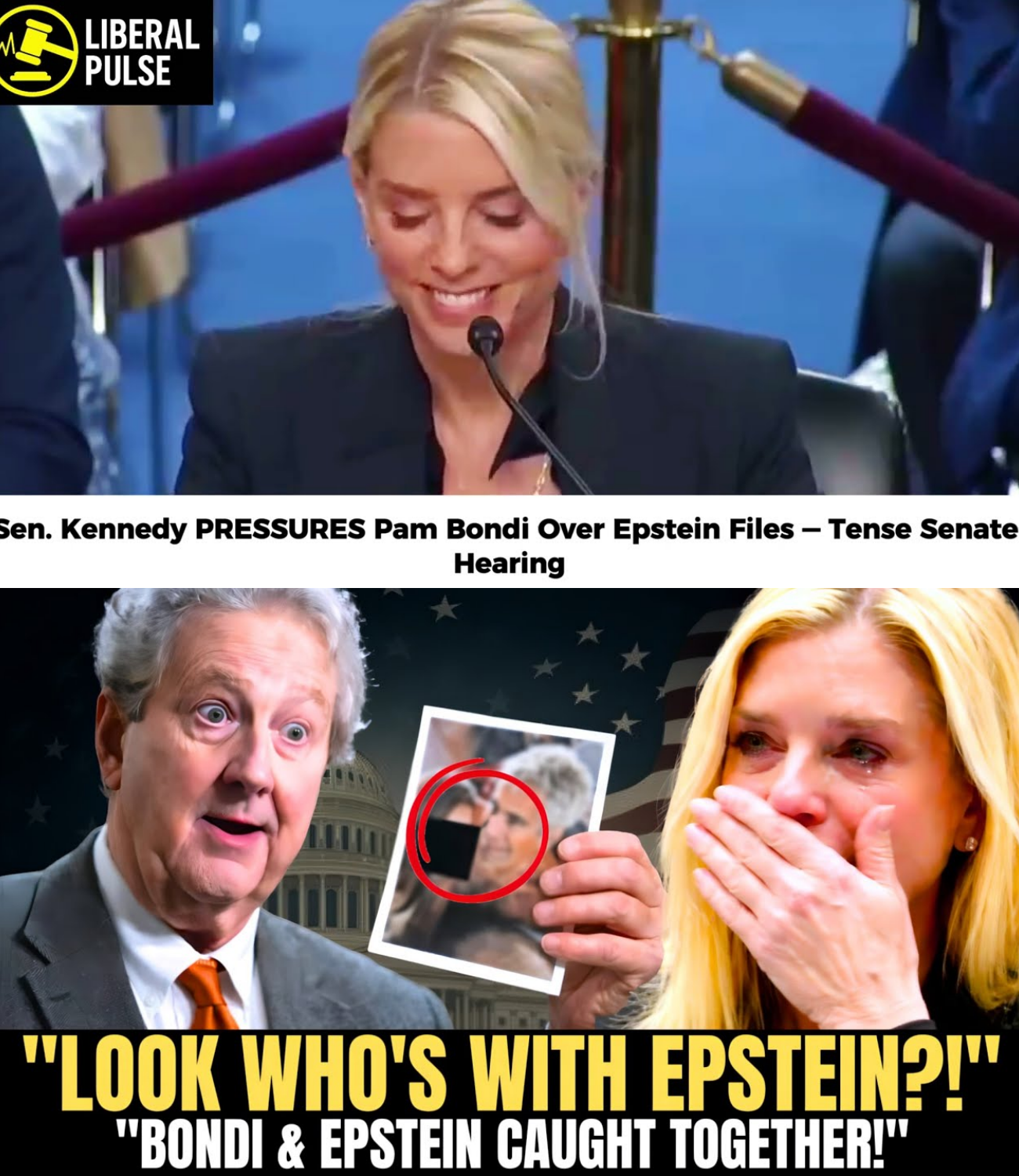
A Tense Confrontation on Capitol Hill
What began as a routine Senate hearing quickly transformed into one of the most high-stakes interrogations in recent memory. As Attorney General Pam Bondi sat before the committee, the atmosphere shifted instantly when Senator John Kennedy began a line of questioning that pierced through the typical political decorum. The subject was the lingering, dark cloud of the Jeffrey Epstein scandal—a case that has haunted the American justice system for years and continues to leave the public demanding answers that remain perpetually out of reach.
For many Americans, the Epstein case is not just a historical criminal file; it is a symbol of a justice system that often seems to shield the powerful while leaving victims in the dark. During this hearing, Senator Kennedy sought to confront that perception head-on, focusing on claims that could reframe our entire understanding of the scandal.
The Allegation of a “Greatest Blackmailer”
The core of Kennedy’s questioning revolved around recent comments made by Commerce Secretary Howard Lutnik. In a prior interview, Lutnik, who lived next door to Epstein for years, described the late financier not merely as a criminal, but as the “greatest blackmailer ever.” Lutnik alleged that Epstein’s entire method of operation involved drawing influential men into private settings—specifically massage rooms—where their actions were secretly recorded to secure leverage.
Senator Kennedy pressed Attorney General Bondi on whether the Department of Justice had taken the steps to interview Lutnik regarding these claims. The response was telling: Bondi had not reviewed the full transcript, only a brief clip, and confirmed that no interview with Lutnik had taken place. When Kennedy asked if the DOJ planned to reach out to him, Bondi provided a conditional response, suggesting that such a conversation could only happen if both parties were willing. To those watching, this felt less like an active investigation and more like a passive wait-and-see approach, deepening the frustration of those who believe the full extent of Epstein’s network has never been fully exposed.
The Question of Congressional Subpoenas
The hearing took an even more dramatic turn when Senator Kennedy pivoted to a “hypothetical” scenario that hit remarkably close to home. He asked the Attorney General to walk through the legal process of investigators obtaining phone records of a sitting United States Senator. He meticulously detailed the steps: the necessity of probable cause, the involvement of a judge in approving the subpoena, and the role of telecommunications companies in protecting their clients’ privacy.
Kennedy’s line of questioning eventually suggested that this was not entirely hypothetical. He alluded to reports indicating that federal investigators had accessed sensitive communications tied to as many as eight sitting U.S. Senators. When he asked if Bondi possessed the copies of these subpoena applications, she declined to provide any details, citing the need to avoid discussing potentially active or sensitive investigations.
The Senator highlighted a crucial point: if major telecommunications companies turned over the private records of sitting members of Congress without a rigorous legal challenge—essentially failing to file a motion to quash—they might be opening themselves up to significant civil liability. By framing it this way, Kennedy pointed to a potential systemic failure where both the private sector and federal investigators may have prioritized expediency over the rigorous legal protections required for government officials.
A Struggle for Transparency
The tension between Kennedy and Bondi underscored a broader struggle between the desire for transparency and the government’s instinct for institutional secrecy. The Epstein scandal has been marked by a cycle of periodic document releases. While these releases are touted as milestones for transparency, they are often met with public skepticism because so much of the material remains heavily redacted or entirely withheld.
For the survivors of Epstein’s trafficking network, the lack of complete information is a persistent wound. Many believe that the official narrative is incomplete and that the true extent of Epstein’s reach—and the identity of those who enabled him—remains hidden. Senator Kennedy’s persistence during the hearing appeared to tap into this deep-seated public exhaustion with the “nothing to see here” approach that often follows high-profile government investigations.
Why This Matters
The exchange between Senator Kennedy and Attorney General Bondi serves as a poignant reminder that the Epstein story is not a closed chapter. Every time a official refuses to address the “missing pieces” of the puzzle, the public’s distrust in the justice system deepens. Whether it is the failure to interview key witnesses like Howard Lutnik or the lack of clarity surrounding sensitive subpoenas involving lawmakers, these moments highlight a dangerous gap in accountability.
As the hearing concluded, the message from the dais was clear: the public is no longer satisfied with generalities. When investigators say they have “not uncovered evidence,” skeptics are now asking exactly where they looked, who they talked to, and what they chose to leave out. The pressure for answers is mounting, and as Senator Kennedy demonstrated, lawmakers are becoming increasingly unwilling to accept silence as an acceptable response when it comes to one of the most disturbing criminal networks in modern history.
For now, the questions remain. Was Epstein truly the greatest blackmailer, and if so, where are the recordings that could have implicated the powerful? Were records of sitting Senators improperly accessed, and who authorized it? Until the Department of Justice moves beyond cautious, procedural responses and engages in a genuine effort to address these outstanding leads, the shadow of the Epstein case will continue to loom over Washington, keeping the debate alive and ensuring that the demand for true accountability does not fade away
Full video: