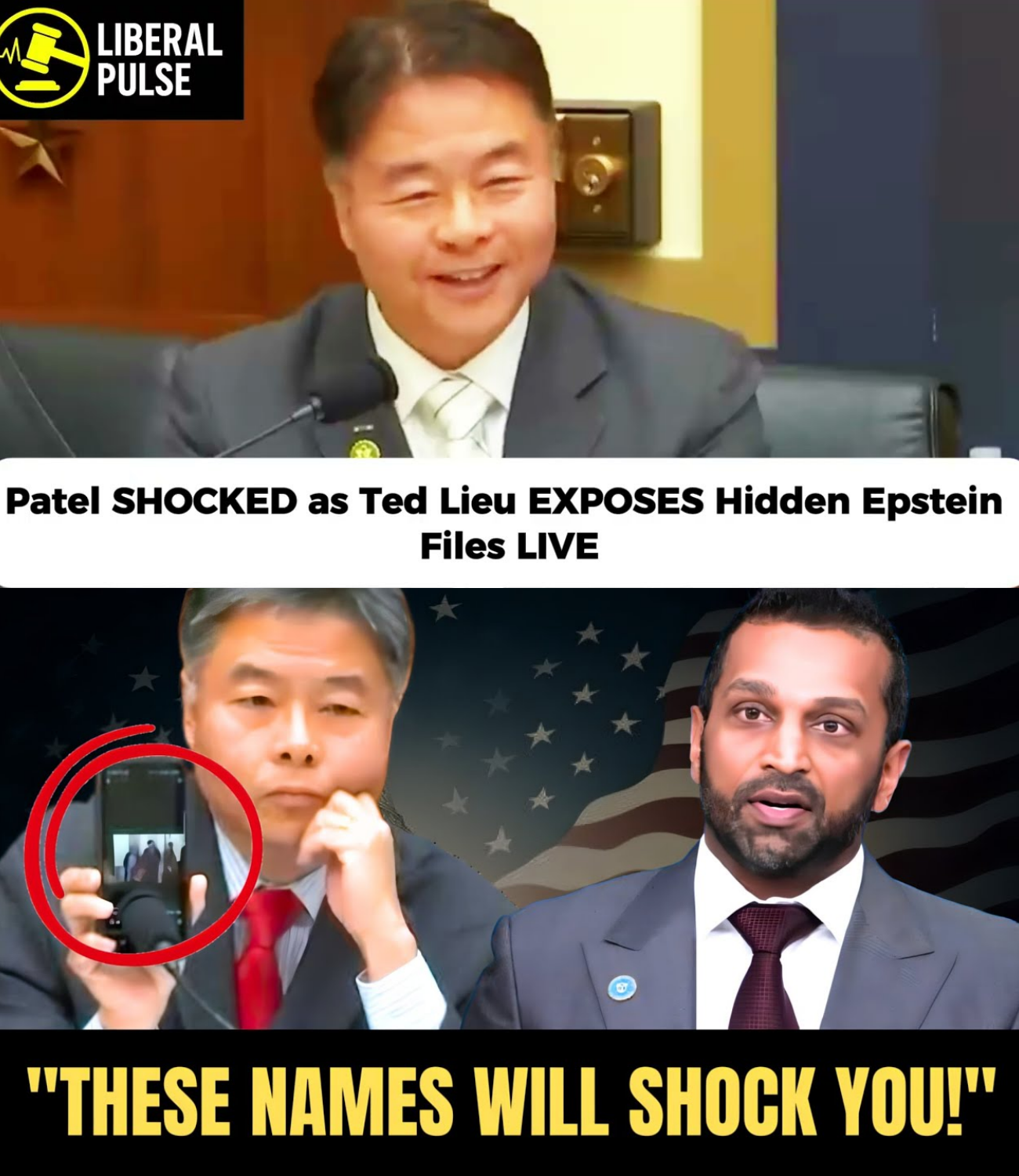
In a moment of political theater that quickly transformed into a serious inquiry into the nature of institutional accountability, the halls of Congress witnessed a standoff that left many Americans questioning the depth of the FBI’s investigation into Jeffrey Epstein. The scene was a routine oversight hearing, a venue often characterized by dry procedural discussions. However, when Congressman Ted Lieu took the microphone, he brought the focus squarely onto the unanswered questions surrounding the Epstein files—and the results were nothing short of electric.
As the hearing progressed, the temperature in the room grew noticeably cooler. With FBI Director Cash Patel seated at the table, Lieu launched into a line of questioning that pierced through the typical bureaucratic veneer. He centered his inquiry on the infamous safe found at Epstein’s Manhattan residence—a repository of potential evidence that has been the subject of endless public speculation. When Lieu asked about the nature of the items seized from that safe, Director Patel’s responses were marked by hesitation and a reliance on defensive, repetitive language.
The tension peaked when Lieu introduced a video clip featuring author Michael Wolf. Wolf, who claimed to have witnessed Epstein opening the safe to reveal Polaroid photographs of high-profile individuals, provided a firsthand account that directly challenged the prevailing narrative of the investigation. As the clip played, the chamber went quiet. Following the video, Lieu pressed the Director on whether the FBI had ever interviewed Wolf or subpoenaed the recordings he held of the late financier. Patel’s inability to confirm these basic investigative steps—frequently deferring with “I don’t know” or “I’ll get back to you”—created a palpable sense of unease among those in attendance and the millions watching from home.
The frustration in the room was not merely over the specific answers given, but rather the underlying culture of non-disclosure they seemed to represent. When a leader of the nation’s top law enforcement agency cannot affirm whether key witnesses were interviewed or whether critical, potentially incriminating evidence was secured, the public trust begins to erode. Lieu highlighted this gap by pointing out that even a “creepy birthday message” written by Donald Trump to Epstein had been disclosed by journalists long before it reached official channels. This prompted a sobering question: if the FBI missed such a detail, what else have they missed, and why does the public still lack access to a comprehensive inventory of seized materials?
A central point of contention was the existence of an “Epstein client list.” While Patel confirmed that an index of names had been released, he remained evasive when asked about specific high-profile individuals. His insistence that “the index speaks for itself” felt, to many, like a pivot away from transparency rather than a commitment to it. In the eyes of critics, such avoidance confirms the suspicion that the truth is being shielded by bureaucratic walls rather than protected by legitimate legal barriers.
The exchange also touched upon the role of the Epstein estate, which reportedly still holds a vast amount of information that has not been made public. When Lieu suggested that the FBI should aggressively subpoena these materials, Patel offered a technical defense, noting that the estate is under no obligation to provide them. Lieu was quick to challenge this, pushing back with the assertion that the FBI possesses the authority to pursue such leads. This clash underscored the fundamental divide between how the public views the FBI’s duty—to follow evidence wherever it leads—and how the agency defines its own procedural constraints.
As the hearing unfolded, the focus shifted from a single safe or a set of photos to a broader constitutional question: what does it mean for an agency to be accountable to the people? Oversight is not just about listening to testimony; it is about reviewing documents, examining inventories, and demanding clarity on why certain information remains sealed. By consistently avoiding direct answers, Patel’s testimony raised more questions than it settled. The “I don’t know” responses, while perhaps technically accurate in a bureaucratic sense, failed to satisfy the public’s need for certainty in a case of such immense historical and moral significance.
This hearing served as a stark reminder that transparency is not a slogan to be recited at committee meetings; it is a standard that must be proven through actions. For survivors and the public at large, vague statements about “legal limits” offer little comfort. What is required is a transparent accounting of what was found, what remains under wraps, and the specific, documentable reasons for those restrictions.
In the aftermath of the hearing, the clip of the exchange spread rapidly across social media, signaling a shift in the public conversation. Citizens are no longer satisfied with being told that an investigation is “complete” when key evidence remains unreviewed and critical witnesses remain unheard. The persistence shown by Congressman Lieu demonstrated that even in the most entrenched institutions, a single voice demanding specificity can force a reckoning.
Moving forward, the expectations are clear. There is a growing demand for a full, itemized inventory of materials seized from Epstein’s properties. If the FBI has faced legal obstacles in obtaining information from the estate, those barriers should be explained and, where possible, challenged in court. Furthermore, there is an urgent need for the bureau to clarify its investigative steps, including whether all potential leads—such as the testimonies gathered by journalists—have been formally integrated into their case files.
Ultimately, the goal of this oversight is not to relitigate the past, but to ensure the integrity of the future. If a case of this magnitude can be mired in such procedural uncertainty, it sets a concerning precedent for how other powerful individuals might be investigated. Public trust is the currency of any democratic institution, and it is a currency that must be earned through rigorous, unvarnished accountability.
As the dust settles on this intense exchange, the challenge for the FBI remains. Will they continue to hide behind the ambiguity of “legal procedure,” or will they take the necessary steps to provide the clarity the public deserves? The questions asked by Congressman Lieu are not going away; they are being echoed by a public that is increasingly unwilling to accept silence as an answer. In the end, the truth has a way of surfacing, and sometimes, the most revealing moments are not found in what is said, but in the awkward, telling pauses that occur when a simple question is asked of those in power. The pursuit of justice requires more than just the appearance of transparency—it demands the substance of it.
Full video: