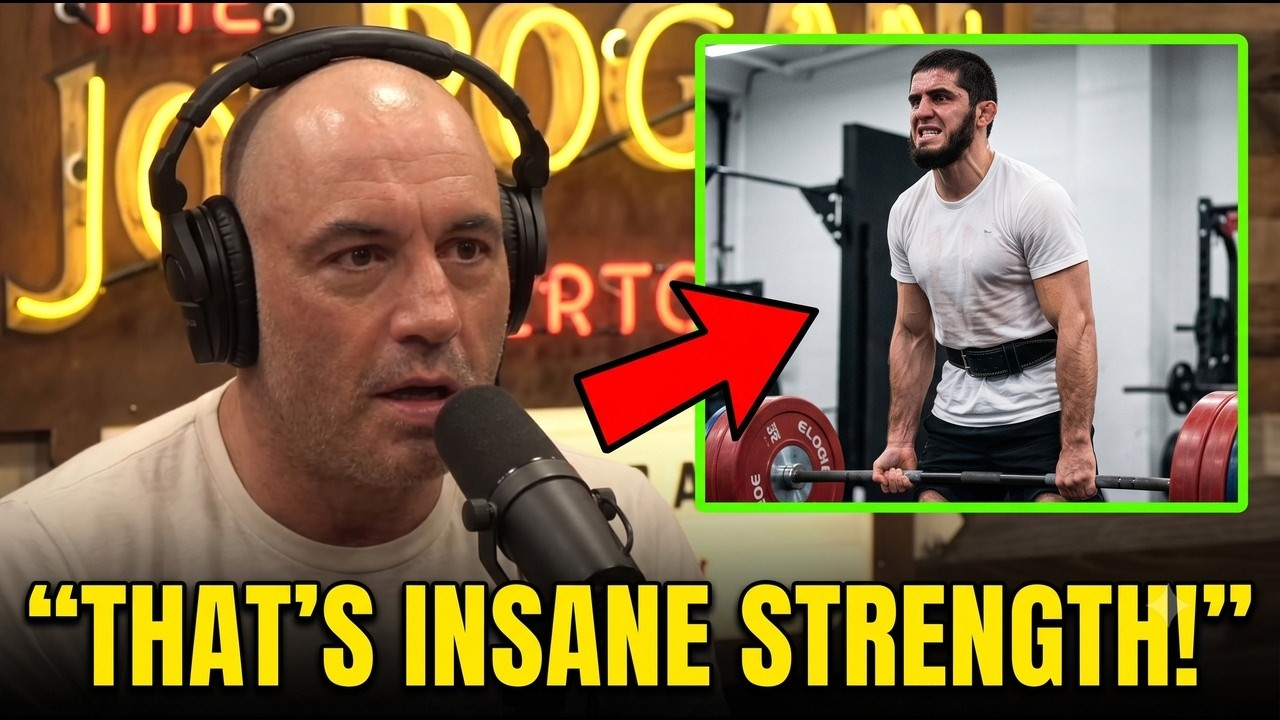
For months, casual fans and seasoned pundits alike have debated how Makhachev’s world-class grappling will translate to the 170-pound division. Welterweight has historically been a land of physical anomalies—tall, lanky, highly mobile strikers who present unique geometric puzzles for traditional wrestlers. Recently, leaked clips and inside accounts from Makhachev’s brutal preparation camp have sent shockwaves through the community, leading prominent commentators like Joe Rogan to openly marvel at the champion’s terrifying physical progression. This isn’t just about a standard fight camp; it is a profound look into a meticulously engineered system of athletic dominance. Under the watchful eye of head coach Javier Mendez at the American Kickboxing Academy (AKA) and alongside his lethal team of Dagestani training partners, Makhachev is fine-tuning an arsenal designed to render the physical advantages of larger welterweights completely obsolete.
To truly comprehend the gravity of Makhachev’s impending welterweight incursion, one must first look at the unique mechanical adaptations he has integrated into his submission game. Professional grapplers and former opponents have frequently pointed to Makhachev’s extraordinary squeezing power as a primary source of psychological terror on the canvas. Unlike typical fighters who rely on standard, angled choke mechanics, Makhachev has popularized a highly unorthodox front choke variation—breaking down traditional defensive barriers. Rather than sliding his arm all the way to his opposite bicep to cinch a classic D’Arce choke, the champion locks his grip directly on his forearm, pulling his opponent’s head straight into his chest.
Yet, the towering hurdle standing in the champion’s path is not merely a weight adjustment; it is the specific evolutionary archetype currently dominating the 170-pound landscape. Analysts have pointed to a rising pattern in the division: the rise of the ultra-tall, lanky, well-rounded strikers. Fighters like Carlos Prates, Michael Morales, and Ian Garry represent a new breed of welterweight “mutants”—athletes who possess massive reach advantages, elite point-fighting capabilities, and highly underrated takedown defense. Garry, who has spent significant time sharpening his Brazilian jiu-jitsu under elite coaching, represents a highly complex challenge.
With his slick movement, precise jab, and a tricky, range-heavy kickboxing style, Garry has visualized himself capturing UFC gold, confidently asserting that he represents the absolute future of the sport. Prominent analysts like Dan Hardy and Brendan Schaub have noted that Garry’s best path to victory lies in his ability to inflict serious, fight-altering damage on the feet early on. Garry cannot rely on a conservative, five-round point-fighting strategy against a relentless pressure cooker like Makhachev; he must find a way to catch the champion clean, leveraging his height and reach to land a decisive blow before the fight is forced onto the canvas.
The contrast between the two athletes extends far beyond their physical attributes and bleeds heavily into their underlying philosophies. While Garry utilizes high-profile media campaigns, verbal jabs, and bold public proclamations to build his brand, Makhachev operates with a quiet, stoic discipline that values legacy far above internet gossip. Addressing Garry’s recent verbal provocations, the champion remained entirely unbothered, signaling that he has zero interest in trading petty insults back and forth.
Makhachev clarified that his recent period of inactivity was not due to ducking opponents or avoiding high-profile cards, but rather a persistent hand injury that required careful medical management. Even with lucrative offers constantly rolling in from the professional wrestling and grappling worlds, Makhachev’s focus remains resolutely fixed on mixed martial arts dominance. To him, preserving his spot at the absolute peak of the pound-for-pound rankings carries far more spiritual and professional weight than any quick paycheck. He is a purist, fighting to test the absolute limits of human capability alongside a brotherhood of elite Dagestani athletes who are all molded in the same, uncompromising image.
As the highly anticipated clash draws closer, the MMA community is forced to reckon with the sheer unpredictability that has defined the sport. While head coach Javier Mendez has openly questioned whether Garry possesses the elite-level grappling required to survive even a single round under Makhachev’s heavy top control, the string of massive, jaw-dropping upsets that have occurred across various weight classes serves as a vital reminder that nothing in the Octagon is ever guaranteed. One perfectly timed knee, a clean counter left hook, or a momentary lapse in concentration can dismantle a legacy in a fraction of a second.
Ultimately, Makhachev’s jump to welterweight is a high-stakes testament to his relentless hunger. He has already conquered the lightweight mountain, but true greatness requires entering the deep, hostile waters of the unknown. Whether Ian Garry can successfully weaponize his tricky range and elite striking to author the biggest upset of his life, or whether Islam Makhachev will systematically execute his suffocating game plan to cement his status as a two-division ruler, this historic encounter promises to rewrite the modern book of combat sports forever.