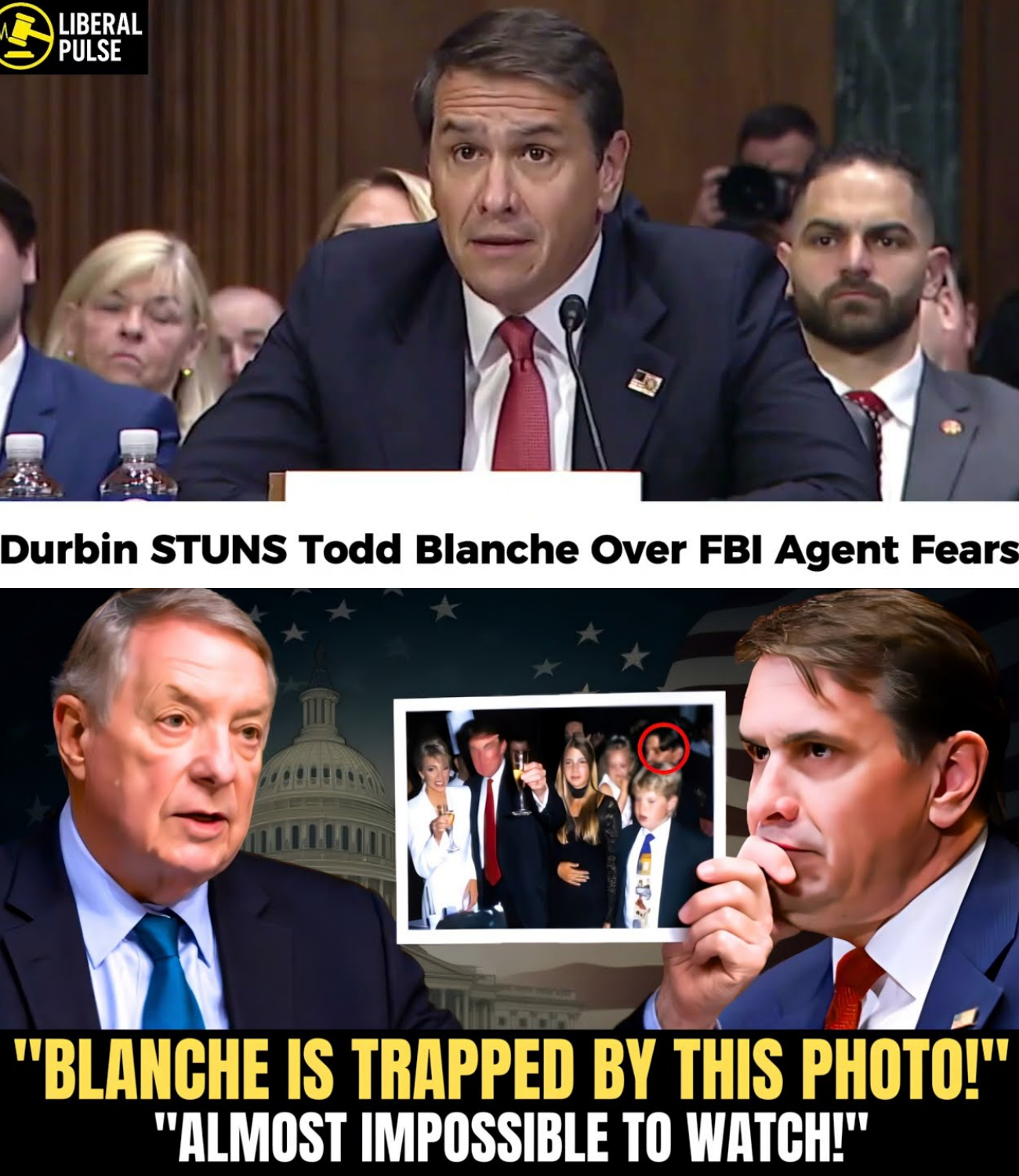
In a high-stakes confirmation hearing that left observers stunned, Senator Dick Durbin, chair of the Senate Judiciary Committee, engaged in an intense, pointed exchange with nominee Todd Blanche. The hearing, which initially appeared to be a standard procedural confirmation, quickly spiraled into a heated debate over loyalty, institutional independence, and the mounting fears surrounding the future of the Federal Bureau of Investigation (FBI) under a potential new administration.
The Shadow of January 6th
Senator Durbin began the session by grounding the conversation in the stark reality of the January 6th, 2021, attack on the U.S. Capitol. By walking the nominee through specific, harrowing images—officers being crushed in doorways and rioters breaching the building—Durbin set a tone of gravity. When Blanche acknowledged that such acts of violence against law enforcement must be investigated, he likely expected a standard path toward approval. However, Durbin immediately shifted the focus from the rioters to the investigators themselves.
The Senator brought up the massive, unprecedented scope of the Department of Justice’s (DOJ) investigation into January 6th, which involved approximately 5,000 FBI agents. The core of the conflict emerged when Durbin questioned Blanche about reports regarding efforts to identify and potentially disclose the names of those thousands of agents. While Blanche maintained he was not aware of a public effort to release these names, Durbin pushed back, framing the issue as one of systemic fear and political intimidation.
A Climate of Fear
The atmosphere in the room grew increasingly tense as Durbin highlighted the psychological toll these political winds are taking on career law enforcement officers. He pointed to the case of Guy Refett, a convicted January 6th rioter who received a presidential pardon and subsequently called for supporters to “clean house” at the FBI. For many, this phrase is not merely metaphorical; it represents a genuine anxiety that the bureau is being prepared for a political purge.
Durbin pressed Blanche to commit to protecting the safety and identities of FBI agents. Blanche’s responses were marked by legal precision and caution. He repeatedly stated that he was “not aware” of specific directives and emphasized that agent safety is “extraordinarily important.” However, he refused to provide a broader commitment that would unequivocally halt any efforts that might jeopardize the staff. To many critics in the room and watching at home, this hesitation spoke volumes. It painted the portrait of a nominee struggling to balance his professional integrity with the political realities of the man who nominated him, President Donald Trump.
The Comparison to Prosecutors
A particularly revealing moment occurred when Durbin contrasted the work of FBI agents with that of federal prosecutors. Durbin reminded the committee that, unlike high-level appointees, rank-and-file agents do not have the luxury of choosing their assignments; they are directed by leadership to investigate crimes as they appear. Durbin argued that holding agents responsible for the political fallout of their assigned cases creates a dangerous precedent that could paralyze federal law enforcement.
Blanche attempted to defend the DOJ’s oversight role, arguing that the department has historically maintained authority over the FBI and that requesting information is not inherently malicious. Yet, Durbin countered with the argument that the scale of the January 6th investigation is unique in American history. He posited that the current situation is not about standard oversight but rather about creating an environment where future agents may fear investigating politically sensitive cases for fear of retaliation by incoming administrations.
A Partisan Divide or Institutional Crisis?
The reaction to the hearing was immediate and sharply divided. Online, supporters of Donald Trump accused Durbin of using the hearing to relitigate January 6th, viewing the Senator’s line of questioning as a political stunt meant to smear the nominee. Conversely, critics of the former president saw the hearing as a chilling preview of a future where federal agencies are purged of independent voices and filled with political loyalists.
The debate goes beyond the individuals involved. It touches upon the very foundation of American governance: whether agencies like the FBI can remain independent institutions or if they are destined to become shifting battlegrounds of partisan revenge. Durbin’s final warnings about the potential for long-term damage to morale and recruitment within the FBI echoed throughout the hearing room, leaving an unanswered question about the long-term cost of this political friction.
The Road Ahead
As the hearing concluded, the tension remained unresolved. Blanche maintained that the information gathering discussed in various memos was not a “purge” but rather an attempt to learn from past investigations. However, the perception of his testimony by the public and his peers suggests a deeper, more entrenched anxiety.
Whether this hearing is remembered as a standard legislative disagreement or as a turning point in how Americans view their federal law enforcement remains to be seen. What is clear, however, is that the specter of January 6th continues to cast a long, polarizing shadow over Washington. The exchange between Senator Durbin and Todd Blanche served as a stark reminder that the fight for the soul of the Department of Justice is far from over—and that the fear felt by those tasked with upholding the law is becoming an increasingly central feature of the American political landscape.
Ultimately, the nation is left with a difficult reality: when the guardians of the law start to fear those in power, the very mechanisms of justice are at risk. As political discourse becomes more heated, the independence of the FBI remains a critical, and perhaps fragile, cornerstone of the republic. The nation continues to watch, waiting to see if institutional integrity will withstand the pressure of partisan ambition.
Full video: