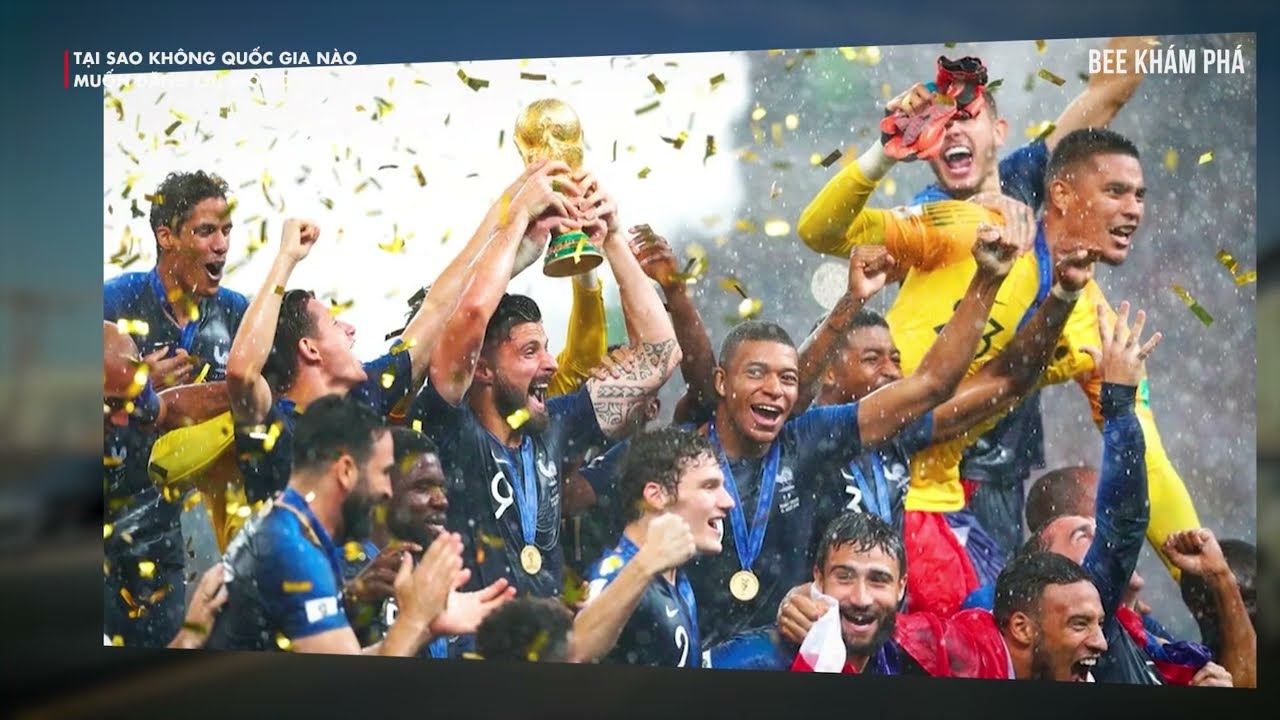
The FIFA World Cup has long been celebrated as the undisputed pinnacle of global sports. It is an event of unmatched magnitude, drawing the eyes of over five billion people—more than half of the global population—who tune in to witness history unfold on the pitch. From the tears of Cristiano Ronaldo to the triumphant, legacy-cementing moments of Lionel Messi, the tournament has consistently delivered the highest peaks of human emotion. Since its humble beginnings in Uruguay in 1930, featuring just thirteen invited teams, the World Cup grew into a symbol of ultimate national pride. For decades, governments practically fought each other for the prestigious honor of hosting the event, believing it would bring an incredible influx of tourism, international prestige, and economic prosperity. However, as the tournament expands and the true financial devastation comes to light, a harsh reality has set in. Today, the world’s biggest nations are actively turning their backs on the World Cup, running away from a system that has mutated into a terrifying financial trap.

To understand why countries are suddenly fleeing from the bidding process, one must first look at the staggering, almost comical list of demands that FIFA places on any potential host nation. Before a single ball is kicked, the host government must legally commit to a series of extreme concessions. They must establish a completely visa-free environment or heavily expedited customs procedures for everyone associated with the tournament. They are required to issue unconditional work permits. But perhaps the most financially devastating requirement is that the host nation must grant a one hundred percent tax exemption to FIFA and all of its corporate partners. This means that while the host country bleeds money to build the infrastructure, the governing body operates entirely tax-free within its borders.
The physical infrastructure requirements are equally nightmarish, especially now that the tournament has been expanded to feature forty-eight competing teams and a grueling schedule of 104 matches. FIFA demands a massive fleet of state-of-the-art venues. Group stage matches require stadiums with a minimum capacity of forty thousand seats. Semifinals demand sixty thousand seats, and the opening and final matches require a staggering eighty thousand seats. Furthermore, these colossal structures cannot exist in isolation. They must be seamlessly connected by advanced public transportation networks to five-star hotels, international hospitals, and major airports, all situated within a strict thirty to sixty-kilometer radius.
The financial imbalance of this arrangement is staggering. While the World Cup generates billions of dollars, that money does not flow into the economy of the host nation. Instead, it goes directly into FIFA’s bank accounts. Between 2019 and 2022, FIFA reported a record-breaking revenue of 7.5 billion dollars, derived primarily from lucrative broadcasting rights, commercial marketing, premium hospitality services, and ticket sales. Out of this massive sum, FIFA pays the prize money—such as the 400 million dollars distributed to the teams—and covers operational costs like referee salaries and broadcasting logistics. However, they keep the vast majority of the profits. The host nation, meanwhile, receives absolutely zero revenue from the merchandise or beverages sold by FIFA’s corporate partners.
The devastating aftermath of this one-sided deal is best illustrated by the phenomenon of “white elephants”—massive, highly expensive stadiums that are entirely abandoned once the tournament concludes. When Brazil hosted the event in 2014, the government promised that the 15 billion dollar investment would modernize the country. Instead, they spent nearly 900 million dollars building the National Stadium in the capital city of Brasília. Today, that stadium sits largely empty because the city does not even have a top-tier professional football team to fill the stands. It costs the local government up to 160,000 dollars every single month just for basic maintenance, yet it generates a miserable 130,000 dollars in revenue for the entire year. South Africa suffered a remarkably similar fate in 2010. The government spent 3 billion dollars to build or renovate five massive stadiums. Over a decade later, not a single one of those venues operates at a profit.
As a direct result of these financial horror stories, the enthusiasm to host the World Cup has completely evaporated. For the 2018 tournament, four nations submitted bids. By 2022, there were five. But recently, the bidding pool completely dried up, forcing FIFA into an unprecedented maneuver. Because the demand was so incredibly low, FIFA had to simultaneously trigger the bidding processes for both the 2030 and 2034 tournaments just to secure hosts. The cost of hosting has simply escalated beyond the realm of sanity. In 1994, the United States hosted the tournament for approximately 500 million dollars. By 2018, Russia spent 11 billion. In 2022, Qatar shattered all records by spending an incomprehensible 220 billion dollars.
Because of this hyper-inflation, the era of a single, average nation hosting the World Cup is officially dead. Today, there are only two types of viable hosts left in the world. The first type is a massive alliance of neighboring countries that can pool their resources and share the crushing financial burden. This is exactly why the United States, Canada, and Mexico joined forces to secure the 2026 tournament. They already possess a continent filled with massive, pre-existing NFL and football stadiums, meaning they do not have to build new venues from scratch. A similar strategy was adopted for 2030, where Morocco was forced to ally with Spain and Portugal to realistically afford the logistical nightmare of providing fourteen elite stadiums.
The second type of viable host is an ultra-wealthy nation backed by endless oil revenues, willing to absorb a massive financial loss in exchange for global prestige and accelerated national development. Qatar is the ultimate example of this. Of their 220 billion dollar expenditure, only about 10 billion was actually spent on football stadiums. The remaining 210 billion was utilized to completely build a new city, construct entire highway systems, and lay down modern subway networks from absolute scratch. For Qatar, the World Cup was simply a convenient excuse to fast-track their “Vision 2030” national modernization plan.
For developing nations, however, attempting to host the tournament is nothing short of economic suicide. This harsh reality sparked unprecedented social unrest in Morocco. Scheduled to co-host in 2030, the Moroccan government committed to spending 16 billion dollars on infrastructure. In a country where the average monthly wage hovers around 500 dollars, and citizens face severe shortages in education and healthcare funding, the public reaction was explosive. In late 2025, massive protests erupted across the country. Over 180,000 young people, organized through a digital movement dubbed “Gen Z 212” on platforms like TikTok and Discord, flooded the streets to condemn the government’s reckless spending on football stadiums while the general population struggled to survive.
To make matters worse, FIFA’s relentless pursuit of profit is now directly alienating the fans. During recent events in the United States, FIFA implemented a highly controversial “dynamic pricing” model for ticket sales, causing prices to wildly fluctuate and artificially inflate by an average of thirty-four percent. Fans were shocked to discover that secondary or tertiary seats were suddenly costing upwards of two thousand dollars. Furthermore, FIFA restricted parking and forced fans to use specific public transit lines, resulting in local transit authorities hiking train fares from a standard thirteen dollars up to an extortionate one hundred and fifty dollars. This blatant price gouging sparked fierce arguments between local governments and FIFA, ultimately leading the Department of Justice in New York and New Jersey to open official investigations into deceptive consumer practices and artificial scarcity.
Ultimately, the World Cup has profoundly lost its innocence. It is no longer just a beautiful, unified celebration of the world’s most popular sport. It has transformed into a ruthless, high-stakes financial game where the house always wins. If international football does not drastically change its operational model, the list of countries willing to bankrupt themselves for a month of glory will soon completely disappear.