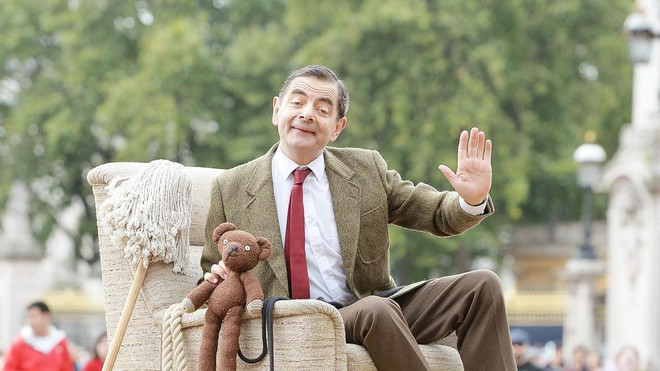
When you mention the name Rowan Atkinson, the immediate image that flashes across the minds of millions is that of a bumbling, socially awkward man in a tweed suit, clutching a worn-out teddy bear. For decades, the character of Mr. Bean has been a universal symbol of physical comedy, transcending language barriers to bring uncontrollable laughter to audiences in every corner of the globe. However, the man behind this iconic, childish persona is a complex tapestry of contradictions. Far from being the simple-minded fool he so masterfully portrays, Atkinson is a highly educated scholar, a courageous real-life hero, an astoundingly wealthy businessman, and a man whose controversial romantic choices have deeply divided his fiercely loyal fan base.
To truly understand the dichotomy of Rowan Atkinson, one must look back at his surprisingly academic beginnings. Born in nineteen fifty-five in County Durham, England, to a farming family, Atkinson was not exactly predestined for the glitz and glamour of international stardom. Instead, he was a remarkably bright student with a profound aptitude for the sciences. After achieving top marks in his early education, he earned a place at Newcastle University, where he graduated with a degree in Electrical Engineering. Still unsatisfied with his academic conquests, he went on to secure a highly coveted spot at The Queen’s College, Oxford, where he obtained his master’s degree. It is a stunning paradox that the actor who would later become famous for playing a character who barely speaks and struggles with basic logic is, in reality, an Oxford-educated engineer.
It was during his rigorous studies at Oxford that Atkinson discovered his true calling. Despite battling a debilitating stutter—a condition that would seem like a death knell for any aspiring performer—he found that stepping onto a stage allowed him to adopt different personas, miraculously causing his speech impediment to vanish. He joined the renowned Oxford Revue, an esteemed comedy group, where he began collaborating with Richard Curtis and Howard Goodall. It was in these historic halls that the seeds of Mr. Bean were planted. Atkinson has often described the character as “a child in a grown man’s body,” a brilliant observation that highlights the character’s selfish, yet deeply innocent approach to the world. When Mr. Bean made his television debut in nineteen ninety, he became an overnight sensation, cementing Atkinson as a comedic genius and securing his legacy in television history.
Yet, Atkinson’s life is not entirely defined by his time on stage or in front of the camera. In March of two thousand and one, he proved that he possessed a level of courage and composure that rivaled any Hollywood action star. While on holiday in Kenya with his family, tragedy nearly struck thousands of feet in the air. Atkinson, his then-wife, and their two children were flying in a private Cessna plane when the pilot suddenly collapsed at the controls, completely unconscious. The aircraft immediately began to lose altitude, hurtling toward the earth in what appeared to be a guaranteed fatal crash.
With absolutely no flight training or experience, Atkinson threw himself into the cockpit. Demonstrating extraordinary calm under unimaginable pressure, the comedian took hold of the controls and managed to stabilize the aircraft, keeping it airborne while desperately trying to revive the incapacitated pilot. After several terrifying minutes and numerous attempts to wake him, the pilot finally regained consciousness and safely landed the plane. Atkinson’s heroic actions saved his entire family from certain death, proving that the man famous for playing cowards and fools possessed the heart of a lion.
Beyond his intellect and bravery, Atkinson is also a fiercely successful businessman with a taste for the finer things in life. Through his production company, Hindmeck, and the enduring global merchandising of the Mr. Bean franchise, he has amassed a jaw-dropping fortune. Today, his net worth is estimated to be well over one hundred and fifty million dollars. He has used this massive wealth to quietly build an impressive real estate portfolio, owning exquisite properties in London and across the globe.
More famously, his wealth fuels his most dangerous passion: an obsession with high-performance supercars. In stark contrast to the lime-green, beaten-up Mini Cooper associated with his famous alter ego, the real Rowan Atkinson is a speed demon who relishes the adrenaline of the racetrack. His multi-million-dollar collection has included some of the rarest and most expensive vehicles on the planet, including Aston Martins and McLaren F1s. He is not just a collector who lets these machines gather dust in a garage; he is a skilled driver who regularly pushes these incredible feats of engineering to their absolute limits on professional racing circuits.
Despite his brilliant mind, heroic deeds, and astronomical success, Atkinson’s reputation has taken a significant blow in recent years due to his turbulent personal life. For twenty-four years, he was married to Sunetra Sastry, a former makeup artist he met during his early days at the BBC. The couple shared two children and were long considered one of the entertainment industry’s most stable and enduring partnerships. Sunetra was with him before the staggering wealth and the global fame, standing by his side as he built his empire from the ground up.
Therefore, the public was left reeling when rumors of infidelity began to surface, culminating in the complete collapse of their marriage. The wholesome, family-man image Atkinson had cultivated for decades was shattered when it was revealed that he was leaving his wife of nearly a quarter-century for a much younger woman. Atkinson began a highly publicized relationship with Louise Ford, an English actress who is thirty years his junior. The couple later welcomed a child together in two thousand and seventeen.
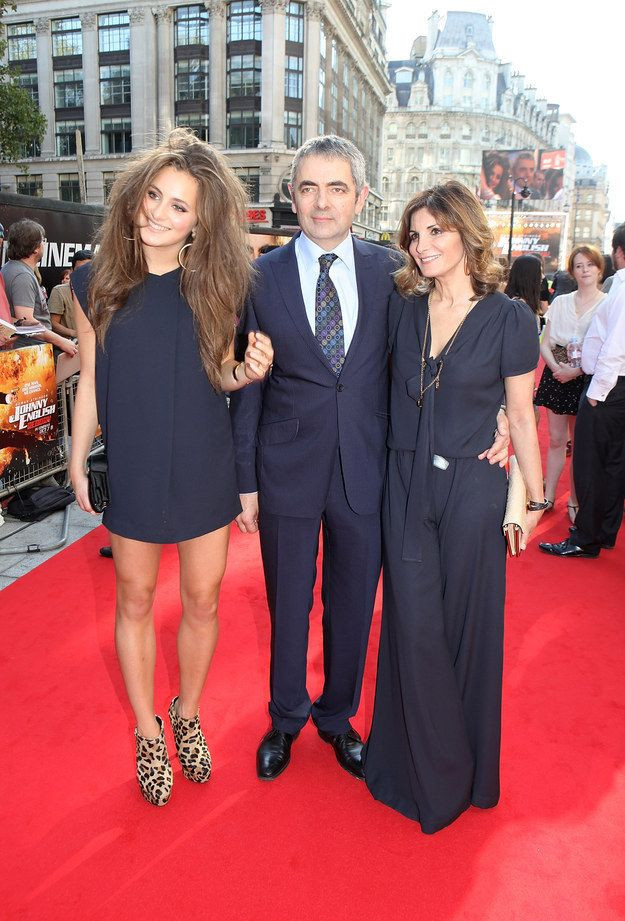
The backlash from the public and the media was swift and merciless. Many long-time fans expressed deep disappointment, criticizing Atkinson for discarding the woman who had supported him through his hardest years in favor of a youthful romance. The narrative shifted from a beloved comedic icon to a man experiencing a stereotypical, albeit destructive, late-in-life crisis. It forced audiences into the uncomfortable position of separating the art from the artist, reconciling the joyous innocence of Mr. Bean with the harsh, often selfish realities of the man who created him.
Ultimately, Rowan Atkinson remains a fascinating enigma. He is a man who conquered the world without saying a word, an Oxford engineer who mastered the art of playing the fool, and a billionaire thrill-seeker who once saved his family from plummeting from the sky. Yet, he is also a profoundly flawed human being whose personal choices have left an indelible stain on his legacy. Whether you view him as a legendary entertainer, a real-life hero, or a cautionary tale of fame and fading loyalty, there is no denying that the story of Rowan Atkinson is far more compelling, dramatic, and complex than any comedy sketch he could ever write.