The exclusive VIP room reserved for soccer’s greatest legends is heavily guarded, and very few ever manage to secure an invitation. Yet, a Brazilian wizard with an iconic, gap-toothed smile simply dribbled past the security, effortlessly dancing his way into the pantheon of the sport’s immortals. We are talking about a man who became the absolute personification of magic and joy on the pitch: Ronaldinho Gaúcho. He is a player who made fierce rival supporters stand up and applaud, even while enduring the bitter boos of the very fans who watched him grow up. He was an unstoppable force of nature, blending raw street-ball creativity with a relentless desire to entertain. Grab a seat, because the story of Ronaldinho is a breathtaking rollercoaster of stunning victories, heartbreaking losses, and bizarre off-field adventures.
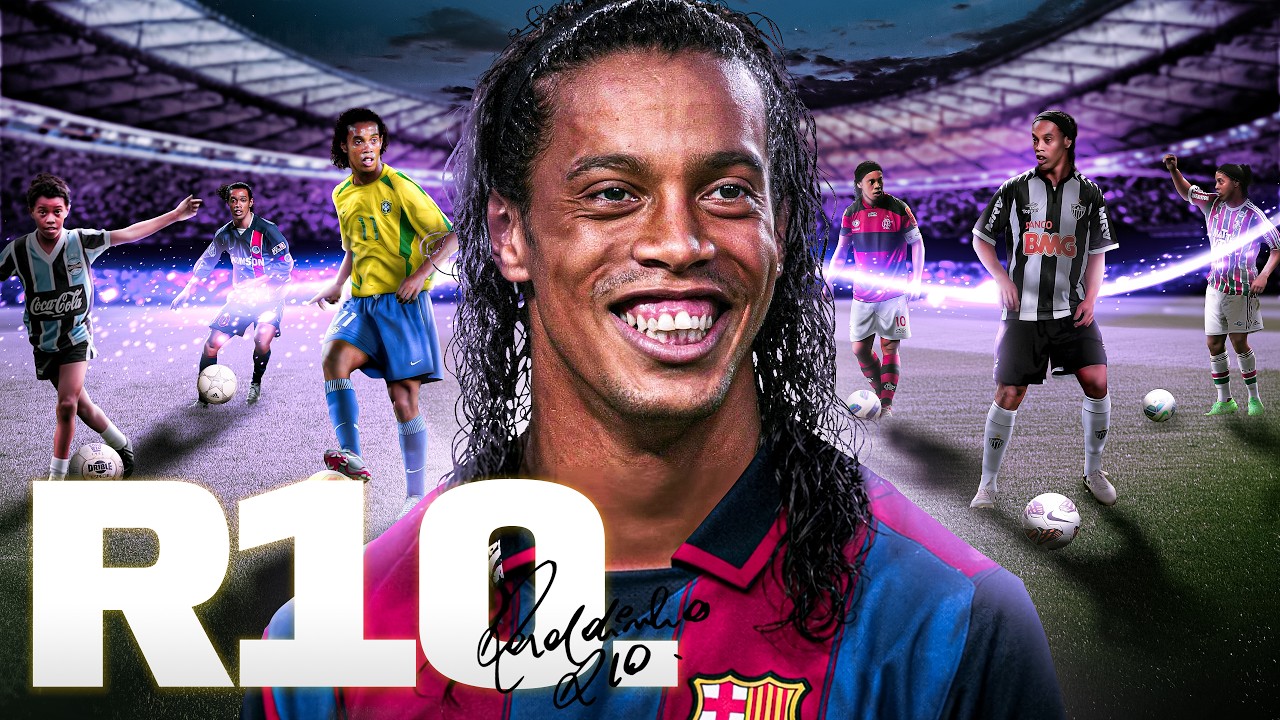
The incredible saga begins on March 21, 1980, in the humble neighborhoods of Porto Alegre, Brazil. Born Ronaldo de Assis Moreira, he grew up in a working-class family. His father, João, was a welder who moonlighted as a security guard for the local soccer club, Grêmio, while his mother, Miguelina, held the family together. Soccer was in his blood; his older brother, Roberto Assis, was already a promising professional player. Young Ronaldo honed his jaw-dropping skills in the streets, famously practicing his dribbling against his pet dog, Bombom, when his friends grew too tired to keep playing.
However, tragedy struck the family when Ronaldinho was just eight years old. Returning home from a training session, he found his house crowded with people. It was not a celebration; his older brother pulled him aside to deliver the devastating news that their father had suffered a fatal heart attack. This profound loss altered the trajectory of Ronaldinho’s life forever. His brother Assis was forced to step into the dual role of a father figure and, eventually, a shrewd agent who would mastermind his career.
Channeling his grief into his profound love for the beautiful game, Ronaldinho rapidly ascended through Grêmio’s youth ranks. By 1998, he was a regular starter, showcasing an arsenal of tricks, pinpoint free-kicks, and impossible ball control. He captured the national spotlight during a state championship final by repeatedly humiliating Dunga, the legendary captain of Brazil’s 1994 World Cup-winning team, with a series of audacious flicks and dribbles.
Yet, the fairytale romance with his boyhood club quickly devolved into a bitter nightmare. As major European clubs like Leeds United and Barcelona began circling with massive transfer offers, Grêmio’s leadership stubbornly refused to sell their prized jewel. However, a new Brazilian labor law known as the “Lei Pelé” changed the landscape of the sport, effectively ending the restrictive pass system that bound players to clubs indefinitely. Exploiting this newly found legal loophole, Assis orchestrated a controversial pre-contract agreement with Paris Saint-Germain, allowing Ronaldinho to leave for absolutely nothing. When the young star played his final matches for Grêmio, the stadium echoed with vicious boos and banners labeling him a greedy traitor, permanently scarring his relationship with his hometown club.
Arriving in the French capital in 2001, Ronaldinho began to broadcast his dazzling skills to a global audience. Despite frequent clashes with PSG manager Luis Fernandez regarding his notorious love for late-night partying, his on-field performances were nothing short of spectacular. His growing international reputation earned him a highly coveted spot on the Brazilian national team for the 2002 World Cup in South Korea and Japan.
Forming the terrifying attacking trio alongside Ronaldo and Rivaldo, the young sorcerer left an indelible mark on the tournament. During the tense quarter-final clash against England, Ronaldinho executed one of the most famous free-kicks in World Cup history. Spotting goalkeeper David Seaman slightly off his line, he floated a miraculous, looping shot from an impossible distance perfectly into the top corner. Brazil ultimately lifted the trophy, and Ronaldinho returned home as a World Cup champion, ready to conquer Europe entirely.
In the summer of 2003, a massive bidding war erupted between Manchester United and Barcelona. Through the cunning negotiation tactics of his brother Assis, who literally bounced between hotel rooms fielding competing offers, Ronaldinho ultimately chose Catalonia. His debut was as unconventional as his playing style: scheduled at five minutes past midnight due to an international scheduling dispute, a staggering 80,000 fans packed the Camp Nou just to watch him play.
Ronaldinho breathed life back into a struggling Barcelona franchise. Teaming up with Samuel Eto’o and mentoring a young, quiet prodigy named Lionel Messi, he transformed the team into an unstoppable juggernaut. He secured back-to-back La Liga titles and finally delivered the prestigious UEFA Champions League trophy in 2006. His individual brilliance peaked in 2005 when he was awarded the Ballon d’Or, cementing his status as the undisputed best player on the planet. Perhaps his greatest moment came during a match against Real Madrid at the Santiago Bernabéu. Ronaldinho was so devastatingly brilliant, scoring two majestic solo goals that left legendary defender Sergio Ramos utterly helpless, that the fierce, partisan Real Madrid fans actually stood up and gave the Brazilian a stunning standing ovation. It was a rare and magical gesture of pure respect that will echo through eternity.
Unfortunately, the blinding peak of Ronaldinho’s career was relatively brief. His well-documented love for the nightlife, combined with a sudden lack of physical discipline, began to heavily toll on his body. When Pep Guardiola took over Barcelona in 2008, he deemed the partying Brazilian a bad influence on the emerging Messi and promptly sold him to AC Milan. While he displayed occasional flashes of genius in Italy, the relentless magic had begun to fade.
Seeking a fresh start, Ronaldinho shocked the world by returning to Brazil to play for Flamengo in 2011. He immediately delivered one of the most astonishing performances in Brazilian league history against a Santos squad led by a teenage Neymar. Trailing by three goals, Ronaldinho orchestrated a miraculous comeback, scoring a breathtaking hat-trick—including an audacious free-kick rolled gracefully under the jumping defensive wall—to seal an unbelievable 5-4 victory. However, disputes over unpaid wages and intense clashes with management led to another messy exit.
Written off by many critics as a washed-up superstar seeking a final payday, Ronaldinho signed with Atlético Mineiro in 2012. What followed was a beautiful renaissance. Feeding off the passionate energy of the fans, he led the underdog club to its first-ever Copa Libertadores title in 2013. With this historic victory, he achieved an incredibly rare milestone: becoming the only player in history to win a World Cup, a Champions League, a Copa Libertadores, and a Ballon d’Or
Following brief, chaotic stints in Mexico and with Fluminense, Ronaldinho quietly retired. However, his post-career life transformed into a bizarre internet phenomenon known as random hangouts. He inexplicably appeared playing bongos at the 2018 World Cup closing ceremony, starred in a martial arts movie with Mike Tyson, and walked in Paris fashion shows. The most shocking chapter occurred in 2020 when he and his brother were arrested in Paraguay for using fake passports. Spending a month in a maximum-security prison, Ronaldinho predictably ended up dominating an inmate futsal tournament, scoring five goals and assisting six. When he was finally released, hardened inmates openly wept at his departure.
Ronaldinho Gaúcho is far greater than the trophies he lifted or the prestigious individual awards he collected. He represents the absolute essence of football. In an era increasingly dominated by sterile statistics, rigid tactical systems, and robotic efficiency, Ronaldinho was a vibrant reminder that sports are meant to be fun. He played the game with the boundless joy of a child in the streets, proving that sometimes, a simple, genuine smile is the most powerful magic trick of all.