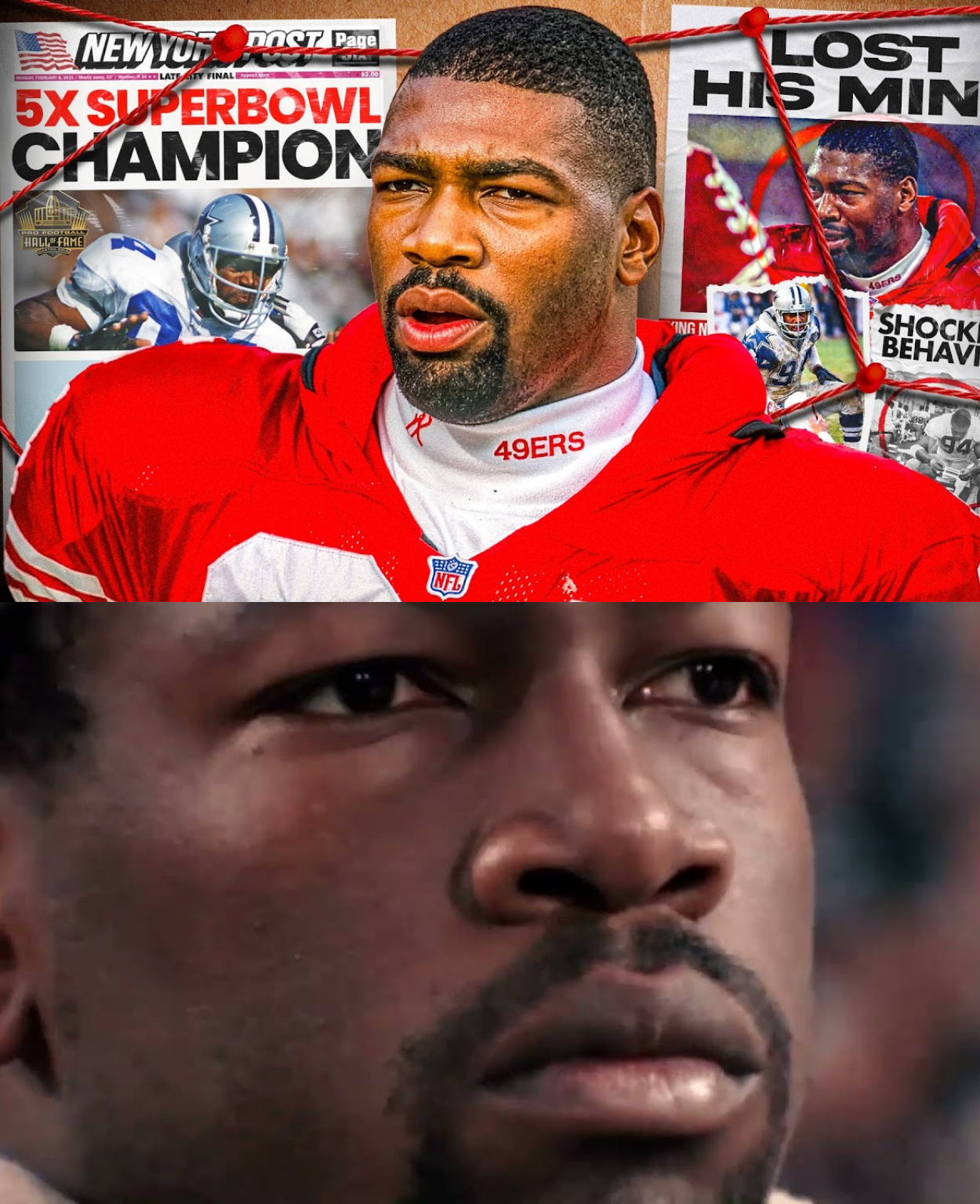
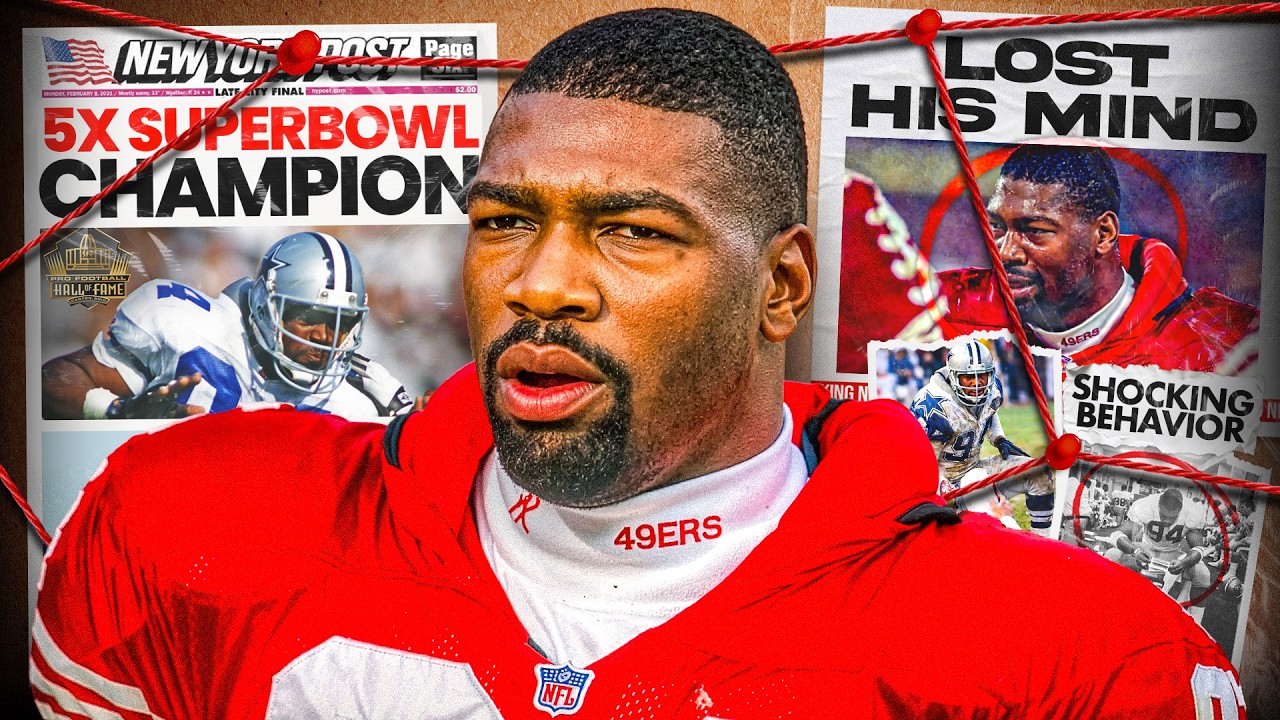
The glittering history of the National Football League is heavily adorned with legendary figures who transformed the sport through raw athleticism, unmatched dedication, and unyielding grit. We frequently look back at the golden eras of the San Francisco 49ers and the Dallas Cowboys with a deep sense of nostalgic reverence, celebrating the tactical genius of iconic quarterbacks and the poetic grace of hall-of-fame wide receivers. Yet, football is fundamentally a brutal, collision-heavy game of survival, and few individuals embodied that violent reality more completely than defensive powerhouse Charles Haley. Standing as the first player in NFL history to proudly hoist five Super Bowl trophies, Haley’s resume on the field is absolutely bulletproof. But behind the thunderous tackles and the historic championship rings lies a deeply disturbing, profoundly complex narrative. For twelve grueling seasons, Haley walked a razor-thin line between athletic immortality and absolute psychological self-destruction, unleashing a wave of locker room terror, physical violence, and unpredictable chaos that left the football world utterly stunned.
The Genesis of a Violent Fuel
To understand the intense fury that defined Charles Haley’s career, one must trace the roots back to his modest upbringing in Gladys, Virginia. Growing up as one of five brothers born to hardworking, blue-collar parents, Haley routinely struggled to fit in with his peers. As a child, he felt awkward, unathletic, and intensely isolated, experiencing an early, nagging realization that something inside his mind was fundamentally different from everyone else. Desperate to escape a life of financial hardship and fulfill his childhood dream of building a brand-new home for his mother, Haley ultimately found his salvation within the violent confines of tackle football.
The lawless, pad-free street games of his youth served as his formal indoctrination into a world where physical dominance was the only currency that mattered. Haley quickly realized that the football field was a rare sanctuary where his raw, pent-up aggression was not only tolerated but deeply celebrated. “The point was, it didn’t matter who came in front of me, I tried to break that neck,” Haley later reflected, noting that he would routinely knock down his own brothers during neighborhood clashes. This hyper-aggressive mindset propelled him through a dominant college career, earning him All-American honors and a highly anticipated ticket to the professional ranks of the NFL.
A Catalyst for Dominance and the 49ers Dynasty
When Haley was drafted by the San Francisco 49ers in 1986, he found himself sharing a locker room with legendary icons like Joe Montana and Jerry Rice. However, the ultimate catalyst for his professional awakening came from veteran safety Ronnie Lott. Following a tough rookie-season loss where Haley had been soundly beaten on the field, Lott famously stopped a team film session, demanding the projector be shut off before screaming, “Charles, if I ever see you getting beat like that again, I’ll kick your ass myself.” Infuriated and deeply shaken, Haley bit his tongue until it bled, channeling that explosive humiliation into an unstoppable pass-rushing fury.
Over his first few seasons, Haley became an absolute nightmare for opposing quarterbacks, amassing a spectacular 18.5 sacks in his first two years alone. His high-octane motor was completely unstoppable, driving the 49ers’ defensive unit to back-to-back Super Bowl victories in the 1988 and 1989 seasons. Yet, even as he hoisted the Lombardi trophies, the darkness simmering just beneath the surface began to aggressively leak into his off-field interactions. Just forty-eight hours before his second Super Bowl appearance, a violent altercation erupted between Haley and nose tackle Jim Burt, resulting in actual punches being thrown during a heated team gathering. It was an early, ominous sign that Haley’s intense competitive drive was deeply intertwined with an unstable, volatile nature.
The Reign of Terror and the Locker Room Meltdown
As the 49ers dynasty began to naturally transition, parting ways with key veteran leaders like Ronnie Lott, Haley’s behavior rapidly spiraled completely out of control. He aggressively cultivated a deeply disturbing reputation within the team facility, utilizing extreme, explicit acts of psychological and physical intimidation against teammates, trainers, and reporters. Haley would routinely expose himself to individuals in the locker room, masturbate openly during critical team meetings, and casually trash-talk his fellow players’ wives. He admitted to intentionally striking teammates in vulnerable areas during standard practices simply to establish complete and absolute dominance.
This ongoing psychological unraveling reached a horrifying peak during a week-five matchup in 1991 against the Los Angeles Raiders. Following a hard-fought, frustrating loss, Haley completely lost touch with reality inside the visiting locker room. In a blind fit of pure rage, he violently ripped an intravenous IV line straight out of his own arm and aggressively confronted head coach George Seifert, screaming that the entire organization had grown incredibly soft. When Seifert desperately tried to physically restrain the seething pass-rusher, Haley took a wild, ferocious swing at his coach’s head, narrowly missing and smashing his fist entirely through a glass window.
The resulting scene was utterly chaotic, with blood pouring profusely from Haley’s deeply cut hand and wrist. Refusing all immediate medical treatment, a completely unhinged Haley sat bleeding in the corner, experiencing a profound, full-fledged nervous breakdown. The incident permanently shattered his relationship with the franchise. In the weeks that followed, Haley’s behavior grew increasingly alarming; he reportedly showed up to the facility clad in full military camouflage, urinated on a coach’s vehicle, and in a final, terrifying act of defiance, allegedly pulled out a loaded firearm inside the general manager’s office to forcefully demand his immediate release.
Shifting the Balance of Power: The Dallas Years
Recognizing that his presence had become entirely untenable, the 49ers made the monumental, short-sighted mistake of trading the volatile superstar to their chief rivals, the Dallas Cowboys, in 1992. Haley’s sudden arrival instantly shifted the absolute balance of power within the National Football Conference. While he immediately courted controversy in Dallas by cornering quarterback Troy Aikman and aggressively stating he wasn’t half the player Joe Montana was, the Cowboys organization was uniquely equipped to weaponize his explosive personality.
| Phase of Career | Team | Key Championship Success | Documented Locker Room Incidents |
| Early Dynasty | San Francisco 49ers | Super Bowl XXIII, XXIV | Jim Burt physical altercation; open locker room misconduct |
| The Meltdown | San Francisco 49ers | 1991 Season Collapse | Attacking Coach Seifert; shattering glass window; GM office firearm threat |
| The New Empire | Dallas Cowboys | Super Bowl XXVII, XXVIII, XXX | Troy Aikman intimidation; destroying training room; concrete wall helmet smash |
Haley completely transformed the Dallas defensive unit, elevating them to a top-tier ranking and driving the franchise to a resounding 52-17 victory over the Buffalo Bills in Super Bowl XXVII. Yet, the familiar cycle of dominance and destruction quickly repeated itself. During a frustrating 1993 regular-season opening stretch, an enraged Haley hurled his helmet with such immense ferocity that it embedded itself directly into the training room sheetrock, narrowly missing a nearby teammate. In another fit of unbridled frustration, he completely tore apart the team’s medical training room after a staff member discarded a set of dominoes. Despite the constant turbulence, his on-field impact was undeniable, leading to a record-breaking fourth Super Bowl victory.
The Numb Game: A Descent into Addiction
The massive physical toll of maintaining such a hyper-violent style of play inevitably began to catch up with Haley’s body. To survive within the unforgiving landscape of the NFL, playing through excruciating, debilitating pain became an absolute prerequisite. Following a severe, chronic back injury, Haley became heavily reliant on the league’s widespread culture of medical numbing.
His daily routine quickly evolved from basic anti-inflammatory treatment to heavily chewing on Vicodin and consuming Percodan, an incredibly potent and highly addictive schedule-II narcotic. On any given game day, Haley would regularly consume a dangerous cocktail of four Vicodins and multiple Percodans just to tolerate the physical impact of rushing the passer. This heavy substance dependency reached a terrifying climax when Haley woke up in the middle of the night drenched in a panicked, icy sweat, his heart beating violently out of his chest, fully convinced he was suffering a fatal heart attack. Yet, driven by an insatiable desire to win, he continued to push his broken body to the absolute limit, ultimately securing a historic fifth Super Bowl ring in 1995. His legendary career only came to a definitive, screeching halt when he permanently lost all physical sensation in his left leg during a routine play in the 1996 season.
The Enigma Explained: A Belated Diagnosis
For years after his abrupt departure from the gridiron, the true source of Charles Haley’s terrifying, volatile behavior remained a dark, misunderstood enigma to the sports world. It was only after his retirement from professional football concluded that the chaotic puzzle pieces finally came together: Haley was formally diagnosed with bipolar disorder.
The revelation provided a profound, deeply necessary context to a career defined by terrifying extremes. “I was a sick man. I was dealing with an illness, and it made me do some crazy stuff,” Haley later courageously confessed. His entire life had been dictated by severe, unmanageable chemical highs and devastating, isolating lows, leaving him with absolutely no middle ground or emotional balance. Tragically, Haley revealed that the inner torment was so incredibly severe that he frequently contemplated ending his own life during his playing days, purposefully riding his motorcycle while actively wondering if he should simply take a sharp turn into a concrete wall to silence the noise in his head.
Charles Haley’s legacy will forever stand as a deeply complicated, cautionary tale within the annals of modern American sports history. On the stat sheets, he remains an absolute immortal—a fierce, five-time champion whose induction into the Pro Football Hall of Fame was entirely earned through pure gridiron dominance. But off the field, his story serves as a raw, sobering reminder of the devastating human cost of untreated mental illness. The very same inner fury that allowed him to shatter records and conquer the football world was actively tearing his own life apart from the inside out, proving that true greatness often requires a profound, heartbreaking battle with the demons lurking in the dark.