
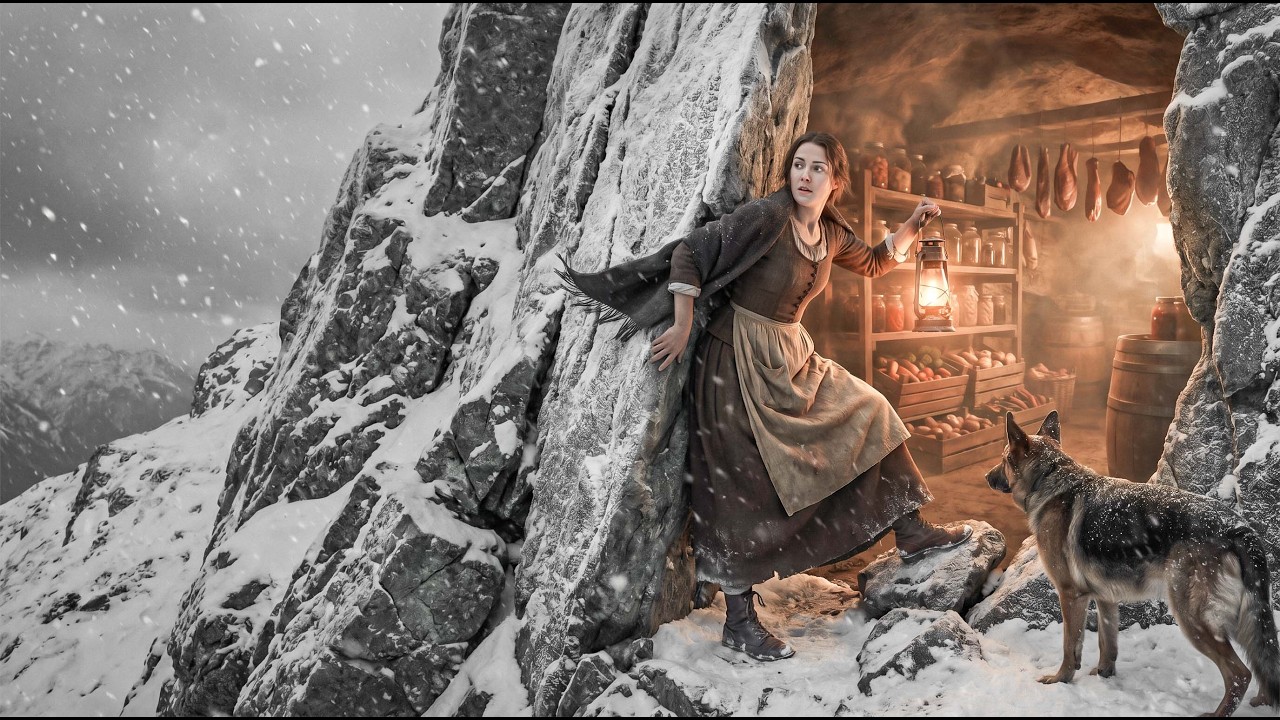
She did not know yet what the fissure was. She knew only what it looked like a wound. 20 paces long, narrow enough to step across at its widest point, dropping into a darkness that swallowed the gray October light without a trace. The locals called it the devil’s gullet. Children were forbidden from playing near it.
The wind that crossed its opening produced a low sustained moan that the old-timers in Coldridge, Montana said was the sound of the mountain in pain. Alaina had stopped hearing the moan 3 days after moving onto the land. She had too many other sounds competing for her attention. The canvas of her tent snapping against its stakes, the distant percussion of the town’s life carrying across the plateau, the silence inside her own chest where Thomas’s voice used to live.
She was 38 years old, 5 feet and 4 inches of New England stubbornness wrapped in a wool coat that had been good quality once before two hard winters and a great deal of grief had worked it over. Her hands were the most honest part of her raw at the knuckles, the nails broken down to the quick, the skin along her palms beginning to split in the cold.
They were not the hands she had arrived in Montana with 6 years ago when Thomas had brought her west with three trunks of books, a crate of geological instruments, and an enthusiasm for the landscape that bordered on spiritual devotion. Back then her hands had been a schoolteacher’s hands, ink-stained and precise.
Now they were something else. She was still discovering what. Coldridge had been built by men who treated the landscape as an opponent, something to be subdued, routed around, extracted from. The town sat at an elevation where the summer lasted 11 weeks if you were generous in your accounting, and the winters came with the weight of institutional memory, each one adding to the collective understanding that life here was a negotiation conducted entirely on the mountain’s terms.
The buildings were stone low and thick-walled, their windows small to minimize heat loss, their doors hung heavy on iron hinges that the forge at the south end of town produced and would produce again when the cold warped the wood and the frame shifted. The streets were unpaved and froze solid by November into a rutted treacherous gray that caught boot heels and threw ankles with impartial efficiency.
There were no trees in the center of town, they’d been taken for lumber and fuel years ago. Only the suggestion of where trees had once been in the regularity of certain low stumps worn smooth by decades of use as informal seating. Thomas had loved it. That was the thing Elena returned to in the quiet moments when she allowed herself to return to anything.
He had stood on the plateau his first morning in Coltrane, the wind plastering his coat against his back, his hair in absolute disarray, squinting at the rock formations along the ridge with an expression of pure uncomplicated joy. He had a way of seeing landscapes that other men only measured. Where the mining consortium surveyors had looked at these mountains and calculated extraction costs, Thomas Marsh had looked and seen 400 million years of story.
He could read time in stone. He had tried patiently and with great affection to teach Elena to do the same. She had learned more than she had ever told him. He died on a Tuesday in June, which seemed wrong in some fundamental way. June was supposed to be the safe month, the reprieve, the proof that survival had been worth the effort.
The fever came fast and burned hotter than the doctors in their letters from back east had warned her to expect. She sat with him for 4 days reading aloud from his own notebooks because he had asked her to his handwriting becoming unfamiliar to her as she read it as though the man who had written those careful observations about mineral composition and subterranean water tables was already somewhere else.
On the fifth morning she woke in the chair beside his bed and the room had changed in the way rooms change when they are no longer occupied by the living. She was careful. She had always been careful. It was her school teacher’s instinct, the habit of accounting of measuring what was available against what was needed, of finding the arrangement that made the most of the materials at hand.
She applied it now to calories, to fabric, to firewood, to the precise angle at which she hung her damp clothes to dry fastest in the limited warmth of Mrs. Greer’s kitchen. She applied it to her grief as well, rationing it in the same deliberate way, allowing herself an hour of it in the evening before she redirected her attention to practical problems.
She was not sure this was healthy. She was fairly sure it was necessary. What she didn’t show anyone because showing it would have required an explanation she wasn’t ready to give was that she was frightened in a way that had nothing to do with the cold or the dwindling money or the approaching winter. She was frightened of becoming invisible, of being slowly reclassified from person to problem, from widow to burden, from a land to marsh, to simply that woman, and then eventually to nothing at all, a cautionary whisper shared between women
in the market. The kind of story told to illustrate what happened when you made bad choices or simply had bad luck and there was no one positioned to absorb the consequences. She had watched it happen to other women. She knew the stages. The money ran out on a Wednesday in late September, which was not a dramatic event.
There was no moment of discovery, no sudden realization. It was simply that she counted what was in the small leather pouch Thomas had used for geological samples and found the number that remained, and the number was not enough to carry her through another month of rent, let alone the winter. She sat with this information for a long time, the way she had sat with the information of Thomas’s death, not in shock because she had been watching it approach, but in the particular stillness that comes just before decision must be made. She was sitting
with exactly this stillness on the evening Aldous Heck found her on the path between the boarding house and the market. He was a large man in the way that certain structures are large, not through any particular dimension, but through the cumulative impression of solidity, of mass, of something that had been built to occupy space and resist movement.
He was 61 years old with a face that had been rearranged by decades of Montana wind into something that suggested geographical features rather than human expression. He had come to Coldridge when it was still primarily a mining operation and had stayed as it transitioned, positioning himself at each shift with the timing of someone who understood that the real resource was not gold or timber or agricultural land, but the human need for authority in uncertain places.
He was the head of the town council, the owner of the largest property holdings, and the man whose approval or disapproval shaped the social weather of Coldridge with the same reliability that the northern peaks shaped the actual weather. He did not approach her as a predator. That was the thing she understood later, turning the encounter over in her mind.
He approached her the way he approached every transaction with the comfortable certainty of a man who had never been seriously wrong about anything and therefore had no internal mechanism for recognizing the possibility. His face arranged itself into an expression of concern generosity that did not quite reach his eyes.
Not because he was concealing something but because his eyes had been calibrated for calculation for so long that they operated independently of whatever emotion his features were performing. He had a proposition. A matter of charity he called it though the word sat uneasily on his vocabulary like a piece of furniture bought for appearance rather than use.
He knew her situation. He knew the rent was due. He could not he explained his tone carrying the weight of reluctant necessity simply give her a place to live. That would set a precedent the town could not afford financial charity being a precedent that multiplied itself in communities where the margins were already thin.
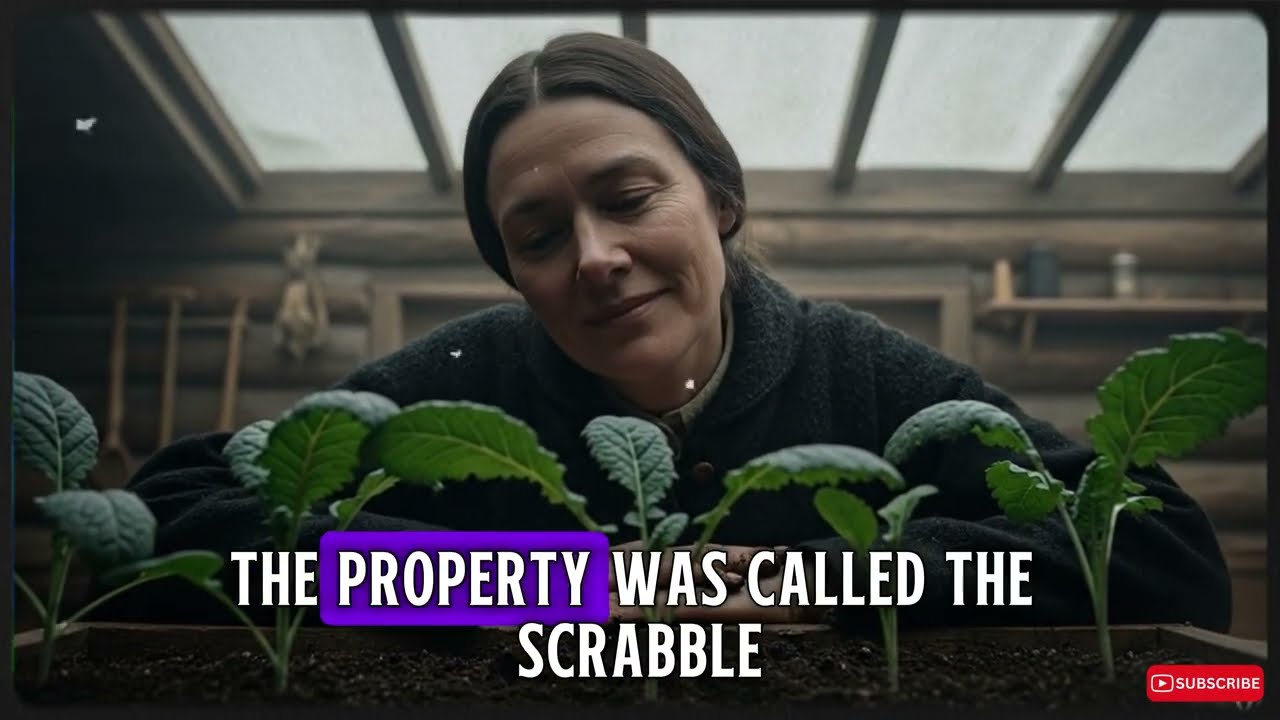
But he could sell her one. The property was called the scrabble a name she would come to understand later as a compressed history of every failed attempt anyone had ever made on that land. It sat at the windward edge of town on a plateau of exposed rock and compacted gravel where the topsoil had been stripped away by decades of wind until the underlying geology was visible the way bone is visible through a bad wound.
It’s most prominent feature was the fissure locals called the devil’s gullet 20 paces of dark crack running through the rock at a diagonal moaning at the wind warning away children. Nothing grew there. The lichen that colonized the rock seemed to do so not from any nutritional optimism but from sheer spite. He offered it for the exact sum remaining in her pouch.
He knew the sum. She did not ask how. He offered it with the particular generosity of a man providing someone a chance to fail on their own terms rather than on his, which is a species of mercy that benefits primarily the one extending it. Elena listened to him with the focused attention she had once given to students who were explaining why they hadn’t completed the assignment tracking not just what was being said, but the shape of the reasoning, the places where logic curved away from honesty.
She heard the unspoken portion of the proposition clearly. The scrabble was where Coleridge put things that he had given up on. Once she was out there, her failure would be a private matter enacted at the periphery requiring no one’s involvement. She looked at his face for a long moment.
The comfortable certainty in it, the absence of any doubt about the essential reasonableness of what he was proposing. He genuinely believed he was offering her something. He was He was offering her the town’s back turned deliberately, which in its own way was cleaner than the slow withdrawal of its face. Something moved through her chest that was not warmth and not cold, but something older than either the same thing that had kept her reading Thomas’s notebooks aloud when her voice had given out and her eyes burned and the room smelled of fever and
ending. Stubbornness maybe or it’s more respectable cousin resolve. Here, she said, the word came out quieter than she intended scraped clean of everything except its meaning. She untied the pouch and poured Thomas’s last legacy into Aldous Hex’s waiting palm. The coins were cold. They made a small sound against his skin less than she had expected.
The deal was witnessed by two men who happened to be passing which was perhaps by design. By the next morning the town knew. By noon it had passed through two cycles of reinterpretation and had solidified into something closer to dark comedy than tragedy. “The poor widow,” some said with genuine sorrow. “The mad woman,” others said with a particular satisfaction of people who have seen their assessment confirmed.
Cal Briggs, the town’s blacksmith, a man built along the lines of the work he did, dense and heat-hardened, his forearms mapped with the pale marks of old sparks, put down his hammer when he heard and walked out to the scrabble to see for himself. He was 53 years old with the economy of movement that comes from decades of working in a confined space around extreme heat, and he had the blacksmith’s habit of assessing everything for its structural properties before considering anything else.
He found Elena dragging a length of salvaged timber across the gravel, her boots sliding on the loose stone, her face set with an expression that was not quite anger and not quite desperation, but something between them that was, if anything, more unsettling. He watched her for a moment before he spoke. She did not stop moving.
His voice came out gentler than he expected, which surprised him. “Mrs. Marsh, what are you doing?” She let the timber down and looked at him. The wind came between them, carrying grit. He gestured at the landscape, the gray rock, the moaning fissure, the vast cold absence of anything that could sustain human life.
“You cannot build here. The wind will take it apart before you get the roof on. The ground is bedrock under 6 in of gravel. Nothing grows here. This is not a place for living.” He paused, and what came next cost him something. “This is a place for ending.” Elena looked at him for a long moment without speaking.
He was a practical man. She could see it in the economy of his posture, the way his eyes moved over the terrain with the automatic assessment of someone accustomed to reading materials for their load-bearing properties. He was not trying to be cruel. Cruelty required a kind of engagement he hadn’t extended. He was simply reporting what he saw with the authority of a man who had spent his life working with the truth of materials.
Her voice, when it came, was small and steady, both things at once. “It’s all I have.” He sighed a long breath that became visible in the cold and then vanished. He offered to talk to Heck to argue for the return of at least some of her money, to find her a corner in someone’s barn where she would at least be protected from the worst of what was coming.
She shook her head. He waited studying her the way he studied metal when he wasn’t sure of its composition, looking for the flaw, the place where it would fail under pressure. He didn’t find it. He turned and walked back toward town shaking his head and the wind swallowed the sound of his footsteps before he had gone 20 yards.
That night alone in her tent, the oilcloth snapping with violent enthusiasm in the dark, the temperature dropping below freezing, the moan of the Devil’s Gullet audible even through the canvas, Elena allowed herself a full hour of the kind of doubt that she did not permit herself in daylight. It was thorough. It covered every angle.
What she was planning required more physical labor than she might be capable of sustaining. It required materials she didn’t have and knowledge she had only partially absorbed. It required the fissure to be what she thought it was, which was based on a theory her husband had sketched in a notebook, and a single chapter in a text that 40 years of geological academia had largely ignored.
She thought about Thomas sitting at the table in their rented room in town three winters ago. The lamp burning low because they were conserving oil. His finger tracing a diagram in the geological text while he described with the particular excitement he reserved for ideas that had not yet been proven wrong the concept of what the author called winterless earth places where subsurface heat seeped upward through rock fissures in quantities too small to be dramatic but large enough to prevent the ground temperature from dropping to
the lethal thresholds that govern life at elevation. He had talked about the scrabble then. She remembered his exact words because she had written them down in her own notebook not because she thought she’d need them but because she wrote down everything he said about geology. It was her way of keeping up. The fissure there isn’t random he had said.
The orientation suggests a pressure differential. Could be residual volcanic activity. Could be something older. Either way the air movement would be upward. Elena if someone built down instead of up. He had stopped himself laughed a little shaking his head. A lunatic idea. She had agreed at the time. Agreement had seemed easier than following the idea to its conclusion.
She was following it now. She reached into the wooden chest beside her sleeping roll the one that held Thomas’s books which she had kept even when she sold everything else because some things were not negotiable and found the geological text with the dog-eared chapter. Near the back in the margin beside the author’s cautious theoretical description of harnessing geothermal variation for agricultural purposes.
Thomas had made a small notation in his cramped pencil script. She had first read it the night after his funeral sitting in the cold back room with the lamp turned up all the way because she had needed to see clearly a date a set of coordinates she recognized as the scrabble’s location and the words written with the slight upward slant his handwriting took when he was excited.
Warmth below. Investigate spring. He had been planning to come back to it. He had cataloged it, marked it, assigned it to the season when ground investigation became practical. He had not come back to it because June had other plans for him. But he had known. He had known about the fissure, had read its geological signature, had formed a hypothesis, and she was now in possession of both the hypothesis and the land it described, having arrived at this confluence by a road that involved a calculating man’s contempt and the last of her
money. The tent snapped. The wind pressed against the canvas with personal intensity. The Devil’s Gullet moaned in the dark like an old regret. Elena closed the book and set it carefully back in the chest and lay down on the bedroll with her coat still on. She did not feel hope. Hope was too warm, too forward-looking for what she actually felt.
What she felt was something more angular, the specific clarity that comes when you understand that there is exactly one option remaining, and it is, by any reasonable measure, unreasonable. She would build Thomas’s winter garden, not for herself or not entirely. She would build it because he had imagined it and had not had the chance, and because the idea deserved to be tested by someone who understood the notes, and because Aldous Hex’s comfortable face, certain as bedrock, needed to be wrong about at least one
thing before she was finished. She was up before dawn. The ground defeated her the first day with comprehensive efficiency. The top inch of soil was frozen solid, and beneath it the gravel layer ran 4 in deep before hitting clay, hardened to the consistency of old brick. And beneath the clay was the rock itself, granite, she thought, remembering Thomas’s maps of the area, implacable and massive sedans.
Her only tool was a small spade Thomas had used for collecting botanical specimens, a thing designed for delicate extraction rather than industrial demolition. She broke three blisters in the first hour. By mid-morning her shoulders were producing a pain that seemed to come from somewhere deeper than muscle. Something she would later identify as the particular ache of tendons asked to perform work they were never designed for.
By afternoon she had cleared a section of ground roughly the size of a dining table. She stood at its edge and looked at it for a long time without any particular expression. The next morning she was back before the light was fully established because the light in that part of Montana at that time of year was not something you waited for.
You went out into the gray pre-dawn and did what needed doing and the light arrived when it arrived. She had developed a system spade for the top layer, a heavy stone she’d found for pounding through the clay, her hands for removing the loosened material and sorting it. She sorted everything large flat stones in one pile, smaller angular ones in another gravel.
In a third the thin dark soil that appeared occasionally in pockets between the rock layers she set aside with a particular care someone gives to something rare. She was thinking about walls already. She was thinking about what Thomas’s diagram had shown about the structural requirements of a sunken space. She was thinking about the physics of the roof she would eventually need to build, which was so far beyond her current capacity as to be effectively theoretical, but which she thought about anyway because the alternative was thinking about nothing but the pain in
her hands. The town watched with the fascination of people observing something they expect to end badly but cannot look away from. Her solitary figure on the plateau became a feature of the visual landscape bent over her work. In the gray morning light, the periodic arc of displaced earth marking her progress.
Children watched from the road. Their mothers pulled them away with the particular urgency adults deploy when the thing being observed is too close to a lesson they aren’t ready to explain. The joke that had been circulating about the widow’s folly about the mad woman digging. Her grave went through a second revision after the first week.
It was no longer quite funny. It had taken on the quality of something that kept not being over when everyone expected it to be over. Cal Briggs returned to the edge of her property on the fourth day and stood with his arms crossed watching with the focused attention he normally reserved for work that interested him technically.
He did not speak. She was in the pit. It was barely a pit yet, more a significant depression. And she came level with his boots when she straightened, which told them both something about how much she had accomplished. He watched the way she worked the sequence of movements, the absence of wasted motion, the methodical sorting of materials that went on even when her hands were shaking with fatigue.
When he left the silence between them remained unbroken, but it had changed register less dismissal, more consideration. On the seventh day she nearly stopped. Not from the pain which had reorganized itself into a background condition she’d stopped registering as remarkable. And not from hunger, though she was being very careful with what she ate.
And the careful management of food is its own kind of continuous exhaustion. She nearly stopped because she hit a section of granite that refused, absolutely refused to yield to anything she had available. And she stood in the depression she had made the wind cutting across the exposed plateau with casual brutality and calculated the number of similar sections she was likely to encounter before the hole was deep enough to work with.
The number was not encouraging. She put her hands flat against the cold granite and pressed, which accomplished nothing structurally but occupied the moment when she might otherwise have sat down and not gotten up. She thought about what Thomas would do with an obstacle that could not be removed.
He would find the way around it not in defeat but in genuine curiosity about what the obstacle was hiding because in his experience things that resisted direct approach were often pointing towards something more interesting on the other side. She picked up her stone and her spade and began working the clay at the edges of the granite section looking for the path that went around it and found 2 ft to the left a seam where the rock had fractured along its own natural line.
It wasn’t a solution so much as an accommodation and the hole deepened. She found the warmth by accident on a morning she had been awake since two with a cough she’d been developing moving slowly because everything moved slowly when she hadn’t slept picking up the small sticks along the fissure’s edge. Her right hand outstretched to retrieve a twig from the lip of the devil’s gullet passed over the opening.
She stopped. She moved a hand back more slowly with the attention of someone who was not sure what they detected but is sure they detected something. The air over the fissure’s mouth was different. Not warm, she would not have called it warm not in any comfortable sense. But it lacked the particular quality of the Coldridge October air which was cold in a way that felt aggressive almost intentional as though the temperature were trying to accomplish something.
The air from the fissure was simply cool. Like the air in a stone cellar. Like deep shade on a June day, like the bottom of a well. The notation was in her own notebook, recorded the first week of their marriage. The specific date Thomas had first described the concept of Winter as Earth, the title and page number of the relevant chapter, his exact words about the scrabble.
She had written them down because his excitement was always worth recording. She had not thought about those notes in months. She went back to the tent and found the notebook and read them in the thin October light, her breath fogging the pages. She stayed with the idea for the rest of that day and through the night, sitting with the geological text and Thomas’s diagram, and the memory of his voice describing a space that went down instead of up, that borrowed warmth from the planet instead of fighting the sky for it, that used the mountain’s own
deep temperature as its primary building material. The idea was not impossible. It was, she realized sitting in the cold tent with the lamp low, the moan of the fissure audible outside, already half-built in someone’s notes. She would not be inventing anything. She would be finishing what Thomas started.
Heck came out personally on the 12th day. He rode his horse to the edge of her property and sat in the saddle with the expansive confidence of a man surveying his domain from a position of comfortable altitude. What he saw was a pit nearly 4 ft deep and 6 ft wide at its widest, with stone-lined walls of some precision, and a woman in a worn coat standing in it sorting rocks with the systematic focus of a professional.
The confidence in his posture underwent a small private adjustment. His voice came down from horseback with a particular authority of an elevated position. Mrs. Marsh, this has gone far enough. She looked up at him from the pit. He was not expecting her to be below him. The visual geography of the encounter had been arranged in his mind differently.
He continued, “This project of yours is an embarrassment to the community. I’ll return half of what you paid me. Leave now. Leave with some dignity. No one needs to watch this play out to its conclusion.” A pause in which the wind filled the silence helpfully. “The conclusion is not going to be good for you.
” Elena set down the stone she was holding and straightened, which brought her eye level with his horse’s belly. She looked at Aldous Heck the way she had once looked at students who had confused confidence for understanding without malice, without particular heat, with the steady patience of someone who has decided where the conversation ends.
“This is my land, Mr. Heck.” Her voice was entirely level, carrying nothing extra. “This is my home.” She picked up the stone and resumed placing it in the wall. The next morning when she came out of the tent in the first gray suggestion of dawn, there was a pickaxe and a long-handled iron shovel leaning against the largest rock pile.
Forged iron, well-balanced, the handles smooth from use, but not worn through working tools, not display pieces. There was no note. She stood looking at them for a moment, then turned toward the distant thread of smoke rising from the forge chimney on the far side of town. She stood there for a full minute, then she picked up the pickaxe and went to work.
The difference was immediate and significant. The pickaxe broke through clay and light granite alike with a controlled efficiency her small specimen spade could never have managed. The hole deepened at nearly three times the rate of the previous days. By the end of the first week with the new tools, she had reached a depth where the ambient temperature of the surrounding earth began to be distinguishable from the surface temperature, not dramatically but measurably in the way you’d measure it with your hand rather than a thermometer.
The walls held. The flat stones she’d sorted and set were fitted close enough to hold without mortar. The dry stone technique she’d read about in one of Thomas’s construction texts proving itself practical under actual application. She was building something real. The town revised its assessment again. The joke was entirely gone.
In its place was something more uncomfortable, a collective uncertainty about what they were watching. The pit was real. The walls were real. The woman in the pit was not stopping. Heck, who had announced to anyone who would listen that the widow’s folly would be over by first frost found himself delivering increasingly quiet modifications to this prediction.
First frost came. The folly continued. On an afternoon when sleet had begun to fall in thin stinging sheets across the plateau, Elena lost her footing on the wet rock and went down hard, the spade clanging against the stone wall of the pit. She was still for a moment that stretched. Then she pushed herself upright, her face streaked with mud and ice water, and stood.
She took one breath, then another. She picked up the spade. She pushed it into the clay. From a hundred yards away, a large figure who had been standing with arms crossed turned and walked back toward town without speaking. The problem was structural. She had no money for food. The mending work for Mrs. Pollard at the bakery had continued, but the coins it generated were spoken for, earmarked in her mental accounting for the lead strips she still needed from the tinker who came through Coldridge every third week for the oakum. She wanted to seal the door frame
she hadn’t built yet for contingencies she could feel approaching without being able to name. Spending those coins on flour meant the roof remained theoretical longer than the weather would permit. Not spending them on food meant she might not be alive to build the roof. She ate dinner with the Whitmore’s twice a week after that sitting at their crowded table and the calories reorganized her capacity for work in ways that were almost immediate.
The dizziness did not return. Her pace in the pit increased. She began to understand that she had been operating at perhaps 60% of her actual capability, which meant the previous week’s progress achieved at that diminished capacity represented a kind of stubbornness she hadn’t fully credited herself with. Cal Briggs had not spoken to her directly since the morning he had offered his grim assessment of the scrabble and she had declined his alternatives.
He had left the tools without comment, which was its own kind of conversation conducted at a register that suited them both. He continued to appear at the edge of her property at irregular intervals, always at a distance that preserved the fiction of coincidence. Watching with the focused attention he normally reserved for work that interested him technically, she did not call to him.
He did not approach. The distance between them was an agreement they had not negotiated in words, but maintained with the precision of a formal contract. And Alaina suspected he’d spent some time with the decision before leaving them. The walls as they rose became something she took genuine satisfaction in, which surprised her.
She had not expected to feel anything that resembled craft pride in the middle of survival labor, but the dry stone technique demanded a specific kind of attention that turned out to be absorbing in the same way that a difficult problem was absorbing. it. required her to hold multiple variables simultaneously to think three moves ahead, to read each stone for its load-bearing potential, the way Thomas had read rock faces for their geological history.
Flat stones for the base courses angled so their weight distributed inward. Smaller stones filling the gaps, not as filler, but as genuine structural members. Each course slightly offset from the one below, the irregular faces of the granite becoming an aggregate, something that approached a coherent surface. She had never built anything before.
She discovered stone by stone that she had opinions about how it should be done. It was during the second week of November, with 6 ft of depth achieved, and the stone walls rising above the pit floor in courses she was becoming genuinely proud of, that she found the damage. Someone had walked the perimeter of her construction in the night and applied their weight to the section she’d most recently completed.
She stood in the pit looking at the damage for a long time. The cold came up from the ground around her feet, the fissure’s breath moving through the space with its usual mineral patience. Her first instinct was anger, but the anger required a target, and she didn’t have a confirmed one, just the obvious candidate Heck, whose investment in her failure had been publicly stated, and whose means and motivation aligned neatly with the evidence.
She filed the instinct without acting on it. Her second response arriving close behind the first was more useful. She rebuilt the wall. Not the same way. Wider at the base, the outer face angled backward, the stones chosen this time for their mass rather than their surface regularity. The second version of that wall was objectively better than the first.
She noted this without particular irony and moved on. She told no one about the sabotage. Not because she wanted to protect whoever had done it, but because announcing it would have consumed time and social capital she didn’t have in a community where her credibility was still provisional and where the saboteur if it was Heck would simply deny it with a comfortable authority of a man accustomed in to having his denials accepted.
The better response was to build something that couldn’t be knocked down which was what she had been doing anyway. The roof presented itself as a central problem of the whole enterprise at the beginning of the third week of November when the first real snow not flurries not frost but actual accumulation put an inch on the ground overnight and refused to leave.
She had been planning the roof in the abstract for weeks running calculations in her notebook about span and load about the angle necessary to shed Montana snow without losing the light that the glass panels needed to transmit. Thomas’s sketch in the geological text was a suggestion rather than a blueprint a low angle A-frame braced against the wind with enough translucent coverage to let in the pale winter light while trapping the thermal differential between the pits managed climate and the air outside.
The sketch assumed access to materials. Elena had to work backward from the materials available to her. Glass was a constraint around which everything else organized itself. In Coldridge in 1886 window glass was an imported commodity whose price reflected the difficulty of getting breakable things across mountain passes in freight wagons expensive in the way that things are expensive when replacing them is genuinely difficult.
She could not buy it outright. She needed a different approach which meant she needed to think about what she had instead of money which brought her back to labor which was the only currency she possessed in reliable supply. The first significant piece came from a derelict barn on the Harlow property east of town.
The Harlow family had sold their land 3 years prior when they relocated south, but the elder Mrs. Harlow, the original homesteaders widow, had stayed on in a small house at the property’s edge, too settled in her habits to follow her children. One wall of the old barn had collapsed inward, bringing a large window frame, three panes.
Only one cracked down into the debris. Elena traded 2 weeks of mending for Mrs. Harlow’s permission to salvage it. The frame was heavy and she moved it to the scrabble in sections over three separate mornings, carrying what she could and returning for the rest, which was humbling labor that she performed without visible humiliation, because humiliation also required energy she had redirected.
From a rubbish heap behind the old mining assay office, she recovered four smaller panes in varying states of integrity. One cracked across a corner, but structurally serviceable if framed carefully. A traveling tinker who came through Coldridge on the third Wednesday of November, his first visit since October, which explained why Elena had not been able to acquire the lead strips earlier, had what she needed in his wagon.
She bought the strips with coins she’d been holding in reserve and felt the purchase as a physical sensation in her chest, the closing of a gap she’d been measuring for weeks. Cal watched this phase of the operation with what was becoming she sensed something more than professional curiosity. The quality of his attention was shifting less the assessment of someone waiting for failure, more the focused observation of a craftsman reverse engineering a problem someone else was solving in a way he hadn’t considered.
One afternoon as she crossed the plateau with a section of salvaged timber balanced on her shoulder, she heard his voice carrying from the direction of the road. “That brace angle is going to lose you the load. If the snow packs to the north, which it will, you need 15° more pitch or the frame folds.” She kept walking.
She adjusted the angle in her notebook that evening by 17° because 15 seemed conservative given the wind pattern she’d been observing. Two days later, a short length of iron rod bent to a specific angle she recognized as a roof brace fitting appeared near her timber pile. No note. He was teaching her without crossing the line he’d drawn.
She was learning without asking him to cross it. The arrangement had its own integrity, its own dignity on both sides. The roof frame went up on a day of brutal clarity, the sky so blue it seemed pressurized, the cold absolute. She had built the frame components in sections on the ground following the bridge primer’s instructions for joinery with the careful attention of someone who understood that a mistake here was not recoverable with her remaining materials.
The lap joint she cut with a handsaw, borrowed from the Whitmore household, returned each evening, borrowed again each morning, were not the work of a carpenter, but they were the work of someone who had read about carpentry with genuine attention and had enough respect for the material to go slowly. The frame, when she raised it into position above the pit and secured it to the stone walls with iron brackets she’d salvaged from the same rubbish heap as the glass held.
She stood beneath it looking up at the angle of the timbers against the blue sky, her arms burning from the effort of lifting her breath loud in her own ears, and felt something she had not felt in a long time, the specific satisfaction of a thing that works. The glass installation took 4 days. Each pane handled with a concentration that was close to reverence, seated in the lead strips and sealed with oakum pressed carefully into every gap.
The cracked pane she positioned at the north end where the load would be least and the light requirement most forgiving. The large salvaged frame from the Harlow barn formed the central section, its three intact panes producing a span of coverage that exceeded what she’d hoped for when the project was still theoretical.
Standing in the pit below the completed roof on the evening she finished looking up through the mismatched glass panels at the darkening Montana sky, Elena felt the difference in the air. Immediately the wind’s presence reduced to an abstraction, a sound rather than a physical force, the temperature inside the structure holding a degree or two above what the surface registered.
Not much. Enough. She knelt beside the fissures iron great, a heavy cast-off piece from the forge that she’d arranged to acquire through Cal’s assistant paying with 3 days of repair work for the Briggs household’s accumulated mending, and held her palm above it. The breath was there.
Cool mineral patient moving upward through the space she’d enclosed, filling it with the deep earth’s indifference to seasons. Thomas had been right. The temperature inside the pit house on the first night after the roof was complete did not drop below 42°. Outside the thermometer Mr. Whitmore kept on his porch read 18. She had not announced what she was building or why.
The structure’s purpose was visible enough to anyone who cared to observe it, but Coldridge had settled into a collective decision to interpret it as either an elaborate form of denial or a species of madness. Both interpretations more comfortable than the alternative that the widow knew something they didn’t.
Heck had made one more appearance in the second week of November standing at the property line with two men from the council ostensibly to assess whether the structure violated any town ordinance regarding construction near the fissure. It didn’t because no one had ever considered that the fissure required one. He looked at what she’d built with an expression that had evolved past contempt into something that resembled perplexity which was in some ways more satisfying.
He didn’t speak to her directly. He left. The planning happened on the 1st of December, which was also the day the temperature dropped 15° in 6 hours and the sky took on the particular greenish-gray color that the old men in Coldridge’s saloon described when they were being serious as the color that preceded the worst winters.
Elena had been watching the sky for a week with the attention Thomas had taught her to give to weather systems reading the cloud formations, the wind direction, shifts, the behavior of the birds, which had mostly gone south already, but whose stragglers moved with the specific urgency of creatures that knew something was coming.
She was not a meteorologist. She was a woman who had spent six Montana winters paying close attention to the things that mattered for survival and the sky looked wrong in a way that she did not have precise language for, but understood in her body. She planned it quickly and systematically working through Thomas’s seed catalog with the triage logic of someone allocating limited resources.
Lettuce first fastest to establish highest nutritional return on space invested resilient under the light conditions the glass roof would provide. Kale for the same reasons plus it’s cold tolerance even in managed temperatures. Carrots whose root structure would benefit from the particular quality of the deep soil she’d excavated soil that had spent centuries below the frost line developing a mineral richness that surface agriculture couldn’t match.
Six tomato seedlings from a packet Thomas had carried from a Vermont seed merchant. She’d started them 2 weeks earlier in small pots inside her sleeping space nursing them with the attentiveness of someone who understood their symbolic weight as much as their practical value. The tomatoes were the longest shot.
They needed more warmth than she could confidently promise them. She planted them anyway against the south-facing wall where the glass would concentrate whatever light came through and told herself that Thomas would have planted them because he always believed the conditions were better than the data suggested.
She was covering the last of the planting with a thin layer of fine dark soil when she heard the sound the old men had been describing for 40 years. The sound that preceded the iron wolf not wind, exactly more like pressure. A building atmospheric weight that had no directional source but came from everywhere simultaneously as if the sky itself were inhaling.
She stood up in her pit house, her hands dark with soil, her knees aching and looked up through the glass panels at the sky. It had gone the color of old pewter. A flat dead silver that absorbed the last of the afternoon light without reflecting any of it back. Thomas had written in a journal entry from their second Montana winter that the most frightening thing about the high country was not the cold itself but the moment before it committed the held breath of the landscape in the instant before a serious storm released
its full intention. She had read that entry so many times she could reproduce it without the journal in front of her. She understood it now with her whole body in a way she hadn’t when she’d first read it sitting safe in the rented room with the stove going, and Thomas across the table alive and annotating something with his careful pencil.
She went to the door of the pit house, heavy insulated with batting she’d stitched into its planking hung on iron hinges Cal’s assistant had made. She pulled it shut behind her. The latch, a simple iron bar she’d fitted herself, dropped into its bracket with a sound that was modest and final. She stood in the enclosed space, the glass roof above her admitting the last flat light of the pewter sky.
The breath of the fissure moving through the still air around her. The smell of fresh soil and planted seeds filling the space with a green promise that was almost physical in its intensity. Through the glass she could see the lights of Coldridge beginning to appear in the distance as households closed against the evening.
Yellow light in square windows, the kind of light that means people inside who don’t know yet what’s coming. She had no standing in this community’s social hierarchy that would have given her warning words any weight. She was the widow from the scrabble, the mad woman who dug the object of diminishing joke.
Her warning would have been received as another symptom. Her voice when she finally spoke was a sound she hadn’t quite intended to make. Not loud, barely above a whisper directed at the roof and the sky beyond it, at the pewter dark that was deepening as she watched. It’s here, Thomas. Not grief, not fear. Something more composed than either the statement of a woman who has made her preparations and is ready for the examination.
She had done what the notes described. She had built what the theory suggested. The earth was warm below her. The glass held above. The seeds were in the ground. What happened next was going to be determined by whether Thomas Marsh, reading landscapes the way other men read maps, had understood what was underneath the scrabble well enough to stake both of their lives on it.
She stood in the still cool air of her underground space, listening to the pressure build outside, and found that she was not afraid. She was waiting, the specific, focused waiting of a woman who has worked toward a single outcome for months, who has bent every remaining resource and capacity toward a moment she cannot control, who has done everything the knowledge available to her suggested was possible, and who understands that what comes next is not in her hands.
The first real gust hit the glass roof with a sound like a flat palm striking a drumhead. The frame held. The lead-sealed seams held. The insulated door did not move in its frame. Outside the iron wolf drew its first breath, and inside the pit house on the scrabble in the dark, the temperature held at 43° and something small and green and improbable pushed its first root downward into the deep, warm, seasonless earth.
The iron wolf did not arrive the way storms arrive in stories, with dramatic announcement, with the theatrical build of wind and darkening sky that gives people time to prepare their responses. It came the way serious things come all at once, committed from the first moment, leaving no space for the gradual adjustment that allows people to believe they are managing the situation.
1 hour after Elena latched her door, Coldridge ceased to exist as a visible thing. The snow did not fall so much as occupy, filling the air from every direction, simultaneously horizontal as often as vertical, driven by a wind that had no interest in the distinction between open ground and built structure. The temperature dropped to -22 before midnight.
By morning it had found -31, and stopped there, holding that number with the patience of something that understood it had time. Inside the pit house, Elena worked through the first hours in focused inventory checking each sealed seam in the glass roof with her fingertips in the dark, pressing her palm against the door to feel for drafts, crouching beside the fissure grade to confirm the geothermal breath was moving through the space with its usual mineral steadiness.
Everything held. The temperature settled at 44°, 2° warmer than the previous night, which she attributed to the snow beginning to accumulate on the glass roof above insulation she had calculated for, but whose actual effect was more pronounced than the calculation had suggested. Thomas’s sketch had noted this possibility in a small parenthetical snow load as thermal benefit.
She had thought it an optimistic footnote. It was instead accurate. She lit the small iron stove she’d installed in the corner. Not for survival warmth, which the pit house now managed independently, but for cooking, for the kettle, for the particular human comfort of a visible flame in an enclosed space during a storm.
She ate a meal that was by the standards of the previous 3 months generous dried beans reconstituted with melted snow water. A heel of bread from the Whitmore’s last delivery, two carrots she’d kept back from planting because they were too small to be viable seed stock but entirely viable as food. She ate slowly with the attention of someone who had learned to treat meals as events rather than interruptions.
Then she pulled Thomas’s journal from the chest, opened it to no particular page, read until the lamp needed trimming, trimmed it, kept reading. The storm’s second day was when the first structural failure hit Coldridge. The community storehouse, a building the town had spent three summers constructing to specifications designed by the previous council, thick-walled, heavy roof, the pride of Hex’s administration, had a section of roof give way under a drift accumulation that exceeded every historical precedent
anyone in Coldridge had used for their load calculations. The collapse happened in the afternoon when the building was mercifully unoccupied, but the result was immediate cold poured through the gap like water through a broken dam, and the stores it reached began the irreversible process of freezing. Flower in its sacks became a solid mass.
Salt pork in its barrels froze to the staves. The root vegetables stored in the lower section, the town’s insurance against a long winter, crystallized from the outside in over the course of 6 hours, becoming things that looked like food, but would behave like ice when thawed. The cellular structure destroyed, the nutrition lost.
Hex learned about the collapse from his foreman, and stood in his own kitchen with the news for a long time before he moved. He was a man who had built his authority on the premise that preparation and property were synonymous, that the man who owned enough, who had planned far enough ahead, who had accumulated sufficient buffer between himself and contingency, was the man who would not be surprised by what the mountain decided to do.
The storehouse roof had been his preparation. He had signed off on its specifications personally. He stood in his kitchen while the storm shrieked at his thick stone walls and understood with the particular quality of understanding that does not come gradually, but arrives complete, that the buffer he had believed in was not as wide as he had measured it.
His own root cellar, the deepest in Coldridge, was failing by the third day. The frost line had penetrated deeper than any recorded winter had driven it, reaching the upper storage level where he kept the overflow from the main cellar. The secondary stores he’d always regarded as the comfortable margin of a man who planned well.
The potatoes in that level went first, their skins splitting as the ice crystals expanded inside them. The smell reaching him when he opened the cellar door on the morning of the third day, the specific sour-sweet rot of food that had frozen then begun to break down, a smell that was not metaphorical but physical, entering the sinuses with the blunt honesty of a fact that cannot be reframed.
He closed the cellar door. He stood in his kitchen again. Outside the iron wolf continued its work with the impersonal efficiency of a process that does not take the community’s prior assumptions into account. Inside the pit house, Elena was recording temperature readings in her notebook every 4 hours. The glass roof bore a snow load she estimated at 2 ft of pack.
She could tell by the quality of the light filtering through, diffused to an even soft luminescence, that was in its way more useful for plant growth than direct winter sunlight would have done. The seedlings she had planted were not merely surviving. By the fourth day she could see the lettuce had germinated small pale green loops pushing up through the dark soil with the unselfconscious confidence of things that don’t know they’re supposed to be impossible.
The kale followed on the fifth day, its seed leaves broader, darker, more emphatic. The carrots showed the thin green threads of their first growth on the sixth. She noted each emergence in the notebook with the same careful handwriting she’d used for 6 years assisting Thomas’s field documentation. Date and time and temperature in the particular quality of what she observed because data recorded without a reader in mind is still data, still the foundation of whatever understanding comes next. The tomatoes remained
dormant until the seventh day when two of the six showed the first tentative uncurling of growth from the soil line. She looked at them for a long time before writing the notation. Thomas had been right about the conditions. He had sketched this into a margin note in a text that the Geological Academy had largely dismissed as speculative and he had been right, which was something she would need to find the right moment to say to someone, though she wasn’t sure yet who that someone would be or whether it would
matter to them the way it mattered to her. The town’s crisis reached the register of genuine emergency on the eighth day when the Hanson child, youngest of the five Hanson children, 4 years old, the one Mrs. Whitmore had described as the family’s most energetic problem, developed the particular lethargy that in small children in winter means the body is conserving resources it should not need to conserve.
The family’s food stores were not exhausted, but they had lost access to the fresh vegetables in their small cold cellar to the same frost penetration that was affecting every root storage in Coldridge, leaving them on a diet of dried goods that sustained caloric function but provided nothing the body needs from living food.
The child was not dying. She was however declining with the quiet efficiency of a small system running on insufficient inputs. Mrs. Hanson told Mrs. Whitmore, Mrs. Whitmore told her husband, her husband who worked as the town’s informal record keeper and had therefore the most comprehensive mental map of Coldridge’s social geography sat down at his kitchen table and thought through every possible source of fresh food within the town’s current reach, which meant within the snow that had sealed them from the world as effectively as
stone. The inventory took him less than 10 minutes. It was a short list. It ended with one item, which was not in the town. Roy Heck was 24 years old with his father’s physical solidity softened by a temperament that had never quite committed to all this his certainties. He had been for most of his life the consequence of being a large man’s son in a town that regarded the large man as his primary authority, simultaneously advantaged and constrained moving through Coaldridge in the shadow of a reputation he hadn’t earned.
He was not a bad person. He had done a bad thing in the service of a father whose approval had been the organizing principle of his decisions for as long as he could remember, and the bad thing had been sitting inside him since the morning he’d walked the perimeter of Elena Marsh’s construction in the dark and applied his weight to the east wall section.
He had told himself what his father had told him, she would leave sooner with fewer resources wasted, the outcome was inevitable. He had believed it the way you believe something you need to believe in order to act, which is a different thing from actually believing it. On the eighth evening of the storm, Roy Heck dressed in every layer he owned, told no one where he was going, opened his father’s back door against the wind’s full opposition and began moving in the direction of the scrabble.
He made it in 40 minutes, which was 20 minutes longer than the same distance required in normal conditions, navigating by the feel of the ground beneath his boots, rather than any visible landmark because the landmarks had been erased. When he found the mound, he found it by his foot striking something that didn’t yield the way snow yielded the outer wall of the pit house buried to 2 ft above its door.
He dug with his bare hands until his fingers found the door frame, then pounded on the wood with a fist that had lost significant sensation. The figure that fell through it brought a wall of frozen air that dropped the interior temperature 8° in 60 seconds. She got the door closed before the second drop could follow, then turned to look at what the storm had delivered.
Roy Heck sat on the pit house floor, his face the white gray color of extremities that have been asking for blood that wasn’t coming. His breathing the controlled deliberate breathing of someone who knows they are in trouble. Ice had formed in his eyebrows and along his jaw. His hands, when she took them and held them between her own, were hard in a way that hands should not be.
She did not speak to him while she worked, warming his hands progressively. The slow methodical rewarming that does not shock tissue the way sudden heat does, pressing them between her palms and then against her own neck, and then wrapping them in the wool she pulled from the bedroll. She got the stove fed with the timber scraps she’d been conserving, not because the pit house needed them for survival temperature, but because Roy Heck needed to see fire, which is a psychological requirement of the human animal that operates
independently of actual thermal need. She made the kettle hot and put the cup in his thawing hands when they had recovered enough to close around it. He told her about the wall. He did not frame it strategically or come at it obliquely. He said what had happened in the order that it happened, including his father’s instructions and his own reasoning at the time, which he now characterized without editorializing as wrong, a simple designation, no self-flagellation, just the accurate labeling of a concluded error.
His voice was steady in a way that suggested the confession had been prepared, that he had been carrying it toward this moment from the night he’d done the thing. Elena listened without expression. When he finished, she was quiet for a moment, looking at the seedlings in their rows, the lettuce now tall enough to read as vegetation, rather than potential.
The kale, broad and dark green in the diffused light. The tomatoes on the south wall climbing the first inches of the trellis she’d strung. “When the storm breaks,” her voice came out measured, each word placed deliberately, “you will tell your father what you’ve told me in front of whoever needs to hear it.
” Roy’s hands tightened around the cup. He nodded once, the nod of a man accepting terms rather than agreeing with them. She had not said she forgave him. She had identified what accountability looked like and handed him the shape of it. She gave him the spare bedroll to sleep on the pit floor because returning him to the storm in his current condition was not a moral option she was willing to exercise, regardless of what he’d done to her wall.
She went back to her notebook. On the morning of the ninth day, the iron wolf broke. Not gradually, it stopped the way it had started with committed totality, the shrieking wind dropping to a sustained moan, and then to a cold silence so complete it had physical weight. The sky that appeared above Coldridge as the cloud cover fractured was a blue so intense it seemed to belong to a different atmosphere, a sky from some more generous latitude that had been borrowed for the occasion.
The light that came with it hit the snow-covered landscape and produced a brightness that was almost painful, the entire world reflecting at once. The silence after the bar lifted and the door swung inward was the kind that has mass. Calder Bridge stood at the threshold with four men behind him. Their faces carrying the specific expression of people whose expectations are being revised in real time against their will.
Heck was at the back, his face stripped of everything she had ever seen it carry the authority, the comfortable certainty, the merchants assessment. What remained was a face that looked older than she remembered and simpler reduced to something closer to its original material. She stood in the center of her pit house with the harvest crate in her arm and looked at the men who had watched her from a distance for months, who had assessed her and categorized her and waited with collective patience for her to demonstrate the failure they had already
concluded was inevitable. She looked at them looking at her. At the rows of growing things behind her, at the warm humid air moving past her into the frozen morning carrying its smell of living soil, a smell that hit the cold scraped sinuses of the men outside with the physical force of a thing impossible made undeniable.
I misjudged you. The words came out rough stripped of their usual authority, the voice of a man reporting something he has confirmed past dispute. Not an apology she could hear the difference had always been able to hear it. An acknowledgement, a factual revision. It was she understood probably the most honest thing old as Heck had said in years and the honesty was written in his face as something that cost him considerably.
She looked at him for a moment. Not with triumph triumph would have required her to have spent the previous months positioning against him and she had not. She had spent the previous months building something. Take this to the Hanson family first. She extended the crate toward Cal who took it with both hands holding it as though the greens were something fragile, which they were not.
They were in fact among the most durable things in Coldridge at that moment. The youngest child needs this before anyone else does. Cal nodded. He turned toward the door without additional words because additional words would have been weight added to a moment that was already fully loaded. The story moved through Coldridge ahead of them.
By the time Cal reached the Hanson house with the crate, three other families had already heard fragments. The green light through snow, the warm air, the rows of growing things, and the fragments had traveled through the particular telephone of a snowbound community the way that anything unbelievable travels in desperate circumstances, faster than logic, carrying more weight than evidence strictly required.
The Hanson child ate lettuce that afternoon sitting up in bed with the slightly formal attention small children give to unexpected things. Her color improved before evening. Roy Heck stood in the public square beside his father when Elena arrived, and he told what he’d done to the wall in front of the seven men who constituted Coldridge’s informal council, including the two who had witnessed her transaction with Aldis six months earlier.
His voice did not waver. Aldis did not speak during his son’s account. When Roy finished, the silence was the kind that precedes realignment. Heck reached into his coat and produced a bank draft. The amount, when she saw it later, was four times what she’d paid for the scrabble. He placed it on the table between them without commentary, without the apparatus of magnanimity he deployed in their first transaction.
She folded it and put it in her pocket. She would use it for lumber. The spring came eventually as springs do, with the grudging quality of something that has been resisted too long and arrives already behind schedule. The snowmelt began in the high passes in late March, sending thin silver threads down the rock faces that widen through April into serious runoff, and the ground around Coldridge emerged from its cover in stages.
First, the south-facing slopes and then the flatter ground revealing itself in the state the Iron Wolf had left. It compacted sodden. The frost having driven deeper into the soil profile than any living resident had seen. The root sellers that had failed would need rebuilding. The storehouse required reconstruction.
The practical damage was substantial, and the work of recovery would occupy the community for the better part of 2 years. Cal Briggs began work on the first community pit house in the first week of May on a plot of town land whose geothermal potential Elena had assessed the previous winter using Thomas’s field methods.
Moving across the ground with systematic patience, holding her palm close to the surface, reading the subtle variations in temperature the way Thomas had taught her to read mineral variation in exposed rock. She found two viable sites. Cal chose the more accessible one and began excavating with three other men, all of them working from a set of plans Elena had drawn over the winter in her notebook and transferred to proper drafting paper.
The plans were not Thomas’s sketch. They incorporated everything she had learned from the original construction, the wall thickness that had proven adequate, the roof angle that had shed the Iron Wolf’s snow load, the great dimensions that allowed geothermal air flow without compromising structural integrity.
Every improvement she had made over Thomas’s original concept was documented in her own hand in the same careful notation she’d used to record his ideas for 6 years of marriage. She taught as she had once taught school, which is to say without condescension, beginning with principles before moving to application, asking questions more often than she gave answers because questions built understanding in a way that instruction alone did not.
Cal absorbed everything with the focused attention of a craftsman who has found a new material worth mastering. He improved on her designs in the areas where his expertise exceeded hers, the joinery of the roof frame, the iron fittings at the wall connections, the drainage management at the pit floor, and she incorporated his improvements without territorial feeling because the point was not the design, it was the outcome.
They worked together with the easy efficiency of people who have established trust through a process that bypassed the usual social stages, arriving at a functional respect that was in its way more durable than the kind built on shared history. Roy Heck worked on the second community pit house, which his father funded without public announcement, which was the form the Heck family’s restitution took.
Roy had a physical capability that made him useful on the excavation in the way Cal was useful in the fabrication. Large, willing, genuinely confident once he had clear instruction. He never sought Elena’s acknowledgement for the work, which was appropriate because acknowledgement was not the currency being exchanged.
The currency was labor directed towards something that would outlast the transaction. Aldous Heck did not transform. He was 61 years old, his character formed from decades of accumulated conviction, and the iron wolf had cracked it without dismantling the underlying structure. He did not become generous. He did not become warm.
He became instead someone who had made one serious miscalculation, documented it in his own understanding, and was conducting himself according to the revised data. He attended the council meetings where Elena presented the expansion plans. He voted for the land allocations. He signed the bank drafts that funded construction without requiring his name attached to the credit.
He did not apologize again. She did not require it. Between them existed the particular piece of two people who have accurately assessed each other and chosen to operate within that accuracy rather than pretended away. The Scrabble received its new name in July at a small ceremony that Elena had not requested, but that the Whitmore family organized anyway because communities need rituals to mark the things that have changed them.
The naming was contentious in the small way that Coleridge was contentious about everything practical. People arguing practical points about what was memorable, what was appropriate, what would make sense to strangers who needed to understand the town’s geography. Elena was asked for her preference and gave it without drama.
Marsh Flats. Not for herself, for Thomas whose name should attach to the place where his idea had been proven correct. Some of the council members looked at her with the slight discomfort of people being asked to honor someone they’d never particularly noticed while he was alive.
She held their discomfort without relieving it. Thomas Marsh had spent six years in this landscape reading things that no one else bothered to look at. His name on the land was the minimum the land owed him. The summer that followed was the most productive Coleridge had recorded in 11 years. The community pit houses were not yet finished.
Cal’s first was operational, the second two-thirds complete, but the knowledge had changed what was possible. Families who had the ground for it began smaller personal versions, not the full construction, but adapted approaches. Simple cold frames built against south-facing walls, deeper root cellar designs that use the insulating principle, if not the geothermal one, winter gardens that extended the productive season by weeks at either end.
The hunger that the Iron Wolf had introduced into the town’s body memory did what serious hunger always does to communities that survived it. It reorganized priorities permanently, directed attention toward things that had previously seemed marginal, created a collective appetite for the knowledge that had made survival possible.
Elena’s original pit house on Marsh Flats became a place people came to understand the principle, rather than simply witness the result. She walked them through it the same way each time, the walls, the roof angle, the great above the fissure, the soil composition, the planting sequence. Not because the sequence was sacred, but because understanding sequence was how you learn to adapt it to different conditions.
She showed them Thomas’s diagram in the geological text, the margin annotation, with its date, the words she had transferred to the sign above the door. She told them who had written those words, in what context, with what expectation for the idea’s future. She told them because it was accurate, and because accuracy in Elena Marsh’s understanding of what mattered was not optional, even when it complicated the story people preferred.
She did not leave Coldridge. The question came up occasionally, usually from well-meaning people who imagined she might prefer a larger life elsewhere, a city the east somewhere that her evident capability would find a broader stage. She declined these imaginings without extended explanation. Marsh Flats was hers. The pit house was hers.
The fissure still breathed its patient mineral breath through the grate she’d fitted above it. The tomatoes had produced their first real fruit in February of that first winter, small and improbably red in the diffused winter light, and she had eaten the first one standing in the dirt-floored space of her underground structure, alone in the dark with the snow a foot deep above her glass roof.
It had tasted like June in a season that had no business containing June, which was she had concluded approximately everything she had set out to prove. Decades later, when Coleridge had become something the original settlers would not have fully recognized, the journalists who came from the Eastern papers to report on the anomaly of a Montana mountain town that produced winter vegetables for three counties, would sometimes ask the founding residents what they remembered about the woman who had started it. The residents
who had been children during the Iron Wolf winter remembered her in the way children remember people who have been important to them before they had language for importance as a quality more than a person. A specific feeling associated with green light through snow with the smell of living earth in dead winter, with the understanding that the world contained more options than the obvious ones.
Cal Briggs Cal Briggs, when asked in his later years, would say only that she had understood something about materials that most people missed. That she had looked at the ground others had written off and seen what it was actually made of. He would say this as though it were a technical observation, which it was, but the way he said it suggested he was also describing something else.
A quality of attention that had nothing to do with geology, a willingness to look at the thing everyone had agreed to stop looking at with fresh eyes and no investment in the conclusion. The sign above the pit house door on Marsh Flats remain for as long as the structure stood, which was longer than anyone had expected from something built by one woman with a pickaxe and a theoretical framework.
Below Thomas Marsh’s line, warmth below, investigate Spring Elena’s handwriting in its neat schoolteacher script had been added the morning after the Iron Wolf broke before she opened the door to Cal’s knock in the quiet of the pit house with the green rows around her and the world outside still white and silent. Investigated. It works.
No one who understood the story could have explained why it felt wrong to move those words. Why those five syllables in their plain declarative completeness said everything the larger story required. Elena Marsh had arrived in Coldridge as an appendage to a man’s ambition had been reduced by circumstance to a problem requiring disposal had been given worthless land as a dignified form of abandonment.
She had taken the worthless land, listened to it the way her husband had taught her to listen to the earth with patience, with attention with the willingness to revise your expectations in response to what the evidence actually showed and had grown something in it that the mountain in all its authority could not kill.
The mountain had tried. The mountain had committed everything it had to the attempt. Elena Marsh had made notes throughout.