A Foundation Under Fire: The Breach of Military Neutrality
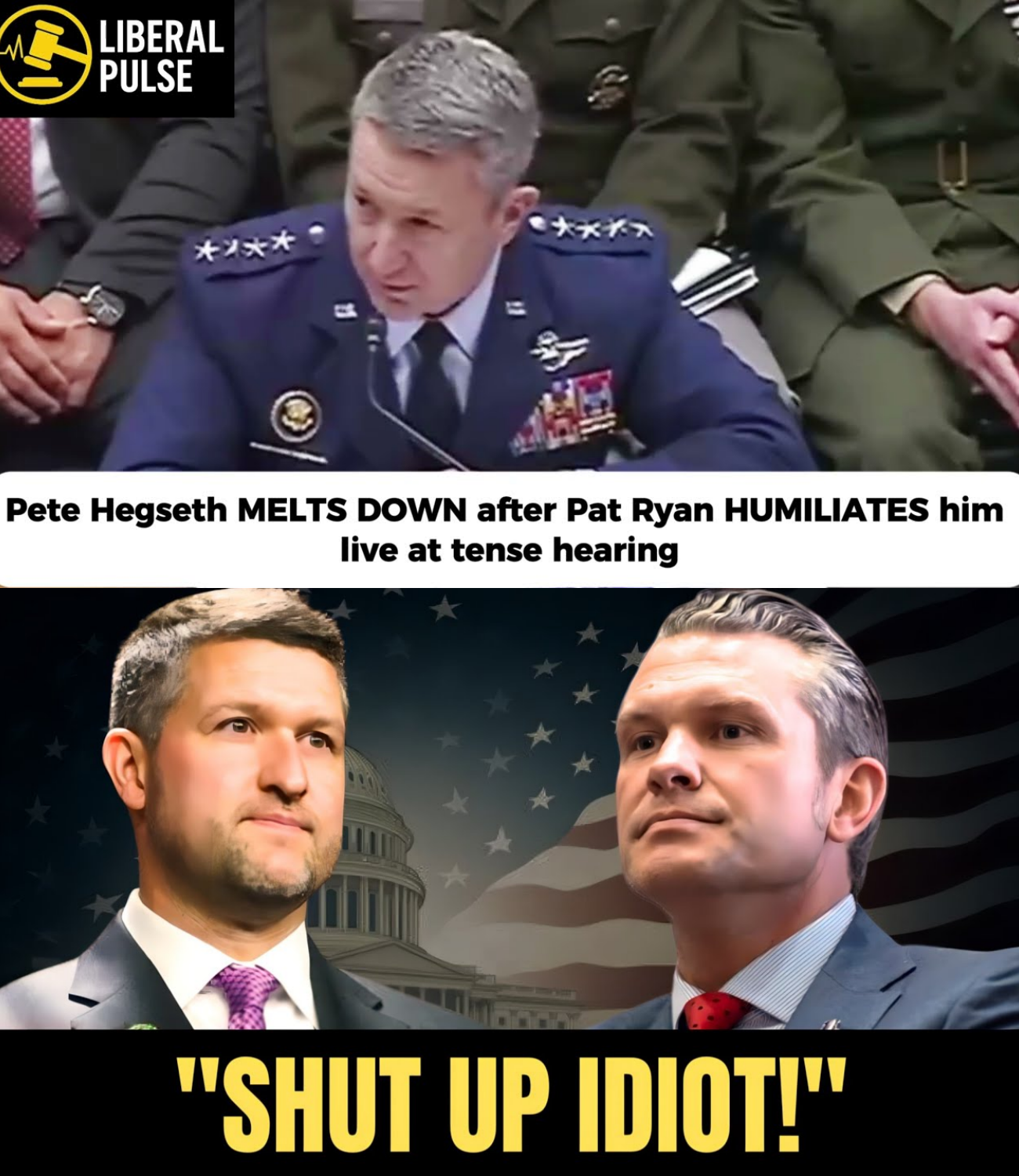
In a moment that stunned observers and sent shockwaves through Washington, the principle of an apolitical military—the bedrock of American democracy—faced a brutal examination. During a high-tension congressional hearing, Representative Pat Ryan, a veteran who served his country in uniform, leveled a blistering critique against Secretary of Defense Pete Hegseth. The exchange was not merely a political spat; it was a desperate plea to restore the wall between partisan influence and the armed forces, culminating in a demand for the Secretary’s resignation.
The hearing, which centered on the conduct of the Department of Defense, quickly pivoted to recent, deeply troubling reports emanating from Fort Bragg. According to verified accounts, soldiers of the 18th Airborne Corps were allegedly told that if their political views stood in opposition to the current administration, they should contact leadership to be “swapped out” of an event featuring the President. Compounding this, reports surfaced of pop-up shops selling campaign merchandise directly on military property. For many, these incidents were not just logistics errors; they were symptoms of a systemic failure to protect the sanctity of military neutrality.
The Question of Loyalty: Service to Constitution vs. Party
Congressman Ryan approached the hearing not as a partisan warrior, but as a veteran seeking to uphold the oath he once took. He first engaged General Kaine, a veteran with over 30 years of distinguished service, to establish the baseline of professional military conduct. Ryan’s questioning was precise and deliberate: “As a junior officer, were you ever required to make a pledge of political loyalty?” [01:03]
The answer from the General was a definitive “no.” This exchange reinforced a core truth of the American experience: the military exists to defend the Constitution, not to serve as a prop for political figures. Ryan pressed further, asking if in over three decades of service, the General had ever been forced to pledge partisan loyalty. Again, the answer was a resolute “no.” [01:19] This served as a chilling contrast to the allegations at Fort Bragg, where the lines between civil service and political campaigning appeared to have been dangerously erased.
The Clash with Secretary Hegseth
The temperature in the room spiked when Ryan turned his attention to Secretary of Defense Pete Hegseth. Ryan’s objective was to determine if official Department of Defense (DoD) directives regarding political activity were still being enforced—or if they had been eroded under the current administration’s guidance.
When asked if he was familiar with DoD Directive 1344.10, which governs the political activities of service members, Hegseth appeared evasive, at one point attempting to reject the premise of the questions entirely. [03:42] Ryan continued to press: “Has anything changed in that directive under your guidance given what happened two days ago at Fort Bragg?” [04:25]
The Secretary’s refusal to provide a clear, direct answer to the concerns regarding political merchandise and loyalty pledges only heightened the friction. When Ryan questioned whether it was appropriate for the Commander-in-Chief to wear political campaign gear at official military events, Hegseth offered a response that shocked many watching: he claimed the Commander-in-Chief could “wear whatever he wants.” [05:08] This dismissal of established norms signaled to many that the traditional standard of military neutrality was being actively disregarded at the highest levels.
A Demand for Accountability
As the hearing neared its conclusion, the atmosphere in the room shifted from investigative to accusatory. Ryan, clearly exasperated by what he perceived as a fundamental abandonment of duty, did not hold back. With his remaining time, he looked directly at the Secretary and delivered a sharp, sobering indictment of his leadership.
“Mr. Secretary, I don’t say this lightly. I have to say this on the record,” Ryan declared. “I think your tenure as Secretary of Defense has been shameful and weak, and you should resign.” [09:37]
This statement was not merely a headline-grabbing soundbite; it was the culmination of a broader fear that the military is being turned into a political instrument. When political loyalty begins to supersede loyalty to the Constitution, the integrity of the institution suffers. Ryan’s call for resignation reflects a growing concern among those who believe that the Department of Defense must remain the most neutral institution in the country, immune to the shifting winds of electoral politics.
The Path Forward
The aftermath of the hearing has left the nation with a difficult question: What is the proper role of the military in a hyper-partisan era? While the military is an arm of the executive branch, it has historically operated with a firewall against partisanship to ensure that the troops serve the nation as a whole, rather than the administration of the day.
The events at Fort Bragg, and the subsequent failure of the Secretary of Defense to adequately address these concerns, have exposed a crack in that foundation. If soldiers feel pressured to adopt political views to participate in official events, or if bases become platforms for political merchandise, the military’s role as a unifying national institution is fundamentally compromised.
As this story continues to develop, it serves as a stark reminder that democratic institutions are not self-sustaining; they require active, vigilant protection. Congressman Ryan’s decision to put his reputation on the line to demand accountability shows that some in Washington are still willing to stand up for the principles of the Constitution, even when the political cost is high. Whether this leads to a shift in policy or further debate remains to be seen, but the message has been delivered: the American people expect their military to remain neutral, professional, and entirely focused on the defense of the nation.
Full video: