
In a recent, highly charged segment, political commentator Bill Maher delivered a scathing critique of the Democratic Party’s current trajectory, warning that its embrace of democratic socialism is pushing it away from the electorate and toward political irrelevance. For Maher, the issue is not just one of policy but one of fundamental denial—a party seemingly disconnected from the reality of what voters are asking for, and more importantly, what they are explicitly rejecting.
The Great Ideological Split
Maher highlighted a glaring division within the party that has become impossible to ignore. On one side, there are those—like Virginia Governor-elect Abigail Spanberger—who urge the party to anchor itself in the middle, avoid divisive labels like “socialist,” and focus on practical governance. On the other, there is a vocal, influential wing that proudly identifies as democratic socialist, pushing for structural changes that many voters find alarming rather than appealing.
Maher’s assessment is that this is not merely a difference of opinion; it is a fundamental strategic failure. When a party cannot agree on its basic identity, it creates chaos that voters can clearly see. Maher pointed to the 2024 elections as a case study, noting that while the “loud” wing of the party was busy pushing grand, radical theories, the candidates who actually won were those who focused on stability, competence, and results.
The Allure of the Socialist Fantasy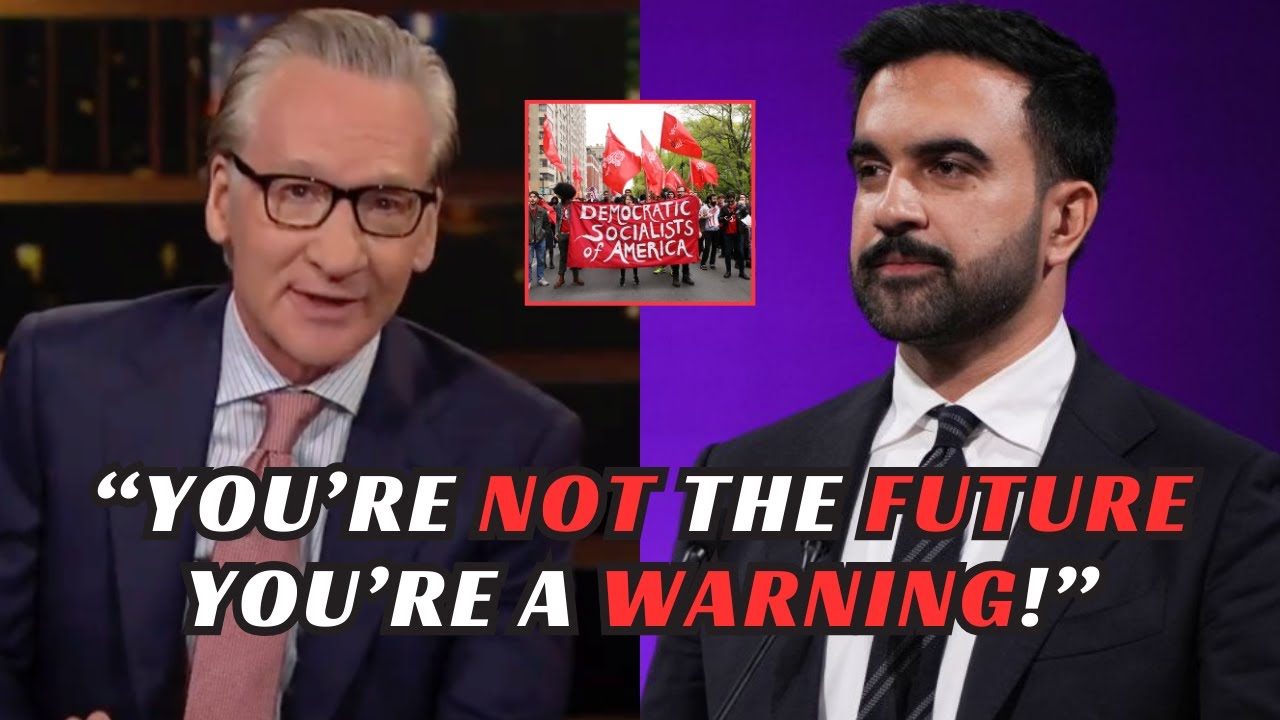
One of the most compelling parts of Maher’s argument was his psychological breakdown of why young voters—specifically Gen Z—are drawn to socialist rhetoric. He acknowledged that for many, capitalism has felt like a “tired” system that has failed to provide the upward mobility promised to previous generations. When you are buried in debt, struggling with rent, and watching the cost of living soar, the promise of a radical, egalitarian alternative can sound like a lifeline.
However, Maher warned that this is a dangerous illusion. He argued that socialism, while theoretically seductive, fails every time it makes contact with reality. He pointed to historical and contemporary examples—notably Venezuela—as evidence of what happens when a nation trades market-based systems for central planning. Maher’s message to younger voters was blunt: socialism isn’t a rescue plan; it is a warning sign. He stressed that systems are easily gamed, power is routinely abused, and the “free” things promised by such policies are eventually financed by the very people they intend to help, usually at a devastating cost to the economy.
A Demand for Competence
Beyond the economic arguments, Maher focused on the cultural and political disconnect between the party’s leadership and the average American. He argued that voters are not asking for a revolution or a total philosophical makeover; they are begging for “normalcy.” They want a government that functions—one that handles basic services effectively rather than one that prioritizes ideological crusades.
Maher contrasted this with the current trend of “cosplay authoritarianism” he sees among some activists. He cited specific examples, such as the absurdity of requiring negative COVID-19 tests at 2025 political conventions, as evidence that the movement has become more focused on performative purity than practical policy. To Maher, this is proof of a party drifting into territory that is politically toxic, pointing to stances on open borders and social issues as primary reasons why the party continues to lose ground.
The Warning: Adapt or Lose
The central theme of Maher’s critique is that the Democratic Party is currently on a collision course with reality. He noted that even establishment institutions, such as the New York Times, have begun to acknowledge that the party has moved too far to the left, alienating the very middle-class voters it needs to sustain a winning coalition. Maher’s warning is simple: if the party does not recognize that it has outrun its own voters, it will not just lose individual elections; it risks losing its standing as a viable national party.
He pointed to the success of moderate Democrats in districts where voters also chose Republican candidates as proof that the path to victory is in the center. By ignoring this data and continuing to chase the policies of the extreme left, the party is essentially writing the attack ads for their opponents.
In closing, Maher’s segment was less of a political debate and more of an urgent plea for common sense. He painted a picture of a party at a crossroads: it can either listen to the warnings, pivot back toward grounded, pragmatic, and popular policies, or it can continue to cling to the fantasy of a socialist revolution—a path that he believes ends only in failure.
As the political landscape continues to evolve, Maher’s words serve as a stark reminder that in a democracy, the ultimate judge of any policy is the voter. When the gap between political rhetoric and the daily reality of the public grows too wide, a reckoning is inevitable. The question now is whether the party will choose to bridge that gap or continue to drift into the ideological wilderness.
Full video: