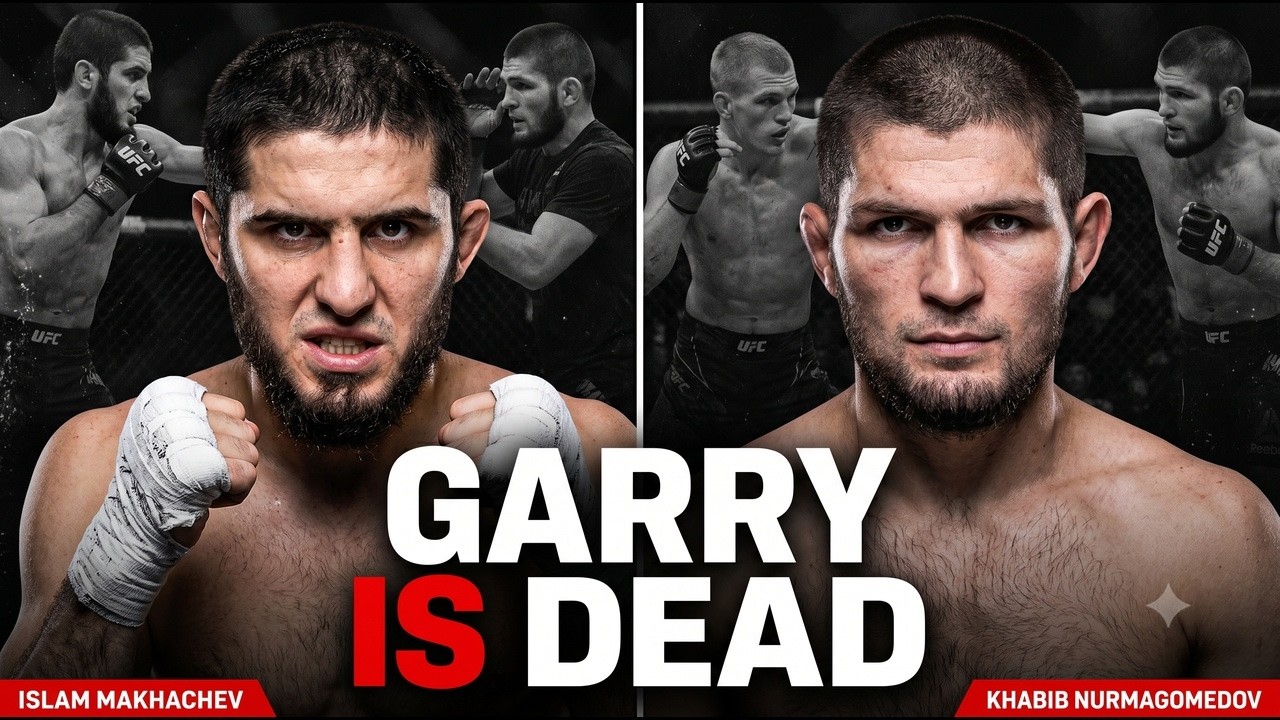
In the highly volatile, elite landscape of modern mixed martial arts, greatness is never maintained by simply defending what has already been won. The history of the Ultimate Fighting Championship is littered with champions who became comfortable at the summit, only to be unceremoniously dethroned by a hungrier, younger generation. To build a legacy that is truly bulletproof, a fighter must possess the audacity to seek out new frontiers, moving up in weight to face larger, physically imposing adversaries who present entirely different geometric and stylistic problems. Standing at the absolute center of this historic transition is the reigning lightweight king, Islam Makhachev.
As the pound-for-pound titan readies himself for a monumental welterweight showdown against the rangy, strategic Irish phenom Ian “The Future” Garry at UFC 330, the stakes have escalated to an unprecedented level. If Makhachev secures the victory, he will move within touching distance of breaking the legendary Anderson Silva’s record of 16 consecutive UFC wins. Recognizing the sheer magnitude of this historical milestone, the Dagestani camp has summoned its ultimate weapon: the former undefeated lightweight king and global icon, Khabib “The Eagle” Nurmagomedov.
The return of Khabib to the active training mats of the American Kickboxing Academy has sent a clear, chilling message to the rest of the sporting world. Khabib’s presence in camp is not merely symbolic or ceremonial; he is actively leading the grueling, daily physical grind. In rare, candid footage captured from deep within the training room, the legendary “Eagle” detailed his uncompromising training philosophy.
Khabib explained that while he spent the preceding week relentlessly pushing the fighters to the absolute brink of exhaustion, his brief weekend departure offered them only a temporary reprieve. Returning for another five-day block of high-intensity training, Khabib delivered a blunt, sobering warning: while the process is a fun and fulfilling intellectual challenge for him as a coach, it represents a brutal, agonizing psychological trial for the athletes. This level of physical preparation is designed to systematically dismantle a fighter’s comfort zone, ensuring that when Makhachev steps inside the Octagon under the bright lights of UFC 330, the real-world violence of the cage will feel like a welcome relief compared to the horrors endured in training.
This extreme preparation is highly intentional, as Makhachev and his brain trust recognize that Ian Garry represents an exceptionally unique, head-scratching puzzle. Standing at 6’3″ with a long, lanky frame and highly polished kickboxing timing, Garry is a master of maintaining distance, leveraging unconventional footwork, and utilizing deep strategic patience to pick his opponents apart.
Unlike many traditional welterweights who engage in high-octane, chaotic brawls, Garry is a highly intellectual point-fighter who refuses to make emotional mistakes. Makhachev himself has noted this stylistic complexity, openly comparing Garry to the undefeated rising star Michael Morales. In Makhachev’s estimation, Morales represents a far more traditional, complete martial arts competitor—a fighter possessing heavier wrestling credentials and a more predictable, high-output striking game. Garry, on the other hand, is what prominent analysts describe as “a weird one.” His awkward timing, cerebral cadence, and rangy movement make him exceptionally difficult to look good against, transforming any stand-up exchange into a high-stakes chess match where a single mistake can result in a fight-ending counter.
To neutralize this lanky threat, head coach Javier Mendez is focusing on a holistic, all-encompassing approach rather than obsessing over a single opponent’s habits. Mendez, a legendary trainer who has overseen the championship rises of multiple UFC Hall of Famers, understands that preparing strictly for one style is a dangerous trap in modern MMA. While acknowledging that Garry possesses the elite, tricky kickboxing to potentially cause Makhachev problems in a vertical battle, Mendez maintains that the moment the fight transitions to the canvas, the playing field shifts entirely.
According to Mendez, while Garry has spent significant time in Brazil and various international camps sharpening his defensive jiu-jitsu, there is a vast, unbridgeable chasm between standard defensive grappling and the suffocating, soul-crushing top pressure applied by Makhachev. Mendez is supremely confident that while Garry might possess the athletic durability to survive multiple rounds, he will be completely unable to mount any meaningful offense once Makhachev begins dictating the grappling sequences. The plan, therefore, is not to prepare for “Ian Garry the kickboxer,” but to prepare Makhachev to be the most complete, dangerous martial artist on earth, capable of transitioning from vertical striking to elite chain-wrestling in the blink of an eye.
This structural philosophy of dominance is echoed by veteran fighters like Stephen “Wonderboy” Thompson, who have spent decades analyzing the specific mechanics of the Dagestani wrestling system. Thompson points out that the style popularized by Khabib and refined by Makhachev is uniquely terrifying because it goes far beyond physical damage. It is a methodical, psychological grinding process designed to systematically break an opponent’s spirit, mental fortitude, and emotional resolve over the course of 25 minutes.
Thompson describes how opponents facing this style often reach a heartbreaking breaking point halfway through the contest, physically exhausted and mentally overwhelmed by the constant, heavy weight of their adversary. It gets to a point where fighters are no longer looking for a path to victory; they are simply looking for an honorable way out of the cage, sometimes exposing their backs just to accept a quick, clean submission and escape the grueling torment. To defeat a machine like Makhachev, Thompson argues, a challenger cannot merely possess crisp kickboxing; they must possess legendary cardio, a bulletproof mind, and an endless, stubborn willingness to scramble back to their feet every single time they are taken down.
The sheer unpredictability of this sport was recently highlighted by the monumental events of the historic White House card, an evening that prominent commentator Joe Rogan branded as the greatest, wildest night of fights in combat sports history. The event saw Justin Gaethje enter his lightweight championship clash against the heavily favored, undefeated phenom Ilia Topuria as a massive 6-to-1 underdog. Topuria, widely heralded as the absolute peak of the new, highly skilled generation of martial artists, was expected by many to easily overwhelm the veteran BMF champion. Yet, through sheer heart, tactical patience, and a willingness to embrace “controlled chaos,” Gaethje weathered an early storm, adjusted his distance, and began landing devastating, fight-altering bombs that ultimately forced Topuria to quit on his stool at the end of the fourth round.
This historic upset serves as a vital, sobering reminder for Makhachev’s camp: in the upper echelons of the UFC, no champion is truly invincible, and a single moment of overlooking an opponent’s heart can result in a devastating fall from grace.
Ultimately, the impending collision between Islam Makhachev and Ian Garry at UFC 330 is far more than a standard title defense; it is a battle for the historical soul of the welterweight division. Backed by the wisdom of Javier Mendez and the terrifying, relentless energy of Khabib Nurmagomedov, Makhachev is preparing to cement his name alongside the greatest to ever grace the Octagon. He does not merely want to hold a belt; he wants to walk away from the sport strictly on his own terms, still wearing the gold and leaving an legacy of absolute, unquestioned dominance. As Ian Garry prepares to step into the cage to test his slick Irish striking against the ultimate wrestling machine, he must reckon with a chilling reality: he is not just fighting the man standing across from him—he is fighting an entire system of combat, forged in the mountains of Dagestan and overseen by the shadow of the Eagle himself.