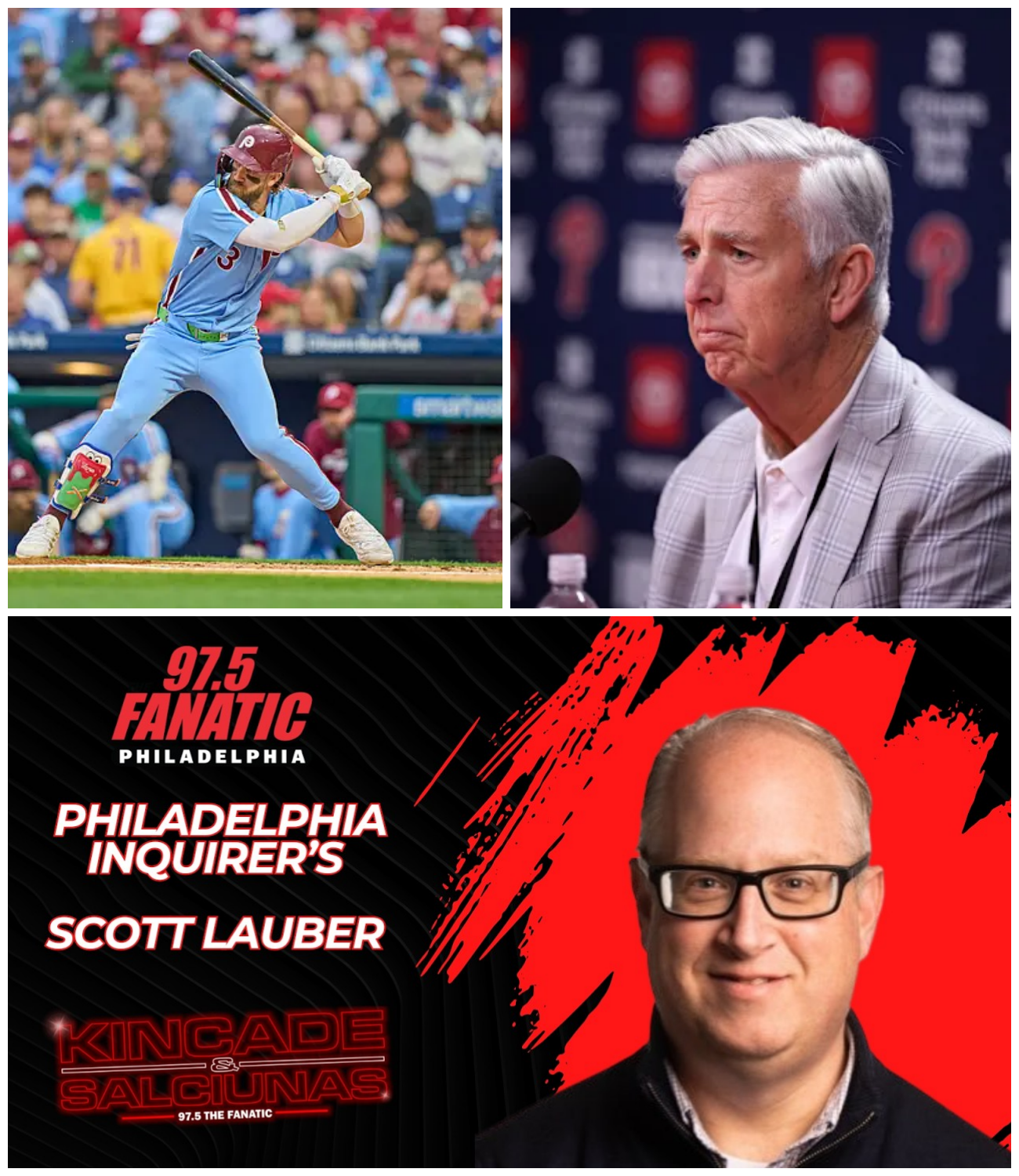
If you were driving into Pennsylvania from New Jersey over the Ben Franklin Bridge this week, you likely found yourself slowing down—not just because of the notoriously frustrating morning traffic, but because of a massive, imposing billboard that commands the Philadelphia skyline. Erected by Major League Baseball, the towering advertisement features the brightest stars in the sport today: Bobby Witt Jr., Shohei Ohtani, Yordan Alvarez, and standing proudly among them, donning the iconic Philadelphia pinstripes, is Bryce Harper. It is a striking, larger-than-life visual that immediately begs a massive question for baseball purists and casual fans alike: Is Bryce Harper still the undisputed face of Major League Baseball?
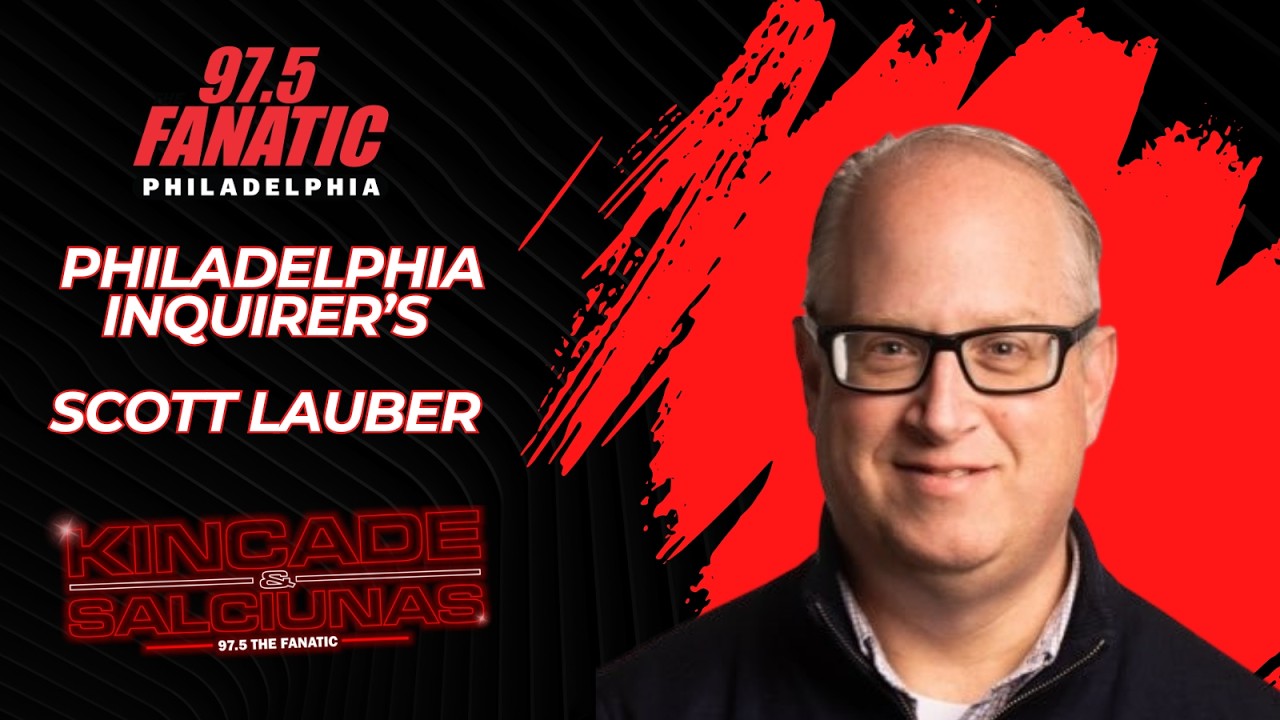
According to long-time Phillies beat writer and baseball insider Scott Lauber, the answer is a resounding yes, and the proof lies in the actions of the highest office in the sport. When Commissioner Rob Manfred utilized his “legend selection” to ensure Harper’s presence in the All-Star game—especially with the festivities taking place in Philadelphia—it was a highly calculated move. As Lauber rightly points out, this was a tacit admission from MLB that you simply cannot hold a marquee event in the city of Philadelphia without its biggest star taking center stage. Harper’s inclusion wasn’t just a charitable nod to the hometown crowd; it was a mandate.
However, the player vote painted a strangely different picture, one steeped in a complicated history. In the ballots cast by his own peers, Harper finished a distant third behind Matt Olson and Freddie Freeman. To understand this perceived snub, you have to travel back in time and examine the deeply ingrained psychological narrative surrounding Harper since his teenage years. Long before he was a Phillie, Harper was heavily scrutinized. There was palpable jealousy among veteran players who openly questioned what this brash, highly publicized kid had ever done to deserve the cover of Sports Illustrated. That resentment boiled over in infamous moments, such as when former Phillie Cole Hamels intentionally hit a rookie Harper with a pitch just to “make a point” and welcome him to the big leagues.
Years later, an anonymous ESPN player poll even infamously labeled Harper as the most “overrated” player in the game. Yet, the beautiful irony of Bryce Harper’s career is that he has systematically dismantled every single critique lobbed his way. The kid everyone loved to hate is now a battle-tested veteran on the doorstep of 400 home runs, with a highly realistic trajectory to hit 500 or even approach 600 before he hangs up his cleats. He is assembling a surefire, first-ballot Hall of Fame resume. While some lingering biases might remain in the locker rooms of his opponents, Harper has undeniably backed up the astronomical hype that surrounded him as a teenager.
While Harper dominates the cultural conversation at the plate, a different kind of historical debate is brewing in the Phillies’ bullpen. For years, the gold standard of Philadelphia relief pitching has been Brad Lidge’s legendary, flawless 2008 season. Going 41-for-41 in save opportunities during the regular season and an unblemished 7-for-7 in the postseason to secure a World Series title is the stuff of sports mythology. However, Lauber raises a fascinating point: are we currently witnessing a closer who is inherently more dominant than Lidge, even if the save column isn’t perfectly spotless?
Those who vividly remember the 2008 season know that Lidge’s saves were often heart-pounding, anxiety-inducing affairs. There were “hairy saves” involving bases-loaded jams and game-ending plays at the plate. Lidge relied almost exclusively on a two-pitch mix—a fastball and a devastating slider. If a batter guessed right, they had a fighting chance. In stark contrast, the modern Phillies bullpen features a closer equipped with a frankly unfair arsenal. We are talking about a devastating combination of a triple-digit fastball, a gravity-defying sinker, and three distinct off-speed pitches that can easily put a batter away. When the current closer steps on the mound, he isn’t just escaping jams; he is regularly striking out the side with mechanical, ruthless efficiency. While Lidge’s perfect record remains sacred, the sheer, unadulterated dominance of today’s bullpen ace is arguably unmatched in franchise history.
Despite these incredible individual performances, the ultimate success of the Phillies hinges on their ability to navigate the treacherous waters of the National League. Currently, they are firmly entrenched in the top four of the NL hierarchy, sitting shoulder-to-shoulder with the Atlanta Braves, the Milwaukee Brewers, and the Los Angeles Dodgers. But there is a glaring caveat that has fans deeply concerned: the Phillies have struggled to prove they can consistently beat the heavyweights.
Series losses to Milwaukee and Los Angeles loom large, and the haunting memories of back-to-back weekend series against the Braves in April—a stretch so disastrous it had fans irrationally calling for manager Rob Thomson’s job—are hard to shake. There is an underlying fear that a team capable of going on a terrifying 9-19 skid at any moment might not have the consistency required for a deep October run. However, the counter-argument is just as potent. The Phillies are uniquely built for the postseason. If they can punch their ticket to the dance, a playoff rotation spearheaded by Zack Wheeler and Cristopher Sánchez, supported by the explosive, game-altering bats of Harper and Kyle Schwarber, is a nightmare scenario for any opposing manager.
This brings us to the agonizing dilemma facing President of Baseball Operations Dave Dombrowski as the trade deadline rapidly approaches. Dombrowski is haunted by the ghost of the 2024 Division Series loss to the New York Mets, a series where he admittedly regretted not being more aggressive in acquiring a back-end starting pitcher. The front office thought they could patch things together with Tyler Phillips and Taijuan Walker, but a lack of rotational depth caused the team to limp into the playoffs and ultimately collapse. Fast forward to today, and history threatens to repeat itself.
The Phillies are staring down multiple gaping holes. They desperately need a reliable right-handed bat to lengthen a lineup that can sometimes go cold. Even more pressingly, they have a glaring fifth-starter problem that could easily morph into a fourth-starter problem. While Aaron Nola looked brilliant recently against the Kansas City Royals, skeptics are quick to point out that the Royals are not exactly an offensive juggernaut. Nola’s frustrating inconsistency means he needs to string together several dominant starts against tough competition before the fanbase can fully trust him in a decisive playoff game.
The most painful part of this deadline dilemma? The Phillies’ farm system is essentially barren. Outside of healthy, top-tier prospect Gage Wood, there is precious little prospect capital to leverage in trade negotiations. Dombrowski is operating with one hand tied behind his back; he simply cannot afford to shop in the “high-end aisle” of the trade market. The reality is that the Phillies will likely have to settle for complimentary, marginal pieces rather than a blockbuster savior. They have to give in order to get, and right now, the cupboards in Philadelphia are incredibly bare.
As the summer heats up and the dog days of August approach, the Philadelphia Phillies find themselves at a thrilling, yet terrifying, crossroads. They have the superstar face of baseball cementing his legacy, a historically dominant bullpen arm rewriting the standards of relief pitching, and a core group of players capable of catching lightning in a bottle in October. Yet, undeniable flaws remain, and the margins for error are razor-thin. Whether Dombrowski can pull off a minor miracle at the trade deadline, or whether this star-studded roster can overcome its own inconsistencies, will ultimately determine if this era of Phillies baseball ends in a parade down Broad Street or another heartbreaking chapter of what-ifs.