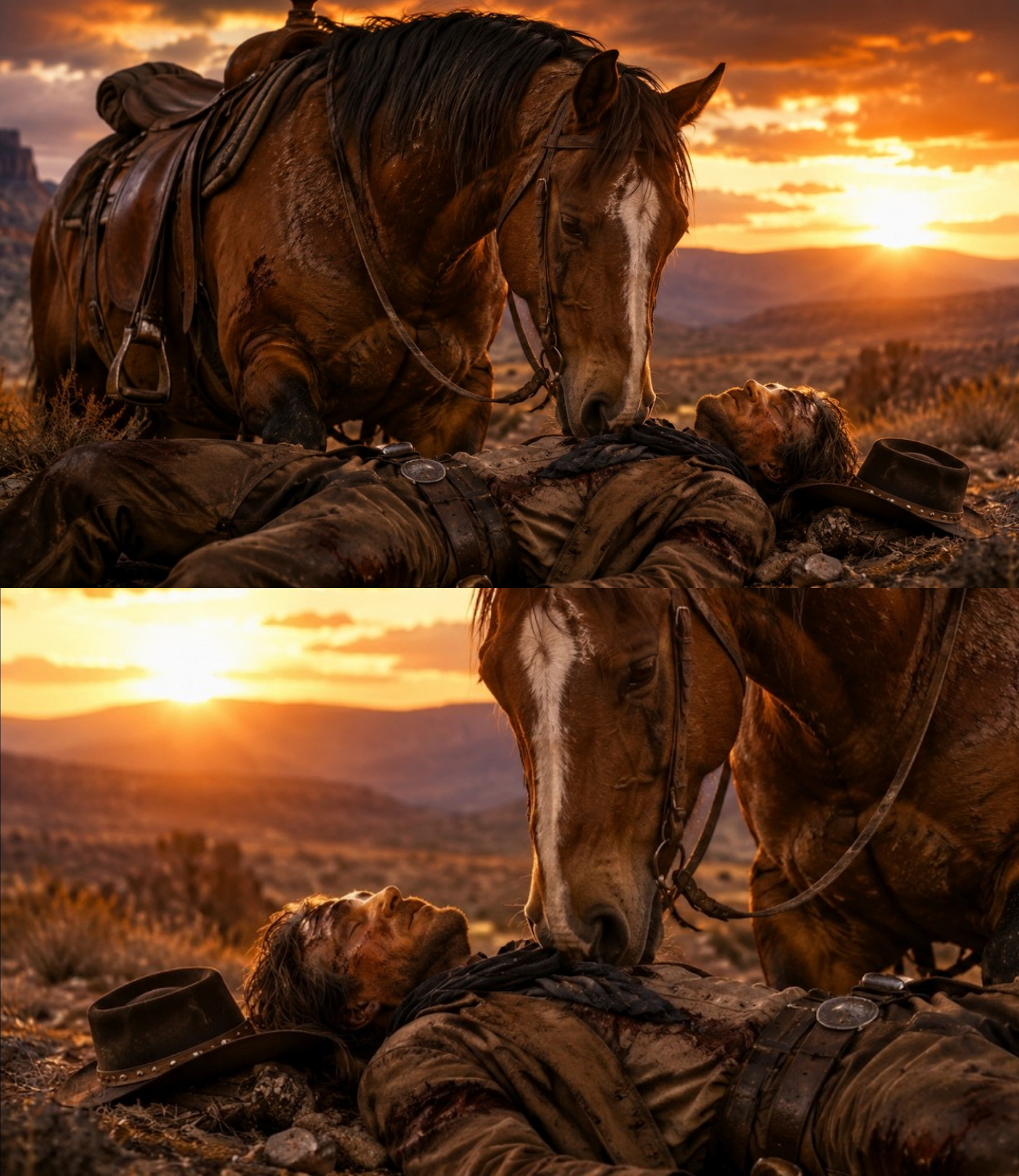
There’s a thing men out west used to say when they didn’t want to admit they’d been wrong about an animal. They’d say, “That horse has more sense than the man riding it.” They said it as a joke, mostly. I stopped laughing at that joke on a gray morning in the winter of my 41st year, standing knee-deep in a river that was trying its level best to kill a boy I’d promised to look after, and watching a half-broke roan I’d already given up on refused to do the one sensible thing every instinct in its body was screaming at it to do.
Run. Every horse runs, friend. That’s the whole shape of them. Prey animals built long and light for one purpose, to be somewhere else when the killing starts. I have spent 30 years learning the language of when a horse decides it’s had enough, and I have never once blamed a single one of them for leaving. But this one didn’t leave.
This one stood in water cold enough to stop a heart, with the current pulling at its legs and the ice cracking like pistol shots up and down the bank. And it planted itself over a drowning boy like it had grown roots straight through the riverbed. I’m going to tell you what I saw. I’m going to tell you all of it, even the parts I’ve kept to myself for a long time, even the part at the end I still can’t say out loud without my voice going somewhere I don’t want it to go.
But I need you to understand something before we start, so you’ll believe the rest of it. I did not want to love that horse. I had good reasons not to. By the time this story is over, you’ll understand why that’s the saddest sentence I know. Stay with me. The river was called the Powder, and it lied about everything.
It lied about its depth, running shallow and brown and lazy across the flats, so you’d think a child could wade it, and then dropping without warning into holes that swallow a steer whole. It lied about its temper, and on the morning I’m telling you about, it lied worst of all about the ice. A skin of it laid clean across the slow water near the bank, white and honest-looking as a tablecloth, thick enough to trick a tired animal into trusting it, and thin enough to break the second weight came down.
I was 40 paces back and upstream when it broke. I heard it before I understood it. That’s how it always is with the bad ones. The sound arrives first and hangs there in the air a full second before your mind catches up and tells you what it means. A crack, then a splash that was too big, too heavy, the kind of splash that has a horse in it.
Then the boy shouting, and the shout cutting off wrong. I want to tell you I moved fast. I didn’t. For that one second, I sat frozen on my own mare with my mouth open like a fool, because the man who moves fast is the man who’s practiced the disaster in his head a hundred times, and I had spent that whole drive practicing every disaster except this one.
His name was Wesley, Wes. 16 years old and built like a bundle of fence wire, all elbows and stubbornness, with a calic at the back of his head that no amount of water or hat would ever lie flat. He’d come to the outfit in the spring with nothing but a saddle two sizes too big for any horse he owned, and a chip on his shoulder the size of a wagon wheel. His daddy was dead.
Nobody said how. He didn’t ask about mine, and I didn’t ask about his, and that was about as close to friendship as men like us tend to get. I’d promised his mother I’d bring him home. I hadn’t wanted to make the promise. I want you to know that. I stood in the doorway of a soddy up near Buffalo with my hat in my hands, and this small dried out woman looking up at me with eyes that had already buried a husband.
And every honest bone in my body wanted to tell her, “Ma’am, I can’t promise you the weather. I can’t promise you the river. I can’t promise you the thousand things that kill boys on a drive.” But she wasn’t asking for honesty. She was asking for something to hold on to. So I lied gentle, the way you lie to the grieving, and I said, “Yes, ma’am.
I’ll bring him back to you.” 40 paces upstream from a broken sheet of ice, that lie came due. The horse was already down when I got my mare turned. And here’s where I have to stop and tell you about the horse, because you can’t understand what happened next without understanding what that animal was to me, which was, up until that exact morning, a failure I couldn’t forgive myself for.
We called him Gideon. He came to the ranch 2 years before as part of a rough string of mustangs the boss bought cheap off a mustanger down near the sweetwater, and Gideon was the one nobody wanted. Big bigger than a mustang has any business being, 16 hands of muscle and bad opinion, a blue roan so dark he looked like a thundercloud that had learned to hate.
The mustanger threw him in for free. “Can’t gentle that one,” he told me, spitting. “Tried. He’ll take the saddle, won’t take a soul.” I should have listened. But I was younger then in the ways that matter, and I had spent my whole life believing there wasn’t a horse alive I couldn’t reach. And Gideon looked at me across that corral with an expression I can only describe as insulted, like my very existence was an imposition on his morning.
And something in me said, “That one. I’ll break that one.” I never did. Oh, I got a saddle on him. Got a bridle. Got eventually to where I could ride him without ending up in the dirt more than once out of every three tries, but breaking a horse isn’t about the saddle. It’s about the moment the animal decides that when everything goes wrong, it’ll look to you instead of to its own legs.
That’s the whole thing. That’s the covenant. Every good horse I ever made, there came a day when it stopped asking, “Can I trust this man?” and started asking, “What does this man need?” Gideon never crossed that line for me. Two years. I put two years into that ornery, iron-headed, magnificent son of a gun, and he gave me nothing back but tolerance.
He’d let me ride him the way a bank lets you keep your money in the vault, grudgingly, on terms, and never for 1 second forgetting that it was his and not mine. By the winter of the drive, I’d about given him up. I’d said as much to the boss. “Cut him from the string,” I said. “He’s beautiful and he’s useless, and every day I ride him, I feel like a liar.
” And then the boy asked to ride him. That’s the part I skipped, isn’t it? Let me go back. Wesley’s been riding a steady little bay all season, and the bay came up lame 2 days before we hit the powder, and there wasn’t a spare in the remuda worth the name except one big blue roan nobody could handle. I told the boy no.
I told him no three times. I told him Gideon would kill him just to watch the expression on his face. He rode him anyway. I still don’t know exactly how, and I’ve had years to figure it out. I was mending a girth on the far side of camp when I looked up, and there was Wesley sitting easy on Gideon’s back. Both of them still as a photograph in the gray morning light, and the horse wasn’t fighting.
Wasn’t tolerating, either. There was something soft in the set of his ears that I had never once earned in 2 years of trying, and this 16-year-old boy with a cowlick and a dead father had earned it in about 10 minutes of sitting quiet and not asking for anything. I should have been proud. I was proud. I was also, God help me, jealous in the small ugly way a man gets jealous of a thing he loves that loves somebody else better.
I climbed to my feet and I walked over and I said something I’ve regretted every day since. I said, “Well, guess he just needed somebody with nothing to prove.” And the boy grinned at me, that awful gileless 16-year-old grin, and said, “Or maybe he just likes me better, Cole.” Two days later, the ice broke under both of them.
The current had them. By the time I got my mare to the bank, Gideon was down on his side in the shallows with his legs half through the broken ice, thrashing. And the boy, the boy was under him. That’s what my mind gave me first in that flat terrible way the mind hands you the worst piece. The boy is under the horse and the horse is on top of the boy and the water is over both of them.
I came off my mare before she’d fully stopped. Went into the powder up to my thighs and the cold hit me like a fist closing around every bone at once. I’ve been cold in my life, friend. I’ve wintered in country that freezes the breath in your beard. But I have never felt a cold like that river. A cold with intention in it.
A cold that wanted something from me. I got to them shouting the boy’s name. “Wheeze! Wheeze! Wesley!” And here is the thing I saw that I have spent the rest of my life trying to make sense of. Gideon was not thrashing to get away. I’d read it wrong from the bank. Any man would have. But up close, with my hands on the horse in the water dragging it all three of us, I could see it plain.
Every wild movement of that animal was toward the boy, not away from him. He’d gone down when the ice broke, gone down hard, and the current wanted to roll him off downstream. And instead of letting it take him, instead of doing the one thing that would have saved his own life, he was fighting to keep his big body between Wesley and the deep water.
The boy was pinned. Not under the horse, I’d got that wrong, too. His leg had gone down through the ice into a snag of old cottonwood root, wedged, and the current had folded him back and down until his face was inches from going under. And the only thing on this earth keeping the river from finishing the job was 1,600 lb of blue roan planted upstream of him like a breakwater.
Taking the full weight of the powder on his own flank so the boy wouldn’t have to. I have watched men die trying to save each other. I have seen the best of what people have in them. And I am telling you as plain as I know how, I had never in my life seen anything choose the way that horse was choosing. “His leg,” Wesley gasped when I got to him. His lips were already going blue.
“Cole, my leg, I can’t.” “I got you, I got you.” I didn’t have him. I got both hands down into that black water and felt along his leg to where the root had him, and it was bad. The boy’s boot was wedged sideways in a fork of old drowned wood, and the more the current pushed, the tighter it jammed. I pulled. Nothing.
I pulled until I felt something give in my own shoulder, and the boy screamed, and it still didn’t move. And the whole time, Gideon held the line. I want you to picture it. The ice cracking off in sheets, the water the color of gunmetal moving fast enough to take a grown man off his feet. And this horse that had spent 2 years refusing to give me his heart, standing splay-legged in the killing cold with the entire river shoving at him, refusing refusing to step off the boy and save himself.
Every few seconds a fresh surge would hit him and he’d stagger, and I’d feel the water leap higher up Wesley’s chest in that moment. And then Gideon would find his feet again and lean back into it, and the water would drop. He was drowning himself by inches to buy the boy air. I got my knife out.
I want to be honest about what that meant. There’s a thing you do when a man’s boot is trapping him underwater and you can’t free the boot, and it is a thing I had done exactly once before in my life on a different river on a different man, and that man had thanked me for it every day of the shortened limping life he lived afterward.
I got my knife out and I put my mouth close to the boy’s ear so he’d hear me over the water and I said, “Wesley, I might have to cut you loose. Do you understand me? The boot may be more than the boot. Do you understand what I’m telling you?” And I felt him go still. Not the stillness of a boy giving up, the other kind, the stillness of somebody choosing.
“Not yet,” he said. “Try the try the horse. Cole, get him to pull.” I thought he’d lost his mind to the cold. “He can’t pull you, son. He’s holding the water. If he moves, you go under.” “He’ll pull if I ask him.” The boy’s teeth were chattering so hard I could barely make out the words. “He’ll pull if I ask. Get the rope.
” Now, I have to stop the story here because I want you to sit with the size of what that boy was saying. He was trapped in a river that was killing him. He had at most a minute of consciousness left. And the plan he was proposing depended entirely on a half-wild mustang, an animal that had never once in 2 years done a hard thing on command for the man who trained him.
Doing the hardest thing a horse can be asked to do at the exact moment for the right reason out of nothing but love. I did not believe it would work. I got the rope anyway because a man does not tell a drowning boy no. I looped my catch rope around the boy’s chest up under his arms and I fought my way through the current to Gideon’s head and I did the only thing I knew to do which was the thing I’d been doing for two useless years.
I took hold of him and I asked. He didn’t even look at me. His eyes were on the boy. That whole time through all of it, his eyes had never left the boy. And I understood kneeling there in the water with my hands on a horse that had never given me the time of day that I was not the one who could ask him for this. I never had been.
The covenant I’d spent 30 years learning to build with horses, Gideon had already built it just not with me. So I did the last thing my pride would ever have let me do on any other day in any drier place. I got out of the way. I dragged myself back to the boy and I put the tail of the rope in his blue shaking hands and I said, “Then you ask him. I can’t. He’s yours. Ask him.
” And Wesley, 16 years old, half drowned, one heartbeat from the dark, turned his face toward that horse and he didn’t shout. That’s what I remember most. Everybody thinks the moment would be a shout. It wasn’t. He said it soft, the way you talk to something you love that was scared.
The exact same soft voice I’d heard him use two mornings before when he climbed onto a horse nobody could ride. “Gideon, back. Come on, boy, back.” And the horse moved. He didn’t step off the boy. He was smarter than that, smarter than me, God knows. He kept his body over the deep water, kept breaking the current, and he backed and turned all at once in that heavy churning cold, so that the rope came tight between his chest and the boy’s.
And then he threw his whole magnificent, hated, two years wasted weight against the pull. And the river fought him for it. And the old drowned cottonwood root that had a boy’s leg in its teeth groaned, and shifted, and gave. I felt Wesley come free the way you feel a splinter finally leave a thumb. A sick, glorious lurch of release.
And the current took him instantly, and would have had him gone downstream in a half second if the rope hadn’t been there. If the horse hadn’t been there. If two years of failure hadn’t turned out to be the exact and necessary shape of the only thing that could have saved him. Gideon dragged him into the shallows. Step by step.
Backing, hauling, planting, hauling again up out of the deep and onto the broken shelf of ice, and up further onto the gravel bar where the water only ran ankle deep. And I was beside them the whole way with my hands under the boy’s arms doing what little I could, but I want to be truthful with you. It was the horse.
It was the horse that did it. I was there. I helped. But if you took me out of that river entirely, Wesley still walks out of it. Because that horse was never going to leave without him. We got him to the bank. He was blue, and he was shaking, and his leg was a ruin, and he was alive. He was alive. He was coughing up the powder and crying and laughing at the same time the way you do when your body hasn’t caught up to the fact that it isn’t going to die today.
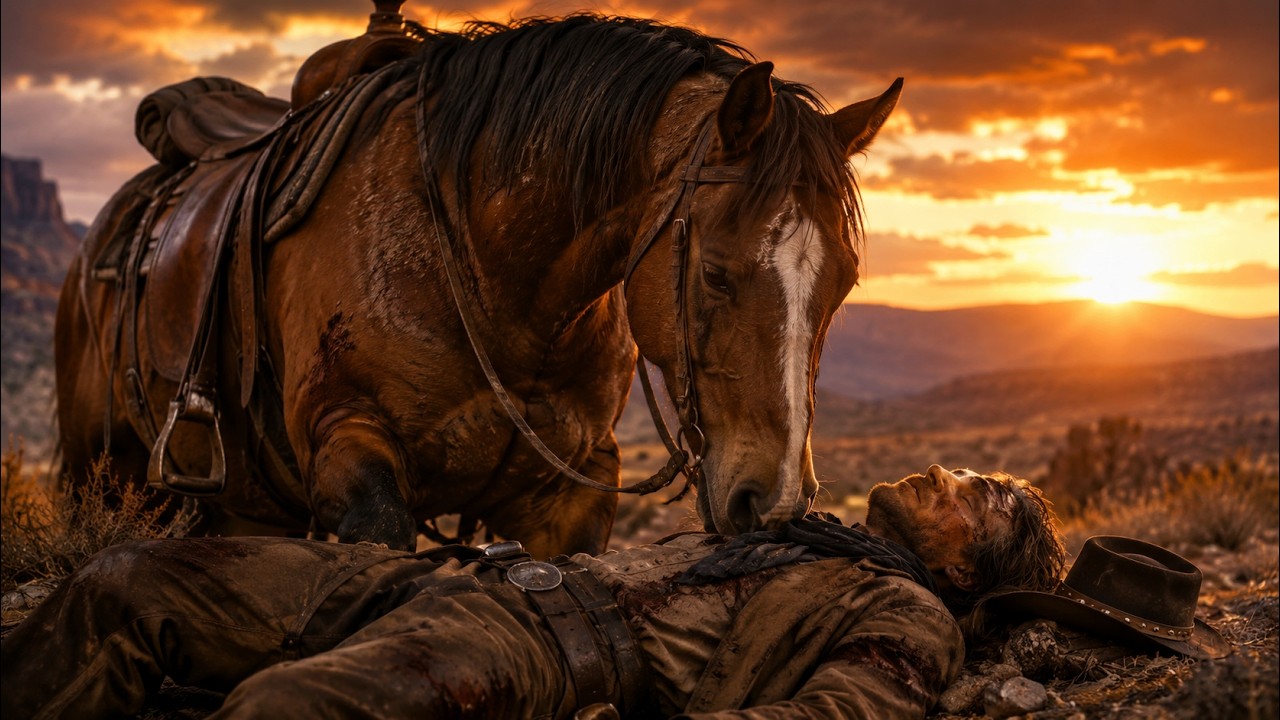
And Gideon stood over him. Streaming water, sides heaving like a bellows, legs cut up bad from the ice, and he lowered that big, ugly, beautiful head down until his nose was against the boy’s chest, and he just breathed in and out like he was making sure, like he was counting. I sat down in the freezing mud, and I put my face in my hands, and I did something a man of my age and profession is not supposed to do.
I’ll leave what I did there. You can guess. That should be the end of it, shouldn’t it? Boy saved, horse redeemed, old man humbled. That’s a whole story right there. And if I stopped telling it now, you’d go away satisfied, and you’d sleep fine tonight. But I told you at the start there was a part I couldn’t say out loud, and it isn’t in part one.
Because here’s what I hadn’t told you yet, the thing I’d been holding back, the thing that turns everything you just read from a rescue into something harder to hold. Gideon was heart worse than any of us knew. That cold in those legs, and the two years I’d wasted, and the price a horse pays for standing in a river when every instinct it owns is begging it to run.
None of that comes free. I got the boy warm. I got the boy home to his mother, and I kept my lie into a promise. And to this day, Wesley walks with a hitch in his step and a story he doesn’t tell. But the horse Ah, the horse. Let me catch my breath, friend. Part two is the one that costs me. Cold does its worst work slow.
I need you to understand that because otherwise the rest of this won’t sit right in you. When a body, man or horse, comes out of water like the powder, the danger isn’t over. The danger’s just changed shape. The river tries to kill you fast. The cold that comes after tries to kill you patient, and it is much better at its job.
We didn’t have far to go. The wagon was 2 miles back with the rest of the outfit, and I got the boy up on my mare wrapped in every dry thing three men owned, and I led Gideon behind us at a walk, and I told myself the horse was fine. He was walking, wasn’t he? He’d hauled 140 lb of drowning boy out of a river not 20 minutes before.
A horse that could do that was fine. That’s the lie a tired man tells himself when he’s already spent his whole heart and hasn’t got any left over for a second emergency. I have made a study of that particular lie in the years since. I have got to know it very well. Gideon walked those two miles. He walked them because the boy was on the horse ahead of him and he wasn’t going to be anywhere the boy wasn’t.
I understand that now. At the time I just thought good, he’s walking. But I noticed the way you notice a thing and file it away to worry about later when there’s room that his head was carried lower than a horse carries its head, and that every few steps there was a hitch, a little catch in the near hind.
The leg he’d braced against the current with, the leg that had taken the river. We made camp. We got the boy into blankets and hot broth, and the color came back into him by inches, and there was a good hour there, the best hour, where the whole camp was loud and glad and men were slapping each other, and somebody produced a bottle that was supposed to be for snakebite.
And Wesley sat propped against a wagon wheel with his ruined leg splinted out in front of him telling the story already, telling it big, the way 16-year-olds tell the thing they survived, and every third word was Gideon. And I stood at the edge of the firelight with the horse. He wouldn’t eat. That’s the first hard thing. A horse that’s cold and shaken but sound will eat, will eat like the world’s ending, will drive its nose into the grain and not come up for air.
Gideon stood at the picket line with the whole camp warm and loud behind him, and he faced out into the dark toward the river, and he would not touch the feed I put down. I ran my hands over him then, really over him, every inch, the way I should have done at the bank and didn’t because I was too busy weeping into my palms like a boy, and I found it.
The near hind, up high, where he’d braced, hot, swollen. And when I pressed gentle, just the flat of my hand, he swung his head around and looked at me. Not to bite. Gideon never once bit me in his whole life, for all his ornery ways. He looked at me the way he’d looked at the boy in the river, steady, like he was telling me something and trusting me to be man enough to hear it.
I’d waited 2 years for that horse to look to me when things went wrong. He finally did it the night he was dying. That’s the joke, isn’t it? That’s the whole rotten joke of my life right there. He gave me the covenant at last, and he only gave it because he needed somebody, and the somebody he needed was gone into a wagon with a ruined leg, and I was all that was left.
I took what he gave me. God knows I didn’t deserve it, but I took it because a man doesn’t refuse a gift like that, no matter how late it comes. There wasn’t a horse doctor within a hundred miles. There was me. I’ve doctored a lot of animals in my life. It’s most of what the work is when you strip away the romance.
A horseman is a nurse to a thousand small hurts and a few large ones, and I knew what to do for a strained leg and a chill, and I did all of it. I wrapped the leg. I got a fire moved close, and I blanketed him, and I stayed up the whole first night with my hand on his neck, and toward morning he finally, finally dropped his head and dozed against me, and I let myself hope.
Hope is a cruelty we do to ourselves. I know that now, but I hoped. The boy asked after him every hour. From his blankets through the fever that came up in him that second day, because the river took its toll on Wesley, too. It just took it in a form he could survive. The first word out of his mouth every time he surfaced was the horse’s name.
Gideon. Is Gideon all right? Cole, tell me Gideon’s all right. And I said, yes. I said yes for 3 days. I want to tell you about those 3 days, because they were, I think, in a strange and terrible way, the best days I ever spent with anything alive. Once Gideon gave me the trust, once the wall came down that had stood between us for 2 years, there was nothing left but the horse himself.
And he was, underneath all that iron and insult, the finest creature I have ever had my hands on. I understood in those 3 days exactly what Wesley had seen in 10 minutes that I’d missed in 2 years. It wasn’t that the boy was gentler than me. It was that the boy had come to Gideon with nothing to prove. I’d said those very words myself, meaning them cruel, and they turned out to be the truest thing I ever said.
I’d spent 2 years asking that horse to make me a good horseman. The boy had spent 10 minutes just keeping him company. So, for 3 days, I kept him company. I stopped trying to fix him, and I just sat with him. I talked to him. I’m not ashamed of it now. I talked to that horse for 3 days about every fool thing in my life, about the man I’d cut loose from a different river long ago, about the woman I didn’t marry, about how I’d wanted so badly to be the one to break him, and how wrong I’d been to want it. How break was the
wrong word for the whole enterprise, how you don’t break a good horse any more than you break a good man. You just wait, humble and patient and with nothing to prove until they decide you’re worth their trust. On the third night, his fever broke the wrong way. I’ve seen enough dying to know the shape of it.
There’s a settling that comes, a letting go that isn’t peace exactly, but isn’t struggle either. Gideon’s breathing changed, went long and slow and far apart, and he lowered himself down onto the ground the way a horse almost never does willingly. And I got down there in the cold dirt with him, and I put his big head in my lap. And here’s the decision, the heavy one.
I promised you there’d be one, and here it is, and it’s mine, not the boy’s. I had my rifle. There’s a mercy a horseman owes an animal at the end, and it’s a mercy made of one shot, quick, before the long bad hours can get their hooks in. I’ve given that mercy more times than I can count, and it never gets easier, and it is, every single time, the right thing to do.
Gideon was suffering. I knew he was suffering, and I sat there in the dirt with his head in my lap and the rifle an arm’s length away, and I could not make my hand move toward it. Because down the picket line in the wagon, a fevered boy was sleeping, and if I fired that shot, the sound of it would wake him, and he would know before he was even fully awake what it meant, and I could not I could not be the thing that told Wesley his horse was gone.
Not like that. Not with a rifle shot in the dark. The boy had carried a dead father into that outfit already. I would not hand him a dead horse the same way. So, I made a choice, and I’ll let you judge it because I’ve never been sure of it myself. I set the rifle down. I stayed in the dirt with Gideon’s head in my lap, and I gave him the only other mercy I had, which was worse for me and I think better for him. I stayed.
I did not make it quick. I made it not alone. I kept my hands on him and I kept talking low the whole night and near the very end, I swear this to you, I have never told it to a living soul, but I swear it, near the very end his ear turned toward me, toward my voice. That’s all. Just the ear turning, tracking me in the dark the way a horse tracks the thing it trusts.
Two years I waited for that horse to look to me. He looked to me at the last. And I have decided in the long time since that I’d trade every easy horse I ever broke for that one turned ear in the dark. He was gone before the sun. I dug the grave myself. Wouldn’t let the others help.
It took most of a day and my hands were raw before it was done, and I was glad of the rawness, glad of something to feel that wasn’t the other thing. Then I went to tell the boy. Wesley’s fever had come down that morning. He was sitting up, weak, pale, that cowlick still standing up wrong at the back of his head, and he saw my face before I said a word.
Boys who have buried a father learn to read a man’s face coming. He knew. He knew before I reached him. I’m not going to tell you what he said. Some grief belongs to the one who carries it, and it’s not mine to hand around. But I’ll tell you what he did, because it’s the thing that finishes the story, the thing I’ve turned over in my mind 10,000 nights since.
He asked me to help him walk out to the grave. He couldn’t stand on his own. The leg wouldn’t hold him for months yet. So I got him up with his arm across my shoulders, and I half carried that boy a quarter mile out to a raw mound of dirt under a lone cottonwood, and I stood him up at the head of it, and I held him there so he wouldn’t fall.
And Wesley looked down at the grave of the horse that had stood in a river and refused to leave him. The horse that had drowned itself by inches and walked 2 miles on a killing leg just to be where the boy was. The horse that had given its whole heart to a stranger in 10 minutes when it wouldn’t give me the time of day in 2 years.
And he didn’t cry, not then. He’d cried himself out on the wagon. He just reached down slow, balancing against me, and he pressed his flat hand into the fresh dirt the same gentle way he’d pressed it against that horse’s neck the first morning he climbed on. Held it there. Like he was checking for a heartbeat he already knew wasn’t coming.
Like he was counting. And he said, so quiet I almost missed it, in the exact soft voice that had moved a horse to back into a killing river. You could have run, you old fool. I’d have understood. I got him home to his mother. I kept the lie I’d told her in that doorway, brought her boy back walking, more or less, walking.
She never knew what it cost and I never told her. And Wesley never told her either. And some promises you keep by leaving things out. He’s a grown man now. Got his own place up near the Sweetwater, not far from where a mustanger once threw a useless blue roan into a string for free. He runs horses, good ones, gentle ones. And I hear, I only hear this, I’ve never gone to see, I don’t know if I could stand to, I hear that every colt he raises, he raises the same way.
Slow, patient, with nothing to prove. I hear he tells the young ones who work for him the same thing every time, when they get frustrated, when they can’t reach some hardheaded animal that won’t give them its heart. I hear he tells them, “You’re asking it to trust you. Stop asking, just stay.” I never taught him that.
A horse did. I said at the start there was a part I still can’t say out loud without my voice going somewhere I don’t want it to go. You’ve been patient, so I’ll try. And if I can’t finish it, you’ll understand why. For 30 years, I believed the measure of a horseman was what he could make an animal do. I know better now.
The measure of us, man or horse, it turns out it’s the same measure. Isn’t what we can make each other do. It’s what we’ll refuse to leave behind when every sensible thing we own is screaming at us to go. That horse knew it before I did. Wesley knew it before I did. I’m an old man and I learned it last from a creature I’d given up on in a river that lied about everything except the one true thing it showed me.
That the finest thing alive is the one that plants its feet in the killing cold and takes the whole weight of the current on its own flank. End.