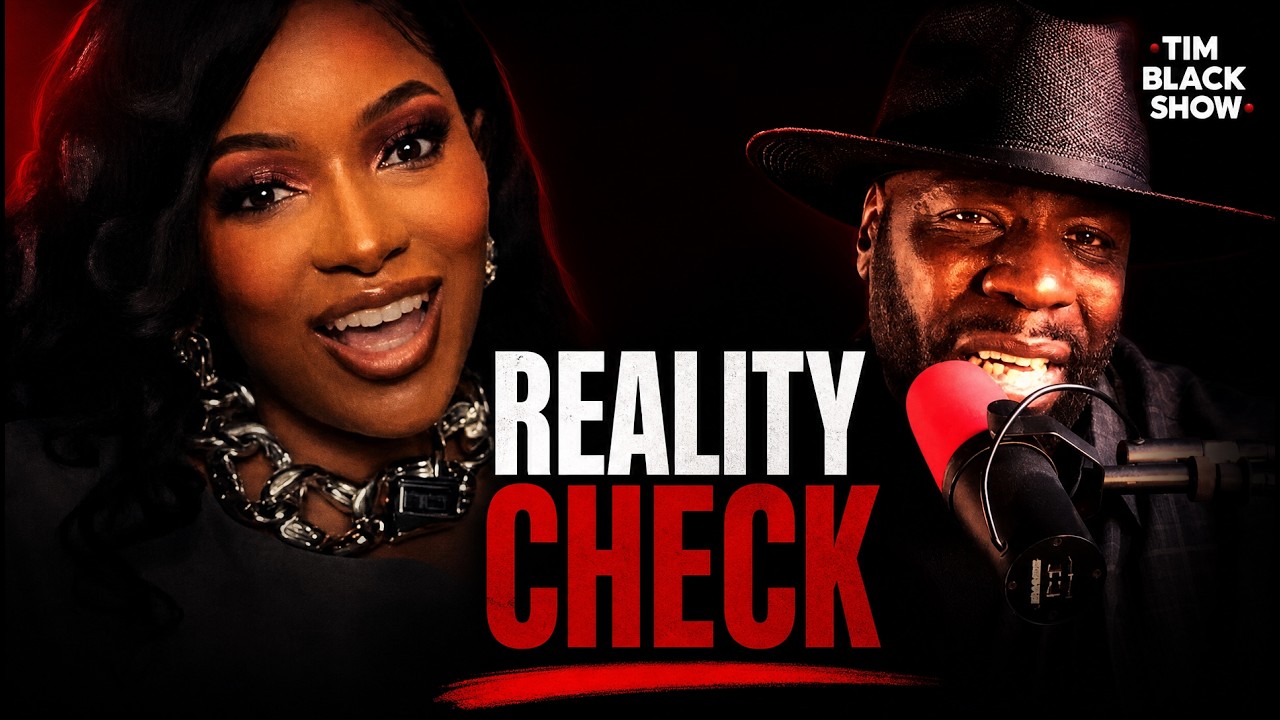
In the ever-evolving landscape of American politics, the relationship between political parties and their most loyal voting blocs is frequently scrutinized. However, it is rare to witness a public critique as raw, unfiltered, and deeply resonant as the one recently delivered by political commentator Tim Black. In a viral broadcast that is currently sending shockwaves across social media, Black took direct aim at Representative Jasmine Crockett, dissecting her recent comments regarding the Democratic Party, the concept of political loyalty, and what Black Americans are truly owed in exchange for their unwavering electoral support.
The controversy centers around a speech in which Representative Crockett discussed the deeply entrenched loyalty of Black voters to democratic ideals. Crockett proposed that as a baseline, the Democratic Party should commit to one non-negotiable standard for each demographic faction under its wide umbrella. For the LGBTQIA community, immigrants, and women, she suggested firm, specific commitments. However, when it came to Black Americans—a group she rightly identified as the party’s most loyal demographic—her ultimate demand was startlingly symbolic: that the nation “honestly acknowledge our humanity.”
For Tim Black, and for a rapidly growing segment of frustrated voters, this statement was not just insufficient; it was a glaring representation of the political establishment taking its most reliable supporters completely for granted. In a blistering takedown, Black unpacked the dangerous psychology of blind political allegiance, coining what can best be described as the “Loyalty Trap.”
Black’s core argument operates on a fundamental truth of negotiations: loyalty is not inherently rewarded; it is often taken advantage of. He drew a brilliant and relatable comparison to interpersonal relationships. A person who remains relentlessly loyal without demanding a firm commitment in return is inevitably misused. Black argued that for decades, Black voters have essentially given their political “order” to the Democratic Party without demanding that the party fulfill an order in return. “If you’re a person that’s going to give your order to somebody without them giving their order to you, your ass is going to be used,” Black stated emphatically. He stressed that a voting bloc only possesses true leverage when they are willing to withhold their vote until their specific, tangible demands are met.
What made Crockett’s comments particularly frustrating to her critics was the glaring disparity in her proposed political strategy. While suggesting that other groups receive concrete policy commitments, her baseline for Black Americans was reduced to a plea for the recognition of humanity. Black completely dismantled this approach, arguing that Black Americans do not need politicians to recognize their humanity—they need politicians to recognize their economic reality.
“I don’t want nobody to recognize my humanity; that’s what lawsuits are for,” Black fired back. Instead, he pivoted the conversation directly toward the concept of tangibles. He demanded that political loyalty be met with policies that address historical economic injustices, specifically calling for reparations, tax exemptions, and structural economic reform. Black provided a brief but potent history lesson, reminding his audience that the wealth gap is not merely a relic of slavery, but the direct result of systemic policies spanning through the Jim Crow era, redlining, and discriminatory lending practices that persisted heavily into the late 20th century.
He pointed out that while other demographic groups have seen significant upward mobility and increased homeownership rates over the last few decades, Black Americans have frequently seen their progress stall or even regress under multiple political administrations, regardless of which party controlled the White House. To offer mere symbolic recognition to a community that has been systematically deprived of generational wealth is, in Black’s view, a profound political insult.
The critique did not stop at economic policy. Black took significant issue with Crockett’s framing of Black history, specifically her use of the word “sacrifice.” During her speech, Crockett spoke eloquently about the sacrifices Black women have made for the country and the Democratic Party, from the horrors of the transatlantic slave trade to modern political organizing.
Black immediately halted the broadcast to push back on this terminology, highlighting a critical semantic and historical distinction. He argued passionately that the atrocities committed against Black Americans were not voluntary “sacrifices”—they were instances of profound victimization and abuse. A sacrifice, Black noted, implies a voluntary action taken out of love, duty, or a desire to help others. To frame historical oppression as a “sacrifice” for the betterment of the nation or a political party fundamentally softens the brutal reality of that history.
Furthermore, Black criticized the notion of sacrificing for a political party today. He argued that voting for a party that fails to deliver on its promises is not a noble sacrifice; it is a strategic mistake driven by a perceived lack of alternative options. He urged his audience to stop romanticizing their political disenfranchisement and to start treating their vote as a highly valuable transaction that requires a significant return on investment.
Another major point of contention in Black’s broadcast was Crockett’s tendency to compartmentalize the Black electorate, specifically her focus on elevating Black women separate from the broader Black community. While acknowledging the unique struggles and immense contributions of Black women, Black questioned the political utility of dividing the messaging. He argued that the systemic issues facing Black Americans—from wealth inequality to the justice system—affect the community collectively, and that political leaders should focus on unifying the demographic rather than segmenting it for what he perceived as self-serving political theater.
He accused Crockett of utilizing this divisive language to build her own personal brand and elevate her status within the Democratic Party, rather than fighting for comprehensive policies that would uplift working-class families across the board. “Why are you trying to separate us?” he asked, suggesting that true political advocacy requires standing up for the entire community rather than seeking individual political stardom.
Ultimately, Tim Black’s fiery response to Jasmine Crockett is much more than a critique of one specific politician; it is a profound reflection of a shifting tide in American politics. There is a growing vocal movement of voters who are entirely exhausted by symbolic victories, emotional rhetoric, and empty political theater. They are no longer satisfied with having a “seat at the table” if they are not allowed to eat.
Black’s broadcast serves as a powerful wake-up call to both voters and political leaders. For voters, it is an urgent plea to recognize the true value of their political leverage and to stop giving it away for free. For politicians, it is a stark warning that the era of securing votes through historical loyalty and fear-mongering is rapidly coming to an end. If political parties want to retain their most dedicated supporters, they must stop offering mere acknowledgments of humanity and start delivering the tangible economic policies that have been delayed for far too long.