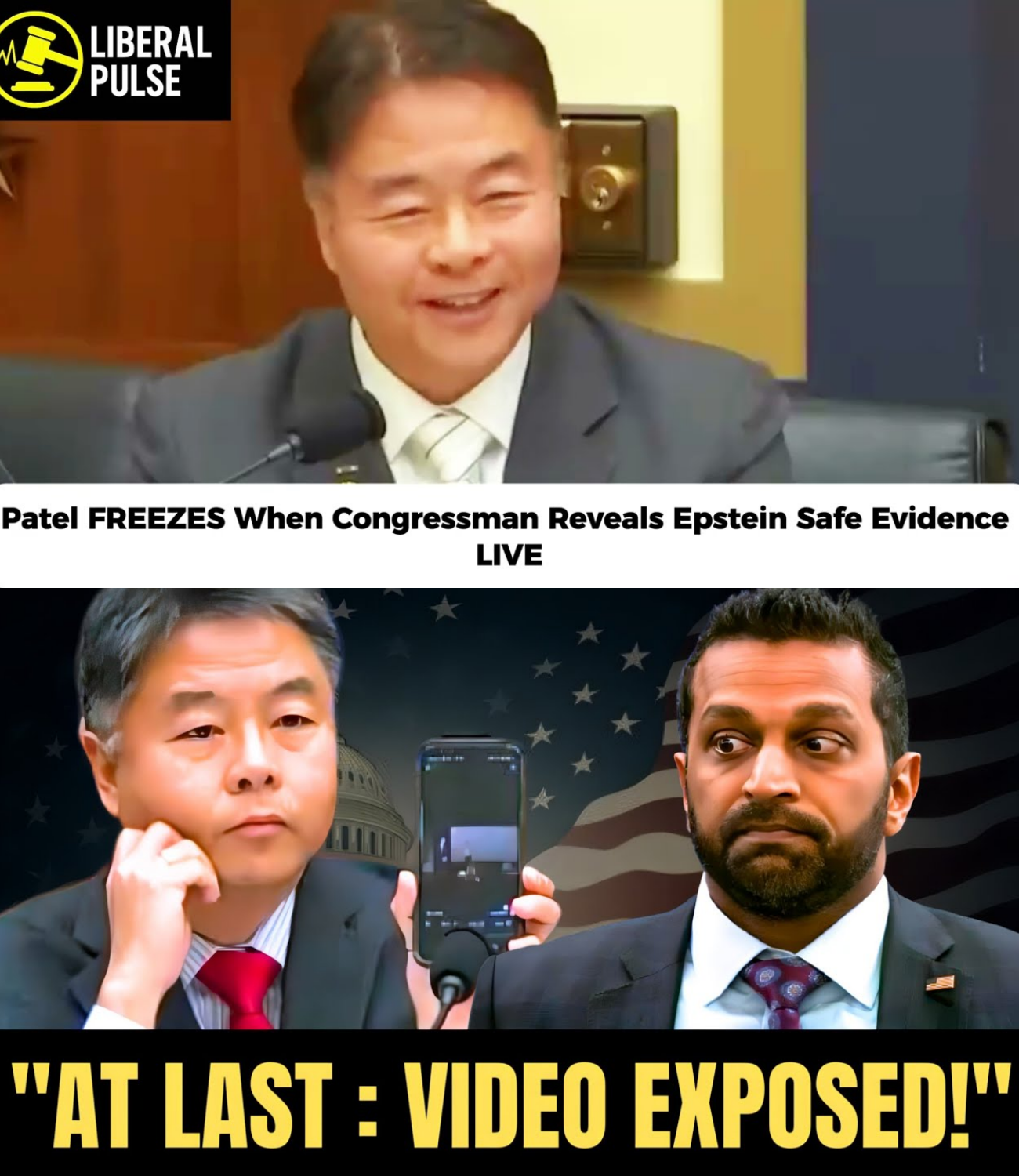
The halls of Congress are designed for debate, procedure, and, theoretically, the pursuit of truth. But every once in a while, a single exchange occurs that strips away the veneer of bureaucratic normalcy, exposing the raw, uncomfortable reality of institutional power. Recently, such a moment unfolded when Congressman Ted Lieu pressed FBI Director Kash Patel on one of the most enigmatic and disturbing chapters of modern American history: the fate of the evidence found inside Jeffrey Epstein’s private safe.
For years, the mere mention of Epstein’s safe has been enough to stop conversations in their tracks. Rumors have persisted regarding a “treasure trove” of material—photographs, documents, and names—that could potentially implicate powerful figures in the highest echelons of society. When Congressman Lieu stepped up to the microphone to interrogate the Director of the FBI, he wasn’t looking for political theater; he was looking for answers that have been missing for far too long.
The Question That Cracked the Silence
The exchange began with a focus on a July 2019 report from The New York Times, which detailed the discovery of lurid, compromising photographs found within a safe at Epstein’s Manhattan mansion. Citing the account of author Michael Wolf—who claimed Epstein had personally shown him Polaroids of powerful men with girls of uncertain age—Lieu confronted Patel with a series of direct, procedural questions.
Had the FBI seen the contents of these files? Had they cataloged the images? Had they even attempted to secure the full breadth of material held by the Epstein estate?
The responses from Director Patel were, to put it mildly, underwhelming. Instead of providing the clarity the public has craved, the Director repeatedly fell back on bureaucratic jargon. “I’ll accept your representation,” “I don’t know,” and “I don’t have the catalog of evidence in front of me” were the refrains that defined his testimony [00:34], [06:55]. For viewers watching at home, the message was clear: the system was not interested in transparency.
The Conflict Between Procedure and Justice
The climax of the hearing arrived when Lieu suggested that the FBI should simply subpoena the Epstein estate for all remaining information. Patel’s pushback—claiming the estate was under no obligation to comply—drew a sharp, immediate rebuke from the Congressman: “That’s just false. You’re the freaking FBI; you can subpoena the information from the estate and you better do that” [07:32].
This moment highlighted the fundamental friction currently existing between the American public and its law enforcement agencies. On one side, the FBI maintains that investigations are complex, governed by strict privacy rules, grand jury secrecy, and the need to verify every piece of evidence before acting [08:08]. They argue that this is the slow, deliberate work of justice.
However, the public perspective is starkly different. To many, “due process” has become a convenient mask for “delay and cover-up.” When a federal agency responsible for the most sensitive investigations in the country cannot—or will not—state definitively whether they have pursued every lead in the Epstein case, the immediate assumption is that there is something to hide. It breeds a sense of deep-seated distrust that is difficult to reverse.
The “Client List” and the Void of Information
The frustration only intensified when the conversation shifted to the notorious Epstein “client list.” Lieu questioned whether prominent individuals were included, specifically asking about Prince Andrew and Donald Trump. Patel’s response was characteristically clinical: the index has been released, and the material is public [04:58].
But the public knows that the “index” is not the same as the full, unredacted truth. The version provided to the public was incomplete—a jigsaw puzzle missing the centerpieces that would actually hold power to account. This vacuum of information is where conspiracy theories thrive, but it is also where valid, grounded skepticism lives. When the public is denied access to the truth, the imagination becomes the only courtroom left open [09:46].
The Human Cost of Secrecy
Beyond the political maneuvering and the headlines, it is vital not to lose sight of the core of this tragedy: the victims and survivors. While officials debate subpoena powers and evidentiary rules, survivors are left to navigate the trauma of a justice system that feels fundamentally stacked against them. For these individuals, every “I don’t know” from a federal official is a painful reminder that their pain is secondary to the preservation of institutional secrets [10:27].
The irony is deep: the same laws meant to protect the identities of those harmed are frequently used to protect those who caused the harm. When the line between protection and cover-up blurs, the concept of justice loses its integrity.
Is Sunlight Truly the Best Disinfectant?
The incident with Congressman Lieu and Director Patel serves as a mirror for the nation. It reflects the growing frustration of citizens who watch elite figures glide through systemic cracks while ordinary people face the full force of the law.
What happens next remains to be seen. Congress has the authority to demand documentation, sworn declarations, and unredacted records. They could force the issue by creating an independent council to ensure that the investigation is not compromised by internal conflicts [12:07]. Yet, the risk of this story fading into the background remains high. Silence is a powerful weapon; it kills momentum, and without momentum, accountability is impossible.
Ultimately, the safe in Jeffrey Epstein’s mansion has become more than a piece of evidence. It is a symbol of everything the public has been told to forget. Every time a high-ranking official dodges a question, that safe door closes just a little tighter. But the story is not over. As long as there are people asking the hard questions, the truth remains within reach. The power of the public’s attention is the only thing that can force the light into these dark corners. If the truth is ever to see the day, it will be because we refused to let the questions die.
Full video: