In the highly competitive, physically demanding universe of the Ultimate Fighting Championship (UFC), the transition between weight divisions represents the absolute ultimate gamble. Moving up fifteen pounds is not merely a matter of eating more food or carrying extra weight; it requires a complete, systemic adaptation to navigate the raw power, structural size, and elite-level athleticism of naturally larger competitors. Throughout the history of mixed martial arts, only a select group of legendary athletes have possessed the courage and technical genius to successfully capture gold in multiple divisions.
Yet, when the reigning lightweight king, Islam Makhachev, made his highly anticipated welterweight debut at UFC 322 inside the iconic Madison Square Garden, he did not merely test the waters—he completely redefined the limits of physical dominance. Facing the highly dangerous, world-class striker Jack Della Maddalena, Makhachev delivered a wrestling masterclass, effortlessly taking down and controlling the Australian phenom from the opening bell to secure a definitive victory.
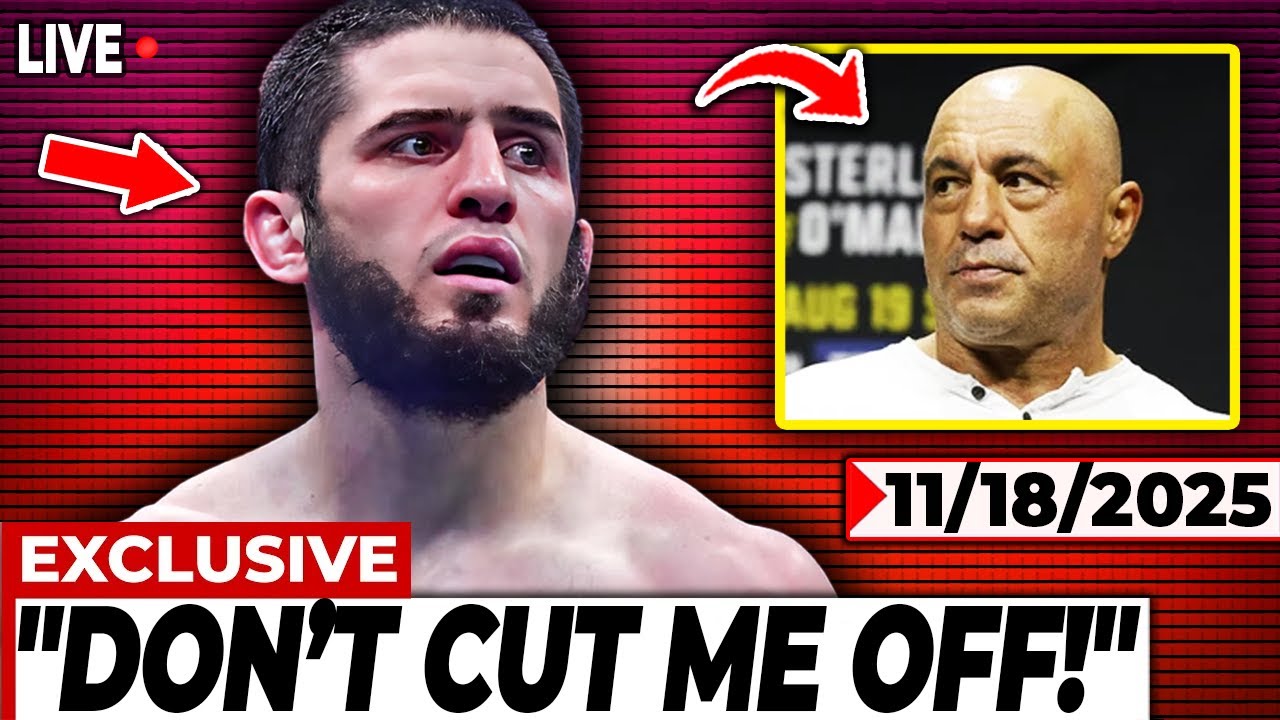
However, the true climax of this historic evening did not occur during the twenty-five minutes of active competition, but rather during the live, high-pressure post-fight interview inside the Octagon. For years, a persistent, highly critical narrative had circulated throughout the sports media, championed prominently by iconic commentator Joe Rogan. Critics had continuously labeled Makhachev a “weight bully,” suggesting that his dominance at lightweight was merely the product of brutal, unnatural weight cuts that allowed him to walk into the cage far heavier than his opponents. Rogan had publicly stated on his podcast that Makhachev’s ability to make 155 pounds was practically incomprehensible, claiming he must walk around in the 190-pound range and calling the entire weight-cutting process “silly.”
When Rogan stepped forward with the microphone at UFC 322, Makhachev seized the opportunity to directly address these long-standing criticisms, snapping back with a calm, clinical logic that completely dismantled the media’s favorite narrative. Makhachev explained that the accusations made absolutely no sense, pointing out that almost every elite lightweight on the roster naturally walks around at 177 or 178 pounds. He detailed his highly disciplined, clean lifestyle, explaining that he avoids sugar, has not touched soda in over five years, and naturally hovers around 180 pounds without needing to follow restrictive, exhausting diets. By exposing the reality of his everyday physical preparation, Makhachev forced the commentary team to acknowledge that his dominance is not the result of weight manipulation, but rather a product of superior technique, lifestyle discipline, and relentless work ethic.
This physical reality was instantly validated by fellow fighters who watched the historic welterweight debut unfold. Rising British star Paddy “The Baddy” Pimblett shared his first impressions of Makhachev’s new division, admitting that the second he saw Makhachev and Della Maddalena standing side-by-side inside the Octagon, any fears of the lightweight champion looking undersized completely vanished. Pimblett noted that once they initiated the grappling sequences, Makhachev’s sheer skeletal leverage and core strength completely nullified Jack’s defensive wrestling, making the highly decorated welterweight look like the smaller, less experienced competitor.
Maddalena, despite the tough setback, showed immense sportsmanship, and Makhachev himself was quick to praise the 28-year-old Australian. Islam confidently predicted that Jack’s elite striking and youth mean he will inevitably correct his grappling mistakes and return to the absolute peak of the welterweight title picture in the near future.
The immediate fallout of Makhachev’s historic victory has completely scrambled the UFC’s championship landscape, throwing several divisions into a state of high-stakes confusion. UFC President Dana White wasted no time in confirming that Makhachev’s double-champion status has officially rocketed him to the undisputed number-one spot on the global pound-for-pound rankings. But with greatness comes a target, and a long, chaotic line of elite challengers has already begun to form.
At the forefront of these potential matchups is a truly monstrous, highly anticipated super-fight against featherweight champion Ilia Topuria. Topuria’s camp has aggressively insisted that a collision with Makhachev is a matter of destiny, hinting at an unprecedented, historic chase for a third championship belt. Makhachev’s head coach, Javier Mendez, has openly embraced the potential matchup, calling it a massive spectacle that would capture the imagination of the entire sporting world.
However, navigating the timeline for such a super-fight is exceptionally complicated, as the welterweight division is currently teeming with hungry, elite contenders who are ready to assert their own claims to the throne. Killers like Shavkat Rakhmanov, Ian Machado Garry, and the legendary former champion Kamaru Usman represent immediate, highly dangerous hurdles that could easily delay any cross-divisional superfights.
According to Makhachev’s high-powered manager, Ali Abdelaziz, the most likely immediate scenario is a blockbuster title defense against Usman, a legacy matchup that would test Makhachev’s wrestling credentials against one of the most dominant welterweights to ever live. This divisional logjam has drawn sharp criticism from contenders like Paddy Pimblett, who took to his YouTube channel to express frustration, pointing out that until Makhachev officially decides his next move, top lightweight and welterweight contenders like Carlos Prates and Michael Morales are left completely in the dark regarding their own career trajectories.
Beyond the title picture, the dramatic atmosphere of UFC 322 was further intensified by an explosive, backstage brawl that took place behind closed doors at Madison Square Garden. Team member Megamed Shanko Shanakov shocked fans by launching a physical confrontation against controversial figure Dylan Danis. Explaining his actions in the aftermath, Shanko made it clear that Danis had to be held personally accountable for his continuous, offensive verbal provocations, asserting that some words simply cannot be forgiven and that men must take responsibility for their public actions.
The UFC responded with absolute severity, permanently banning Danis from all future events, while Shanko and other involved members of Makhachev’s entourage were immediately escorted from the building, forced to watch the remainder of the historic event from their hotel rooms. Ironically, the chaotic brawl has turned Shanko into an overnight internet sensation, with fans turning him into a viral meme and eagerly anticipating his official UFC debut under a newly signed contract from Dana White.
Ultimately, Islam Makhachev’s triumphant welterweight transition at UFC 322 stands as a defining chapter in the history of modern combat sports. By stepping out of his comfort zone to dominate a heavier division, he has silenced the vocal critics who attempted to diminish his legacy with petty arguments about weight. Guided by the wisdom of coach Javier Mendez, the managerial brilliance of Ali Abdelaziz, and the enduring spirit of his Dagestani brotherhood, Makhachev has built an empire of dominance that is virtually bulletproof. As the sporting world eagerly awaits his next move, one thing remains absolutely certain: whether he defends his lightweight throne, battles the elite welterweights, or engages in a historic super-fight with Ilia Topuria, the King of Dagestan continues to prove that true greatness is not inherited—it is systematically engineered through discipline, humility, and an unbreakable warrior spirit.