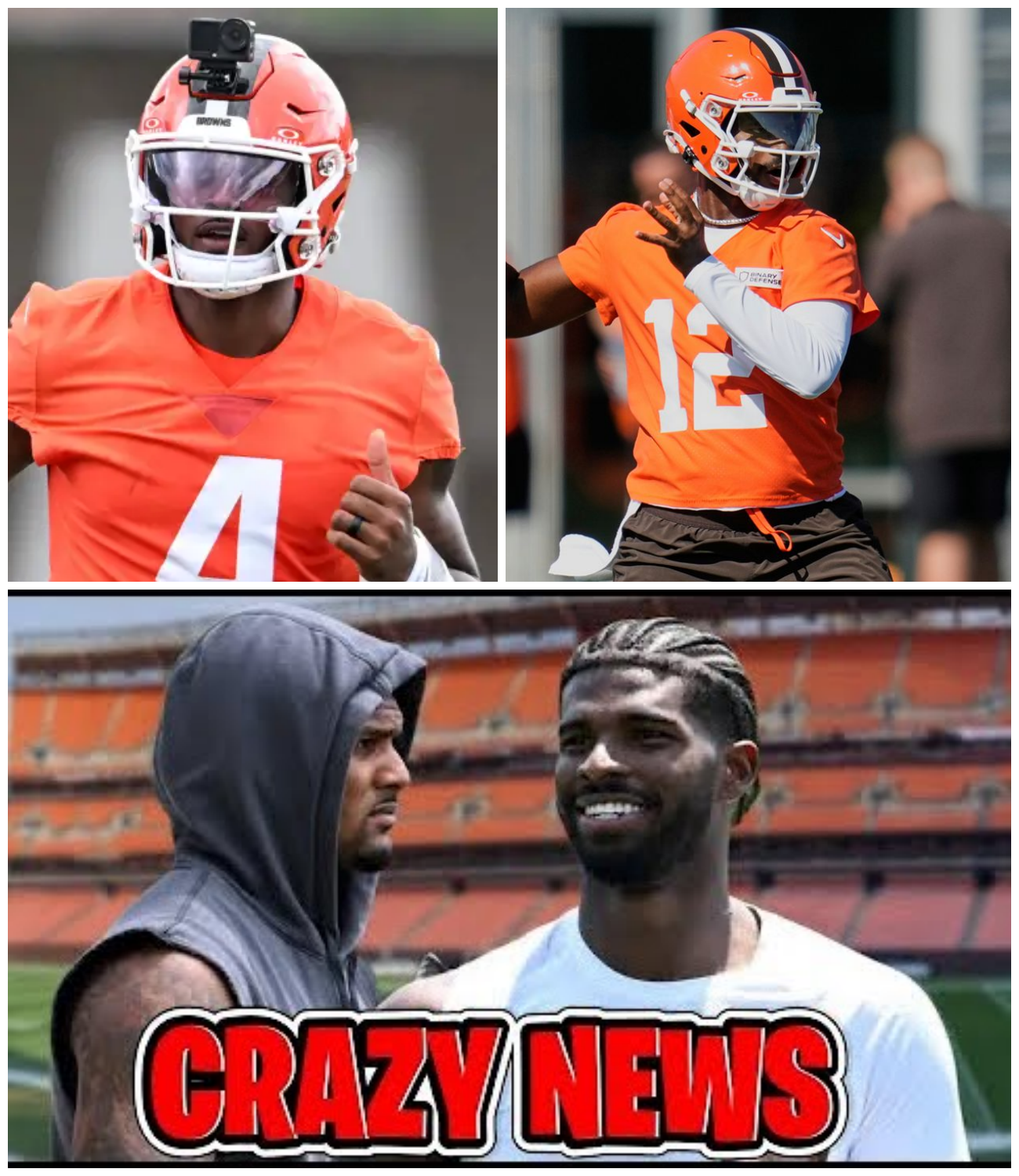
As the Cleveland Browns inch closer to the start of training camp, the atmosphere in Berea is heavy with a mixture of anticipation and undeniable tension. While the organization had hoped for a calm, productive offseason, the narrative surrounding their franchise quarterback, Deshaun Watson, has instead become a complex web of medical uncertainty and mounting pressure. Recent reports regarding Watson’s physical condition, combined with the rising visibility of quarterback competition, have sparked a legitimate conversation about the stability of the team’s most important position.
For several months, the Browns have navigated a challenging path following a 2023 campaign that was derailed by injury. However, as the 2026 season approaches, the focus has shifted from the past to an urgent, present-day reality: Can Deshaun Watson stay healthy, and can he return to the elite level of consistency expected of an NFL starting quarterback?
The medical narrative has taken center stage. Recently, discussions involving beat reporters and organizational insiders have highlighted that Watson’s shoulder, which underwent surgery, remains a point of concern. Observations from springtime workouts revealed a troubling trend: Watson’s throwing arm seemed to “tail off” toward the end of sessions, raising questions about whether the surgical repair has fully withstood the rigorous demands of professional football training. Fatigue in a surgically repaired shoulder is not merely a minor setback; it is a red flag for any NFL organization that has invested heavily in a player’s long-term potential.
This physical uncertainty is compounded by a lack of rhythm. Watson has faced a series of unfortunate events, including Achilles issues and the ongoing recovery from his shoulder procedure. Since arriving in Cleveland, the veteran quarterback has made fewer than 20 regular-season starts, creating a sample size that is both frustratingly small and, when evaluated, inconsistent. During the mandatory mini-camp and recent offseason practices, observers noted a disjointedness in his performance—a mix of flashes of brilliance followed by throws that lacked the necessary precision.
This lack of sustained consistency has created a vacuum, and into that vacuum has stepped the narrative of competition. Second-year pro Shedeur Sanders, who has been aggressively working within the Browns’ facilities, has become a focal point of discussion. The juxtaposition is striking: on one side, a veteran trying to regain his form amidst injury concerns; on the other, a hungry young prospect who is physically present, visible, and seemingly gaining favor with coaches like Todd Monkin.
The internal conversation at the Browns’ facility is not necessarily about replacing Watson immediately, but rather about the fundamental question of “best available option.” Coaching staffs operate under the pressure of immediate results. When a veteran displays “inconsistent” practice habits, the natural instinct of any professional coach is to evaluate whether the backup—or in this case, a challenger—offers a more reliable, or perhaps higher-ceiling, trajectory for the team’s success.

There is also the financial aspect that has clouded the public perception of the Browns. While initial rumors floated reports of an $88.9 million hit to the team’s cap due to insurance payouts, the reality is significantly more nuanced. Reports now indicate that the cap credit is closer to $9.8 million. While this is a financial win compared to the worst-case scenarios discussed on social media, it doesn’t solve the on-field problems. Financial maneuvering cannot fix a quarterback’s arm fatigue, nor can it calm the anxieties of a fanbase that is exhausted by the cycle of instability.
The debate has now transcended mere speculation and entered the territory of philosophical disagreement regarding team building. Some argue that the Browns should remain committed to Watson because of the sheer investment and the belief that he provides the highest ceiling if healthy. Others, however, point to the “unknown” factor of Sanders—his development curve, his health, and the sheer energy he brings to the building—as evidence that the team should be prepared to pivot if the season begins with a stumble.
This creates a high-stakes environment for the upcoming training camp. Every practice, every throw, and every media appearance will be scrutinized with a level of intensity usually reserved for the regular season. For Deshaun Watson, this camp represents a “prove-it” scenario not just to the media or the fans, but to his own coaching staff. He must demonstrate that his shoulder is robust, his mechanics are sound, and his consistency is not just a fleeting hope but a tangible reality.
If Watson falters, the Browns will be forced to confront a dilemma that most teams dread: the choice between a veteran who is trying to recapture a fading past and a younger player who represents a volatile but enticing future. It is a decision that could define the tenure of the coaching staff and the immediate future of the franchise.
The fan sentiment, while often dismissed by team leadership as secondary to “the best player on the field” approach, is becoming impossible to ignore. The team has announced limited open practices for fans, and while that is standard procedure, the lack of transparency about the quarterback battle has only fueled the flames of speculation. If the Browns cannot clarify the situation through their play on the field during the summer months, they risk entering the regular season with a divided locker room and a fanbase that is rightfully skeptical.
As we look toward the final weeks before training camp, the message from the Browns organization seems to be one of cautious optimism. Yet, behind the scenes, the reality is starkly different. This is a team at a crossroads. The shoulder that needed surgery, the arm that showed fatigue, and the quarterback who has not had a consistent run of games since 2021 all point to a season that will be defined by the health and performance of one man.
For Deshaun Watson, the time for excuses has passed. For the Cleveland Browns, the time for tough decisions is rapidly approaching. Whether they stick with their veteran or embrace a new direction, the coming weeks will likely reveal the true state of the team’s championship aspirations. One thing is certain: the eyes of the NFL world will be firmly fixed on Berea, watching to see if the Browns can finally put their quarterback drama to rest, or if they are destined to continue the chaotic cycle that has plagued them for years.
In the end, the truth will be written on the practice field. Every snap will be calculated, every completion will be analyzed, and every incompletion will be debated. The Browns have the talent to compete, but in the NFL, that talent is worthless if the quarterback position is shrouded in doubt. It is time for Cleveland to show the world whether they are a contender or a team trapped in the shadow of its own internal controversies. The summer of 2026 will be the proving ground, and the results will dictate the legacy of this team for years to come.