In the rarefied air of A-list celebrity culture, every gesture is magnified. A wave, a smile, a glance—these actions are parsed by the media and dissected by fans in a perpetual quest to understand the icons we see on the big screen. Rarely, however, does a single, seemingly minor gesture spark as much conversation as the recent viral moment involving Tom Cruise and Victoria Beckham. When the superstar actor leaned in to kiss the fashion designer’s hand on the red carpet, it was intended as a polite, old-fashioned greeting. Instead, it ignited a global debate about etiquette, gender dynamics, and the “chivalry” of the old Hollywood guard.
Yet, to characterize this interaction as a sudden departure from the norm would be a mistake. For those who have followed the career of Tom Cruise—an actor whose public persona is as carefully constructed as the stunts he performs in his blockbuster films—this gesture is not a novelty. It is, in fact, a signature. It is a recurring flourish in his public repertoire, a manifestation of a “gentleman” archetype he has cultivated since his rise to stardom in the 1980s. The Victoria Beckham incident did not create the narrative; it merely amplified a pattern that has existed, quietly but consistently, for decades.
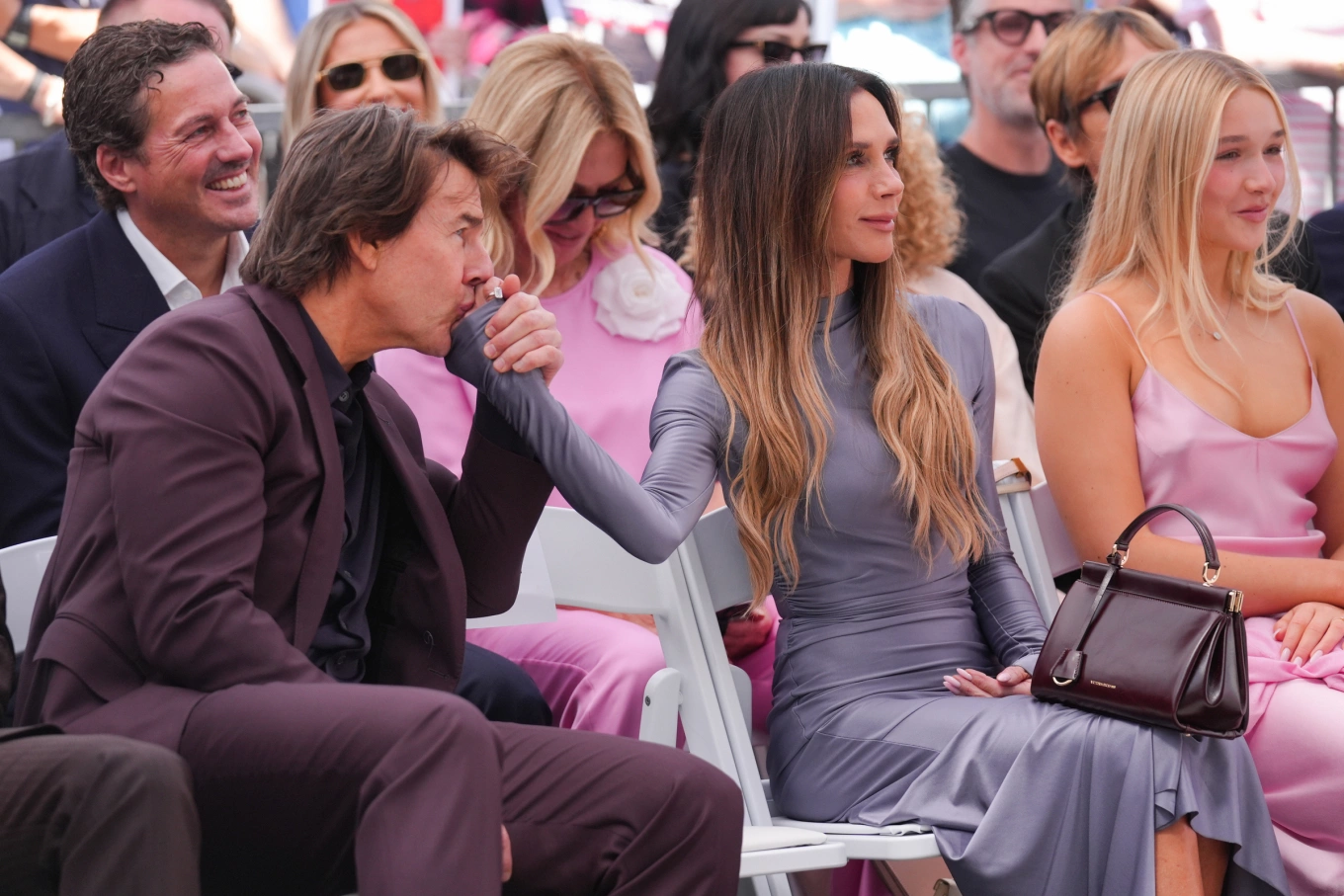
The Anatomy of the Gesture
To understand why this habit draws such polarized reactions, one must first look at the gesture itself. The hand kiss—a quick touch of the lips to the back of the hand—is a relic of European aristocratic etiquette. It is a sign of extreme deference, or, when used in a casual setting, a display of performative charm. When Cruise performs it, he brings the same intensity he applies to his acting. He is deliberate. He is focused. He leans in with practiced ease.
For some, it is the height of charm. It is a reminder of a bygone era when actors carried themselves with a certain polish and a respect for “proper” social interactions. It reinforces the image of Cruise as the “Last Movie Star”—a man who exists slightly outside the flow of modern, digital-native culture, clinging to the manners of a mid-century leading man. It is consistent with his role as a producer and professional who controls every aspect of his environment, including how he greets his peers.
For others, however, the gesture is perceived through a different, modern lens. In an era that emphasizes personal space, equality, and the rejection of antiquated power dynamics, the hand kiss can feel like an intrusion. It is seen by some as performative, a way to establish a specific “gallant” persona that can come across as forced or even patronizing in a professional environment. The debate, therefore, is not really about a kiss on the hand. It is about the clash between traditional modes of celebrity interaction and the evolving expectations of contemporary society.
A Pattern Established Over Decades
A review of Cruise’s public appearances over the last thirty years reveals that this is not a one-off occurrence. Whether on the press lines of the Mission: Impossible franchise, at the Golden Globes, or during high-profile charity galas, Cruise has frequently utilized this form of greeting. He has kissed the hands of co-stars, fellow industry legends, and acquaintances, often with the same level of commitment.
Why does he do it? The answer likely lies in the unique isolation of celebrity life. Tom Cruise does not inhabit the same world as the rest of us. He is surrounded by handlers, security, and the insulated bubble of Hollywood elite. Within that bubble, social rules are different. When you are the biggest star on the planet, you have the license to define your own rituals. The hand kiss is a way of signaling a specific type of connection—an acknowledgment of the “glamour” of the moment. It is a tool he uses to elevate a standard red-carpet interaction into something memorable.
The Victoria Beckham Moment: Why Now?
If he has been doing this for decades, why did the interaction with Victoria Beckham go viral? The answer is twofold: timing and audience.
First, the Beckham family represents a different tier of global fame—a brand that, like Cruise, is synonymous with media control and aesthetic perfection. Seeing the “Queen of Fashion” interface with the “King of Hollywood” creates an intersection of two very different types of stardom.
Second, the discourse surrounding celebrity behavior has changed. We are in a period of intense scrutiny regarding how powerful men interact with women in the workplace. Even if a gesture is objectively benign, it is processed through a filter of suspicion. Is it respectful? Is it performative? Does it make the other person uncomfortable? The fact that Beckham, a consummate professional who navigates public scrutiny with surgical precision, appeared to handle the moment with grace did not stop the internet from projecting its own anxieties onto the interaction.
The “Last Movie Star” Paradox
The fascination with Cruise’s manners points to a larger truth about his career. He is an anomaly. In a world where actors are expected to be “relatable,” “authentic,” and “just like us,” Cruise has doubled down on being an icon. He does not tweet his daily thoughts; he does not engage in social media bickering. He delivers movies, he promotes them with unparalleled energy, and he maintains a persona of unwavering professionalism.
His hand-kissing habit is part of this persona. It is “Movie Star” behavior. It is what audiences expect from a legend of his stature. If a TikTok influencer kissed a fan’s hand, it would be viewed as cringeworthy or predatory. When Tom Cruise does it, it is viewed as “Tom Cruise being Tom Cruise.” It is a testament to the power of his brand that he can essentially act like a character from a 1940s film in the middle of a 2026 press junket, and it is accepted as part of his specific charm.

Conclusion: Manners as a Performance
Ultimately, the debate over Tom Cruise’s habit highlights the divide between how we view celebrities and how they view themselves. We want them to be grounded and egalitarian, yet we are obsessed with the ways in which they are different, sophisticated, and “above” the mundane realities of our lives.
Whether one finds his hand-kissing charming or outdated is subjective. It is a performative act of chivalry from a man whose entire life has been a performance. As long as he remains the face of global cinema, these small, idiosyncratic behaviors will continue to attract attention. They are the friction points between the old world of Hollywood glamour and the new world of digital accountability.
For now, the actor shows no signs of changing his approach. He will continue to show up, do his stunts, flash his megawatt smile, and, when the moment feels right, lean in to offer that signature gesture. And we, in turn, will continue to debate it. Perhaps that is exactly what he wants—to remain a figure who is admired, scrutinized, and never fully understood. In the business of movie stardom, that is the most valuable currency of all.