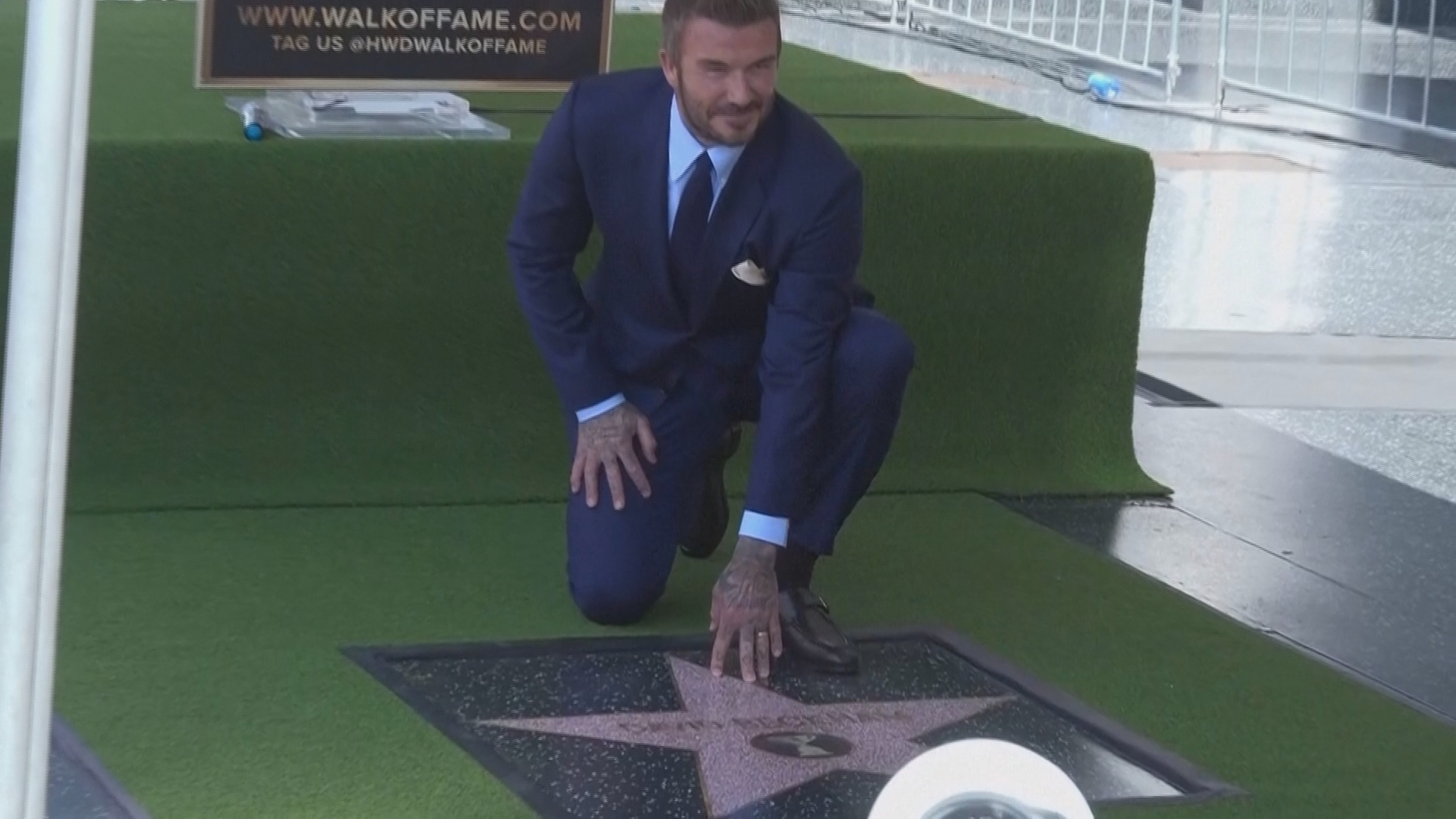
In the sprawling, sun-drenched expanse of Los Angeles, where fame is often fleeting and stars are made overnight, there are few honors that carry the weight of permanence. Among these, the Hollywood Walk of Fame stands as a definitive marker of cultural significance—a concrete testament to those who have shaped the entertainment landscape. In June 2026, David Beckham, a man whose life has been a relentless series of high-stakes transitions, added one final, glittering laurel to his collection: a star on the Walk of Fame.
For those who have followed his journey since he first broke onto the scene in the late 1990s as a spindly, precocious midfielder with a penchant for bending the ball with impossible physics, this moment feels less like a surprise and more like an inevitability. Yet, to categorize David Beckham merely as a “footballer” is to miss the entire point of his career. The ceremony on Hollywood Boulevard was not just a celebration of goals scored or trophies lifted; it was a recognition of a man who mastered the art of becoming a global brand.

The Architect of a Global Brand
To understand why Beckham’s star is so significant, one must look back at the trajectory of his life. He emerged from the quintessential working-class environment of East London, a product of the rigorous Manchester United youth academy. In those early years, he was simply “Becks,” the golden boy of the Premier League. However, it was his transition into the celebrity sphere—a journey punctuated by his high-profile marriage to Victoria Adams, a member of the world’s biggest girl group—that signaled the beginning of a new era for professional athletes.
Before Beckham, the line between athlete and celebrity was distinct, and rarely crossed. Players were expected to perform on the pitch and keep their private lives tucked away in the back pages of the tabloids. Beckham shattered that paradigm. He was the first athlete to truly understand the currency of image, style, and marketability. He navigated the precarious waters of fame with a steady hand, turning himself into a global icon whose face adorned billboards from Tokyo to New York long before he ever set foot in a Hollywood studio.
The American Pivot
While his success in Europe is well-documented—a career defined by Champions League glory and domestic dominance—his second act in the United States was the masterstroke that led him here. When he signed with the LA Galaxy in 2007, the decision was met with skepticism from European pundits who feared his career was essentially ending. They were wrong.
Beckham’s move to Los Angeles was not a retirement; it was an expansion. He didn’t just come to play; he came to build. He became the face of Major League Soccer, raising the profile of the sport in a country that had long resisted its charms. He brought Hollywood to football, and in return, he integrated himself into the very fabric of American entertainment. This period was crucial for his Hollywood identity. He frequented the courtside seats at the Lakers, walked the red carpets of the Oscars, and developed the business relationships that would eventually lead him into film production and ownership.
Ownership and Business Acumen
The star on the Walk of Fame is also a nod to his evolution into a formidable businessman. As the co-owner of Inter Miami, Beckham has demonstrated a vision that goes beyond vanity. He has managed to turn a franchise into a legitimate powerhouse, proving that his instincts for success are not limited to the penalty box. He has navigated the complex world of corporate sponsorships, fashion lines, and digital media with the same precision he once displayed on the free-kick line.
This evolution is what makes the Walk of Fame honor so appropriate. The Walk is not merely for actors; it is for entertainers. In the 21st century, the definition of an entertainer has expanded to include those who command the global stage through personality, style, and cultural influence. Beckham has been a constant presence in the zeitgeist for nearly thirty years. He has managed to remain relevant through sheer force of will, constantly pivoting, adapting, and refining his image.
The Human Element
Behind the glamour and the accolades, there is the man himself. Those who have interacted with Beckham describe a person who is disarmingly humble and profoundly aware of the absurdity of his own trajectory. He has faced massive public scrutiny, including the infamous vilification following the 1998 World Cup, and he has survived it with a level of grace that few in the public eye could muster.
His family has been the cornerstone of this stability. The sight of Victoria and their children alongside him at the ceremony was a reminder that for all the glitz, his most enduring legacy is the foundation he built at home. The Walk of Fame star is, in many ways, a shared victory—a testament to a partnership that has withstood the pressures of extreme global fame.
A Legacy Cemented
As David Beckham stood on the sidewalk, looking down at his name etched in brass and terrazzo, it was a moment of reflection. He is no longer the young man in the Manchester United kit. He is a statesman of sport, a titan of industry, and a fixture of the cultural landscape.
The Walk of Fame is meant to immortalize, but in the case of Beckham, it feels like an acknowledgment of a job well done. He changed how the world viewed athletes, he changed how athletes viewed themselves, and he paved the way for a generation of stars who understand that their platform is as powerful as their talent.
Some may argue that a Hollywood star is just a piece of pavement, but in the mythology of modern celebrity, it is the ultimate validation. It says that you have arrived, that you have contributed, and that you will be remembered. For David Beckham, who has spent his entire life chasing perfection on the pitch and success in the boardroom, the star on Hollywood Boulevard is the final, undeniable proof that he succeeded in every arena he entered. He is not just a footballer, and he is not just a businessman. He is David Beckham—an icon whose influence will be felt long after the lights of Hollywood fade.
As the sun set over Los Angeles on the day of the ceremony, the crowd remained, snapping photos and cheering for the man who had become, quite literally, a permanent part of the city’s identity. It was a fitting conclusion to a career that has been defined by its ability to surprise, to inspire, and, above all, to endure.