In the late 1970s, the NBA was a league struggling to find its pulse. Viewership was abysmal, revenues were stagnant, and the perception of professional basketball was marred by rumors of substance abuse and a lack of mainstream appeal. The league was effectively an afterthought, often relegated to tape-delayed broadcasts late at night. Yet, within the span of a single decade, this landscape would be unrecognizable. The transformation didn’t happen by accident; it was manufactured, engineered, and performed by a group of players and personalities who turned the Los Angeles Lakers into the most captivating spectacle in sporting history: The Showtime Lakers.
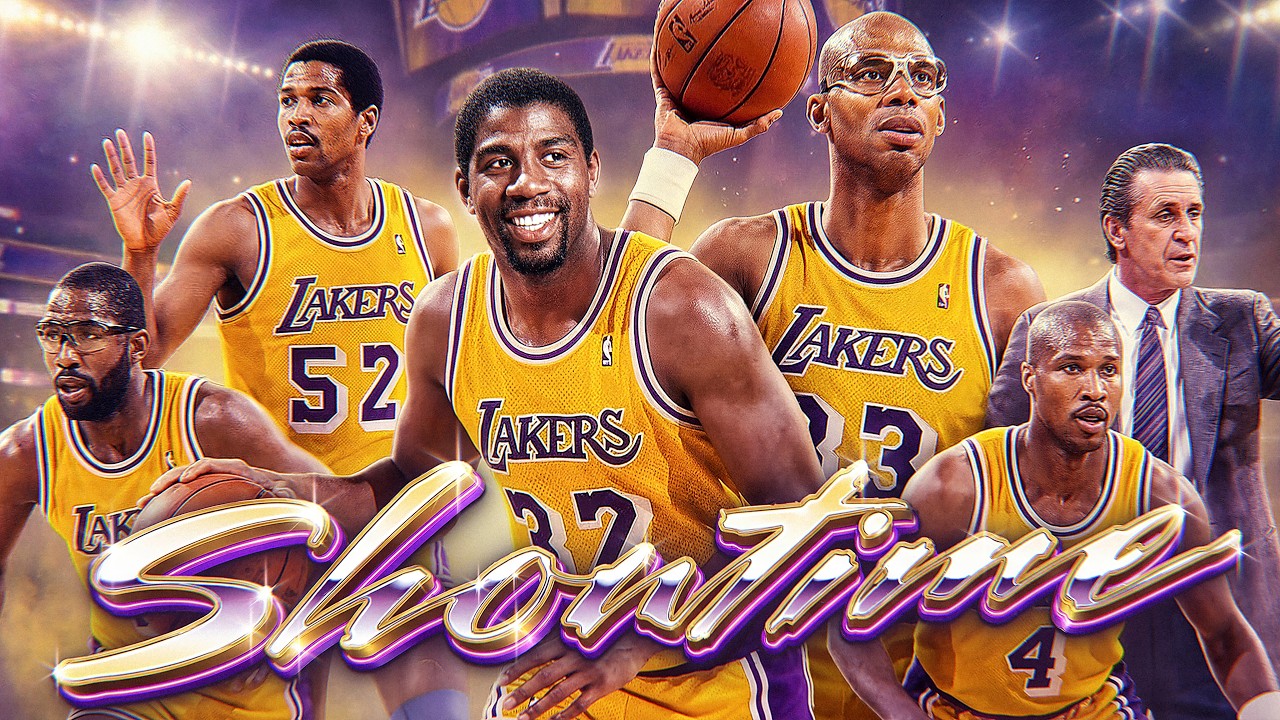
This was not merely a team that won basketball games; it was a cultural phenomenon that redefined what it meant to be a professional sports franchise.
The Visionary Gamble: Dr. Jerry Buss
The seeds of Showtime were planted with the arrival of Dr. Jerry Buss, a real estate mogul who purchased the Lakers in 1979 in the largest deal in sports history at the time [01:42]. Buss was different. While other owners viewed basketball as a sport to be managed, Buss viewed it as an entertainment product to be sold. He famously remarked that he wanted to “entertain the entertainers” [00:56].
Before the glitz and the glamour, however, there was a pivotal moment of pure chance. Due to a 1976 trade with the New Orleans Jazz, the Lakers found themselves in contention for the number one pick in the 1979 draft. A single coin flip decided their fate, and they selected Irvin “Magic” Johnson [02:43]. While legendary GM Jerry West famously lobbied for Sidney Moncrief, the decision to draft Magic changed everything. Johnson brought a charisma, a smile, and a floor vision that the league had never seen, and his chemistry with the established superstar Kareem Abdul-Jabbar would become the bedrock of the dynasty [08:46].
The Blueprint of Entertainment
Buss immediately implemented a radical strategy to make the Forum the place to be in Los Angeles. He didn’t just market the basketball; he marketed the environment. He introduced the Laker Girls, replaced the organist with a high-energy band, and incentivized Hollywood’s elite to occupy courtside seats [05:08]. The Lakers weren’t just playing basketball; they were hosting a nightly party.
This atmosphere demanded a specific style of play. Coach Jack McKinney, and later Paul Westhead, installed an uptempo, fast-paced offense that allowed Magic Johnson’s playmaking ability to flourish. Magic wasn’t just a point guard; he was a conductor, throwing no-look passes and full-court dimes that ignited the crowd [09:00]. This style, eventually dubbed “Showtime,” wasn’t just about winning; it was about doing it with flair.
Turbulence and Transformation
The road to five championships between 1980 and 1991 was far from smooth. The early years were marked by significant internal conflict and instability. The team suffered through the tragic bicycle accident of coach Jack McKinney and dealt with the devastating drug-related fall of Spencer Haywood, who famously nearly derailed his own career—and the team’s championship hopes—by falling asleep at practice [12:16].
Perhaps the greatest test of the young dynasty was the 1980 NBA Finals. When Kareem Abdul-Jabbar twisted his ankle in Game 5, the Lakers looked doomed. In a move that would define his career, a 20-year-old Magic Johnson famously told his teammates, “Have no fear, Mother Irvin Magic Johnson is here,” and proceeded to play center in Game 6, dominating with 42 points and 15 rebounds to clinch the title [13:59]. It was the moment the “Showtime” era truly arrived, erasing the reputation of the Lakers as perennial losers.
The Pat Riley Era: Style Meets Substance
The firing of Paul Westhead in 1981, largely driven by player dissatisfaction—including Magic Johnson himself—ushered in the era of Pat Riley [19:19]. Riley, with his slicked-back hair and Armani suits, brought a level of sophistication and tactical rigor that balanced the team’s flamboyant persona. He was a defensive innovator, implementing half-court traps and demanding relentless effort on the boards. His mantra, “No rebounds, no rings,” became the gospel of a team that had every reason to be soft but chose instead to be ruthless [20:07].
Under Riley, the rivalry with the Boston Celtics reached a fever pitch. The 1984, 1985, and 1987 Finals meetings between the Lakers and the Celtics were the zenith of the NBA’s resurgence. The contrasting styles—Magic’s speed and flash versus Larry Bird’s grit and fundamental perfection—captivated the nation. When the Lakers finally defeated the Celtics in the 1985 Finals, it was a cathartic moment for the franchise, signaling that they could overcome their greatest demons [27:54].
The Peak and the Legacy
The 1987 season is widely regarded as the peak of “Showtime.” With a league-best 65 wins, a triple-threat of Magic Johnson, James Worthy, and a rejuvenated Kareem Abdul-Jabbar, the Lakers bulldozed their way to another championship. By this point, the NBA had become a global brand, with 24 million viewers tuning in for the Finals, a staggering increase from the league’s dark days in the late 70s [32:57].
The end of the era came with the retirement of Kareem Abdul-Jabbar in 1989, and eventually, the shocking 1991 retirement of Magic Johnson following his HIV diagnosis [37:42]. The “Showtime” Lakers left behind a legacy that transcended the sport. They proved that basketball could be a profitable, high-end entertainment product. They set the standard for team building, culture creation, and the importance of superstar charisma.
Jerry Buss’s gamble didn’t just win five championships; it saved the NBA. The principles established in the Forum—the integration of celebrity, the fast-paced style of play, and the relentless pursuit of excellence—are present in every arena in the league today. The “Showtime” Lakers were, quite simply, the greatest show on earth, and basketball history owes them an immeasurable debt for making the game what it is today.