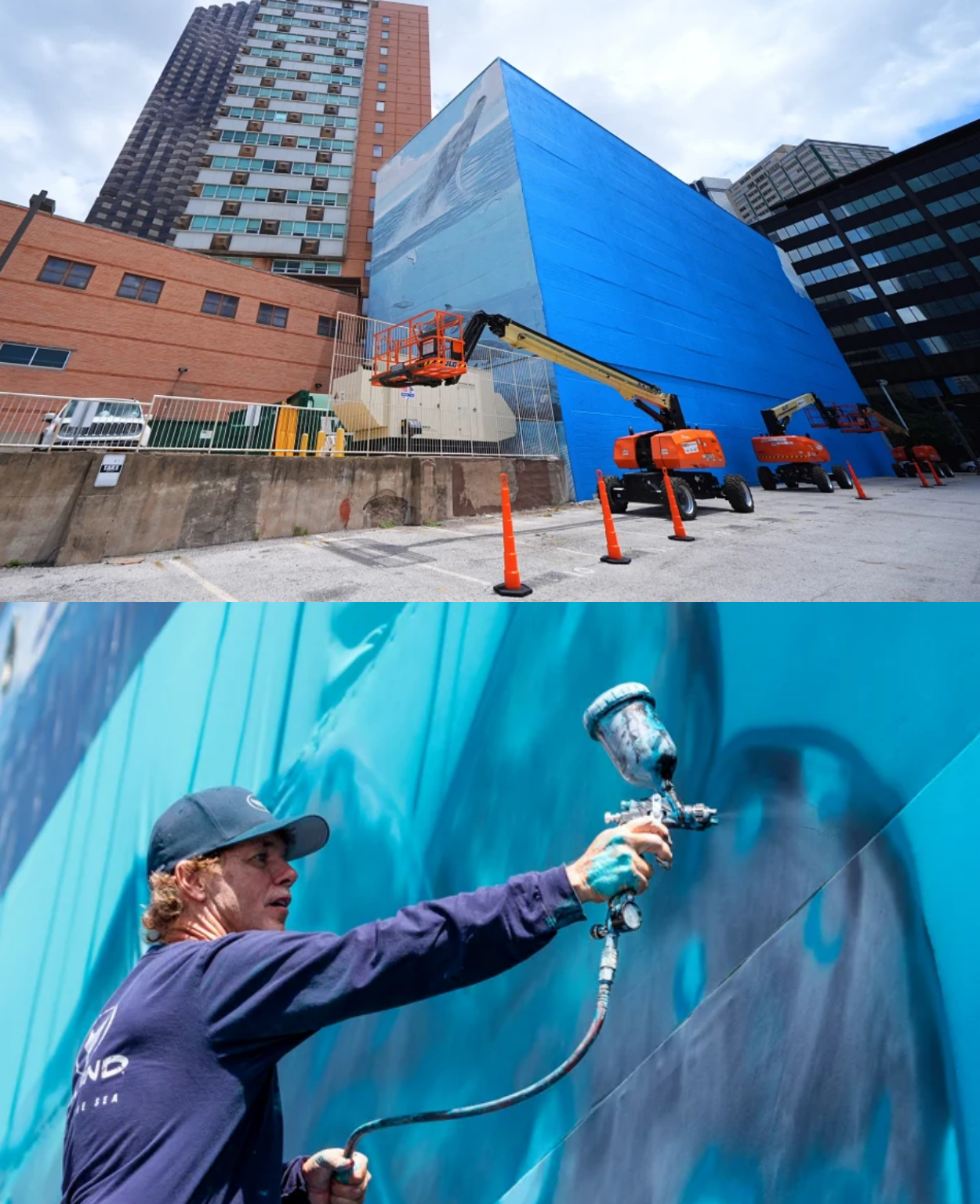
The vibrant, beating heart of any major city isn’t just found in its commerce, its bustling restaurants, or its towering glass skyscrapers; it is etched into the very walls of its streets through public art. For nearly three decades, residents and visitors wandering through downtown Dallas were greeted by a breathtaking vision of the deep blue sea. High above the chaotic Texas traffic, majestic whales and playful dolphins swam across a massive, 164-by-82-foot canvas spanning two sides of the Texas Utilities Building. This beloved piece of the city skyline, officially titled “Ocean Life,” was more than just paint on brick. It was a daily reminder of the natural world, a profound environmental message, and a treasured local landmark. But today, those whales are gone, suffocated under a thick, unceremonious coat of solid blue paint. In their place stands a brewing legal storm, one that pits the visionary creator of that mural against the most powerful sporting organization on the planet.

Internationally renowned environmental artist Robert Wyland, known simply by his surname Wyland, is not taking the destruction of his masterpiece lying down. In a bold move that has sent shockwaves through both the international art world and the global sports community, Wyland has filed a staggering $25 million federal lawsuit against FIFA, the Fédération Internationale de Football Association. The sweeping lawsuit, which also names several property management companies and local organizing entities as defendants, claims that his historic mural was unlawfully defaced and entirely destroyed without his necessary notice or legal consent. The agonizing reason for this sudden erasure? To clear a massive wall space for a temporary, World Cup-themed promotional advertisement.
To understand the sheer gravity of this lawsuit and the heartbreak surrounding it, one must first understand the monumental legacy of Wyland’s life work. Throughout his illustrious career, Wyland has completed over one hundred large-scale marine murals, famously known as “Whaling Walls,” in major cities across the globe. From Laguna Beach, California, to Havana, Cuba, these colossal public artworks were created with a singular, noble purpose: to promote marine conservation and environmental education on a grand scale. The Dallas mural, officially designated as Whaling Wall 82, was meticulously completed in 1999. Wyland essentially gifted this spectacular piece to the people of Dallas, contributing his own valuable time, expensive materials, and unparalleled talent to bring the beauty of the ocean to a landlocked metropolis. It was an ambitious, deeply personal project that earned him a key to the city and a permanent place in the hearts of Texans.
For over a quarter of a century, “Ocean Life” stood as a stunning testament to the intersection of urban development and environmental stewardship. Weary commuters drove past it on their daily routes, wide-eyed tourists stopped to photograph its vibrant hues, and generations of Dallas children looked up in sheer awe at the life-sized marine mammals floating gracefully against the concrete cityscape. It naturally wove itself into the very fabric of Dallas. Yet, last month, a crew of painters quietly descended upon the historic wall. Without any public announcement, community dialogue, or prior warning to the original artist, they began methodically rolling flat blue paint over the whales. In a matter of days, they systematically wiped out nearly thirty years of cultural heritage, all to create a blank slate for a soccer advertisement.
The artist’s reaction to the news was one of profound heartbreak, quickly followed by fierce indignation. When Wyland’s dedicated team was initially alerted to the whitewashing—or rather, blue-washing—they immediately fired off a legal cease and desist letter, but the devastating damage was already largely done. Wyland has been incredibly vocal and raw about his deep emotional connection to his sprawling murals, famously stating to reporters, “These walls are like my kids. This is really, really personal.” To see a piece of fine art that was explicitly created as a permanent message of hope and respect for our oceans treated as nothing more than a disposable billboard was, in his own words, deeply painful. It served as a stark, depressing visual representation of corporate interests casually steamrolling over community values.
The sturdy legal foundation of Wyland’s $25 million lawsuit is built upon the Visual Artists Rights Act of 1990, commonly referred to as VARA. This highly specific piece of federal legislation is specifically designed to protect visual works of “recognized stature” from being intentionally or negligently destroyed, mutilated, or modified without the express written approval of the original artist. Under VARA, an artist fiercely maintains certain moral and legal rights to their creation, even if they do not hold the deed to the physical property on which the art resides. If a building owner wishes to remove or cover a protected mural, they are legally obligated to directly contact the artist and make a good faith effort to come to an amicable agreement, theoretically allowing the artist the opportunity to properly document or carefully remove the work if possible. Wyland and his formidable legal team adamantly assert that no such good faith effort was ever made.
The subsequent defense from the building owners and the local World Cup organizing committee has been fraught with confusing contradictions and rapid finger-pointing. While some corporate spokespeople claim that Wyland was politely informed about the impending project back in March, the artist and his professionally managed non-profit foundation aggressively dispute that narrative, maintaining they have absolutely no record of any such communication. Furthermore, internal emails recently leaked to the press painted a rather grim, cynical picture of how the local economic development agency viewed the historic artwork behind closed doors. One employee callously remarked in an email that the 30-year-old mural was simply “past its useful life.” This utterly dismissive attitude struck a deep, painful nerve with Wyland, who passionately fired back with a poignant rhetorical question: “Is the Mona Lisa beyond its usable life? Would you say a Van Gogh is beyond its usable life?”
The sheer audacity of deciding that a beloved piece of public art has a convenient expiration date simply because an international sports tournament is coming to town is exactly what makes this case so universally compelling. It is a classic David versus Goliath narrative playing out in real-time. On one side, you have a passionate, lifelong environmentalist fighting tooth and nail to protect the integrity of public art; on the other, a multibillion-dollar sports empire and wealthy corporate property developers looking to maximize their advertising real estate at any cost. Wyland’s massive lawsuit is not just about seeking personal financial compensation for a single destroyed mural; it is a critical, highly visible line drawn in the sand. He has explicitly stated that his ultimate goal is to prevent this tragic incident from becoming the accepted standard for how public art is treated in major cities across America.
What truly highlights the fundamental purity of Wyland’s intentions is his unwavering pledge regarding the staggering $25 million in damages he is actively seeking. The artist has publicly committed that any financial recovery resulting from this complex litigation will not go into his own personal bank accounts. Instead, every single cent will be funneled directly back into the Wyland Foundation to fiercely support the very causes that inspired the Dallas mural in the first place. The recovered funds will be utilized to finance bold new public art initiatives, advance critical ocean and waterway conservation efforts, and massively expand environmental education programs for youth. In a beautiful, poetic twist of irony, the heartless destruction of one whale mural could potentially fund the creation of countless others, amplifying the vital message of marine conservation on a scale far larger than before.
The North Texas FIFA World Cup Organizing Committee previously stated to the media that they simply wanted a vibrant new mural that reflected the “energy, unity, and global spirit” of the upcoming tournament. However, as Wyland eloquently pointed out in his response, the highly anticipated arrival of the World Cup should have been a golden opportunity to visually demonstrate how global sports, public art, and environmental stewardship can stand together in perfect harmony. Instead, by lazily painting over an established landmark, they chose a path of erasure and deep disrespect. They could have commissioned a brand new wall, collaborated creatively with the existing artwork, or genuinely engaged the local community in a productive dialogue. Instead, they opted for a covert cover-up that has now spectacularly backfired into a massive public relations disaster and a historic legal battle.
As this high-stakes lawsuit slowly makes its way through the federal court system, it serves as a powerful, unmistakable wake-up call to city planners, ambitious property developers, and mega-event organizers everywhere. It is a firm reminder that public art is not merely temporary decoration that can be thoughtlessly swapped out whenever a more lucrative commercial opportunity comes along. These artworks hold deep cultural significance, heavy emotional weight, and rigorous legal protection. They belong to the community just as much as the bricks, mortar, and steel of the buildings they so beautifully adorn.
In the end, the physical, painted whales of downtown Dallas may have vanished beneath a cold, corporate layer of blue paint, but the massive waves they have caused will undoubtedly be felt for years to come. Wyland’s courageous decision to stand up to a global behemoth like FIFA ensures that the legacy of “Ocean Life” will not be one of quiet, submissive disappearance, but rather a roaring, undeniable defense of artists’ rights. The beloved mural may be gone, but as Wyland himself noted, the powerful message does not have to be silenced. The upcoming World Cup may bring a fleeting month of energetic unity and global spirit to Dallas, but the fierce fight to preserve the enduring soul of the city’s public art will resonate long after the final whistle is blown.